Within UFO Crashes
How Reliable Are UFO Crash Witnesses?
Sincere witnesses can misjudge distance, timing and object shape, especially during brief, confusing or emotionally intense events.
On this page
- Perception under poor viewing conditions
- Memory confidence versus accuracy
- Corroboration and independent testimony
Page outline Jump by section
Introduction
Witnesses to alleged UFO crashes may be entirely sincere and still be wrong about what they saw. Brief viewing times, darkness, unfamiliar lights, emotional arousal and the absence of reliable distance cues can distort estimates of an object’s size, speed, shape and point of descent. Memory then reconstructs the experience rather than preserving it like a recording. Retelling, media coverage and conversations with other witnesses can gradually add detail while increasing confidence.
This does not make eyewitness accounts worthless. A prompt, independently recorded statement may establish that an unusual event occurred and help investigators identify its direction, duration or accompanying sounds. The problem arises when testimony is treated as precise technical evidence: for example, when a light apparently dropping behind trees becomes a vehicle striking the ground, or when vivid recollections recorded decades later are given more weight than contemporary documents.
In UFO crash investigations, reliability therefore depends less on whether a witness appears honest or impressive than on viewing conditions, interview timing, independence and corroboration.
Perception under poor viewing conditions
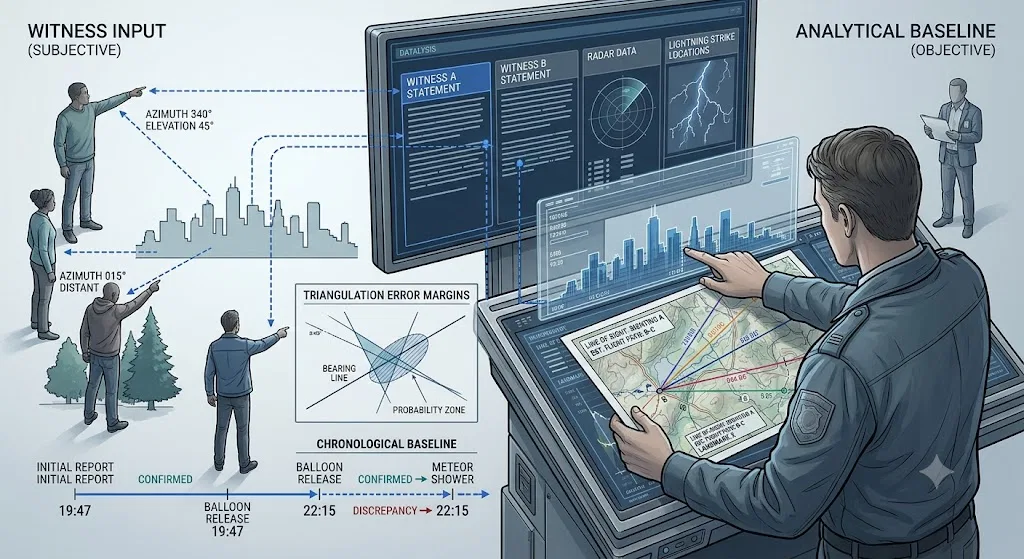
Human vision is good at recognising familiar objects in familiar settings. It is much less dependable when an object is distant, isolated against the sky or seen only as a bright light. Size and distance are especially difficult to separate. A small nearby object and a much larger distant object can occupy the same angular width in the observer’s field of view. Unless the scene contains known landmarks, shadows, stereoscopic depth or measurable movement, the witness may have no sound basis for choosing between them.
This ambiguity affects nearly every later estimate. If the assumed distance is wrong, the inferred size and speed will also be wrong. A light believed to be a kilometre away may seem compact and low-flying; the same light tens of kilometres away may be much larger, higher and faster. Witness descriptions such as “the size of a house” often express apparent size rather than a measurement.
Night observation removes still more reference information. Aviation guidance warns that darkness, haze and reduced visibility can create false impressions of distance, speed, depth and motion. A single stationary light may appear to move when the observer’s eyes shift, while an object seen from a moving vehicle or aircraft can seem to accelerate because of parallax—the changing apparent position of an object against its background.[Federal Aviation Administration]faa.govFederal Aviation Administration Chapter 13: Night OperationsFederal Aviation AdministrationChapter 13: Night OperationsMarch 8, 2019 — Illusions give false impressions or misconceptions of actual c…
Official analysis of several modern UAP videos illustrates how strong such impressions can be. The US All-domain Anomaly Resolution Office, or AARO, concluded that motion parallax contributed to the apparent high speed in the “GoFast” footage: the viewing platform was moving rapidly, the field of view was narrow and the background appeared to sweep beneath a slower object. This is a sensor case rather than a UFO crash claim, but the underlying lesson applies directly to witnesses: apparent motion is not necessarily object motion.[AARO]aaro.milGo Fast Case Resolution Card Methodology FinalAARO GoFast Case Resolution6 Feb 2025 — Motion parallax is an optical effect that induces an observer to perceive that a stationary o…
A descent is not necessarily an impact
Crash stories frequently begin with a witness reporting that a luminous object descended behind a hill, tree line or building. Yet disappearance behind the horizon establishes only a line of sight. It does not establish where the object reached the ground—or that it reached the ground at all.
Bright meteors provide a useful comparison. They may be visible across several regions and appear to individual observers to fall nearby. Their true path can be reconstructed only by comparing observations from separated locations or, more reliably, by using calibrated cameras, radar and infrasound. NASA work comparing eyewitness-derived fireball trajectories with instrument data reflects the difficulty of extracting accurate geometry from unaided descriptions.[NASA Technical Reports Server]ntrs.nasa.govNASA Technical Reports ServerComparing eyewitness-derived trajectories of bright…by DE Moser · 2016 — A description of the tool, examp…
Even when a meteorite survives atmospheric flight, predicting its landing point remains technically demanding. Wind, fragmentation, shape, mass and the unilluminated “dark flight” after the visible fireball ends can move debris away from an apparent descent line. In a well-observed Australian meteorite fall, researchers found that even simplified modelling based on a spherical object produced a substantial error in the predicted recovery position.[arXiv]arxiv.orgOpen source on arxiv.org.
This matters for UFO crash searches. A witness pointing towards a supposed impact area may be providing useful directional information, but not a reliable crash coordinate. Reports of a “nearby” descent should be compared across a wide geographical area before investigators infer a local collision.
Shape can be inferred from light rather than seen
Witnesses often report discs, triangles, cylinders or craft with windows. Sometimes the outline may genuinely have been visible. In many night-time incidents, however, the observer primarily saw lights. The mind then grouped those lights into a plausible solid form.
Three lights can be interpreted as the corners of a triangular object even when they belong to separate aircraft or to parts of a formation. Glare can enlarge luminous points, obscure the space between them and make small sources appear to have structured edges. Atmospheric haze, cloud and reflections may add apparent beams, halos or surface detail.
Investigators should therefore distinguish between what was directly perceived and what was inferred. “I saw three white lights maintaining fixed positions” is a stronger observational statement than “I saw a triangular spacecraft”. The latter may be a reasonable interpretation, but it combines sensory information with an assumption about physical structure.
Stress sharpens some details and loses others
A dramatic aerial event can produce intense attention, fear and a lasting sense of certainty. That emotional force is sometimes taken as evidence that the witness must remember the scene accurately. Research on eyewitness memory does not support such a simple conclusion.
Stress can narrow attention towards whichever feature seems most urgent: a bright object, an explosion, an apparent body, an approaching vehicle or the witness’s own safety. Other details—including timing, surroundings and sequences of action—may receive less attention and therefore be encoded poorly. A study of eyewitnesses exposed to elevated stress found an overall reduction in identification accuracy, consistent with a broader body of work showing that high stress can impair memory performance.[PubMed]pubmed.ncbi.nlm.nih.govOpen source on nih.gov.
The implications for UFO crash narratives are important. A witness may remember the central impression—“a brilliant object came down and I was frightened”—while being much less reliable about:
- how long the sighting lasted;
- how far away the object was;
- whether it passed behind or in front of a landmark;
- the exact order of flashes, sounds and emergency activity;
- details noticed only after the event had been interpreted as a crash.
Stress does not automatically invalidate testimony. Its effects vary with intensity, duration, the witness’s role and the type of information being recalled. Moderate arousal may help retain a central event, while severe or sustained stress can impair broader observation. The practical lesson is not to dismiss frightened witnesses, but to avoid treating emotional intensity as a guarantee of precision.
Professional expertise also has limits. Pilots, police officers, soldiers and emergency workers may be better than the general public at recognising equipment or following an object’s bearing. They are not immune to night illusions, ambiguous distance or reconstructive memory. Aviation authorities explicitly train experienced pilots to distrust unaided visual impressions under conditions that remove normal reference cues.[Federal Aviation Administration]faa.govFederal Aviation Administration Chapter 13: Night OperationsFederal Aviation AdministrationChapter 13: Night OperationsMarch 8, 2019 — Illusions give false impressions or misconceptions of actual c…
Memory confidence versus accuracy
Memory is reconstructive. Each act of recall draws on retained fragments, later knowledge and the story the witness now believes best explains the event. A confident witness is not necessarily inventing anything; confidence may reflect how coherent and familiar the reconstructed account has become.
Research on emotionally powerful “flashbulb” memories is particularly relevant. People may retain exceptional vividness and strong belief in their recollection while the consistency of specific details declines. Emotion helps preserve the feeling of remembering, but that feeling is not the same as an independently verified record.[PubMed Central (PMC)]pmc.ncbi.nlm.nih.govPub Med Central (PMC)Flashbulb MemoriesPub Med Central (PMC)Flashbulb Memories
This distinction helps explain why late UFO crash testimony can sound more detailed than early testimony. Over the years, a witness may repeatedly revisit the event, read books, watch documentaries, see artists’ reconstructions and hear other participants’ accounts. The final narrative may be vivid, fluent and sincerely held, yet contain details whose source is no longer clear.
Later certainty needs a documented baseline
Confidence is most informative when it is recorded during the first uncontaminated account. The US National Academies concluded that confidence expressed much later—for example, in court—is not a dependable predictor of eyewitness accuracy. The confidence–accuracy relationship is generally stronger when the witness first provides the identification, before feedback and repetition can alter certainty.[National Academies]nationalacademies.orgOpen source on nationalacademies.org.
Applied to UFO crashes, an investigator should ask not simply, “How certain is the witness now?” but:
- What did the witness say before discussing the event with others?
- Was uncertainty recorded in the original wording?
- Did major details appear only in later interviews?
- Was the witness shown photographs, diagrams or suggested explanations?
- Did interviewers confirm or praise particular answers?
A statement such as “I could not tell whether it was an aircraft” may disappear from later retellings once the event becomes publicly known as a crashed disc. Comparing versions can reveal this development. It does not prove deception; it shows that the memory has a history.
There is also an important nuance. Some modern eyewitness research argues that high confidence can be meaningfully associated with accuracy under carefully controlled, uncontaminated conditions. That finding should not be turned into a blanket rule that confident UFO witnesses are reliable. UFO crash testimony commonly lacks the conditions that make confidence most diagnostic: immediate testing, neutral questioning, known alternatives and a verifiable correct answer.[National Academies]nationalacademies.orgOpen source on nationalacademies.org.
How accounts change after the event
Post-event information can alter what witnesses later believe they personally observed. Experimental research calls this the misinformation effect. Repeated exposure to the same misleading detail increases its influence, particularly when the original memory is incomplete.[PubMed Central (PMC)]pmc.ncbi.nlm.nih.govPub Med Central (PMC)Experimental and meta-analytic evidence that sourcePub Med Central (PMC)Experimental and meta-analytic evidence that source
UFO incidents create favourable conditions for this process. Witnesses are often interviewed informally before any structured investigation. They may compare stories at the scene, read local reports, join online discussions or encounter questions that already assume a crash: “What shape was the craft?” or “How many bodies did you see?” Such wording invites the witness to choose details within a proposed narrative rather than first describe the experience in neutral terms.
Leading questions can do more than produce a compliant answer; official UK guidance on interviewing witnesses warns that they may distort memory in the direction implied by the question.[Crown Prosecution Service]cps.gov.ukCrown Prosecution Service Achieving best evidence in criminal proceedingsCrown Prosecution Service Achieving best evidence in criminal proceedings
Repeated interviewing is not automatically harmful. A careful second interview can recover additional accurate information, especially when open prompts are used and the witness is allowed to say “I do not know”. The risk rises when interviews introduce facts, reward dramatic additions or repeatedly challenge uncertainty. Investigators should preserve every version rather than combining them into a polished composite.
Roswell shows the problem of compressed timelines
Roswell is the clearest crash-related example of why late testimony requires caution. The recovery of debris occurred in 1947, but many stories involving alien bodies, elaborate recovery operations and unusual military activity entered public circulation decades later.
The US Air Force’s 1997 report compared later body-recovery testimony with military records and argued that witnesses had compressed separate events from the 1950s into the 1947 narrative. These included high-altitude balloon operations, anthropomorphic dummy recoveries and aircraft accidents. The report noted serious chronological discrepancies in some recollections, including events assigned to dates more than a decade from their documented occurrence.[U.S. Department of War]media.defense.govOpen source on defense.gov.(https://media.defense.gov/2010/Oct/27/2001330219/-1/-1/0/AFD-101027-030.pdf)
That explanation remains disputed by Roswell proponents, who argue that dummy tests beginning after 1947 cannot directly account for bodies allegedly seen during the original incident. The narrower point about witness reliability does not depend on accepting every Air Force conclusion. The reports demonstrate that apparently specific memories—vehicles, stretchers, uniformed teams and covered figures—must be checked against dates and records rather than accepted because they are vivid.
Roswell also illustrates how a narrative can expand once a case becomes culturally established. The contemporary record centred on scattered debris and a short-lived “flying disc” press release. Claims about bodies and a second crash site became prominent later. That chronological gap does not by itself disprove them, but it sharply increases the need for independent documentation.
Corroboration and independent testimony
Multiple witnesses can strengthen a case, but only when their accounts are genuinely independent. Ten people repeating details after a group discussion do not provide ten separate lines of evidence.
Research on memory conformity shows that witnesses can incorporate information supplied by one another, especially when their own recollection is uncertain or when the other person is perceived as more knowledgeable. After discussion, accounts may converge even though participants originally saw different details.[nih.gov]pmc.ncbi.nlm.nih.govPub Med Central (PMC)Online misinformation can distort witnesses' memoriesPub Med Central (PMC)Online misinformation can distort witnesses' memories
This is particularly relevant to military or emergency settings, where rank and expertise affect interpretation. A junior witness who first saw “a bright object” may later adopt a senior colleague’s description of a “metallic vehicle”. The agreement may look impressive in a documentary, yet trace back to one influential source.
Strong corroboration has a different structure. It involves accounts taken separately, before witnesses learn what others reported, and containing matching details that were not suggested by interviewers. Agreement about an exact direction, sequence of lights or interval between a flash and a sound is more useful than shared use of broad terms such as “disc”, “crash” or “military cover-up”.
Investigators should also examine disagreement rather than smoothing it away. Independent witnesses observing the same event from different positions should not necessarily give identical descriptions. Some variation is expected because perspective, obstruction and attention differ. Perfect verbal agreement can sometimes indicate shared discussion or a common external narrative rather than independent perception.
What makes a crash witness account stronger?
A reliable assessment separates honesty, observational quality and evidential support. These are different questions. A person may be truthful but mistaken; observant but exposed to later suggestion; or accurate about a light while speculative about its identity.
The strongest witness material normally has several features:
- The statement was recorded promptly. Early notes preserve uncertainty and reduce the opportunity for later information to enter the account.
- The interview used open questions. “Tell me everything you remember” is safer than “Did the craft have windows?”
- Viewing conditions are documented. Investigators need duration, lighting, weather, observer movement, obstructions and whether binoculars or optical sensors were used.
- Estimates are tied to reference points. Bearings, angular height and comparisons with known objects are more useful than unsupported claims about kilometres, metres or speed.
- Witnesses were separated before interviewing. This preserves independent testimony.
- Earlier and later versions remain available. Changes can then be assessed rather than hidden in a single edited account.
- Physical or instrumental evidence agrees with the testimony. Radar, photographs, debris locations, meteorological records and time-stamped communications can test what memory alone cannot.
NASA’s UAP study emphasised that poor and inconsistent data, rather than a shortage of stories, is the central obstacle to resolving unusual observations. It recommended calibrated sensors, standardised reporting and multiple forms of observation.[NASA Science]science.nasa.govOpen source on nasa.gov.
For an alleged crash, corroboration should ultimately move beyond testimony. Independent witnesses may establish that something bright travelled in a particular direction. They cannot by themselves demonstrate that a manufactured object struck the ground, that recovered material came from it or that it had an extraordinary origin. Those conclusions require traceable physical evidence and contemporary records.

Reading witness testimony fairly
Two extreme reactions should be avoided. One is to treat every confident account as a literal record. The other is to dismiss all witnesses as fantasists or liars. The research supports neither position.
Witness testimony is best understood as evidence with measurable vulnerabilities. It can identify where to search, reveal how an incident unfolded and preserve details not captured by instruments. Its value falls when observation was brief, distance was unknown, interviews were delayed, witnesses compared accounts or later claims diverged from contemporary records.
The central question is therefore not whether UFO crash witnesses are generally trustworthy. It is whether a particular detail survived a reliable path from perception to documentation. Claims about direction, colour or a loud report may remain credible even when estimates of size, shape or impact location do not. Conversely, a dramatic account may lose evidential weight if its defining features first appeared after years of publicity.
Sincerity deserves respect, but it cannot substitute for measurement. In high-stress UFO incidents, the fairest approach is to preserve the witness’s experience while testing every physical conclusion against independent evidence.
Amazon book picks
Further Reading
Books and field guides related to How Reliable Are UFO Crash Witnesses?. Use these as the next step if you want deeper reading beyond the article.
Eyewitness Testimony
By shedding light on the many factors that can intervene and create inaccurate testimony, Elizabeth Loftus illustrates how memory can be...
The Seven Sins of Memory: How the Mind Forgets and Remembers
Rating: 3.5/5 from 5 Google Books ratings
A New York Times Notable Book: A psychologist's "gripping and thought-provoking" look at how and why our brains sometimes fail us (Steven...
The Invisible Gorilla: How Our Intuitions Deceive Us
NEW YORK TIMES BESTSELLER • Our minds don’t work the way we think they do. Two renowned psychologists explain how and why our intuitions...
eBay marketplace picks
Marketplace Samples
Live-tested eBay searches with available results related to this page.
Selected fromUFO witness poster oneBay.co.uk.


Endnotes
1.
Source: aaro.mil
Link:https://www.aaro.mil/Portals/136/PDFs/Information%20Papers/AARO_Effect_of_Forced_Perspective_and_Parallax_View_on_UAP_Observations_2024.pdf
Source snippet
Effect of Forced Perspective and Parallax View on UAP...As the airborne observer moves from position 1 to 2 to 3 in the air, they vi...
2.
Source: aaro.mil
Title: Go Fast Case Resolution Card Methodology Final
Link:https://www.aaro.mil/Portals/136/PDFs/case_resolution_reports/AARO_GoFast_Case_Resolution_Card_Methodology_Final.pdf
Source snippet
AARO GoFast Case Resolution6 Feb 2025 — Motion parallax is an optical effect that induces an observer to perceive that a stationary o...
3.
Source: aaro.mil
Link:https://www.aaro.mil/FAQ/
Source snippet
AARO FAQOptical phenomena, such as motion parallax, can explain how a stationary or slow-moving object can appear to be moving rapidl...
4.
Source: ntrs.nasa.gov
Link:https://ntrs.nasa.gov/api/citations/20160008877/downloads/20160008877.pdf
Source snippet
NASA Technical Reports ServerComparing eyewitness-derived trajectories of bright...by DE Moser · 2016 — A description of the tool, examp...
5.
Source: arxiv.org
Link:https://arxiv.org/abs/2108.04397
6.
Source: wrap.warwick.ac.uk
Title: WRAP eyewitness memory distortion following discussion countries Wade 2018
Link:https://wrap.warwick.ac.uk/108300/7/WRAP-eyewitness-memory-distortion-following-discussion-countries-Wade-2018.pdf
7.
Source: science.nasa.gov
Link:https://science.nasa.gov/uap/
8.
Source: science.nasa.gov
Link:https://science.nasa.gov/uap/faqs/
9.
Source: eyewitness.global
Link:https://www.eyewitness.global/
10.
Source: eyewitness.global
Link:https://www.eyewitness.global/connect.html
11.
Source: aaro.mil
Link:https://www.aaro.mil/Portals/136/PDFs/case_resolution_reports/AARO_Puerto_Rico_UAP_Case_Resolution.pdf
12.
Source: aaro.mil
Link:https://www.aaro.mil/UAP-Records/
13.
Source: aaro.mil
Link:https://www.aaro.mil/UAP-Cases/Official-UAP-Imagery/
14.
Source: aaro.mil
Title: all-domain anomaly
Link:https://www.aaro.mil/Portals/136/PDFs/SASC_AARO_Open_Hearing_Case_Slides_19Nov2024.pdf
15.
Source: aaro.mil
Title: AARO Historical Record Report Vol 1 2024
Link:https://www.aaro.mil/Portals/136/PDFs/AARO_Historical_Record_Report_Vol_1_2024.pdf
16.
Source: aaro.mil
Link:https://www.aaro.mil/Resources/
17.
Source: aaro.mil
Link:https://www.aaro.mil/
18.
Source: aaro.mil
Title: UNCLASSIFIED FY23 Consolidated Annual Report on UAP Oct 25 2023 1236
Link:https://www.aaro.mil/Portals/136/PDFs/UNCLASSIFIED-FY23_Consolidated_Annual_Report_on_UAP-Oct_25_2023_1236.pdf
19.
Source: arxiv.org
Link:https://arxiv.org/html/2411.02401v1
20.
Source: war.gov
Link:https://www.war.gov/ufo/
21.
Source: faa.gov
Title: Federal Aviation Administration Chapter 13: Night Operations
Link:https://www.faa.gov/sites/faa.gov/files/Night_Ops_Ch13.pdf
Source snippet
Federal Aviation AdministrationChapter 13: Night OperationsMarch 8, 2019 — Illusions give false impressions or misconceptions of actual c...
Published: March 8, 2019
22.
Source: faa.gov
Link:https://www.faa.gov/pilots/safety/pilotsafetybrochures/media/spatiald_visillus.pdf
Source snippet
Federal Aviation AdministrationSpatial Disorientation: Visual IllusionsDuring visual flight rules (VFR) flights, of distance, speed, and...
23.
Source: pubmed.ncbi.nlm.nih.gov
Link:https://pubmed.ncbi.nlm.nih.gov/32730053/
24.
Source: faasafety.gov
Link:https://www.faasafety.gov/files/events/SO/SO15/2024/SO15134204/YourSensesInTheShadows.pdf
25.
Source: pmc.ncbi.nlm.nih.gov
Title: Pub Med Central (PMC)Flashbulb Memories
Link:https://pmc.ncbi.nlm.nih.gov/articles/PMC4795959/
26.
Source: pmc.ncbi.nlm.nih.gov
Title: Pub Med Central (PMC)Memory for time and place contributes to enhanced
Link:https://pmc.ncbi.nlm.nih.gov/articles/PMC3968901/
27.
Source: nationalacademies.org
Link:https://www.nationalacademies.org/news/report-urges-caution-in-handling-and-relying-upon-eyewitness-identifications-in-criminal-cases-recommends-best-practices-for-law-enforcement-and-courts
28.
Source: nationalacademies.org
Link:https://www.nationalacademies.org/read/18891/chapter/8
29.
Source: nationalacademies.org
Link:https://www.nationalacademies.org/read/18891/chapter/7
30.
Source: pmc.ncbi.nlm.nih.gov
Title: Pub Med Central (PMC)Experimental and meta-analytic evidence that source
Link:https://pmc.ncbi.nlm.nih.gov/articles/PMC10492197/
31.
Source: cps.gov.uk
Title: Crown Prosecution Service Achieving best evidence in criminal proceedings
Link:https://www.cps.gov.uk/sites/default/files/documents/legal_guidance/Achieving%2520Best%2520Evidence%2520in%2520Criminal%2520Proceedings.pdf
32.
Source: media.defense.gov
Link:https://media.defense.gov/2010/Oct/27/2001330219/-1/-1/0/AFD-101027-030.pdf
33.
Source: pmc.ncbi.nlm.nih.gov
Title: Pub Med Central (PMC)Online misinformation can distort witnesses’ memories
Link:https://pmc.ncbi.nlm.nih.gov/articles/PMC10829763/
34.
Source: pmc.ncbi.nlm.nih.gov
Link:https://pmc.ncbi.nlm.nih.gov/articles/PMC8024237/
35.
Source: pmc.ncbi.nlm.nih.gov
Link:https://pmc.ncbi.nlm.nih.gov/articles/PMC9240149/
36.
Source: pmc.ncbi.nlm.nih.gov
Link:https://pmc.ncbi.nlm.nih.gov/articles/PMC12480538/
37.
Source: pmc.ncbi.nlm.nih.gov
Link:https://pmc.ncbi.nlm.nih.gov/articles/PMC12264266/
38.
Source: pmc.ncbi.nlm.nih.gov
Link:https://pmc.ncbi.nlm.nih.gov/articles/PMC4024154/
39.
Source: pmc.ncbi.nlm.nih.gov
Link:https://pmc.ncbi.nlm.nih.gov/articles/PMC4335043/
40.
Source: pmc.ncbi.nlm.nih.gov
Link:https://pmc.ncbi.nlm.nih.gov/articles/PMC6762151/
41.
Source: uapcompany.com
Link:https://www.uapcompany.com/about
42.
Source: dictionary.cambridge.org
Link:https://dictionary.cambridge.org/dictionary/english/eyewitness
43.
Source: faa.gov
Link:https://www.faa.gov/sites/faa.gov/files/regulations_policies/handbooks_manuals/aviation/airplane_handbook/12_afh_ch11.pdf
44.
Source: nationalacademies.org
Link:https://www.nationalacademies.org/read/18891/chapter/12
45.
Source: nationalacademies.org
Title: using science to improve eyewitness testimony
Link:https://www.nationalacademies.org/news/using-science-to-improve-eyewitness-testimony
46.
Source: nationalacademies.org
Link:https://www.nationalacademies.org/read/18891/chapter/6
47.
Source: nationalacademies.org
Link:https://www.nationalacademies.org/read/18891/chapter/2
48.
Source: nationalacademies.org
Link:https://www.nationalacademies.org/read/18891/chapter/4
49.
Source: nationalacademies.org
Link:https://www.nationalacademies.org/read/18891/chapter/5
50.
Source: nationalacademies.org
Link:https://www.nationalacademies.org/read/18891
51.
Source: nationalacademies.org
Link:https://www.nationalacademies.org/read/18891/chapter/3
52.
Source: atsb.gov.au
Link:https://www.atsb.gov.au/sites/default/files/2024-05/FAA-H-8083-3B%20Chapter%2010.pdf
53.
Source: apa.org
Link:https://www.apa.org/monitor/2011/09/memories
54.
Source: ejournals.bc.edu
Link:https://ejournals.bc.edu/index.php/blsr/article/view/21722
Additional References
55.
Source: youtube.com
Title: Neil de Grasse Tyson on UFOs, Government Files, and the Physics of Alien Claims
Link:https://www.youtube.com/watch?v=Yjriq7BcQwQ
Source snippet
The Truth About Aliens: Why You Haven't Seen Them | Neil deGrasse Tyson x Steven Bartlett...
56.
Source: youtube.com
Title: Neil de Grasse Tyson Debunks UFO Sightings & Alien Abductions Science vs Myth
Link:https://www.youtube.com/watch?v=HFf83Kyq3cI
Source snippet
Neil deGrasse Tyson on UFOs, Government Files, and the Physics of Alien Claims...
57.
Source: cia.gov
Link:https://www.cia.gov/readingroom/document/cia-rdp81r00560r000100010001-0
58.
Source: intelligence.gov
Link:https://www.intelligence.gov/publics-daily-brief/publics-daily-brief-articles/[unidentified
59.
Source: frontiersin.org
Link:https://www.frontiersin.org/journals/astronomy-and-space-sciences/articles/10.3389/fspas.2022.1027750/full
Source snippet
FrontiersMulti-instrument observations of the Pajala fireball: Origin...by J Vierinen · 2022 · Cited by 12 — This study presents optical...
60.
Source: researchgate.net
Link:https://www.researchgate.net/publication/257464926_Are_Two_Interviews_Better_Than_One_Eyewitness_Memory_across_Repeated_Cognitive_Interviews
61.
Source: apa.org
Link:https://www.apa.org/pubs/journals/releases/xap7127.pdf
62.
Source: esd.whs.mil
Link:https://www.esd.whs.mil/Portals/54/Documents/FOID/Reading%20Room/UFOsandUAPs/RoswellReportCaseClosed.pdf
63.
Source: facebook.com
Link:https://www.facebook.com/groups/1222594588120217/posts/2531313103915019/
64.
Source: merriam-webster.com
Link:https://www.merriam-webster.com/dictionary/eyewitness