Within Crash Photos
Is the Debris Really as Large as It Looks?
Camera distance, lens choice and angled rulers can make ordinary fragments appear far larger or closer together than they really are.
On this page
- Why familiar objects provide only rough scale
- How lens distortion and perspective alter apparent size
- What a properly aligned measurement photograph requires
Page outline Jump by section
Introduction
Photographs are often presented as evidence that alleged UFO crash debris is unusually large, thick or massive. However, a single image rarely provides a reliable measure of size. Camera position, lens choice, perspective and poorly placed measuring scales can all make ordinary fragments appear much larger than they are. For that reason, forensic photography standards treat photographs as measurement tools only when they are taken using controlled methods rather than dramatic viewpoints.[NIST]nist.govStandard Guide for CrimeStandard Guide for CrimeMarch 27, 2026…
When evaluating photographs claimed to document a UFO crash scene, the question is not simply “Does this object look big?” but “Was it photographed in a way that allows its dimensions to be verified?” Without that distinction, images may exaggerate the apparent scale of debris while providing little dependable information about its actual size.
Why Familiar Objects Provide Only Rough Scale
Viewers naturally estimate size by comparing an unknown object with something familiar such as a boot, a hand, a vehicle or nearby vegetation. While this can provide a general impression, it is not a precise measurement because the comparison itself may be misleading.
Several common problems arise:
- A person standing behind an object may appear smaller because they are farther from the camera.
- An object held closer to the lens than the person carrying it can appear disproportionately large.
- Rocks, shrubs and grass vary enormously in size and therefore make unreliable reference points.
- Without knowing the camera position, it is impossible to determine whether two nearby-looking objects were actually at the same distance from the camera.
These effects become especially important when photographs circulate without accompanying wide-angle context showing where each object was located. An isolated close-up may encourage viewers to assume dimensions that cannot actually be derived from the image.
How Lens Distortion and Perspective Alter Apparent Size
The most common source of scale error is perspective rather than deliberate image manipulation.
Perspective causes nearby objects to occupy much more of the image than distant ones. If a fragment lies only a short distance from the camera while background objects are farther away, the fragment can dominate the frame even when its real dimensions are modest.
Wide-angle lenses increase this effect by exaggerating the difference between near and far objects. Debris positioned close to the lens may appear unusually broad or elongated, while surrounding terrain appears to recede rapidly into the distance. Objects near the edges of wide-angle photographs may also appear stretched because of optical distortion. Modern cameras can correct some lens distortion digitally, but perspective itself cannot be removed simply through software because it results from camera position rather than lens defects.[NIST]nist.govStandard Guide for CrimeStandard Guide for CrimeMarch 27, 2026…
Telephoto lenses create a different illusion. They compress apparent depth, making objects separated by many metres appear almost adjacent. In alleged crash photographs, this can make scattered fragments appear to form a dense debris field even when the pieces are widely dispersed.
Neither effect proves deception. Both are normal consequences of photographic geometry, which is why investigators seek multiple viewpoints instead of relying on a single striking image.

Why Angled Rulers Can Mislead
Including a ruler does not automatically make a photograph suitable for measurement.
If the measuring scale is closer to the camera than the object, the ruler itself appears larger than it should relative to the subject. Conversely, if the ruler lies behind the object, the object may appear larger than the markings suggest.
Even a slight difference in height above the surface can introduce noticeable error during close-up photography. Likewise, photographing a ruler at an oblique angle shortens its apparent length because of perspective, making the nearby object seem comparatively larger.
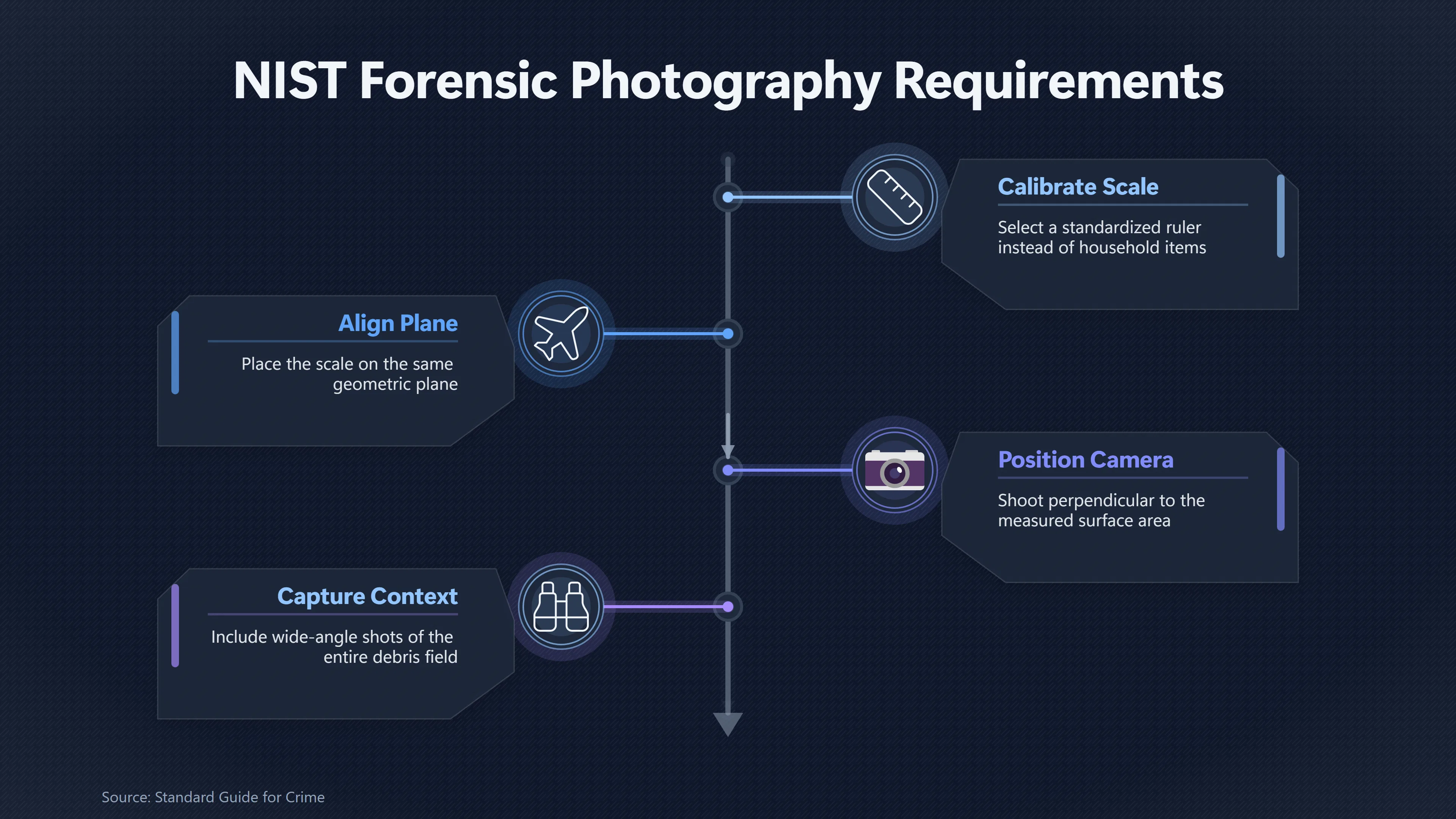
Professional forensic guidance therefore specifies that the reference scale should be positioned on the same plane as the object being measured and photographed as nearly perpendicular to the subject as practical. Investigators normally record one photograph without the scale and another with the scale added, preserving both the undisturbed scene and an accurate dimensional reference.[NIST]nist.govStandard Guide for CrimeStandard Guide for CrimeMarch 27, 2026…
What a Properly Aligned Measurement Photograph Requires
A photograph intended to support size claims should satisfy several practical conditions rather than relying on visual impression alone.
A reliable measurement photograph typically includes:
- A calibrated photographic scale rather than an arbitrary household object.
- The scale placed directly beside the measured surface, not above, below or behind it.
- The entire ruler and object lying in the same geometric plane.
- The camera positioned approximately perpendicular to the measured surface.
- Sufficient image resolution for measurement markings to remain readable.
- Wider photographs showing exactly where the close-up fits within the overall debris field.
Current forensic guidance also recommends documenting camera settings such as focal length and maintaining the original image files whenever possible, allowing later reviewers to evaluate perspective and image integrity.[NIST]nist.govStandard Guide for CrimeStandard Guide for CrimeMarch 27, 2026…

What Scale Errors Mean for UFO Crash Claims
Scale errors do not demonstrate that a crash photograph is fraudulent, nor do they show that debris is ordinary. Instead, they limit what can legitimately be concluded from the image.
If an extraordinary claim depends primarily on photographs in which:
- no calibrated scale is visible,
- the scale is incorrectly positioned,
- only close-up images are available,
- camera angle is highly oblique,
- or no wider contextual photographs exist,
then the apparent size of the debris should be treated as an unverified visual impression rather than a measured fact.
For alleged UFO crash sites, photographs become substantially more persuasive only when multiple overlapping images, correctly positioned measurement scales and consistent scene documentation allow independent observers to reproduce the size estimates instead of relying on appearance alone.[nist.gov]nist.govStandard Guide for CrimeStandard Guide for CrimeMarch 27, 2026…
Amazon book picks
Further Reading
Books and field guides related to Is the Debris Really as Large as It Looks?. Use these as the next step if you want deeper reading beyond the article.
Crime Scene Photography
Crime Scene Photography is a book wrought from years of experience, with material carefully selected for ease of use and effectiveness in...
Understanding Exposure
Rating: 4.5/5 from 19 Google Books ratings
Provides detailed lessons on the elements of exposure and how each relates to depth of field, freezing and blurring action, and shooting...
Forensic Photography: A Practitioner's Guide
Forensic photography plays a vitally important part in the investigation of crime and the subsequent administration of justice. Written b...
The Photographer's Eye
Design is the single most important factor in creating a successful photograph. The ability to see the potential for a strong picture and...
eBay marketplace picks
Marketplace Samples
Live-tested eBay searches with available results related to this page.
Selected fromalien metal collectible oneBay.co.uk.
Endnotes
1.
Source: nist.gov
Title: Standard Guide for Crime
Link:https://www.nist.gov/document/standard-guide-crime-scene-photography
Source snippet
Standard Guide for CrimeMarch 27, 2026...
Published: March 27, 2026
2.
Source: nist.gov
Title: Dimensional Review of Scales for Forensic Photography | NIST
Link:https://www.nist.gov/publications/dimensional-review-scales-forensic-photography
Source snippet
Dimensional Review of Scales for Forensic Photography | NIST...
3.
Source: nist.gov
Title: Forensics Science — Crime Scene | NIST
Link:https://www.nist.gov/forensic-science/nist-forensics-science-crime-scene
Source snippet
May 27, 2026 — NIST FORENSICS SCIENCE — CRIME SCENE Crime scene investigation includes everything that happens to document, locate, prese...
Published: May 27, 2026
4.
Source: pubmed.ncbi.nlm.nih.gov
Title: Dimensional Review of Scales for Forensic Photography
Link:https://pubmed.ncbi.nlm.nih.gov/27404626/
5.
Source: pubmed.ncbi.nlm.nih.gov
Link:https://pubmed.ncbi.nlm.nih.gov/41932800/
Source snippet
2026 Mar;66(2):101403. doi: 10.1016/j.scijus.2026.101403. Epub 2026 Feb 3. LENS CORRECTION TECHNIQUES AND THEIR APPLICATION IN FORENSIC P...
6.
Source: nist.gov
Title: glossary term
Link:https://www.nist.gov/glossary-term/39671
Source snippet
Perspective Distortion | NISTJanuary 15, 2025 — Perspective Distortion in image and video analysis, a warping or transformation of an obj...
Published: January 15, 2025
7.
Source: nist.gov
Title: Committee Facial & Iris Iden
Link:https://www.nist.gov/glossary-term/39666
Source snippet
Perspective | NISTJanuary 15, 2025 — Perspective in image and video analysis, camera-to-subject geometry, including both camera-to-subjec...
Published: January 15, 2025
8.
Source: pmc.ncbi.nlm.nih.gov
Title: As a phased method that depends on photographic optics first and anatomical c
Link:https://pmc.ncbi.nlm.nih.gov/articles/PMC9576648/
Source snippet
superimposition: a review of focus distance estimation methods and an extension to profile view photographs - PMCAugust 24, 2022 — ABSTRA...
Published: August 24, 2022
9.
Source: pubmed.ncbi.nlm.nih.gov
Link:https://pubmed.ncbi.nlm.nih.gov/27107561/
10.
Source: nist.gov
Link:https://www.nist.gov/standard/2246
11.
Source: pmc.ncbi.nlm.nih.gov
Link:https://pmc.ncbi.nlm.nih.gov/articles/PMC6080161/
12.
Source: ngi.dlrrd.gov.za
Link:https://ngi.dlrrd.gov.za/index.php/technical-information/remote-sensing-and-photogrammetry/rectification
Additional References
13.
Source: youtube.com
Link:https://www.youtube.com/watch?v=2VnNzJf0fVc
Source snippet
Ultra Wide Lenses | You NEED to Know THIS...
14.
Source: youtube.com
Title: How Characters Are Made to Look Bigger and Smaller in Movies & TV
Link:https://www.youtube.com/watch?v=DbK8JhnqJp4
Source snippet
Stop Saying Focal Length Changes Perspective (Here's Why)...
15.
Source: youtube.com
Title: Photo Tricks For Beginners: Forced Perspective Photography
Link:https://www.youtube.com/watch?v=uM_TG6SeuYk
Source snippet
How Characters Are Made to Look Bigger and Smaller in Movies & TV...
16.
Source: ojp.gov
Link:https://www.ojp.gov/ncjrs/virtual-library/abstracts/fundamental-principles-and-theory-crime-scene-photography
17.
Source: ojp.gov
Link:https://www.ojp.gov/ncjrs/virtual-library/abstracts/photographic-evidence-protocol-use-digital-imaging-methods-rectify
18.
Source: sciencedirect.com
Link:https://www.sciencedirect.com/science/article/abs/pii/S0379073821004655
19.
Source: encyclopedia.com
Link:https://www.encyclopedia.com/science/encyclopedias-almanacs-transcripts-and-maps/perspective-analysis
20.
Source: sciencedirect.com
Title: A comparison of reverse projection and Photo Modeler for suspect height analysis
Link:https://www.sciencedirect.com/science/article/abs/pii/S0379073821000104
21.
Source: nij.ojp.gov
Title: dimensional review scales forensic photography 2013
Link:https://nij.ojp.gov/library/publications/dimensional-review-scales-forensic-photography-2013
22.
Source: ojp.gov
Title: dimensional review scales forensic photography 2013
Link:https://www.ojp.gov/ncjrs/virtual-library/abstracts/dimensional-review-scales-forensic-photography-2013