Within Witnesses
What Fear Makes UFO Witnesses Miss
Fear can preserve the central impression of a dramatic event while weakening memory for timing, surroundings and sequence.
On this page
- Why attention locks onto the most threatening feature
- Which peripheral details are most easily lost
- How investigators should interpret emotionally intense accounts
Page outline Jump by section
Introduction
Witnesses to alleged UFO crashes often describe the experience as unforgettable. That vividness, however, should not be mistaken for complete accuracy. Decades of research on eyewitness memory shows that acute fear and stress do not simply weaken memory across the board. Instead, they tend to narrow attention onto whatever appears most important or threatening at the moment, while reducing the amount of surrounding information that is encoded. As a result, a witness may retain a powerful memory of a brilliant descending light, an unusual shape or an overwhelming sound, yet have only fragmentary or inaccurate memories of timing, distances, nearby landmarks or the sequence of events.[nih.gov]pubmed.ncbi.nlm.nih.govThe effects of acute stress on eyewitness memory: an integrative review for eyewitness researchers - PubMedJuly 26, 2021…
Within investigations of alleged UFO crashes, this distinction matters because many key questions depend on contextual details rather than the central visual impression alone. Determining whether an object actually struck the ground, where it disappeared, how long it remained visible and whether multiple witnesses observed the same event all require information that psychological research suggests is especially vulnerable during highly emotional experiences.
Why attention locks onto the most threatening feature
Human attention is limited. During sudden, emotionally charged events, the brain rapidly prioritises information that appears most relevant to survival. This process helps people react quickly but leaves fewer mental resources available for processing everything else in the scene. Psychologists have described this general phenomenon for decades, and modern eyewitness research continues to support the conclusion that acute stress changes what is encoded into memory rather than simply making all memories stronger or weaker.[PubMed]pubmed.ncbi.nlm.nih.govPub Med Emotional stress and eyewitness memory: a critical reviewEmotional stress and eyewitness memory: a critical review - PubMed…
In the context of an alleged UFO crash, the attention-grabbing feature might be:
- an intensely bright light;
- a rapidly descending object;
- an unexpected loud sound;
- apparent erratic movement; or
- a sudden flash or explosion.
If observers become visually and emotionally fixed on one of these features, they may devote little attention to everything occurring around it. This does not imply that the central feature is imagined. Rather, it suggests that peripheral information may never have been encoded with sufficient detail to support accurate later recall.
A well-established example from eyewitness research is the “weapon focus” effect. During violent crimes, witnesses often remember the weapon itself better than other aspects of the event because the threatening object dominates attention. Although a UFO incident obviously differs from a crime, the underlying attentional mechanism is relevant: an unusual or frightening aerial object may similarly monopolise attention at the expense of surrounding details.[oup.com]academic.oup.comOUP AcademicThe Weapon Focus Effect in Eyewitness Memory | Oxford Bibliographies in Psychology | Oxford AcademicMay 26, 2023…
Which peripheral details are most easily lost
The details most vulnerable during emotionally intense observation are often precisely those investigators later need to reconstruct what actually happened.
These commonly include:
- the precise order in which sounds, lights and movements occurred;
- how long each stage lasted;
- the positions of nearby buildings, trees or hills;
- the direction in which observers themselves were moving;
- the location of other witnesses;
- weather, visibility and lighting conditions; and
- whether different observations occurred simultaneously or several seconds apart.
These omissions arise because attention was concentrated elsewhere rather than because memories subsequently faded. When later asked to reconstruct the event, witnesses may confidently fill unavoidable gaps using logical inference, expectations or information acquired afterwards without recognising that these details were never directly observed.[frontiersin.org]frontiersin.orgOpen source on frontiersin.org.
For example, someone may vividly remember a bright object descending behind a ridge while being unable to state accurately whether it vanished before reaching the horizon, continued below the treeline or simply became obscured by terrain. Those contextual distinctions can determine whether investigators infer an apparent landing, an impact or merely loss of visual contact.
Why vivid memories are not necessarily complete memories
People often equate emotional intensity with reliability. In practice, the relationship is more complicated.
Research suggests emotionally significant events can produce exceptionally strong memories for central features while simultaneously reducing memory for peripheral information. Consequently, witnesses may honestly report that they will “never forget” what they saw, yet still misremember important contextual facts. This helps explain why confidence and emotional conviction are not reliable indicators of overall accuracy.[PubMed]pubmed.ncbi.nlm.nih.govPub Med Emotional stress and eyewitness memory: a critical reviewEmotional stress and eyewitness memory: a critical review - PubMed…
The literature also shows that stress does not affect every situation identically. Moderate arousal can sometimes enhance memory for important information, whereas very high stress is more consistently associated with poorer recall of broader scene details. Factors such as viewing duration, the delay before the first interview and whether physiological stress was actually experienced all influence outcomes, which is one reason modern reviews emphasise avoiding overly simple claims that stress either always improves or always harms eyewitness memory.[PubMed]pubmed.ncbi.nlm.nih.govThe effects of acute stress on eyewitness memory: an integrative review for eyewitness researchers - PubMedJuly 26, 2021…

How investigators should interpret emotionally intense accounts
Because stress selectively shapes attention, investigators should distinguish between a witness’s central experience and the surrounding context instead of treating every reported detail as equally dependable.
Several practices follow from this understanding.
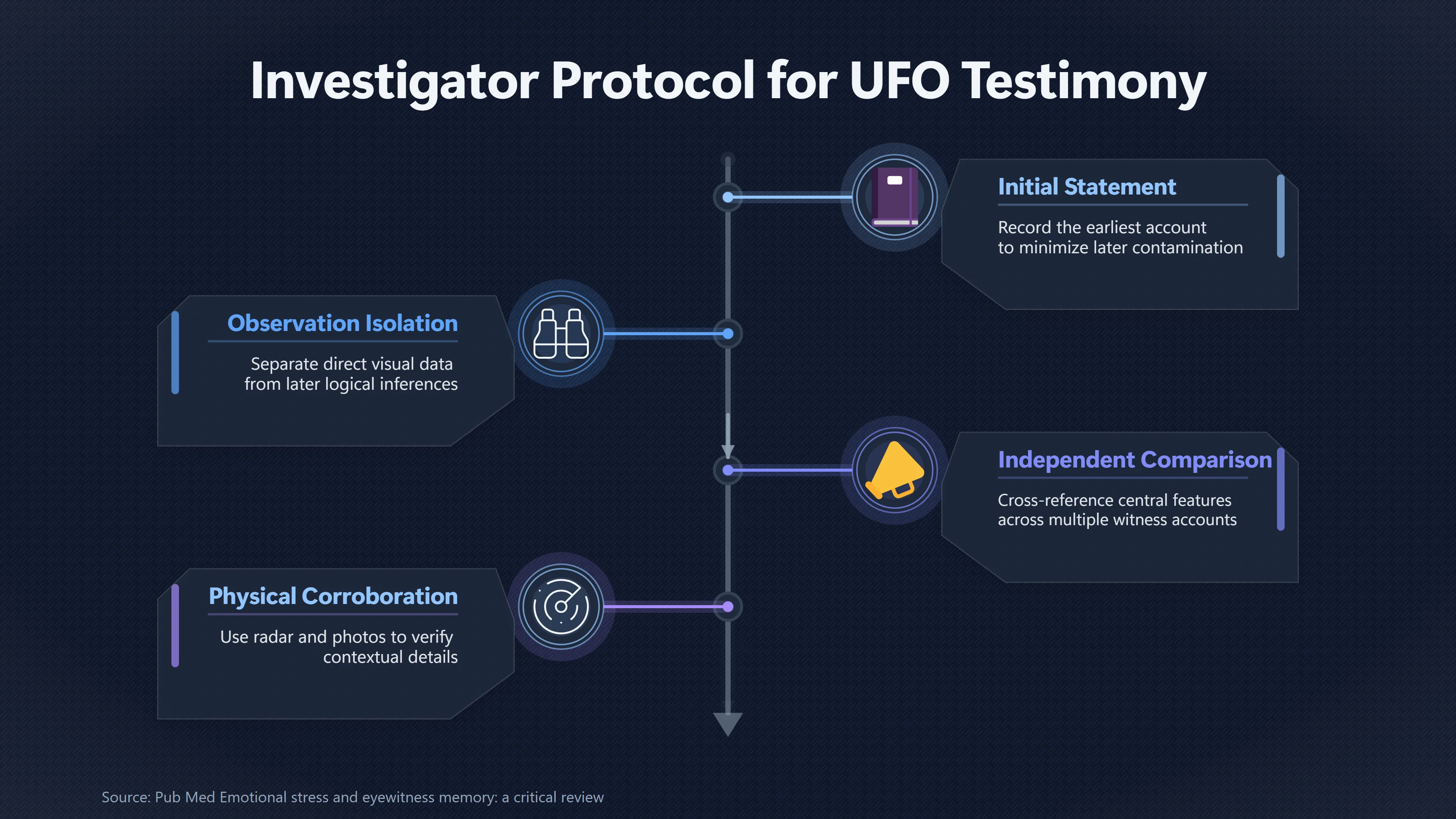
Record the earliest account. Initial statements generally contain fewer opportunities for later reconstruction or contamination through discussion, media coverage or repeated interviewing.[Frontiers]frontiersin.orgOpen source on frontiersin.org.
Separate observation from inference. Witnesses should be encouraged to distinguish between what they directly saw and what they concluded afterwards. Saying “the light disappeared behind the hill” is observationally different from saying “it crashed behind the hill.”
Compare independent accounts. Consistent agreement among witnesses on central features may indicate that something unusual occurred, while differences in peripheral details are expected under stressful viewing conditions rather than necessarily indicating dishonesty.
Use physical evidence to resolve contextual questions. Timelines, photographs, radar records, astronomical data, emergency call logs and environmental evidence are often more dependable than retrospective estimates of duration, direction or distance.
Avoid treating omissions as deception. A frightened observer who cannot recall surrounding landmarks or exact timing may simply have experienced normal attentional narrowing rather than attempting to conceal information.
What fear means for assessing UFO crash testimony
High emotional arousal should neither automatically discredit nor automatically validate eyewitness testimony. Instead, it changes how that testimony should be interpreted.
A frightening aerial event may genuinely leave an enduring memory of a striking object, intense light or extraordinary sound while leaving important contextual information only weakly encoded. Consequently, investigators should place greatest weight on promptly recorded observations, distinguish central impressions from peripheral reconstruction and seek independent corroboration before drawing conclusions about whether an observed aerial event actually resulted in a crash. This approach is consistent with the broader scientific understanding of eyewitness memory: emotionally powerful experiences are often remembered vividly, but not necessarily comprehensively.[nih.gov]pubmed.ncbi.nlm.nih.govThe effects of acute stress on eyewitness memory: an integrative review for eyewitness researchers - PubMedJuly 26, 2021…
Amazon book picks
Further Reading
Books and field guides related to What Fear Makes UFO Witnesses Miss. Use these as the next step if you want deeper reading beyond the article.
Eyewitness Testimony
By shedding light on the many factors that can intervene and create inaccurate testimony, Elizabeth Loftus illustrates how memory can be...
The Seven Sins of Memory: How the Mind Forgets and Remembers
Rating: 3.5/5 from 5 Google Books ratings
A New York Times Notable Book: A psychologist's "gripping and thought-provoking" look at how and why our brains sometimes fail us (Steven...
The Seven Sins of Memory
Rating: 3.5/5 from 5 Google Books ratings
A New York Times Notable Book: A psychologist's "gripping and thought-provoking" look at how and why our brains sometimes fail us (Steven...
The Invisible Gorilla: How Our Intuitions Deceive Us
NEW YORK TIMES BESTSELLER • Our minds don’t work the way we think they do. Two renowned psychologists explain how and why our intuitions...
eBay marketplace picks
Marketplace Samples
Live-tested eBay searches with available results related to this page.
Selected fromalien encounter poster oneBay.co.uk.


Current eBay listing
Alien Encounter Photomosaic Robert Silvers Poster 24x36 1998

Current eBay listing
Alien Encounter with UFO Framed Wall Art Poster Canvas Print Picture

Current eBay listing
SCIFI ALIEN ENCOUNTER Framed Wall Art Poster Canvas Print Picture
Endnotes
1.
Source: pubmed.ncbi.nlm.nih.gov
Link:https://pubmed.ncbi.nlm.nih.gov/34309476/
Source snippet
The effects of acute stress on eyewitness memory: an integrative review for eyewitness researchers - PubMedJuly 26, 2021...
Published: July 26, 2021
2.
Source: frontiersin.org
Link:https://www.frontiersin.org/journals/psychology/articles/10.3389/fpsyg.2021.666724/full
3.
Source: pubmed.ncbi.nlm.nih.gov
Title: Pub Med Emotional stress and eyewitness memory: a critical review
Link:https://pubmed.ncbi.nlm.nih.gov/1454896/
Source snippet
Emotional stress and eyewitness memory: a critical review - PubMed...
4.
Source: academic.oup.com
Link:https://academic.oup.com/reference/62403/reference-article-abstract/555483299
Source snippet
OUP AcademicThe Weapon Focus Effect in Eyewitness Memory | Oxford Bibliographies in Psychology | Oxford AcademicMay 26, 2023...
Published: May 26, 2023
5.
Source: pubmed.ncbi.nlm.nih.gov
Link:https://pubmed.ncbi.nlm.nih.gov/15732653/
Source snippet
A meta-analytic review of the effects of high stress on eyewitness memory - PubMed...
6.
Source: pmc.ncbi.nlm.nih.gov
Link:https://pmc.ncbi.nlm.nih.gov/articles/PMC8024237/
Source snippet
PubMed Central (PMC)The effects of stress on eyewitness memory: A survey of memory experts and laypeople - PMC...
7.
Source: ncbi.nlm.nih.gov
Link:https://www.ncbi.nlm.nih.gov/books/NBK621592/
Source snippet
Guide on Eyewitness Identification - Reference Manual on Scientific Evidence - NCBI BookshelfDecember 31, 2025 — APPLIED EYEWITNESS STUDI...
Published: December 31, 2025
8.
Source: pmc.ncbi.nlm.nih.gov
Link:https://pmc.ncbi.nlm.nih.gov/articles/PMC12610937/
9.
Source: pmc.ncbi.nlm.nih.gov
Link:https://pmc.ncbi.nlm.nih.gov/articles/PMC11298466/
10.
Source: pmc.ncbi.nlm.nih.gov
Link:https://pmc.ncbi.nlm.nih.gov/articles/PMC8076587/
11.
Source: pmc.ncbi.nlm.nih.gov
Link:https://pmc.ncbi.nlm.nih.gov/articles/PMC8821507/
12.
Source: sciencedirect.com
Title: Eyewitness Testimony
Link:https://www.sciencedirect.com/topics/social-sciences/eyewitness-testimony
13.
Source: youtube.com
Title: WEAPON FOCUS EFFECT
Link:https://www.youtube.com/watch?v=4hlCV6DVeyo
Source snippet
Psychology - Eyewitness Testimony...
14.
Source: youtube.com
Link:https://www.youtube.com/watch?v=m6aY9Wr-xjI
Source snippet
Narrowing behavior / Attentional narrowing...
Additional References
15.
Source: simplypsychology.org
Title: Eyewitness Testimony in Psychology
Link:https://www.simplypsychology.org/eyewitness-testimony.html
Source snippet
June 19, 2026 — EYEWITNESS TESTIMONY IN PSYCHOLOGY By Saul McLeod, PhD | Updated on June 19, 2026 Reviewed by Olivia Guy-Evans, MSc & Eye...
Published: June 19, 2026
16.
Source: ojp.gov
Link:https://ojp.gov/ncjrs/virtual-library/abstracts/estimator-variables-and-eyewitness-testimony
17.
Source: ojp.gov
Link:https://www.ojp.gov/ncjrs/virtual-library/abstracts/meta-analytic-review-weapon-focus-effect
18.
Source: legalclarity.org
Title: Legal Clari
Link:https://legalclarity.org/weapon-focus-effect-impact-on-eyewitness-identification/
Source snippet
Weapon Focus Effect: Impact on Eyewitness Identification - LegalClarityMay 13, 2026 — WEAPON FOCUS EFFECT: IMPACT ON EYEWITNESS IDENTIFIC...
Published: May 13, 2026
19.
Source: sciencedirect.com
Link:https://www.sciencedirect.com/science/article/abs/pii/S0160252708000976
20.
Source: tandfonline.com
Link:https://www.tandfonline.com/doi/full/10.1080/09658211.2021.1955935
21.
Source: tandfonline.com
Link:https://www.tandfonline.com/doi/full/10.1080/1068316X.2011.599325
22.
Source: nationalacademies.org
Link:https://www.nationalacademies.org/read/18891/chapter/7
23.
Source: cris.maastrichtuniversity.nl
Link:https://cris.maastrichtuniversity.nl/en/publications/the-effects-of-acute-stress-on-eyewitness-memory-an-integrative-r/
24.
Source: researchportal.port.ac.uk
Link:https://researchportal.port.ac.uk/en/publications/the-effects-of-stress-on-eyewitness-memory-a-survey-of-memory-exp/