Within UFO Crashes
How Alleged UFO Metal Should Be Tested
Extraordinary material claims require repeatable tests that rule out contamination, industrial alloys and natural terrestrial sources.
On this page
- Composition and isotope measurements
- Contamination and sample preparation
- Independent replication and publication
Page outline Jump by section
Introduction
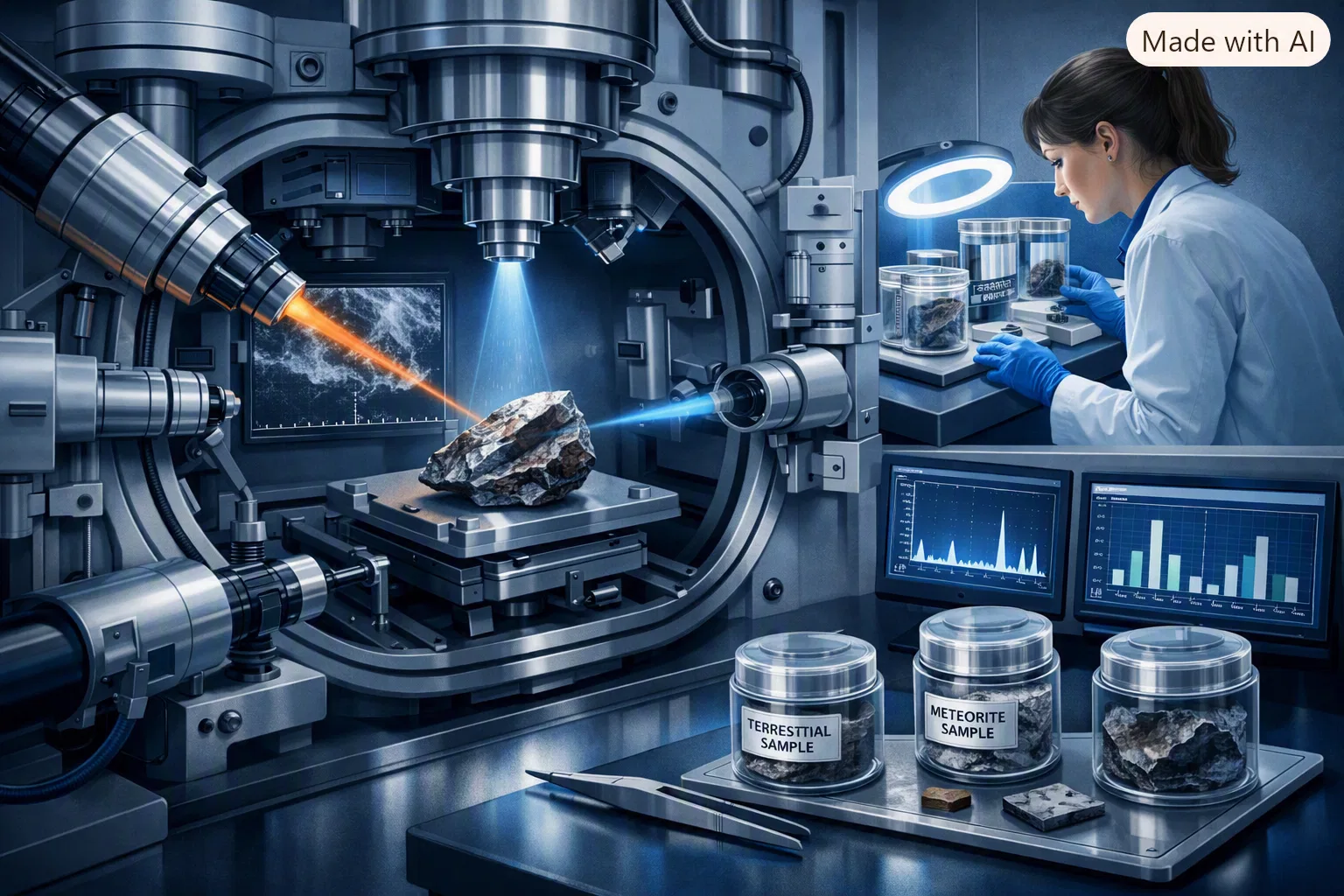
Laboratory testing can determine whether an alleged piece of UFO wreckage is unusual, but it cannot rescue a specimen with no reliable history. The decisive questions are not simply whether a metal looks strange or contains rare elements. Investigators must establish where it came from, protect it from contamination, measure its bulk chemistry and microscopic structure, compare its isotope ratios with terrestrial and meteoritic reference materials, and have independent laboratories reproduce the findings.
Publicly documented tests have so far produced no verified alien material. The most detailed recent examinations by Oak Ridge National Laboratory found that two specimens associated with unidentified anomalous phenomena were conventional terrestrial alloys: one was predominantly magnesium and zinc with lead–bismuth banding, while another was a common aluminium–silicon casting alloy. These cases show why extraordinary claims require a coordinated programme of provenance checking, contamination control, cross-validated measurements and open publication rather than one striking instrument reading.[AARO]aaro.milSynopsis: Analysis of a Metallic SpecimenSynopsis: Analysis of a Metallic Specimen…
Start with provenance, not the spectrometer
A laboratory can describe the material placed in front of it, but it cannot ordinarily prove that the sample was recovered from a particular alleged UFO crash. That link depends on provenance: a documented history from the recovery location to the laboratory. Ideally, this includes dated scene photographs, coordinates, witness records, contemporaneous packaging, transfer logs, seals, sample weights and the identity of every custodian.
This is more than administrative tidiness. A metal fragment bought from a collector decades after an incident may be analysed perfectly and still tell researchers nothing dependable about the claimed crash. It could have been substituted, mixed with another object, cut using contaminated tools or associated with the event only through later storytelling. In its magnesium-alloy investigation, the All-domain Anomaly Resolution Office, or AARO, acknowledged that the specimen’s long chain of custody could not be verified. Oak Ridge could therefore assess its composition and possible function, but not establish that it had actually come from a 1947 crash.[AARO]aaro.milSynopsis: Analysis of a Metallic SpecimenSynopsis: Analysis of a Metallic Specimen…
A credible examination should begin by separating three propositions that are often blurred together:
- The sample is physically unusual.
- The sample is genuinely associated with a reported crash site.
- The sample was manufactured beyond Earth.
Proving the first does not prove the second, and proving the second would not automatically prove the third. A classified aerospace component, experimental alloy, meteorite fragment or industrial by-product could be both unusual and genuinely recovered near an incident without being alien technology.
Before destructive testing begins, the receiving laboratory should photograph and weigh the specimen, record its dimensions, document packaging and surface condition, and obtain non-destructive images. X-ray computed tomography can reveal internal voids, cracks and layers while preserving the object. The sample should then be divided under controlled conditions, with an untouched reserve retained for later replication. Oak Ridge’s magnesium-alloy study followed this general progression, combining a parent specimen and existing subsamples with optical microscopy, computed tomography, electron microscopy and mass spectrometry.[AARO]aaro.milSynopsis: Analysis of a Metallic SpecimenSynopsis: Analysis of a Metallic Specimen…

Composition is a fingerprint, not a verdict
The first analytical task is to determine what the specimen is made from at several scales. No single instrument provides a complete answer.
Bulk methods such as inductively coupled plasma optical emission spectroscopy and inductively coupled plasma mass spectrometry measure major, minor and trace elements after a small portion has been dissolved. These tests can show whether a fragment resembles a recognised alloy family or contains unexpected impurities. Surface and microstructural methods, particularly scanning electron microscopy with energy-dispersive X-ray spectroscopy, reveal where those elements occur and whether apparent layers, particles or inclusions are genuine features rather than dirt, corrosion or preparation residue.
The magnesium specimen examined by Oak Ridge illustrates why both views are needed. The material was approximately 97.5 per cent magnesium and 2 per cent zinc, with smaller quantities of bismuth, lead and other trace elements. Microscopic mapping showed that lead and bismuth occurred together in repeated bands rather than as a pristine, isolated layer of pure bismuth. Transmission electron microscopy further showed ordinary magnesium-alloy crystal structures and highly nanocrystalline or amorphous bismuth-rich regions. These observations contradicted the claim that the object contained the precise pure-bismuth architecture required by the proposed terahertz-waveguide explanation.[AARO]aaro.milSynopsis: Analysis of a Metallic SpecimenSynopsis: Analysis of a Metallic Specimen…
The lesson is that rarity is not enough. A composition can be uncommon in current commercial catalogues yet still result from historic research, failed experiments, corrosion, heat damage or an obsolete manufacturing process. AARO noted that magnesium–zinc alloys and additions of lead and bismuth were investigated during twentieth-century aerospace-material development. It judged the sample consistent with a test object, manufacturing product, by-product or component from terrestrial magnesium-alloy research, although its exact original use remained unknown.[AARO]aaro.mils Supplement to Oak Ridge National Laboratory's Analysis of a Metallic SpecimenAARO's Supplement to Oak Ridge National Laboratory's Analysis of a Metallic Specimen…
A second Oak Ridge examination, published by AARO in 2026, dealt with an aluminium specimen said to be associated with an unidentified event over Ohio in the mid-1990s. Multiple chemical methods found about 86 per cent aluminium and 12 per cent silicon, with expected quantities of iron, copper, magnesium, zinc and manganese. Microscopy revealed silicon plates, ordinary intermetallic phases, casting pores and evidence of slow cooling. The material closely matched widely used near-eutectic aluminium–silicon casting alloys rather than an exotic composition.[AARO]aaro.milSynopsis: Analysis of an Aluminum SpecimenSynopsis: Analysis of an Aluminum Specimen…
This is why a serious report should compare results against more than a web search for an exact alloy recipe. Relevant references include modern and historic alloy standards, patent literature, military and aerospace reports, phase diagrams, slag and smelting by-products, welding materials, coatings and known meteorite classes. “No exact match found” is not equivalent to “non-terrestrial”.
What isotope measurements can—and cannot—show
Isotopes are forms of the same element with different numbers of neutrons. Their relative abundances vary because of stellar nucleosynthesis, radioactive decay, planetary formation and physical or chemical fractionation. Isotope-ratio measurements can therefore help distinguish materials formed in different reservoirs or altered by different processes.
Genuine extraterrestrial matter is not hypothetical in the laboratory. Meteorites and returned asteroid samples can contain isotope patterns that differ from common terrestrial materials, and isotope analysis is routinely used to establish that certain compounds or grains are indigenous to meteorites. Studies of the Murchison meteorite, for example, used carbon-isotope measurements to support an extraterrestrial origin for particular organic compounds rather than later terrestrial contamination.[PubMed]pubmed.ncbi.nlm.nih.govIsotopic evidence for extraterrestrial non-racemic amino…by MH Engel · 1997 · Cited by 654 — The stable carbon isotope compositi…
For alleged manufactured wreckage, however, the interpretation is more difficult. A material made elsewhere in the Solar System might share broadly similar isotope ratios with Earth because the planets formed from related starting material. Manufacturing processes can also fractionate isotopes by preferentially moving lighter or heavier atoms. An unusual value must therefore be compared with natural terrestrial variation, industrially processed materials, meteorites, lunar samples and measurement uncertainty before it is treated as evidence of a non-Earth origin.
Oak Ridge measured magnesium and lead isotope ratios in the layered magnesium specimen. The magnesium values fell within the range expected for terrestrial material affected by kinetic fractionation, while the lead ratios were consistent with terrestrial lead. AARO described both as unremarkable and compatible with manufactured Earth materials. The result did not identify a particular factory or project, but it directly weakened the claim of an extrasolar source.[AARO]aaro.mils Supplement to Oak Ridge National Laboratory's Analysis of a Metallic SpecimenAARO's Supplement to Oak Ridge National Laboratory's Analysis of a Metallic Specimen…
High-quality isotope work depends on calibration. Results should be reported relative to recognised reference materials, with analytical uncertainty, blank measurements, replicate runs and information about mass-bias correction. The International Union of Pure and Applied Chemistry has stressed the importance of internationally comparable reference materials, while the US National Institute of Standards and Technology continues to develop improved isotope standards because older materials do not meet every modern precision requirement.[USGS]usgs.govAssessment of international reference materials for isotope…Assessment of international reference materials for isotope-ratio anal…
An apparent isotope anomaly should trigger checks before headlines:
- Was the instrument calibrated with a suitable standard?
- Did the measured difference exceed both analytical uncertainty and known terrestrial variation?
- Could corrosion, evaporation, electrolysis, refining or another industrial process explain the fractionation?
- Was the same anomaly found in several parts of the specimen?
- Did another laboratory reproduce it using a different instrument or preparation method?
- Does the pattern resemble known meteorites or presolar grains rather than a manufactured object?
A single value outside a researcher’s preferred comparison range is not, by itself, an extraterrestrial signature.
Contamination can manufacture an anomaly
Alleged crash debris is often stored for years in envelopes, plastic bags, display boxes or private collections. It may be touched, polished, drilled, glued, coated or cut before reaching a laboratory. Each step can add material that later appears in sensitive trace-element testing.
Contamination may come from soil, fingerprints, packaging, abrasive paper, cutting blades, polishing compounds, epoxy mounts, laboratory dust, acids or previous samples analysed on the same equipment. The International Atomic Energy Agency’s guidance on clean laboratories identifies airborne particulates and sample preparation as major contamination risks and stresses that analytical blanks are essential to determine what the procedure itself has introduced.[IAEA Publications]www-pub.iaea.orgInflatable glove bags are cheap solutionsIAEA PublicationsClean laboratories and clean rooms for analysis of…January 16, 2003 — One of the main sources of contamination of sam…
The correct approach is not simply to “clean the sample”, because aggressive cleaning may remove meaningful surface deposits or alter corrosion layers. Investigators should first document the untreated surface, then distinguish exterior contamination from the interior material. A practical sequence is:
- Non-destructive documentation: photography, weighing, computed tomography and surface microscopy.
- Controlled surface sampling: collect loose particles and corrosion products separately.
- Clean sectioning: use documented, pre-cleaned tools and retain samples of blades, lubricants and mounting media as controls.
- Interior exposure: examine a polished cross-section taken well below the handled surface.
- Procedural blanks: process empty vessels, reagents and preparation materials alongside the specimen.
- Witness samples: place clean control materials in the preparation environment to detect airborne or handling contamination.
- Archive material: preserve an unprocessed portion in sealed, inert storage.
Space-sample missions demonstrate the level of care needed when origin matters. NASA’s OSIRIS-REx contamination-control programme used precision cleaning, material restrictions, witness plates and archived components so that substances found in asteroid Bennu samples could be compared with the collection system and terrestrial background. An alleged UFO fragment recovered informally decades earlier cannot be made pristine retrospectively, but comparable controls can help identify later additions.[arXiv]arxiv.orgarXiv OSIRIS-REx Contamination Control Strategy and ImplementationarXiv OSIRIS-REx Contamination Control Strategy and Implementation
Contamination control is particularly important for organic compounds, unusual trace metals and biological material. Reviews of meteorite analysis emphasise that specimens with minimal terrestrial exposure and well-documented curatorial histories are preferable because Earth-derived substances can obscure or imitate indigenous chemistry.[PubMed Central (PMC)]pmc.ncbi.nlm.nih.govOpen source on nih.gov.
Test manufacture, structure and claimed function
A convincing analysis must ask not only “What elements are present?” but “How was this material made?” Metallography—the study of a metal’s internal structure—can reveal casting, rolling, extrusion, welding, vapour deposition, heat treatment, rapid cooling, corrosion and mechanical failure.
Useful methods include optical microscopy, scanning and transmission electron microscopy, electron diffraction, X-ray diffraction and computed tomography. Grain shape, phase boundaries, porosity, segregation and fracture patterns can often place a specimen within familiar manufacturing practice even when its exact alloy designation is uncertain.
This distinction matters because visually dramatic layers are frequently described as “metamaterials”. In engineering, a metamaterial is not simply a layered substance; it is deliberately structured so that its geometry produces a specified electromagnetic, acoustic or mechanical response. Demonstrating such a function requires measurements of that response, not merely photographs of bands under a microscope.
The magnesium specimen was claimed to operate as a terahertz waveguide linked to antigravity or inertial-mass reduction. Oak Ridge tested the physical premise behind that claim. It found that the bismuth was mixed with roughly comparable lead, occurred in multiple bands and lacked the required pure single-crystal configuration. The laboratory therefore concluded that the specimen did not satisfy the proposed conditions for the claimed waveguide behaviour. No evidence of antigravity functionality was produced.[AARO]aaro.milSynopsis: Analysis of a Metallic SpecimenSynopsis: Analysis of a Metallic Specimen…
Functional claims should be translated into pre-defined tests. A purported waveguide should be tested for transmission, reflection, loss and directional response across the relevant frequency range. A claimed shape-memory material should undergo controlled thermal cycling. Claims of unusual strength require tensile, compression or hardness tests against suitable comparison alloys. Reports of radiation or energy emission require calibrated detectors, background measurements and repeated monitoring. The Ohio aluminium specimen, for example, was monitored by gamma spectroscopy for roughly two days and showed no abnormal gamma emission.[AARO]aaro.milSynopsis: Analysis of an Aluminum SpecimenSynopsis: Analysis of an Aluminum Specimen…
The protocol and success criteria should be fixed before results are seen. Otherwise, every negative test can be replaced by a new claim that the sample works only under unspecified conditions, was damaged during recovery or forms only one inactive part of a larger system.

Independent replication is the decisive stage
The strongest safeguard against error is replication by laboratories that did not select the sample, develop the original claim or know which subsample is supposed to be extraordinary. Ideally, a neutral custodian should divide the specimen into coded portions and send them to at least two qualified facilities. The laboratories should use overlapping but not identical methods so that one instrument’s bias does not reproduce itself across the project.
A replication plan should include reference specimens with similar expected composition. These controls test whether analysts can distinguish the alleged material from known alloys and help expose unconscious expectation. Some samples can be supplied blind, with ordinary industrial fragments mixed among the disputed pieces.
Agreement means more than both laboratories calling a specimen “unusual”. They should obtain compatible numerical results within stated uncertainty for bulk composition, isotope ratios, phase identity and microstructure. Where findings differ, raw spectra, calibration records, preparation histories and subsampling locations should be compared before any origin claim is made.
Cross-validation strengthened Oak Ridge’s aluminium analysis. The laboratory used dissolved shavings for optical-emission and high-resolution mass spectrometry, a bulk piece for glow-discharge mass spectrometry, microscopy for elemental distribution, computed tomography for internal porosity and gamma spectroscopy for radiation. The shavings and bulk material produced consistent chemistry across different methods. Such convergence is more persuasive than a lone anomalous reading.[AARO]aaro.milSynopsis: Analysis of an Aluminum SpecimenSynopsis: Analysis of an Aluminum Specimen…
Publication must expose the full dataset
Public claims about alien materials are difficult to evaluate when only selected images, interviews or summary statements are released. A scientifically useful publication should provide enough information for another team to assess the work and repeat it.
At minimum, the report should include:
- the specimen’s documented history and unresolved gaps;
- photographs before and after sampling;
- the location and mass of every subsample;
- preparation, cleaning and sectioning procedures;
- instrument models and operating conditions;
- calibration standards, blanks and detection limits;
- numerical results with uncertainty;
- full spectra or machine-readable data where practical;
- comparison datasets and the reason they were selected;
- negative findings as well as anomalies;
- conflicts of interest, funding and ownership arrangements;
- the location and access conditions for archived material.
Peer review does not guarantee that a conclusion is correct, but it forces methods and interpretation into a form that specialists can challenge. Claims should also distinguish observation from inference. “A layered magnesium alloy contains bismuth and lead” is an observation; “the layering was designed for propulsion” is an interpretation requiring separate functional evidence.
The 2022 paper by Garry Nolan and colleagues usefully discussed modern microscopy, mass spectrometry and isotope methods applicable to unusual aerospace materials. Its broader value lies in showing that sophisticated instruments can characterise tiny specimens at high spatial resolution. Yet advanced instrumentation does not remove the need for provenance, controls or replication; better sensitivity can simply reveal more ordinary complexity and more contamination.[ScienceDirect]sciencedirect.comOpen source on sciencedirect.com.
What result would materially change the case?
A credible alien-material finding would not rest on one rare element, one unexplained layer or one isotope measurement. It would require a coherent cluster of results that withstands ordinary explanations.
The strongest case would combine a secure recovery history with chemistry and structure incompatible with known natural and industrial materials; isotope patterns reproducibly outside terrestrial and familiar Solar System reservoirs; evidence of purposeful manufacture; and a measurable function not accounted for by established engineering. Independent laboratories would need to reproduce those findings from separately coded pieces, and the raw data would need to survive open specialist scrutiny.
Even then, “non-terrestrial” and “technological” would remain separate conclusions. A meteorite is non-terrestrial but not manufactured. An unfamiliar manufactured alloy might be terrestrial, classified or historically obscure. The extraterrestrial-technology interpretation becomes compelling only when origin, manufacture and function all point in the same direction.
The publicly documented record has not reached that threshold. Recent government-sponsored examinations instead show how alleged UFO metals can become less mysterious when bulk chemistry, microscopic structure, isotope ratios and manufacturing history are tested together. The practical standard is therefore straightforward: preserve the sample, document its history, control contamination, use complementary methods, predefine extraordinary claims as measurable hypotheses, replicate independently and publish the complete evidence.
Amazon book picks
Further Reading
Books and field guides related to How Alleged UFO Metal Should Be Tested. Use these as the next step if you want deeper reading beyond the article.
Callister's Materials Science and Engineering, Global Edition
Callister's Materials Science and Engineering: An Introduction, 10th Edition promotes student understanding of the three primary types of...
Principles of Instrumental Analysis
Written for a course that deals with the principles and applications of modern analytical instruments, this edition reflects updated tech...
Materials Characterization: Introduction to Microscopic and S...
This book covers state-of-the-art techniques commonly used in modern materials characterization. Two important aspects of characterizatio...
Scanning Electron Microscopy and X-Ray Microanalysis
In the decade since the publication of the second edition of Scanning Electron Microscopy and X-Ray Microanalysis, there has been a great...
eBay marketplace picks
Marketplace Samples
Live-tested eBay searches with available results related to this page.
Selected fromUFO collectible oneBay.co.uk.




Endnotes
1.
Source: aaro.mil
Title: Synopsis: Analysis of a Metallic Specimen
Link:https://www.aaro.mil/Portals/136/PDFs/Information%20Papers/ORNL-Synopsis_Analysis_of_a_Metallic_Specimen.pdf
Source snippet
Synopsis: Analysis of a Metallic Specimen...
2.
Source: aaro.mil
Title: ‘s Supplement to Oak Ridge National Laboratory’s Analysis of a Metallic Specimen
Link:https://www.aaro.mil/Portals/136/PDFs/Information%20Papers/AAROs_Supplement_to_ORNLs_Analysis_of_a_Metallic_Specimen.pdf
Source snippet
AARO's Supplement to Oak Ridge National Laboratory's Analysis of a Metallic Specimen...
3.
Source: aaro.mil
Title: Synopsis: Analysis of an Aluminum Specimen
Link:https://www.aaro.mil/Portals/136/PDFs/Information%20Papers/ORNL_ANALYSIS_OF_AN_ALUMINUM_SPECIMEN.pdf
Source snippet
Synopsis: Analysis of an Aluminum Specimen...
4.
Source: arxiv.org
Title: arXiv Extraterrestrial nucleobases in the Murchison meteorite
Link:https://arxiv.org/abs/0806.2286
5.
Source: usgs.gov
Link:https://www.usgs.gov/publications/assessment-international-reference-materials-isotope-ratio-analysis-iupac-technical
Source snippet
Assessment of international reference materials for isotope...Assessment of international reference materials for isotope-ratio anal...
6.
Source: www-pub.iaea.org
Title: Inflatable glove bags are cheap solutions
Link:https://www-pub.iaea.org/MTCD/Publications/PDF/te_1339_web.pdf
Source snippet
IAEA PublicationsClean laboratories and clean rooms for analysis of...January 16, 2003 — One of the main sources of contamination of sam...
Published: January 16, 2003
7.
Source: arxiv.org
Title: arXiv OSIRIS-REx Contamination Control Strategy and Implementation
Link:https://arxiv.org/abs/1704.02517
8.
Source: sciencedirect.com
Link:https://www.sciencedirect.com/science/article/am/pii/S0376042121000907
9.
Source: aaro.mil
Link:https://www.aaro.mil/FAQ/
10.
Source: aaro.mil
Link:https://www.aaro.mil/
11.
Source: aaro.mil
Title: AARO Historical Record Report Vol 1 2024
Link:https://www.aaro.mil/Portals/136/PDFs/AARO_Historical_Record_Report_Vol_1_2024.pdf
12.
Source: aaro.mil
Title: AARO Metallic Materials Analysis Supplement Jan2026
Link:https://www.aaro.mil/Portals/136/PDFs/Information%20Papers/AARO_Metallic_Materials_Analysis_Supplement_Jan2026.pdf
13.
Source: sciencedirect.com
Link:https://www.sciencedirect.com/science/article/abs/pii/S0265931X09001714
14.
Source: sciencedirect.com
Link:https://www.sciencedirect.com/science/article/pii/S2949822826011731
15.
Source: science.nasa.gov
Title: uap independent study team final report
Link:https://science.nasa.gov/wp-content/uploads/2023/09/uap-independent-study-team-final-report.pdf
16.
Source: science.nasa.gov
Link:https://science.nasa.gov/uap/
17.
Source: science.nasa.gov
Link:https://science.nasa.gov/uap/faqs/
18.
Source: nasa.gov
Title: to release discuss unidentified anomalous phenomena report
Link:https://www.nasa.gov/news-release/nasa-to-release-discuss-unidentified-anomalous-phenomena-report/
19.
Source: nasa.gov
Title: announces unidentified aerial phenomena study team members
Link:https://www.nasa.gov/general/nasa-announces-unidentified-aerial-phenomena-study-team-members/
20.
Source: nasa.gov
Title: update nasa shares uap independent study report names director
Link:https://www.nasa.gov/news-release/update-nasa-shares-uap-independent-study-report-names-director/
21.
Source: nasa.gov
Title: nac science committee report august 2022
Link:https://www.nasa.gov/wp-content/uploads/2022/08/nac_science_committee_report_august_2022.pdf
Published: august 2022
22.
Source: nasa.gov
Title: provides coverage of unidentified anomalous phenomena meeting
Link:https://www.nasa.gov/news-release/nasa-provides-coverage-of-unidentified-anomalous-phenomena-meeting/
23.
Source: astrobiology.nasa.gov
Link:https://astrobiology.nasa.gov/news/caps-study-on-the-community-report-from-the-biosignatures-standards-of-evidence-workshop/
24.
Source: nasa.gov
Link:https://www.nasa.gov/wp-content/uploads/2017/12/2021_agency_foia_log_0.xlsx
25.
Source: smd-cms.nasa.gov
Title: 2020 2024 nasa science plan yr 23 update final
Link:https://smd-cms.nasa.gov/wp-content/uploads/2023/09/2020-2024-nasa-science-plan-yr-23-update-final.pdf
26.
Source: nasa.gov
Title: News Release
Link:https://www.nasa.gov/news-release/page/92/
27.
Source: nasa.gov
Link:https://www.nasa.gov/wp-content/uploads/2025/08/2024-agency-foia-log.xlsx?emrc=646ac0
28.
Source: asrs.arc.nasa.gov
Link:https://asrs.arc.nasa.gov/
29.
Source: ntrs.nasa.gov
Link:https://ntrs.nasa.gov/api/citations/19690022574/downloads/19690022574.pdf
30.
Source: doeic.science.energy.gov
Title: 05 2024 ASER Ch 5 FINAL
Link:https://doeic.science.energy.gov/aser/ASER2024/05%202024%20ASER_Ch%205%20FINAL.pdf
31.
Source: youtube.com
Title: Unidentified Anomalous Phenomena
Link:https://www.youtube.com/watch?v=QhQqundhonk&feature=youtu.be&t=2704
Source snippet
Dr Jacques Vallee presents footage of a Ufo in 1975 with extreme acceleration #UFOs Topper# herbstle O!irvi...
32.
Source: pubmed.ncbi.nlm.nih.gov
Link:https://pubmed.ncbi.nlm.nih.gov/9305838/
Source snippet
Isotopic evidence for extraterrestrial non-racemic amino...by MH Engel · 1997 · Cited by 654 — The stable carbon isotope compositi...
33.
Source: pmc.ncbi.nlm.nih.gov
Link:https://pmc.ncbi.nlm.nih.gov/articles/PMC6617175/
34.
Source: publications.iupac.org
Link:https://publications.iupac.org/pac/74/10/1987/cited_by/index.html
35.
Source: info.ornl.gov
Link:https://info.ornl.gov/sites/publications/Files/Pub211894.pdf
36.
Source: ornl.gov
Link:https://www.ornl.gov/sites/default/files/2025-04/fusion-materials-semiannual-progress-report-76.pdf
37.
Source: info.ornl.gov
Link:https://info.ornl.gov/sites/publications/Files/Pub211456.pdf
38.
Source: dictionary.cambridge.org
Link:https://dictionary.cambridge.org/us/dictionary/english/alleged
39.
Source: dictionary.cambridge.org
Link:https://dictionary.cambridge.org/dictionary/english/alleged
40.
Source: pubmed.ncbi.nlm.nih.gov
Link:https://pubmed.ncbi.nlm.nih.gov/19528640/
41.
Source: pmc.ncbi.nlm.nih.gov
Link:https://pmc.ncbi.nlm.nih.gov/articles/PMC2705565/
42.
Source: pmc.ncbi.nlm.nih.gov
Link:https://pmc.ncbi.nlm.nih.gov/articles/PMC3810360/
43.
Source: vocabulary.com
Link:https://www.vocabulary.com/dictionary/alleged
Additional References
44.
Source: nist.gov
Link:https://www.nist.gov/programs-projects/high-precision-isotopic-reference-materials
Source snippet
High-Precision Isotopic Reference Materials | NISTNIST is implementing a program to produce and characterize a series of new isotopic...
45.
Source: youtube.com
Title: Art’s Parts 1: UFO Crash Recovery Material Analysis
Link:https://www.youtube.com/watch?v=f1LylzKZC-U
Source snippet
Oak Ridge National Laboratory UFO material testing The Pentagon Tested a UFO Metal Sample… and the Result Was SHOCKING CurioClips...
46.
Source: youtube.com
Title: New UAP Materials Tests: What the Results Reveal | Dr. Garry Nolan
Link:https://www.youtube.com/watch?v=Mifx4nzPY68
Source snippet
Testing Metamaterials - Dr. Jacques Vallée...
47.
Source: youtube.com
Title: BREAKING: AARO Releases UFO Material Test Results
Link:https://www.youtube.com/watch?v=2Z_k3BjO4Is
Source snippet
New UAP Materials Tests: What the Results Reveal | Dr. Garry Nolan...
48.
Source: youtube.com
Title: Analysis of the “[Ubatuba]({{ ‘ubatuba/’ | relative_url }})” material by Robert Powell
Link:https://www.youtube.com/watch?v=NamnxaADugo
Source snippet
Art's Parts 1: UFO Crash Recovery Material Analysis...
49.
Source: researchgate.net
Link:https://www.researchgate.net/publication/395858774_Toward_a_Reliability_Scale_for_Assessing_Reports_of_Unidentified_Anomalous_Phenomena_UAP
50.
Source: facebook.com
Link:https://www.facebook.com/popularmechanics/posts/a-possible-ufo-metal-went-to-a-national-labheres-what-the-tests-revealed/1321115933208973/
51.
Source: merriam-webster.com
Link:https://www.merriam-webster.com/dictionary/alleged
52.
Source: dictionary.com
Link:https://www.dictionary.com/browse/alleged
53.
Source: merriam-webster.com
Link:https://www.merriam-webster.com/thesaurus/alleged