Within Material Testing
Does an Unmatched Alloy Mean It Came From Space?
Failure to find an exact modern alloy recipe does not exclude historic experiments, industrial by-products or obsolete manufacturing methods.
On this page
- Why modern alloy catalogues are incomplete
- Historic aerospace and industrial comparison sources
- When an unmatched composition remains terrestrial
Page outline Jump by section
Introduction
Finding that an alleged UFO fragment does not exactly match a modern alloy catalogue is not, by itself, evidence of extraterrestrial manufacture. In metallurgy, an “unmatched” composition is often the beginning of an investigation rather than its conclusion. Alloy specifications have changed over decades, manufacturers have used proprietary recipes, production methods introduce variation, and many industrial materials never corresponded to a single published grade. The central question is therefore not whether a specimen lacks an exact catalogue entry, but whether all plausible terrestrial explanations have been systematically eliminated.
This distinction is especially important in laboratory testing of alleged UFO materials. Modern analytical techniques can determine composition, crystal structure and manufacturing history with remarkable precision, yet they frequently reveal materials that are unusual without being unknown. The challenge is deciding whether apparent uniqueness reflects an extraordinary origin or simply the complexity of human metallurgy.
Why modern alloy catalogues are incomplete
Many discussions assume that every legitimate engineering alloy appears in an easily searchable modern standard. In reality, published catalogues represent only a fraction of materials that have been manufactured.
Several factors explain why an exact match may never appear:
- Historical specifications have changed. Military, aerospace and industrial standards are regularly revised, merged or withdrawn. Alloys common in the 1940s or 1950s may no longer be commercially produced or may exist under different designations.
- Composition ranges overlap. Standards generally define acceptable ranges rather than a single elemental recipe. Two batches of the same alloy grade may differ measurably while remaining fully compliant.
- Manufacturing alters chemistry. Casting, forging, heat treatment, welding, recycling and repair can all redistribute elements or create local chemical variations that obscure the original specification.
- Proprietary alloys exist. Companies often develop internal compositions optimised for particular applications without seeking widespread standardisation.
- Analytical precision exceeds historical documentation. Modern instruments detect trace elements at parts-per-million or lower, revealing impurities that older specifications never recorded because they were irrelevant to engineering performance.
Consequently, the absence of a perfect database match is expected in many forensic investigations involving old industrial materials.
Historic aerospace and industrial comparison sources
Claims of alien manufacture often arise from materials said to date from the late 1940s through the Cold War, precisely the period when metallurgy was evolving rapidly.
During those decades, aircraft manufacturers, military laboratories and research organisations experimented extensively with lightweight magnesium and aluminium alloys, high-temperature nickel alloys and specialised casting techniques. Some compositions were produced only briefly before being replaced by stronger, cheaper or more corrosion-resistant alternatives.
Potential terrestrial comparison classes include:
- Early aerospace magnesium alloys developed before corrosion behaviour was fully understood.
- Experimental aluminium casting alloys that never entered large-scale production.
- Prototype military alloys produced in limited quantities.
- Industrial foundry alloys modified to solve local manufacturing problems.
- Metallurgical research specimens created for laboratory testing rather than commercial sale.
Even when production records survive, identifying the precise origin of a fragment decades later may be impossible because manufacturing documentation has been lost or the producing company no longer exists.
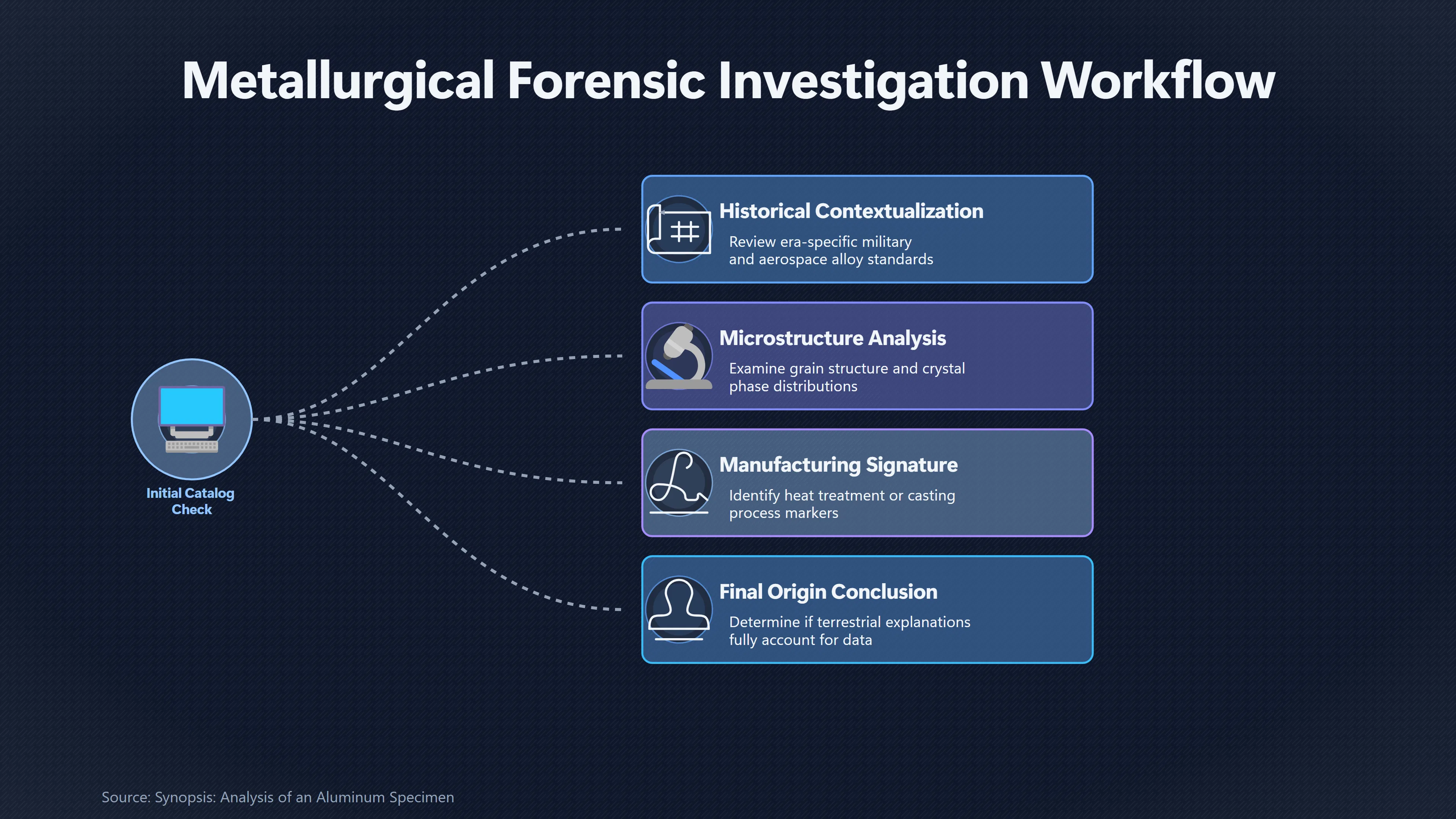
Recent work by Oak Ridge National Laboratory (ORNL) for the U.S. All-domain Anomaly Resolution Office (AARO) illustrates this point. In one investigation, researchers concluded that an aluminium specimen associated with unidentified anomalous phenomena was an ordinary near-eutectic aluminium-silicon casting alloy closely resembling established industrial grades. Although the sample did not perfectly correspond to a single catalogue specification, its chemistry, microstructure and manufacturing characteristics were entirely consistent with conventional terrestrial metallurgy. The report noted that additional manufacturing records could narrow the identification further, but were unnecessary to conclude that the material showed no anomalous behaviour.[AARO]aaro.milSynopsis: Analysis of an Aluminum SpecimenSynopsis: Analysis of an Aluminum SpecimenJanuary 14, 2026…
Why unusual does not mean non-human
Laboratory analysis considers much more than elemental percentages.
Metallurgists also examine:
- Grain structure.
- Crystal phases.
- Heat-treatment signatures.[ornl.gov]ornl.govImage from Envato. This technology is a newlNew High Sustainable Non-Heat Treatment (NTH) Cast Aluminum-Silicon Based Alloy | ORNLFebruary 2, 2026 — NEW HIGH SUSTAINABLE NON-HEAT TR…
- Segregation of alloying elements.
- Manufacturing defects.
- Casting porosity.
- Rolling or forging textures.
- Surface oxidation.
- Residual machining marks.
Together these characteristics often reveal how an object was manufactured rather than simply what it contains.
An alloy may contain an uncommon combination of elements while still displaying unmistakable evidence of terrestrial casting, machining or heat treatment. Conversely, an ordinary chemical composition manufactured using an unfamiliar process may initially appear unusual until its production history is understood.
In the ORNL aluminium investigation, multiple independent analytical methods found conventional casting microstructures, expected impurity distributions and no evidence of unusual radiation or non-standard material behaviour despite the sample’s alleged association with a UAP.[AARO]aaro.milSynopsis: Analysis of an Aluminum SpecimenSynopsis: Analysis of an Aluminum SpecimenJanuary 14, 2026…

Industrial by-products can resemble exotic materials
Another reason apparent “no-match” alloys arise is that many recovered metal fragments were never intended to be finished engineering products.
Examples include:
- Foundry overflow and risers.
- Smelting residues.
- Furnace contamination.
- Scrap produced during machining.
- Failed castings.
- Experimental melts discarded during development.
- Recycled metal containing mixed feedstocks.
These materials often possess irregular chemistry because they combine multiple alloy sources or represent intermediate production stages. They may therefore resist straightforward identification against commercial standards despite having entirely terrestrial origins.
Modern recycling further complicates interpretation. Contemporary metal streams frequently incorporate recycled material from numerous previous products, producing trace-element patterns that differ from those of freshly refined alloys while remaining fully compatible with industrial manufacturing.
Modern processing can create unfamiliar microstructures
Manufacturing technology itself can generate structures that appear novel without requiring unknown physics.
Processes such as:
- rapid solidification,
- additive manufacturing,[ornl.gov]ornl.govSource details in endnotes.
- friction stir processing,
- powder metallurgy,
- laser melting, and
- advanced heat treatment[ornl.gov]ornl.govImage from Envato. This technology is a newlNew High Sustainable Non-Heat Treatment (NTH) Cast Aluminum-Silicon Based Alloy | ORNLFebruary 2, 2026 — NEW HIGH SUSTAINABLE NON-HEAT TR…
can produce microstructures unlike those found in conventionally cast or wrought alloys.
Research continues to discover previously unreported crystal arrangements and phase combinations in materials manufactured using new techniques. Such findings demonstrate that unfamiliar microscopic structures do not automatically indicate unknown technology; they may simply reflect manufacturing methods that were unavailable—or poorly understood—when older reference databases were compiled.[arXiv]arxiv.orgOn the characterisation of a hitherto unreported icosahedral quasicrystal phase in additively manufactured aluminium alloy AA7075Aug…
When an unmatched composition remains terrestrial
The most cautious interpretation is often the strongest one.
An alloy can remain unmatched in the sense that investigators cannot identify its precise commercial grade while still being confidently classified as terrestrial. That conclusion may rest on several independent observations:
- Stable isotope ratios consistent with Earth’s geological materials.
- Conventional metallurgical phases.
- Familiar manufacturing textures.
- Expected impurity distributions.
- Ordinary mechanical behaviour.
- Known corrosion products.
- Processing signatures explainable by casting, machining or heat treatment.
The remaining uncertainty concerns which terrestrial process produced the specimen, not whether it was produced on Earth.
The ORNL investigations into alleged UFO-related specimens illustrate this distinction. One magnesium-based sample employed an uncommon elemental combination by today’s standards, yet isotopic measurements, crystallography and manufacturing evidence indicated terrestrial production, probably reflecting historical aerospace metallurgy rather than exotic technology. The laboratory therefore distinguished between an unusual alloy and an extraterrestrial one—two very different conclusions.[Popular Mechanics]popularmechanics.comInitially thought to exhibit extraordinary properties suggestive of a technosignature—an indicator of intelligent extraterrestrial design…
What would genuinely exceed terrestrial explanations?
An unmatched alloy would become scientifically remarkable only after conventional possibilities had been systematically excluded.
That would require evidence such as:
- composition inconsistent with known terrestrial chemistry,
- isotope ratios incompatible with Earth and known meteorites,
- manufacturing features beyond established physical processes,
- independently replicated analyses from multiple laboratories, and
- a secure chain of custody connecting the specimen to its claimed recovery.
Simply lacking a modern catalogue equivalent does not satisfy these criteria. Human metallurgy encompasses more than a century of evolving industrial practice, proprietary development and experimental research, leaving many pathways by which an apparently unique alloy can still have an entirely terrestrial origin.
Amazon book picks
Further Reading
Books and field guides related to Does an Unmatched Alloy Mean It Came From Space?. Use these as the next step if you want deeper reading beyond the article.
Callister's Materials Science and Engineering, Global Edition
Callister's Materials Science and Engineering: An Introduction, 10th Edition promotes student understanding of the three primary types of...
ASM Handbook, Volume 2: Properties and Selection: Nonferrous...
This index eliminates that need to search through multiple back-of-the-book indexes to find where a subject is addressed. The A-to-Z list...
Physical Metallurgy Principles
This comprehensive, student friendly text is intended for use in an introductory course in physical metallurgy and is designed for all en...
eBay marketplace picks
Marketplace Samples
Live-tested eBay searches with available results related to this page.
Selected fromUFO collectible oneBay.co.uk.




Endnotes
1.
Source: aaro.mil
Title: Synopsis: Analysis of an Aluminum Specimen
Link:https://www.aaro.mil/Portals/136/PDFs/Information%20Papers/ORNL_ANALYSIS_OF_AN_ALUMINUM_SPECIMEN.pdf
Source snippet
Synopsis: Analysis of an Aluminum SpecimenJanuary 14, 2026...
Published: January 14, 2026
2.
Source: arxiv.org
Link:https://arxiv.org/abs/1808.05033
Source snippet
On the characterisation of a hitherto unreported icosahedral quasicrystal phase in additively manufactured aluminium alloy AA7075Aug...
3.
Source: ornl.gov
Title: Oak Ridge National Laboratory Novel Alloys | ORNL
Link:https://www.ornl.gov/content/novel-alloys
4.
Source: ornl.gov
Title: Image from Envato. This technology is a newl
Link:https://www.ornl.gov/technology/202506131
Source snippet
New High Sustainable Non-Heat Treatment (NTH) Cast Aluminum-Silicon Based Alloy | ORNLFebruary 2, 2026 — NEW HIGH SUSTAINABLE NON-HEAT TR...
Published: February 2, 2026
5.
Source: neutrons.ornl.gov
Link:https://neutrons.ornl.gov/highlights/improving-al-ce-intermetallic-strengthened-alloys-through-studies-interface-behavior
6.
Source: ornl.gov
Title: Materials for nuclear environments
Link:https://www.ornl.gov/blog/materials-nuclear-environments
7.
Source: neutrons.ornl.gov
Title: neutrons peer running engine
Link:https://neutrons.ornl.gov/content/neutrons-peer-running-engine
8.
Source: ornl.gov
Link:https://www.ornl.gov/technology/202405831
9.
Source: ornl.gov
Link:https://www.ornl.gov/publication/impurity-control-and-corrosion-resistance-magnesium-aluminum-alloy
10.
Source: ornl.gov
Link:https://www.ornl.gov/technology/201904456
11.
Source: ornl.gov
Link:https://www.ornl.gov/section/materials-in-extremes
12.
Source: impact.ornl.gov
Title: step report on advanced ods fecral alloys for fission application 3
Link:https://impact.ornl.gov/en/publications/step-report-on-advanced-ods-fecral-alloys-for-fission-application-3/
13.
Source: impact.ornl.gov
Title: downselection and basic properties of additively manufactured ods 3
Link:https://impact.ornl.gov/en/publications/downselection-and-basic-properties-of-additively-manufactured-ods-3/
14.
Source: impact.ornl.gov
Title: report on use of inoculants in missile application alloys
Link:https://impact.ornl.gov/en/publications/report-on-use-of-inoculants-in-missile-application-alloys/
15.
Source: popularmechanics.com
Link:https://www.popularmechanics.com/science/a69821680/ufo-alien-tech/
Source snippet
Initially thought to exhibit extraordinary properties suggestive of a technosignature—an indicator of intelligent extraterrestrial design...
Additional References
16.
Source: hjkc.de
Title: Raumfahrt+Astronomie-Blog von CENAP
Link:https://www.hjkc.de/_blog/27064-ufo-forschung-the-pentagon-s-ufo-report-update-152-aaro-synopsis-analysis-of-an-aluminum-specimen/
Source snippet
März 2026 - 19:00 UFO-Forschung - The Pentagon’s UFO Report -Update-152 - AARO: SYNOPSIS: Analysis of an Aluminum Specimen 27.03.2026 Ima...
17.
Source: pubs.acs.org
Link:https://pubs.acs.org/doi/full/10.1021/acsmaterialsau.5c00139
Source snippet
Under aluminum’s shield, humanity conquered space. The chemical element aluminum and its alloys gave mankind the lightness and the streng...
18.
Source: youtube.com
Title: UFO explosion fragments from [Ubatuba]({{ ‘ubatuba/’ | relative_url }}), Brazil | Garry Nolan and Lex Fridman
Link:https://www.youtube.com/watch?v=EBsUIj_UBBE
Source snippet
New UAP Materials Tests: What the Results Reveal | Dr. Garry Nolan...
19.
Source: youtube.com
Link:https://www.youtube.com/watch?v=J6xtxZwrGLY
Source snippet
UFO explosion fragments from Ubatuba, Brazil | Garry Nolan and Lex Fridman...
20.
Source: youtube.com
Title: Metamaterials, To The Stars, and the Army
Link:https://www.youtube.com/watch?v=l4NO_mIPwps
Source snippet
Metal materials science testing UFO alloy analysis The Insane Properties of Superalloys The Efficient Engineer...
21.
Source: pmc.ncbi.nlm.nih.gov
Link:https://pmc.ncbi.nlm.nih.gov/articles/PMC11721274/
Source snippet
MATERIALS AND METHODS Two alloys cast by gravity into a sand mold of approximately 50 mm thick belonging to the AZ alloy group were used...
22.
Source: nature.com
Link:https://www.nature.com/articles/s41467-021-27829-w
23.
Source: youtube.com
Title: New UAP Materials Tests: What the Results Reveal | Dr. Garry Nolan
Link:https://www.youtube.com/watch?v=Mifx4nzPY68
Source snippet
Metamaterials, To The Stars, and the Army...
24.
Source: youtube.com
Title: Garry Nolan, Ph.D. on The Material Science of UAP
Link:https://www.youtube.com/watch?v=7UW1jyN2o8A
Source snippet
Metal Piece From 1947 [Roswell]({{ 'roswell/' | relative_url }}) Incident Analyzed By a Government Lab...
25.
Source: slideshare.net
Link:https://www.slideshare.net/slideshow/all-domain-anomaly-resolution-office-supplement-to-oak-ridge-national-laboratory-s-analysis-of-a-metallic-specimen/270239442