Within Witnesses
Can a Stationary Light Look Like a UFO?
Eye movements, moving vehicles and shifting backgrounds can make a fixed or slow light seem to dart, accelerate or change direction.
On this page
- How autokinesis creates motion in isolated lights
- How parallax changes apparent speed and direction
- Simple checks that can expose false movement
Page outline Jump by section
Introduction
A stationary or slowly moving light can genuinely appear to dart, accelerate or change direction, particularly when viewed at night against a featureless sky. This does not require deception or poor eyesight. It arises from well-documented characteristics of human visual perception, especially when there are few reliable reference points and the observer is moving or repeatedly shifting their gaze. These effects are important when assessing reports connected with alleged UFO crashes because an apparent manoeuvre or sudden descent may reflect how the light was perceived rather than how it actually moved.
Research in aviation, human factors and visual perception has identified two especially relevant mechanisms: autokinesis, in which a fixed light appears to drift after prolonged fixation, and motion parallax, in which the observer’s own movement makes a distant light appear to accelerate, stop or change direction. Both are recognised hazards in pilot training and provide evidence-based explanations for some reports of apparently extraordinary aerial motion.[faasafety.gov]faasafety.govYour Senses In The ShadowsYour Senses in the Shadows. Nighttime Visual Illusions and Spatial… | by FAA Safety Briefing Magazine | Jan, 2025 | MediumJanuar…
How autokinesis creates motion in isolated lights
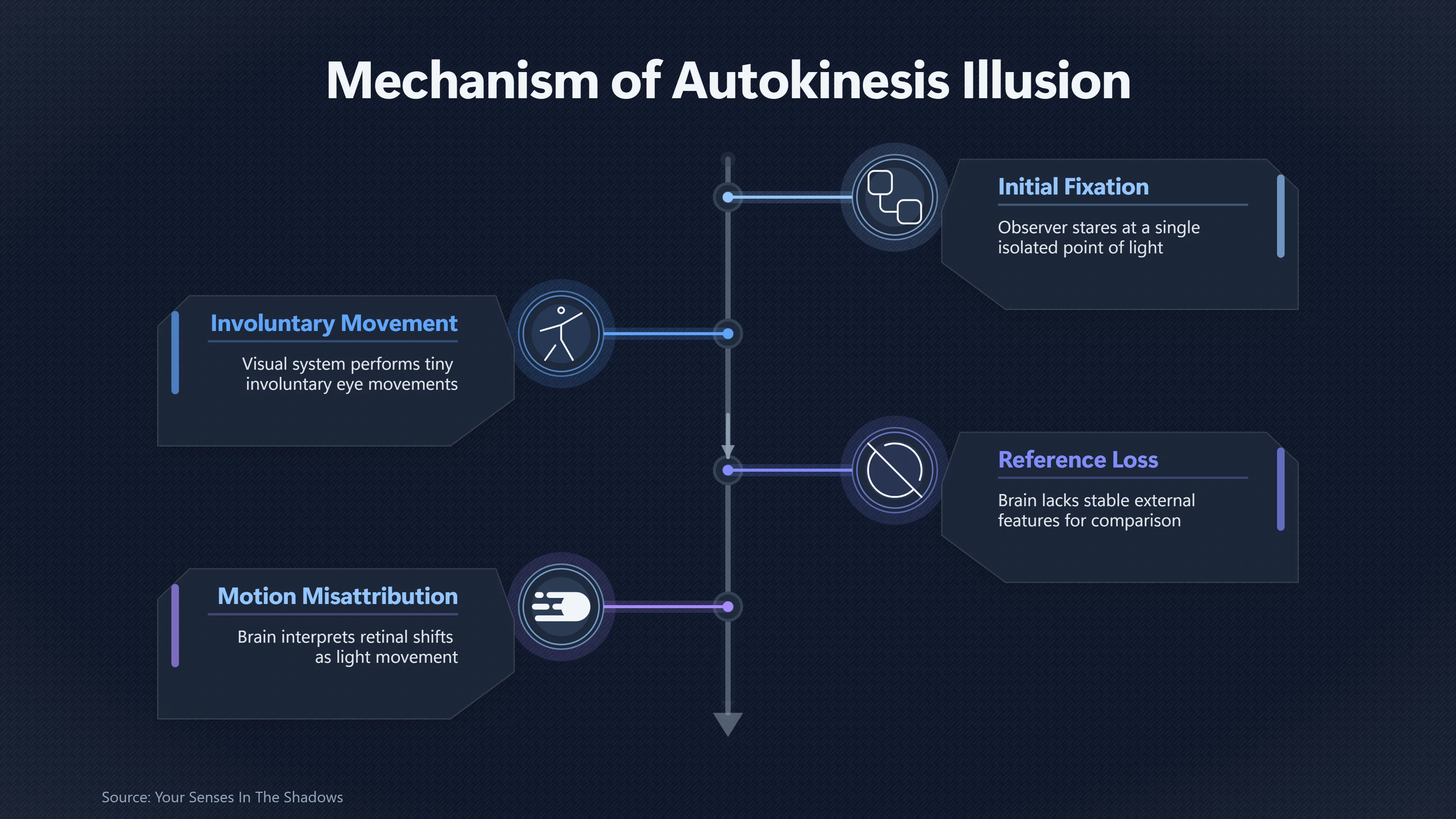
Autokinesis is a visual illusion in which a stationary point of light appears to move when viewed continuously against a dark, featureless background. It has been recognised for decades in aviation medicine because pilots who mistake the apparent motion for real movement may inadvertently manoeuvre their aircraft.
The illusion develops because the visual system constantly makes tiny involuntary eye movements. Under normal conditions, the brain compares these movements with stable features in the surrounding scene, allowing it to distinguish eye motion from object motion. When only a single isolated light is visible, there may be no reliable external reference. The brain can then misattribute the tiny retinal shifts to movement of the light itself, producing the convincing impression that it is drifting, zigzagging or approaching.
FAA guidance notes that apparent movement commonly begins after roughly 8 to 10 seconds of staring at a fixed light. The recommended countermeasure is not to fixate on one object but to keep scanning different parts of the scene so that additional visual references remain available.[Federal Aviation Administration]faa.govFederal Aviation AdministrationFAA-H-8083-4Helicopter Instructor'sMarch 26, 2026…
The effect is strongest when several conditions occur together:
- the light is isolated against a dark sky;
- there are few visible stars, buildings or landscape features;
- the observer fixates on the light rather than scanning naturally;
- fatigue, stress or expectation encourage the observer to interpret ambiguous motion.
Importantly, autokinesis produces apparent motion. It does not imply that the light itself is performing unusual manoeuvres.
How parallax changes apparent speed and direction
Parallax is a completely different mechanism. Instead of arising from eye movements, it results from the observer’s own motion.
Whenever a person walks, drives or flies, nearby objects appear to shift across the visual field faster than distant ones. With a single bright light in the sky, however, estimating distance is extremely difficult. Without knowing whether the light is hundreds of metres away or tens of kilometres distant, the brain can easily misjudge its true motion.
A driver travelling along a road may therefore experience several misleading impressions:
- a distant aircraft aligned with the road appears to hover motionless;
- the same aircraft suddenly seems to accelerate sideways when the road bends;
- a stationary celestial object appears to slide relative to nearby trees or buildings;
- a slow-moving aircraft appears to reverse direction as viewing geometry changes.
These are consequences of changing viewing angle rather than abrupt changes in the object’s flight path.
Modern UAP analysis has demonstrated the same principle using instrumented data. In its resolution of the US Navy “GoFast” video, the All-domain Anomaly Resolution Office (AARO) concluded that much of the apparent extreme speed resulted from motion parallax created by the rapidly moving observing aircraft, combined with viewing geometry and camera characteristics rather than extraordinary object performance. Although that case involved an electro-optical sensor rather than a human witness, the geometric principle is identical.[Federal Aviation Administration]faa.govFederal Aviation Administration Chapter 8. Medical Facts for PilotsFederal Aviation Administration Chapter 8. Medical Facts for Pilots
Why isolated lights are especially misleading
A lone point of light provides remarkably little information about its true behaviour.
During daylight, the brain estimates motion using many simultaneous cues, including terrain, shadows, buildings, cloud structure and binocular depth. At night, most of these cues disappear. The observer is left attempting to infer speed, distance and direction from a single luminous point whose physical size is unknown.
This creates several ambiguities:
- a small nearby drone and a distant aircraft light may appear almost identical;
- a bright planet near the horizon may seem close enough to be airborne;
- atmospheric haze can reduce depth cues further;
- brief interruptions by trees, hills or buildings may create the impression of sudden jumps or changes in course.
Expectation also matters. Someone already wondering whether they are observing something unusual may naturally pay closer attention to ambiguous movements that would otherwise go unnoticed. This reflects normal perceptual interpretation rather than deliberate exaggeration.
Simple checks that can expose false movement
Investigators assessing reports of apparently manoeuvring lights can often distinguish genuine object motion from perceptual illusion by looking for independent reference points.
Useful checks include:
- Compare the light with fixed objects. Does it actually change position relative to stars, buildings or utility poles, or does only the observer perceive movement?
- Stop moving. If the observer is driving, stopping the vehicle can reveal whether the apparent motion disappears with the observer’s own movement.
- Avoid prolonged fixation. Looking away briefly and then returning to the light can reduce autokinetic effects.
- Seek independent observers. People viewing from different locations may report different apparent directions if parallax is responsible.
- Use recorded imagery where possible. Calibrated cameras, radar or multiple synchronised observations provide more reliable evidence than a single unaided visual estimate.
None of these methods proves that every unusual light has a conventional explanation. They simply test whether the reported motion survives when known perceptual distortions are removed.

What this means for UFO crash witness reliability
Reports of lights that appear to dart, hover or descend remain valuable pieces of evidence, but they require careful interpretation. An observer may honestly describe dramatic movement that reflects the interaction between human perception, viewing geometry and environmental conditions rather than extraordinary aircraft performance.
For alleged UFO crashes, this distinction is important because many narratives begin with a witness believing a light rapidly changed direction or plunged behind distant terrain. Before treating such observations as evidence of an actual crash trajectory, investigators should first consider whether autokinesis, parallax or the absence of stable visual references could have created the impression of motion. Established research in aviation human factors shows that these mechanisms are common, predictable and capable of producing surprisingly convincing experiences under exactly the kinds of night-time conditions often reported in UFO cases.[faasafety.gov]faasafety.govYour Senses In The ShadowsYour Senses in the Shadows. Nighttime Visual Illusions and Spatial… | by FAA Safety Briefing Magazine | Jan, 2025 | MediumJanuar…
Amazon book picks
Further Reading
Books and field guides related to Can a Stationary Light Look Like a UFO?. Use these as the next step if you want deeper reading beyond the article.
Sensation and Perception
. Bruce Goldstein's SENSATION AND PERCEPTION, the best-seller which has helped over 150,000 students understand the ties between how we s...
The Seven Sins of Memory
Rating: 3.5/5 from 5 Google Books ratings
A New York Times Notable Book: A psychologist's "gripping and thought-provoking" look at how and why our brains sometimes fail us (Steven...
The Invisible Gorilla: How Our Intuitions Deceive Us
NEW YORK TIMES BESTSELLER • Our minds don’t work the way we think they do. Two renowned psychologists explain how and why our intuitions...
Visual Intelligence: How We Create What We See
A unique, illustrated popular study reveals the way the human eye acts on the visual world not just to represent but to create the things...
eBay marketplace picks
Marketplace Samples
Live-tested eBay searches with available results related to this page.
Selected fromUFO light poster oneBay.co.uk.
Endnotes
1.
Source: faasafety.gov
Title: Your Senses In The Shadows
Link:https://www.faasafety.gov/files/events/SO/SO15/2024/SO15134204/YourSensesInTheShadows.pdf
Source snippet
Your Senses in the Shadows. Nighttime Visual Illusions and Spatial… | by FAA Safety Briefing Magazine | Jan, 2025 | MediumJanuar...
2.
Source: faa.gov
Title: Federal Aviation Administration PHAK Chapter 17
Link:https://www.faa.gov/sites/faa.gov/files/regulations_policies/handbooks_manuals/aviation/phak/19_phak_ch17.pdf
3.
Source: faa.gov
Title: Federal Aviation Administration Chapter 8. Medical Facts for Pilots
Link:https://www.faa.gov/air_traffic/publications/atpubs/aim/aim0801.html
4.
Source: faa.gov
Link:https://www.faa.gov/sites/faa.gov/files/regulations_policies/handbooks_manuals/aviation/FAA-H-8083-4.pdf
Source snippet
Federal Aviation AdministrationFAA-H-8083-4Helicopter Instructor'sMarch 26, 2026...
Published: March 26, 2026
5.
Source: faa.gov
Title: Office of Aerospace Medicine Technical Reports | Federal Aviation Administration
Link:https://www.faa.gov/data_research/research/med_humanfacs/oamtechreports/1970s/1978/197815
Source snippet
March 1, 1978 — OFFICE OF AEROSPACE MEDICINE TECHNICAL REPORTS FAA Office of Aerospace Medicine Civil Aerospace Medical Institute Report...
Published: March 1, 1978
6.
Source: faa.gov
Link:https://www.faa.gov/Air_traffic/publications/atpubs/aim_html/chap8_section_1.html
7.
Source: faa.gov
Link:https://www.faa.gov/data_research/research/med_humanfacs/oamtechreports/1970s/1977/197712
8.
Source: faa.gov
Link:https://www.faa.gov/air_traffic/publications/atpubs/aip_html/chap7_section_6.html
Additional References
9.
Source: amc.af.mil
Link:https://www.amc.af.mil/News/Article-Display/Article/2209213/black-box-sheds-light-on-night-vision-challenges-for-aircrew-students/
Source snippet
box sheds light on night vision challenges for aircrew students > Air Mobility Command > Article DisplayJune 7, 2020 — * Image: A collabo...
Published: June 7, 2020
10.
Source: tc.canada.ca
Link:https://tc.canada.ca/en/aviation/publications/handbook-civil-aviation-medical-examiners-tp-13312
Source snippet
for Civil Aviation Medical Examiners - TP 13312May 6, 2019 — VISUAL ILLUSIONS These may be foveal or vectional, that is concerned with ce...
Published: May 6, 2019
11.
Source: medium.com
Title: Your Senses in the Shadows
Link:https://medium.com/faa/your-senses-in-the-shadows-5ed018e015b5
Source snippet
Nighttime Visual Illusions and Spatial… | by FAA Safety Briefing Magazine | Cleared for Takeoff | MediumJanuary 17, 2025 — Cleared for Ta...
Published: January 17, 2025
12.
Source: youtube.com
Title: Chapter 17 Aeromedical Factors | PHAK | AGPIAL Audio/Video Book
Link:https://www.youtube.com/watch?v=n1UYc615ZTQ
Source snippet
Conformity Research: Sherif's Autokinetic Effect Experiment...
13.
Source: youtube.com
Title: The SHOCKING Math Error Behind Viral UFO Videos | Mick West
Link:https://www.youtube.com/watch?v=ypfbhfEXnBo
Source snippet
Chapter 17 Aeromedical Factors | PHAK | AGPIAL Audio/Video Book...
14.
Source: ufouap.net
Link:https://www.ufouap.net/en/explainers/autokinesis-stationary-light-illusion
Source snippet
Autokinesis: Why a Stationary Light Seems to Move | Global UFO ArchiveJuly 11, 2026 — Evidence / Updated 2026-07-11 / 7 min read AUTOKINE...
Published: July 11, 2026
15.
Source: youtube.com
Title: Conformity Research: Sherif’s Autokinetic Effect Experiment
Link:https://www.youtube.com/watch?v=1-pbW6kc7q0
Source snippet
VFX Artists DEBUNK FLYING ORB UFO Videos...
16.
Source: faraim.org
Link:https://www.faraim.org/faa/aim/chapter-8/section-8-1-5.html
17.
Source: youtube.com
Title: The Truth Behind Famous UFO Sightings
Link:https://www.youtube.com/watch?v=q0Gv9TWY774
Source snippet
The SHOCKING Math Error Behind Viral UFO Videos | Mick West...
18.
Source: studocu.com
Title: airplane flying handbook faa h 8083 3c chapter 11 night operations
Link:https://www.studocu.com/en-us/document/embry-riddle-aeronautical-university/aerospace/airplane-flying-handbook-faa-h-8083-3c-chapter-11-night-operations/119520215