Within Radar Targets
How Roswell Foil Became Indestructible Memory Metal
Decades of retelling may have transformed reinforced foil into claims of metal that resisted cutting, burning and permanent folding.
On this page
- What the 1947 record said about the material
- How laminates can feel unusually resilient
- How repeated retelling amplified extraordinary properties
Page outline Jump by section
Introduction
One of the most enduring claims about the Roswell incident is that witnesses recovered a mysterious “memory metal” that could not be bent permanently, cut, burned or otherwise damaged. Yet this description does not appear in the contemporary 1947 record. Instead, the earliest newspaper reports, military photographs and witness statements described lightweight debris consisting of foil-like material, paper, rubber, tape and sticks. The familiar image of an indestructible extraterrestrial alloy emerged gradually over decades as memories were retold, interpreted through later UFO culture and mixed with increasingly dramatic testimony. Understanding how that transformation occurred helps explain why Roswell’s physical evidence appears so different depending on whether one reads the documents created in 1947 or accounts recorded thirty to fifty years later.[lbl.gov]muller.lbl.govMuller Lab Project MogulMuller Lab Project Mogul

What the 1947 record said about the material
The earliest descriptions are striking for what they do not claim.
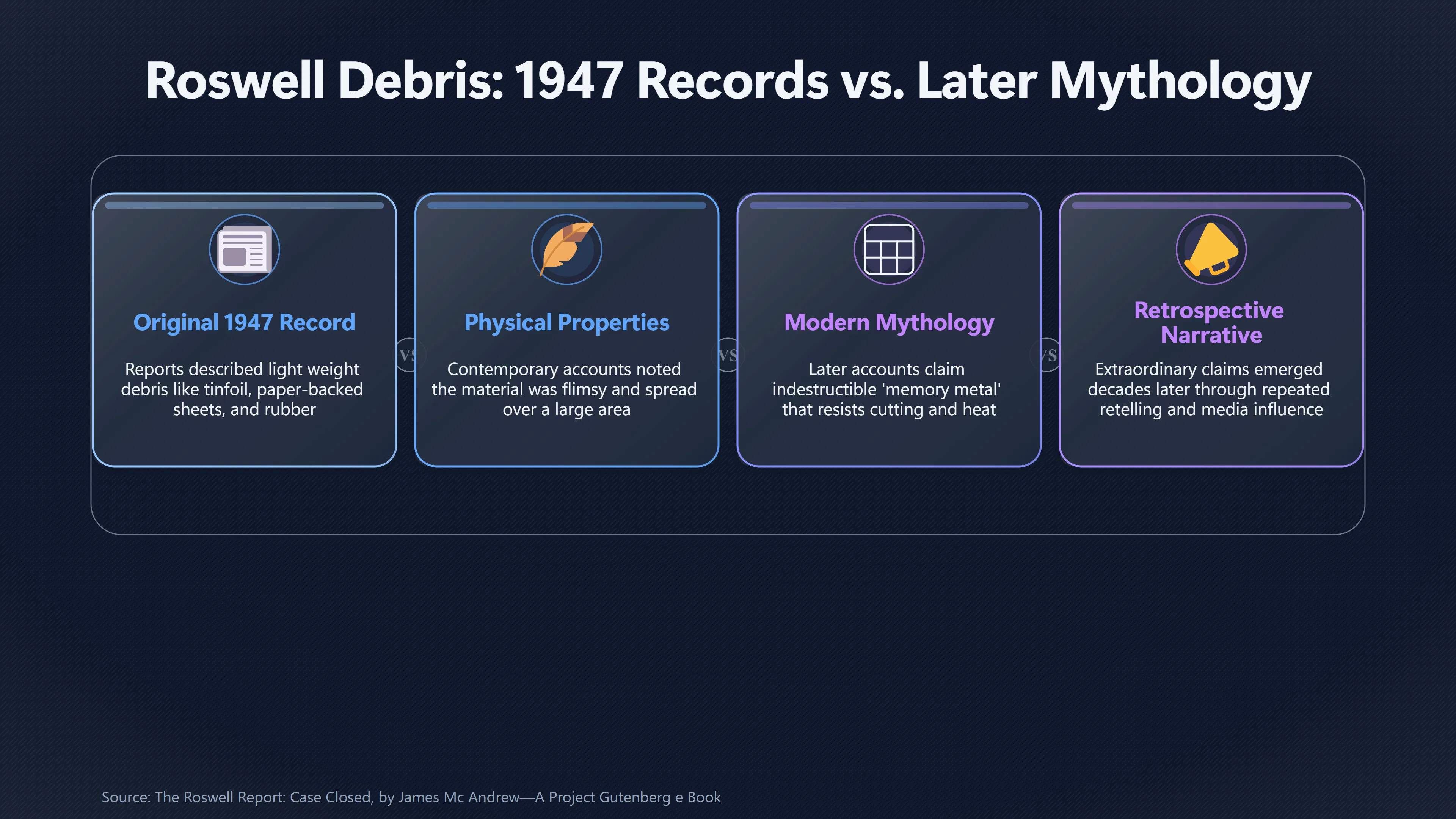
When rancher W.W. “Mac” Brazel’s discovery reached newspapers in July 1947, reports consistently referred to scattered lightweight debris. Contemporary accounts described material resembling tinfoil, paper-backed reflective sheets, rubber, tape and small wooden sticks. General Roger Ramey’s well-known press photographs also show officers handling crumpled metallic material alongside balloon components rather than solid metallic panels.[project1947.com]project1947.comProject 1947PROJECT 1947 - UFO REPORTS 1947…
Just as important, none of the surviving 1947 newspaper coverage attributes extraordinary physical properties to the debris. There are no contemporary claims that:
- foil sprang perfectly back into shape after being crushed;
- the material resisted cutting or tearing;
- it survived intense heat without damage;
- it could not be permanently bent.
Instead, the descriptions emphasise the opposite qualities: the material was light, flimsy and spread over a large area. Those characteristics fit the construction of balloon-borne radar reflectors built from paper-backed metallic laminates rather than solid sheet metal.[lbl.gov]muller.lbl.govMuller Lab Project MogulMuller Lab Project Mogul
This does not, by itself, prove exactly which balloon train produced the debris. It does establish that the famous “memory metal” narrative is absent from the documentary record created closest to the event.
How laminates can feel unusually resilient
The later mythology probably gained traction because the actual reflector materials were unusual for people unfamiliar with wartime radar equipment.
Radar targets used in projects such as MOGUL employed laminated construction rather than ordinary kitchen foil. Thin aluminium foil was bonded to strong paper and attached to lightweight balsa frames. The resulting composite behaved differently from either paper or metal alone. Depending on how it was handled, pieces could:
- resist tearing better than plain foil;
- wrinkle without immediately breaking apart;
- feel unexpectedly stiff despite weighing very little;
- spring partially flatter after being flexed because of the paper backing.
These properties are mundane consequences of laminated engineering rather than evidence of advanced alloys. Modern packaging materials, emergency blankets and reinforced laminates often produce similar surprises if someone expects ordinary household aluminium foil.
The Air Force’s later investigation highlighted exactly this construction, describing radar targets made from aluminised paper, adhesive tape and balsa wood rather than exotic metallic substances.[Project Gutenberg]gutenberg.orgOpen source on gutenberg.org.
How repeated retelling amplified extraordinary properties
The most dramatic descriptions appeared decades after Roswell, not during the event itself.
Former intelligence officer Jesse Marcel became the best-known source for later claims after interviews beginning in the late 1970s. Over time, recollections attributed increasingly remarkable characteristics to the debris, including exceptionally thin metallic sheets that supposedly resumed their original shape after crumpling and beams bearing unusual markings. These interviews helped redefine Roswell from a story about confusing debris into one centred on extraordinary materials.[HISTORY]history.comRoswell - New Mexico, Alien & UFOs | HISTORYNovember 9, 2009…
The evolution illustrates a well-known feature of eyewitness memory. Memories are reconstructed rather than replayed exactly. They can absorb later information, media narratives and repeated storytelling while remaining sincerely believed by the witness. Decades of interviews, books, television documentaries and UFO conferences created an environment in which each retelling tended to emphasise the most remarkable elements.
Researchers studying Roswell have noted that many of the incident’s now-famous features—including alien bodies, impossible metals and elaborate recovery operations—became prominent only from the late 1970s onwards, roughly thirty years after the original event.[U.S. Air Force]af.milU.S. Air Force The Roswell ReportU.S. Air Force The Roswell Report
The influence of “memory metal” technology
Another factor blurred the line between remembered debris and modern materials science.
During the 1960s, nickel-titanium shape-memory alloys such as Nitinol became widely publicised. These genuine engineering materials can be bent and then recover their original shape when heated to specific temperatures. They entered popular science writing, television programmes and eventually UFO literature.
Because Roswell witnesses were being interviewed after shape-memory alloys had become famous, many readers naturally connected the two ideas. Stories of foil that “remembered” its shape sounded remarkably similar to widely reported advances in metallurgy.
However, there is no documentary evidence that the debris described in 1947 possessed the thermally activated behaviour of shape-memory alloys. The association developed retrospectively through analogy rather than through contemporary records. Claims linking Roswell debris directly to later shape-memory alloy research remain speculative and have not been substantiated by historical documentation.[U.S. Air Force]af.milU.S. Air Force The Roswell ReportU.S. Air Force The Roswell Report
Why the later descriptions differ so sharply
Several overlapping processes help explain the widening gap between early and late accounts.
First, witnesses were recalling events after intervals measured in decades rather than days. Memory naturally changes over such periods, especially for unusual experiences.
Second, Roswell itself changed. What began as a briefly reported military incident evolved into the world’s most famous UFO story. Every new book, documentary and interview provided additional narrative material that could influence subsequent recollections.
Third, ordinary technical materials from the 1940s could genuinely seem unfamiliar. Paper-backed metallic laminates, reinforced adhesive tapes and lightweight reflector assemblies were uncommon outside specialised military and meteorological work. Something that initially seemed merely odd could later be remembered as fundamentally impossible.
Finally, interviewing practices varied considerably. Later investigators often sought detailed recollections of extraordinary features, encouraging witnesses to focus on memorable anomalies rather than on routine characteristics documented in 1947. Historians of memory caution that repeated questioning can reinforce and elaborate recollections without implying deliberate fabrication.
What the comparison suggests
The contrast between the two bodies of evidence is one of the clearest features of the Roswell record.
The contemporary documents consistently describe lightweight reflector-like debris assembled from familiar materials in unusual combinations. The celebrated claims of indestructible “memory metal” appear primarily in recollections recorded decades later, after Roswell had become a defining cultural symbol of UFO secrecy.[lbl.gov]muller.lbl.govMuller Lab Project MogulMuller Lab Project Mogul
This does not require concluding that later witnesses were dishonest. Rather, it illustrates how long-term memory, changing cultural expectations and repeated retelling can transform descriptions of reinforced foil laminates into stories of metal with seemingly impossible properties. That evolution is itself an important part of Roswell’s history, because it shows how a modest description of unusual debris gradually became one of the most recognisable legends in modern UFO folklore.
Amazon book picks
Further Reading
Books and field guides related to How Roswell Foil Became Indestructible Memory Metal. Use these as the next step if you want deeper reading beyond the article.
Roswell: Inconvenient Facts and the Will to Believe
For over fifty years an incident near Roswell, New Mexico, has sparked the imaginations of UFO enthusiasts. Did the military recover a cr...
The Roswell Report: Fact versus Fiction in the New Mexico Desert
The Roswell Report: Fact Versus Fiction in the New Mexico Desert is the first of two reports discussing the supposed crash landing of an...
The Seven Sins of Memory: How the Mind Forgets and Remembers
Examines what the author terms "common memory vices," including absent-mindedness, transcience, blocking, misattribution, suggestibility,...
Eyewitness Testimony
By shedding light on the many factors that can intervene and create inaccurate testimony, Elizabeth Loftus illustrates how memory can be...
eBay marketplace picks
Marketplace Samples
Live-tested eBay searches with available results related to this page.
Selected fromRoswell collectible oneBay.co.uk.

Endnotes
1.
Source: project1947.com
Link:https://www.project1947.com/fig/1947f.htm
Source snippet
Project 1947PROJECT 1947 - UFO REPORTS 1947...
2.
Source: gutenberg.org
Link:https://gutenberg.org/files/63659/63659-h/63659-h.htm
3.
Source: history.com
Link:https://www.history.com/articles/roswell
Source snippet
Roswell - New Mexico, Alien & UFOs | HISTORYNovember 9, 2009...
Published: November 9, 2009
4.
Source: wikidisc.org
Link:https://www.wikidisc.org/wiki/Roswell_incident
Source snippet
Roswell incident | WikiDiscJuly 2, 2026 — EVIDENCE[EDIT | EDIT SOURCE] PHYSICAL DEBRIS[EDIT | EDIT SOURCE] The physical evidence from the...
Published: July 2, 2026
5.
Source: gutenberg.org
Title: The Roswell Report: Case Closed, by James Mc Andrew—A Project Gutenberg e Book
Link:https://www.gutenberg.org/files/63659/old/63659-h/63659-h.htm
6.
Source: history.com
Title: roswell ufo aliens what happened
Link:https://www.history.com/articles/roswell-ufo-aliens-what-happened
7.
Source: muller.lbl.gov
Title: Muller Lab Project Mogul
Link:https://muller.lbl.gov/teaching/physics10/Roswell/USMogulReport.html
8.
Source: af.mil
Title: U.S. Air Force The Roswell Report
Link:https://www.af.mil/The-Roswell-Report/About-Us/AF-75th-Anniversary/About-Us/AF-75th-Anniversary/
9.
Source: muller.lbl.gov
Title: Roswell Incident
Link:https://muller.lbl.gov/teaching/physics10/Roswell/RoswellIncident.html
10.
Source: decur.org
Title: Roswell Incident
Link:https://decur.org/cases/roswell-1947
11.
Source: nhinewsnetwork.com
Title: roswell incident
Link:https://nhinewsnetwork.com/records/united-states/roswell-incident/
12.
Source: science.howstuffworks.com
Title: history roswell incident
Link:https://science.howstuffworks.com/space/aliens-ufos/history-roswell-incident.htm
13.
Source: apocrypedia.com
Title: roswell incident
Link:https://apocrypedia.com/entry/roswell-incident/
Additional References
14.
Source: wsj.com
Title: The Wall Street Journal Was It Scrap Metal or an Alien Spacecraft?
Link:https://www.wsj.com/politics/national-security/pentagon-ufo-investigation-lockheed-martin-1bac3d41
Source snippet
The Army Asked an Elite Defense Lab to InvestigateIn 2022, the Pentagon assigned Sean Kirkpatrick to investigate claims of a secret U.S...
15.
Source: youtube.com
Title: Something Strange Happened In This Desert 70 Years Ago
Link:https://www.youtube.com/watch?v=PSoYUcVZDSQ
Source snippet
This list of YouTube videos explores how the 1947 Roswell discovery evolved over time from ordinary [balloon debris]({{ 'balloon-debris/' | relative_url }}) accounts into extraord...
16.
Source: curiolink.net
Title: roswell incident 1947 cover up explained
Link:https://www.curiolink.net/2026/06/roswell-incident-1947-cover-up-explained.html
Source snippet
government went looking for an entirely different set of records. In response to a 1994 Congressional inquiry from th...
17.
Source: unsolvedreport.com
Title: roswell incident 1947
Link:https://www.unsolvedreport.com/en/roswell-incident-1947/
Source snippet
The Government's Story Changed 4 Times | Unsolved ReportMay 4, 2026 — WHERE EACH EXPLANATION ACTUALLY STANDS Reading the evidence the art...
Published: May 4, 2026
18.
Source: scribd.com
Link:https://www.scribd.com/document/152119678/ATS-Roswell
19.
Source: roswellfiles.com
Link:https://www.roswellfiles.com/witness.htm
20.
Source: en-academic.com
Link:https://en-academic.com/dic.nsf/enwiki/3889408/
21.
Source: secretsdeclassified.af.mil
Link:https://www.secretsdeclassified.af.mil/Top-Flight-Documents/[Unidentified
22.
Source: journalofscientificexploration.org
Link:https://journalofscientificexploration.org/index.php/jse/article/view/2635
23.
Source: youtube.com
Title: I Found the REAL Roswell UFO Crash Site
Link:https://www.youtube.com/watch?v=UAnLgCga3Yg
Source snippet
Something Strange Happened In This Desert 70 Years Ago...