Within Missing Records
Does No Records Mean No UFO File Existed?
A no-records response shows that an agency found nothing in its chosen search locations, not that relevant UFO files never existed.
On this page
- What agencies must search
- Why expected documents may not appear
- Evidence that can challenge an inadequate search
Page outline Jump by section
Introduction
A Freedom of Information Act (FOIA) response stating that an agency found “no records” is often misunderstood in discussions about alleged UFO crash evidence. It does not mean that the requested event never occurred or that relevant documents never existed. It means only that, after conducting the search it considered legally appropriate, the agency did not locate records responsive to the request within the systems, offices or repositories it searched. Under US FOIA law, courts judge agencies primarily on whether they conducted a reasonable search, not on whether the search produced the documents the requester expected.[archives.gov]archives.govNational Archives The Freedom of Information Act (FOIA) | National ArchivesNational ArchivesThe Freedom of Information Act (FOIA) | National ArchivesFebruary 10, 2017…
This distinction is especially important in debates over Roswell, Kecksburg and other alleged UFO crash cases. A no-records response may reflect ordinary record-keeping realities, an overly narrow request, records held elsewhere, lawful destruction under retention schedules, or—in some cases—an inadequate search. By itself, however, it is not evidence that no UFO-related file ever existed.
What agencies must search
FOIA requires federal agencies to make a reasonable effort to locate records responsive to a request. The law does not require agencies to search every conceivable location or prove that no responsive document has ever existed. Instead, the search must be reasonably calculated to uncover relevant records based on the request’s wording and the agency’s understanding of where such records would normally be maintained.[foia.gov]foia.govFOI A.govFreedom of Information Act: Freedom of Information Act Statute…
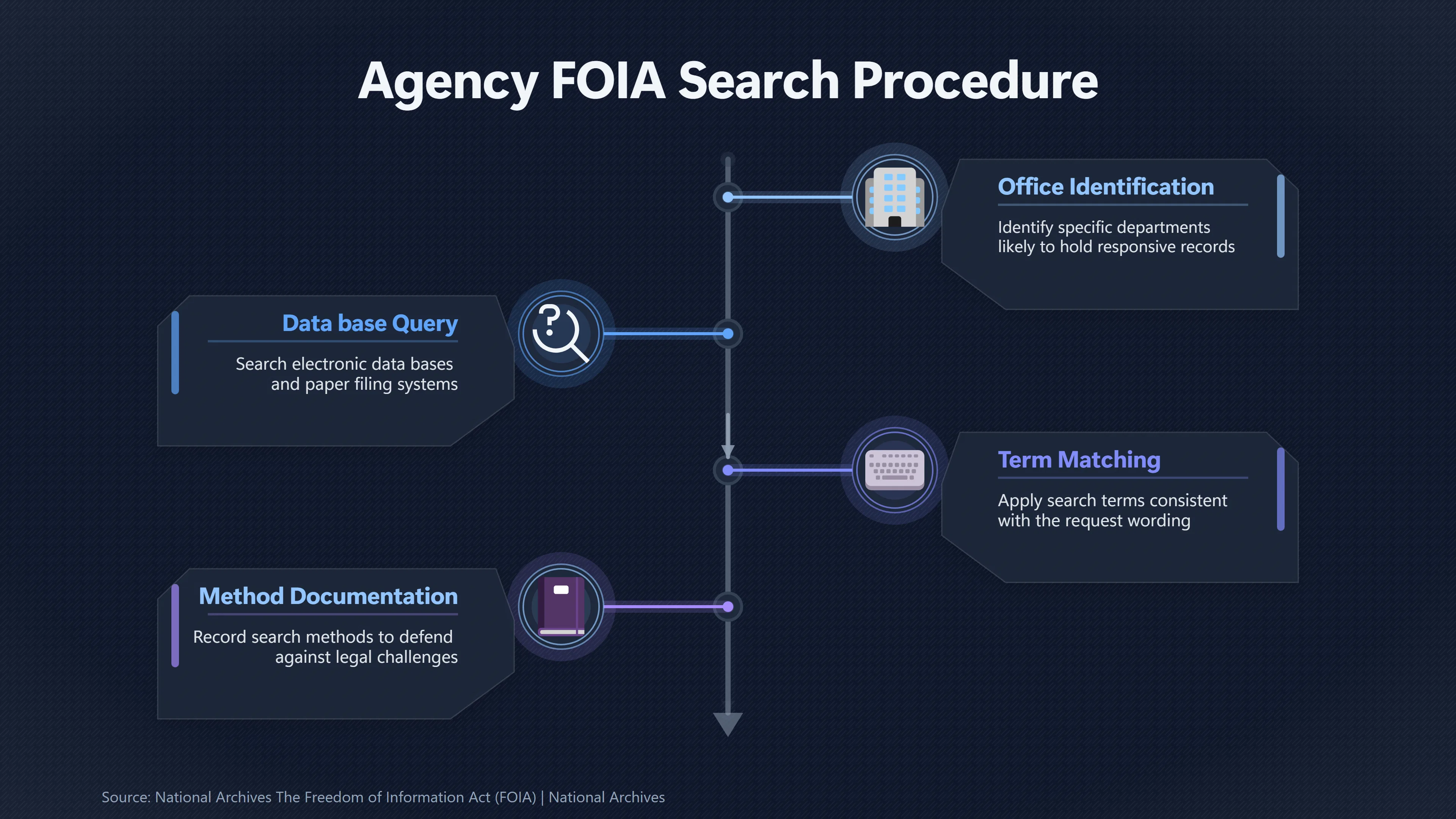
In practice, this means an agency will typically:
- Identify the offices likely to maintain responsive records.
- Search relevant electronic databases and paper filing systems where appropriate.
- Use search terms or file identifiers consistent with the request.
- Document the methods used if the adequacy of the search is later challenged.[foia.gov]foia.govFOI A.govFreedom of Information Act: Freedom of Information Act Statute…
Courts evaluating FOIA disputes generally focus on how the search was conducted rather than whether it produced a desired document. A well-documented search that finds nothing may satisfy FOIA even if the requester strongly believes records should exist.[National Archives]archives.govfoia guideNational ArchivesFreedom of Information Act (FOIA) Reference Guide (2018) | National Archives…
Why expected UFO documents may not appear
A no-records response has several possible explanations that do not require assuming either a cover-up or that the underlying incident never happened.
One possibility is that the request identified the wrong office. Military responsibilities change over time, records are transferred, and historical files may ultimately reside with the National Archives rather than the originating agency.
Another common issue is terminology. A requester searching for “UFO crash” files may receive no responsive records if contemporaneous documents used terms such as “flying disc,” “unidentified aerial object,” “weather balloon,” project names, or administrative file numbers instead. Agencies search for records responsive to the request as reasonably understood; they do not necessarily reinterpret every possible historical description.[Department of Justice]justice.govOpen source on justice.gov.
Records also may have been:
- lawfully destroyed under approved records-retention schedules;
- transferred to another agency or archival repository;
- misfiled or indexed differently from modern expectations;
- never created in the first place if officials regarded an incident as routine.[National Archives]archives.govNational Archives The Freedom of Information Act (FOIA) | National ArchivesNational ArchivesThe Freedom of Information Act (FOIA) | National ArchivesFebruary 10, 2017…
For historical UFO cases, decades of organisational changes within the US military and intelligence community further complicate searches. A negative search result therefore says more about the present location of records than about the historical event itself.
No records is different from a Glomar response
A no-records response should not be confused with a Glomar response.
With a no-records response, the agency states that it searched and did not locate responsive records.
A Glomar response—often phrased as “neither confirm nor deny”—is different. It is used when even acknowledging whether records exist would itself reveal information protected by a FOIA exemption, such as classified intelligence activities or sensitive law-enforcement matters. In those cases, the agency may refuse to confirm whether any responsive records exist at all.[National Archives]archives.govNational ArchivesNCND/Glomar: When Agencies Neither Confirm Nor Deny the Existence of Records | National ArchivesMarch 29, 2024…
This distinction matters in UFO-related discussions because some requesters mistakenly interpret every negative FOIA response as evidence of concealment. Legally, a no-records determination and a Glomar response represent two different procedural outcomes based on different standards.
When a no-records response can be challenged
Although FOIA does not guarantee that requested documents will be found, requesters can challenge a no-records response if there is evidence that the search itself was inadequate.
Examples include:
- contemporaneous documents showing that responsive files once existed;
- agency correspondence referring to specific reports that were not searched for;
- evidence that obvious offices or record systems were omitted;
- inconsistent responses from different agencies concerning custody of the same records;
- affidavits or declarations that fail to explain where and how the search was conducted.[National Archives]archives.govfoia guideNational ArchivesFreedom of Information Act (FOIA) Reference Guide (2018) | National Archives…
Administrative appeals frequently argue that an agency searched too narrowly or overlooked likely record systems. If litigation follows, courts generally require agencies to explain their search methods through sworn declarations. The central question is whether the search was reasonable under the circumstances, not whether every conceivable document was located.[National Archives]archives.govfoia guideNational ArchivesFreedom of Information Act (FOIA) Reference Guide (2018) | National Archives…
What a no-records response does—and does not—prove in UFO crash cases
Within the context of alleged UFO crash investigations, a no-records response establishes only a limited factual point: the agency did not locate responsive records in the places it searched.
It does not prove that:
- no UFO-related file ever existed;
- no crash investigation occurred;
- records were deliberately destroyed;[foia.gov]foia.govFOI A.govFOI A.gov
- an extraterrestrial recovery programme existed and was concealed.
Likewise, it does not disprove those possibilities. The response is procedurally neutral unless accompanied by additional evidence about record creation, retention, transfer or destruction.
A stronger challenge arises when independent evidence demonstrates that specific records once existed—for example, catalogue entries, cross-references in surviving files, inventories or contemporaneous memoranda—and those records cannot now be located despite reasonable searches. Even then, the missing records demonstrate an archival gap rather than the contents of the lost documents.
For this reason, researchers studying alleged UFO crashes generally treat FOIA no-records responses as evidence about the quality and scope of an agency’s search, not as evidence about whether the underlying historical claim is true.
Amazon book picks
Further Reading
Books and field guides related to Does No Records Mean No UFO File Existed?. Use these as the next step if you want deeper reading beyond the article.
The UFO Files: The Inside Story of Real-Life Sightings
'What does all this stuff about flying saucers amount to? What can it mean? What is the truth?' Winston Churchill, prime minister's perso...
UFOs and Government: A Historical Inquiry
Governments around the world have had to deal with the UFO phenomenon for a good part of a century. How and why they did so is the subjec...
The Federal Information Manual: How the Government Collects,...
This reference focuses on the vast amount of federal information and the legal framework that controls the government's collection, manag...
The Art of Access: Strategies for Acquiring Public Records
NEW TO THIS EDITION: 40 additional experts and practitioners offer tips and record ideas for opening new doorways into FOI and open data....
eBay marketplace picks
Marketplace Samples
Live-tested eBay searches with available results related to this page.
Selected fromUFO poster oneBay.co.uk.

Current eBay listing
I Want To Believe UFO Poster Giclée Fine Art Heavyweight Print

Current eBay listing
VINTAGE UFO FLYING SAUCERS COMIC ADVERTISING A2 POSTER PRINT


Endnotes
1.
Source: archives.gov
Title: National Archives The Freedom of Information Act (FOIA) | National Archives
Link:https://www.archives.gov/about/laws/foia.html
Source snippet
National ArchivesThe Freedom of Information Act (FOIA) | National ArchivesFebruary 10, 2017...
Published: February 10, 2017
2.
Source: foia.gov
Title: FOI A.gov
Link:https://www.foia.gov/foia-statute.html
Source snippet
Freedom of Information Act: Freedom of Information Act Statute...
3.
Source: archives.gov
Title: foia guide
Link:https://www.archives.gov/foia/foia-guide
Source snippet
National ArchivesFreedom of Information Act (FOIA) Reference Guide (2018) | National Archives...
4.
Source: archives.gov
Title: National Archives Frequently Asked Questions about FOIA | National Archives
Link:https://www.archives.gov/research/foia/faqs
5.
Source: justice.gov
Link:https://www.justice.gov/oip/oip-guidance/defining_a_record_under_the_foia
6.
Source: archives.gov
Link:https://www.archives.gov/ogis/resources/foia-ombuds-observer/2024-01
Source snippet
National ArchivesNCND/Glomar: When Agencies Neither Confirm Nor Deny the Existence of Records | National ArchivesMarch 29, 2024...
Published: March 29, 2024
7.
Source: archives.gov
Link:https://www.archives.gov/ogis/resources/foia-ombuds-observer/2026-02
Source snippet
Unduly/Overly Burdensome versus Not Reasonably Described Two common phrases used in the FOIA...
8.
Source: justice.gov
Link:https://www.justice.gov/oip/oip-guidance-applying-presumption-openness-and-foreseeable-harm-standard
Source snippet
Office of Information Policy | OIP Guidance: Applying a Presumption of Openness and the Foreseeable Harm StandardSeptember 4, 2024 — When...
Published: September 4, 2024
9.
Source: archives.gov
Title: Freedom of Information Act (FOIA) | National Archives
Link:https://www.archives.gov/foia
Source snippet
December 20, 2022 — Freedom of Information Act (FOIA) Image: National Archives Logo FREEDOM OF INFORMATION ACT (FOIA) The Freedom of Info...
Published: December 20, 2022
10.
Source: justice.gov
Link:https://www.justice.gov/oip/oip-guidance/oip-guidance-adjudicating-administrative-appeals-under-foia
11.
Source: archives.gov
Title: Do Records Show Proof of UFOs? | National Archives
Link:https://www.archives.gov/news/articles/do-records-show-proof-of-ufos
12.
Source: justice.gov
Link:https://www.justice.gov/oip/blog/oip-issues-new-guidance-definition-record-and-processing-records-responsive-request
13.
Source: foia.gov
Title: FOI A.gov
Link:https://www.foia.gov/iso/opa/foia/oip-110228.html
14.
Source: foia.gov
Title: FOI A.gov
Link:https://www.foia.gov/iso/opa/foia/oip-101118.html
15.
Source: foia.gov
Title: FOI A.gov
Link:https://www.foia.gov/iso/opa/foia/oip-100813.html
16.
Source: foia.gov
Title: FOI A.gov
Link:https://www.foia.gov/how-to.html
17.
Source: foia.gov
Title: FOI A.gov
Link:https://www.foia.gov/faq.html
18.
Source: justice.gov
Link:https://www.justice.gov/archive/oip/courtdecisions/adequacy-search.html
19.
Source: justice.gov
Link:https://www.justice.gov/oip/oip-guidance
Additional References
20.
Source: youtube.com
Link:https://www.youtube.com/watch?v=tCr9ft4yWaI
Source snippet
This video highlights how researcher John Greenewald utilizes Freedom of Information Act (FOIA) requests to obtain declassified governmen...
21.
Source: nsa.gov
Link:https://www.nsa.gov/Helpful-Links/NSA-FOIA/Frequently-Requested-Information/
22.
Source: nsa.gov
Link:https://www.nsa.gov/Helpful-Links/NSA-FOIA/Frequently-Requested-Information/Unidentified-Flying-Objects-UFOs/
23.
Source: doioig.gov
Link:https://www.doioig.gov/complaints-requests/foia/processing-foia-request
24.
Source: youtube.com
Title: Hiding Something Big? FOIA and Government UAP Secrets
Link:https://www.youtube.com/watch?v=IV3yH3U51Bg
Source snippet
UFO Researcher Wants Congress to 'Turn Up the Heat' on Agencies...
25.
Source: youtube.com
Title: UFO Researcher Wants Congress to ‘Turn Up the Heat’ on Agencies
Link:https://www.youtube.com/watch?v=_ky79P8vims
Source snippet
USA: UFO Anti-Secrecy Group Demonstration...
26.
Source: youtube.com
Title: The Truth is out There – Just Ask! w John Greenewald
Link:https://www.youtube.com/watch?v=uu1H8SLsrpY
Source snippet
Hiding Something Big? FOIA and Government UAP Secrets...
27.
Source: youtube.com
Title: USA: UFO Anti-Secrecy Group Demonstration
Link:https://www.youtube.com/watch?v=iuaLed7Jnu4
Source snippet
Official Reports on the Roswell UFO Incident | USAF Documentary | 1997...
28.
Source: law.cornell.edu
Link:https://www.law.cornell.edu/cfr/text/36/1250.30