Within Witnesses
Was It a Triangle or Just Three Lights?
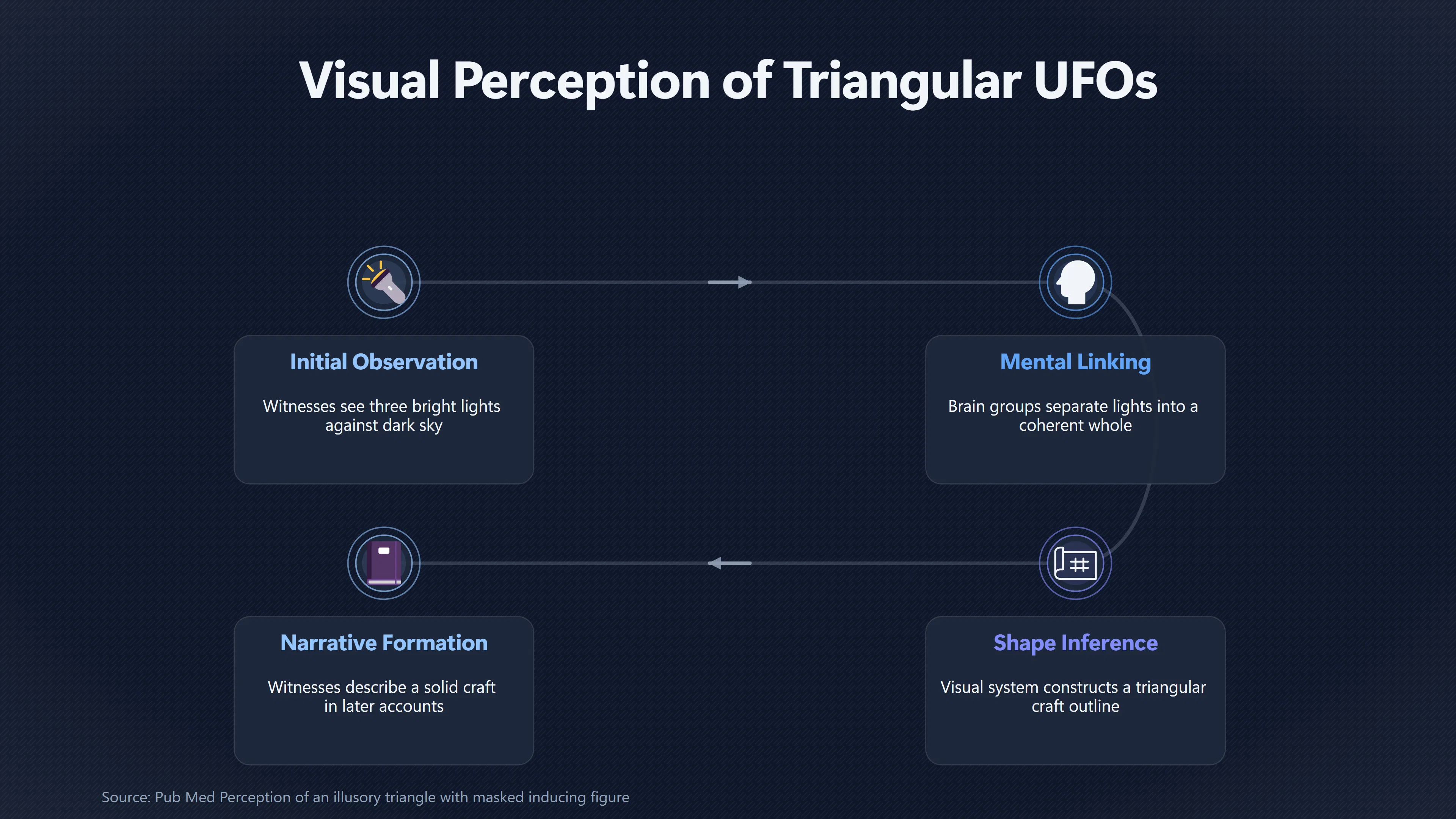
Witnesses may accurately report several lights while mistakenly inferring a single solid triangle connecting them.
On this page
- The difference between visible lights and inferred structure
- How glare and haze create apparent edges
- Questions that reveal whether an outline was truly seen
Page outline Jump by section
Introduction
Reports of large triangular UFOs often begin with a simple observation: three bright lights seen against a dark sky. The important question is whether the witness actually saw a solid triangular object, or whether the mind inferred one from the arrangement of the lights. This distinction matters because many UFO crash narratives later depend on descriptions of a single structured craft rather than separate luminous points.
Human perception is highly efficient at organising incomplete visual information into meaningful objects. Under night-time conditions, where edges, textures and depth cues are largely absent, the visual system can unconsciously connect isolated lights into the outline of a single craft. This does not imply dishonesty or poor observation. It reflects well-documented mechanisms of visual perception that become especially influential during brief, unexpected and emotionally significant sightings.[mit.edu]oecs.mit.eduOpen Encyclopedia of Cognitive ScienceGestalt Perception — OECSApril 22, 2026…
Was It a Triangle or Just Three Lights?
The crucial distinction is between observed lights and inferred structure.
If three lights appear fixed relative to one another, the brain naturally assumes they belong to a single object. Unless the observer can clearly see a dark surface, illuminated edges or stars being obscured behind a body, the existence of a solid triangle is an interpretation rather than a direct observation.
This tendency reflects normal perceptual organisation. Gestalt psychology has shown for more than a century that the visual system groups separate elements into coherent wholes. Laboratory demonstrations such as the Kanizsa triangle show that people readily perceive triangular shapes and edges that are not physically present. The perceived contours are generated by the brain rather than by the image itself.[mit.edu]oecs.mit.eduOpen Encyclopedia of Cognitive ScienceGestalt Perception — OECSApril 22, 2026…
In the context of a night-time sighting, three bright lights can therefore become mentally linked into a single triangular craft even though only the lights themselves were actually visible.
Why Darkness Encourages a Solid-Craft Interpretation
During daylight, an observer can judge shape using surface texture, shadows, colour, perspective and nearby landmarks. At night, most of these cues disappear.
Instead, the observer may see only:
- three bright lights;[disclosurefiles.org]disclosurefiles.orgSource details in endnotes.
- darkness between them;
- little or no reliable indication of distance;
- no visible horizon or reference objects.
The visual system attempts to resolve this ambiguity by constructing the simplest coherent explanation. Three stable lights are more readily interpreted as navigation lights attached to one object than as three unrelated sources suspended independently in space. This is an example of perceptual completion rather than conscious reasoning.[mit.edu]oecs.mit.eduOpen Encyclopedia of Cognitive ScienceGestalt Perception — OECSApril 22, 2026…
Because the background sky is already dark, the absence of visible detail between the lights can itself encourage the impression of a dark, solid surface.
How Glare and Haze Create Apparent Edges
Bright lights rarely appear as perfect points at night.
Atmospheric haze, thin cloud, humidity, dust and imperfections in the eye produce halos and scattered light around bright sources. These halos can overlap visually, especially when several lights are arranged in a geometric pattern.
As the observer’s visual system attempts to separate the lights from the surrounding darkness, the overlapping glow may produce the subjective impression of faint connecting edges or a darker triangular region enclosed by the lights. These apparent boundaries often disappear under improved viewing conditions or optical magnification.
The effect becomes stronger when:
- the lights are exceptionally bright compared with the background;
- visibility is reduced by haze or mist;
- the observation is brief;
- the witness is viewing through a vehicle windscreen or other reflective surface.
These mechanisms affect ordinary visual perception and do not require unusual atmospheric phenomena.

Motion Can Reinforce the Illusion
Once three lights are interpreted as belonging to one object, their shared movement reinforces that interpretation.
If the lights maintain approximately the same spacing while moving across the sky, the observer naturally perceives a rigid craft rather than three independent lights. This is generally a reasonable assumption, but it is not proof that an opaque triangular body was visible.
Night-time motion perception also has well-known limitations. The Federal Aviation Administration warns pilots that darkness can produce illusions involving motion, distance and orientation. A stationary light may even appear to move after prolonged viewing through the phenomenon known as autokinesis. Although autokinesis does not itself create triangular craft, it illustrates how reduced visual cues make night observations less reliable than they feel.[Federal Aviation Administration]faa.govFederal Aviation Administration Chapter 8. Medical Facts for PilotsFederal Aviation AdministrationChapter 8. Medical Facts for PilotsJuly 23, 2025…
When Witnesses Probably Did See More Than Lights
Not every triangular UFO report can be reduced to three isolated lights.
Some witnesses independently describe additional observations such as:
- stars disappearing behind a dark silhouette;
- a clearly defined edge visible against a brighter sky;
- a structured underside illuminated by ambient light;
- multiple observers reporting the same outline from different viewpoints.
These observations deserve to be evaluated separately because they go beyond merely inferring a shape from light positions.
However, investigators should distinguish carefully between statements such as:
- “I saw three lights arranged like a triangle.”
and
- “I clearly saw a solid triangular object connecting the lights.”
The evidential value differs significantly. The first reports light geometry. The second reports direct observation of structure.
Questions That Help Reveal What Was Actually Seen
A careful interview can often distinguish between observed features and later interpretation.
Useful questions include:
- Could you actually see an edge between the lights, or did you assume one existed?
- Did the object block stars behind it, and for how long?
- Were the edges visible continuously or only occasionally?
- Did the triangular outline remain visible when you looked away from the lights?
- Were the lights equally bright, or did glare obscure the area between them?
- Did anyone else independently describe seeing a solid body before discussing the event together?
Questions framed this way encourage witnesses to separate direct sensory observations from conclusions drawn during or after the experience.
Why This Distinction Matters in UFO Crash Investigations
Many alleged UFO crash accounts begin with reports of a triangular craft descending behind terrain. If the original observation consisted primarily of three lights, later descriptions of a massive solid vehicle may represent an understandable evolution of perception rather than deliberate embellishment.
Recognising this possibility neither disproves nor validates any individual sighting. Instead, it improves witness evaluation by distinguishing between what was directly observed and what the visual system plausibly inferred under difficult night-time conditions. That distinction allows investigators to assign greater weight to independently corroborated structural details while treating inferred outlines with appropriate caution.[livescience.com]livescience.comLive Science UFO Sightings & News | History & Psychology of UFOs | Live ScienceLive Science UFO Sightings & News | History & Psychology of UFOs | Live Science
Amazon book picks
Further Reading
Books and field guides related to Was It a Triangle or Just Three Lights?. Use these as the next step if you want deeper reading beyond the article.
The Seven Sins of Memory
Rating: 3.5/5 from 5 Google Books ratings
A New York Times Notable Book: A psychologist's "gripping and thought-provoking" look at how and why our brains sometimes fail us (Steven...
Sensation and Perception
. Bruce Goldstein's SENSATION AND PERCEPTION, the best-seller which has helped over 150,000 students understand the ties between how we s...
Visual Intelligence: How We Create What We See
A unique, illustrated popular study reveals the way the human eye acts on the visual world not just to represent but to create the things...
The Invisible Gorilla: How Our Intuitions Deceive Us
NEW YORK TIMES BESTSELLER • Our minds don’t work the way we think they do. Two renowned psychologists explain how and why our intuitions...
eBay marketplace picks
Marketplace Samples
Live-tested eBay searches with available results related to this page.
Selected fromUFO wall art oneBay.co.uk.
Endnotes
1.
Source: oecs.mit.edu
Link:https://oecs.mit.edu/pub/vibtkyng/release/1/
Source snippet
Open Encyclopedia of Cognitive ScienceGestalt Perception — OECSApril 22, 2026...
Published: April 22, 2026
2.
Source: pubmed.ncbi.nlm.nih.gov
Title: Pub Med Perception of an illusory triangle with masked inducing figure
Link:https://pubmed.ncbi.nlm.nih.gov/7443400/
Source snippet
Perception of an illusory triangle with masked inducing figure - PubMed...
3.
Source: livescience.com
Title: Live Science UFO Sightings & News | History & Psychology of UFOs | Live Science
Link:https://www.livescience.com/20645-ufo-sightings.html
4.
Source: pubmed.ncbi.nlm.nih.gov
Title: Pub Med Interpolation processes in the perception of real and illusory contours
Link:https://pubmed.ncbi.nlm.nih.gov/9616473/
Source snippet
Interpolation processes in the perception of real and illusory contours - PubMed...
5.
Source: faa.gov
Title: Federal Aviation Administration Chapter 8. Medical Facts for Pilots
Link:https://www.faa.gov/air_traffic/publications/atpubs/aim_html/chap8_section_1.html?pubDate=20250723
Source snippet
Federal Aviation AdministrationChapter 8. Medical Facts for PilotsJuly 23, 2025...
Published: July 23, 2025
6.
Source: pubmed.ncbi.nlm.nih.gov
Link:https://pubmed.ncbi.nlm.nih.gov/30090317/
7.
Source: faa.gov
Title: Chapter 8. Medical Facts for Pilots
Link:https://www.faa.gov/air_traffic/publications/atpubs/aim/aim0801.html
8.
Source: nuforc.org
Link:https://nuforc.org/sighting/?id=41731
9.
Source: nuforc.org
Link:https://nuforc.org/sighting/?id=18885
10.
Source: nuforc.org
Link:https://nuforc.org/sighting/?id=1349
11.
Source: cufos.org
Title: Triangular UFOs
Link:https://cufos.org/types-of-ufos/triangular-ufos/
12.
Source: pubmed.ncbi.nlm.nih.gov
Link:https://pubmed.ncbi.nlm.nih.gov/25420329/
Additional References
13.
Source: ufouap.net
Title: Black Triangle UFOs: Sightings and Possible Explanations | Global UFO Archive
Link:https://www.ufouap.net/en/explainers/black-triangle-ufo
Source snippet
July 23, 2026 — Case guides / Updated 2026-07-23 / 10 min read BLACK TRIANGLE UFO SIGHTINGS: WHY TRIANGULAR CRAFT REPORTS KEEP RETURNING...
Published: July 23, 2026
14.
Source: nature.com
Title: Is the illusory triangle physical or imaginary? | Nature
Link:https://www.nature.com/articles/257219a0
Source snippet
Is the illusory triangle physical or imaginary? | Nature...
15.
Source: nature.com
Title: Image segmentation and lightness perception | Nature
Link:https://www.nature.com/articles/nature03271
Source snippet
Image segmentation and lightness perception | Nature...
16.
Source: history.com
Title: Others question whether
Link:https://www.history.com/articles/black-triangle-ufos-facts
Source snippet
Huge, Hovering and Silent: The Mystery of 'Black Triangle' UFOs | HISTORYJuly 22, 2020 — By: Greg Daugherty & Missy Sullivan Mysteries &...
Published: July 22, 2020
17.
Source: youtube.com
Title: Why Your Brain Sees a Triangle That Isn’t There – The Kanizsa Illusion
Link:https://www.youtube.com/watch?v=f1uensCdxi8
Source snippet
Explaining Optical Illusions - Part 7: The Kanizsa Triangle and the Jastrow Illusion...
18.
Source: youtube.com
Title: Explaining Optical Illusions
Link:https://www.youtube.com/watch?v=RZcoFq4-qMQ
Source snippet
7 Fascinating Gestalt Principles of Perception...
19.
Source: youtube.com
Title: The Gestalt Principles
Link:https://www.youtube.com/watch?v=B0bvJWqVhDY
Source snippet
This collection of educational videos explains Gestalt principles of visual perception—specifically the law of closure and illusory conto...
20.
Source: disclosurefiles.org
Link:https://disclosurefiles.org/uap-ufo/triangle/
21.
Source: theblackvault.com
Link:https://www.theblackvault.com/casefiles/triangular-ufos-over-st-thomas-ontario-canada-witness-experiences-physical-markings/
22.
Source: youtube.com
Title: 7 Fascinating Gestalt Principles of Perception
Link:https://www.youtube.com/watch?v=HD7lBUB_7BU
Source snippet
Gestalt Principles of Perception - With Examples...