Within Emergency Response
Does Fast Debris Removal Mean a UFO Cover Up?
Investigators often move wreckage to secure facilities for testing, reconstruction and custody, so rapid removal alone does not prove a cover-up.
On this page
- Why wreckage is moved from exposed crash sites
- How secure custody preserves useful evidence
- Warning signs that removal crossed into falsification
Page outline Jump by section
Introduction
Rapid debris removal after an alleged UFO crash is often presented as evidence that authorities are hiding extraordinary material. In reality, accident investigation procedures across multiple jurisdictions treat prompt recovery of wreckage as a way to preserve evidence rather than erase it. Leaving fragments exposed in fields, forests or roadsides risks theft, contamination, weather damage, scavenging and accidental disturbance, all of which can permanently reduce investigators’ ability to determine what happened. The key question is therefore not whether debris was removed quickly, but whether the removal followed documented evidence-preservation practices, maintained a secure chain of custody and allowed later examination.
Within debates about alleged UFO crashes, this distinction matters because a fast recovery can look secretive from outside a restricted perimeter while still reflecting routine investigative practice. A rapid transfer of material to a secure facility is consistent with how aviation and other technical accident investigations are normally conducted; by itself, it does not demonstrate a cover-up.[gov.uk]GOV.UKHow we investigateHow we investigate
Why wreckage is moved from exposed crash sites
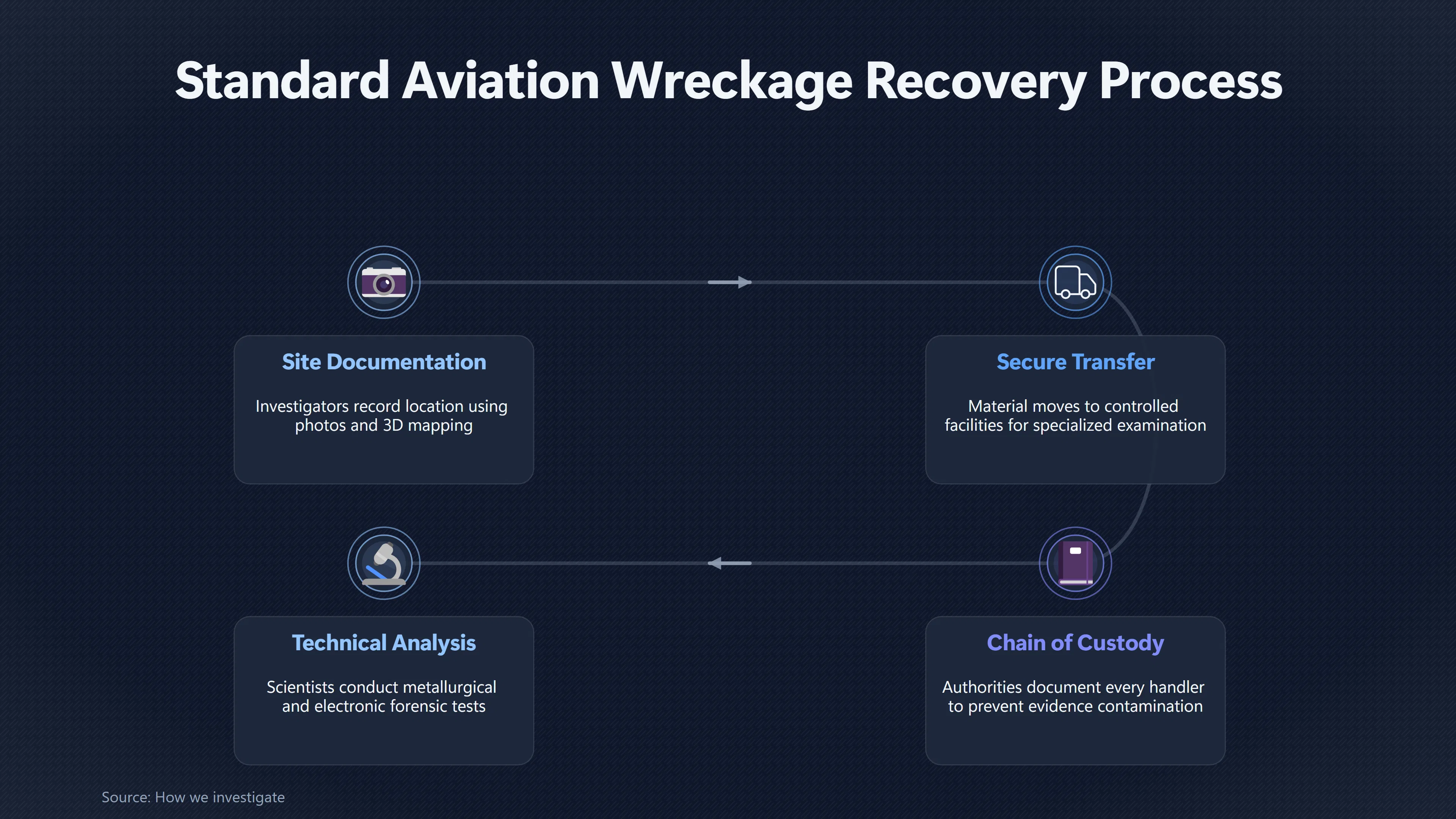
The purpose of a crash-site investigation is not simply to collect fragments but to preserve information. The location, orientation and distribution of debris often reveal more than the objects themselves. Investigators therefore document the site extensively before significant items are moved, using photographs, measurements, sketches, mapping and increasingly three-dimensional recording.
Once that documentation is complete—or sooner if safety requires it—the wreckage is commonly transferred to a controlled environment. There are several practical reasons:
- Preventing evidence loss. Curious members of the public may remove pieces as souvenirs, while animals, vehicles and weather can alter the debris field.
- Reducing environmental damage. Rain, flooding, corrosion and vegetation growth can quickly degrade surfaces that may contain fracture patterns, burn marks or chemical residues.
- Protecting public safety. Aircraft wreckage can contain fuel, batteries, pyrotechnic devices, composite fibres or sharp metal that pose hazards long after the initial event.
- Allowing specialised examination. Many forensic tests require laboratory equipment unavailable at the crash scene.
These procedures are reflected in aviation regulations. In the United States, federal rules allow wreckage to be moved before investigators take custody only when necessary to rescue people, protect the wreckage from further damage or protect the public. If movement is unavoidable, investigators are instructed to record the original positions through photographs and notes whenever possible.[Legal Information Institute]law.cornell.eduLegal Information Institute49 CFR § 830.10Preservation of aircraft wreckage, mail, cargo, and records. | Electronic Code of Federal Regulations (e-CFR) | US Law | LII / Legal Info…
How secure custody preserves useful evidence
Moving debris does not normally end an investigation; it shifts the investigation to a more suitable environment.
Major accident investigation agencies routinely transport recovered wreckage to secure facilities where specialists can reconstruct damaged structures, compare fractured components and examine internal systems that cannot safely be analysed outdoors. The UK’s Air Accidents Investigation Branch (AAIB), for example, explains that once the site has been documented, wreckage is usually recovered and transported to its Farnborough facility for detailed examination.[GOV.UK]GOV.UKHow we investigateHow we investigate
Secure custody serves several important functions:
- Maintaining chain of custody. Investigators document who recovered each item, where it was found and who subsequently handled it. This helps demonstrate that evidence has not been substituted or contaminated.
- Reconstructing the vehicle. Large investigations often lay out recovered components on warehouse floors to rebuild as much of the structure as possible and identify failure sequences.
- Protecting sensitive evidence. Flight recorders, electronics and fractured mechanical parts require controlled handling to preserve microscopic evidence.
- Enabling multidisciplinary analysis. Metallurgists, materials scientists, engine specialists and electronics experts may all examine the same components over weeks or months.
European and UK aviation regulations explicitly require authorities to maintain safe custody of wreckage and protect it from deterioration, unauthorised access and pilfering. The regulations also state that evidence should be preserved by photographic or other means before anything likely to be lost or altered is removed.[EUR-Lex]eur-lex.europa.euEUR-Lex - 02010R0996-20240519 - EN - EUR-Lex…
Why rapid recovery can resemble secrecy
From the perspective of witnesses, evidence preservation can appear almost identical to concealment.
Road closures, armed security, tarpaulins covering debris, vehicles leaving the scene with recovered material and restricted photography are all compatible with standard investigative practice. These measures reduce contamination and protect evidence while investigators establish what has occurred.
This resemblance has contributed to later UFO narratives surrounding incidents such as the 1965 Kecksburg event, where later accounts frequently interpreted reports of official searches and restricted access as proof that an unusual object had been secretly removed. Yet the existence of a search or even the removal of recovered material does not establish the nature of that material. Technical investigations routinely recover objects whose identities remain entirely conventional after examination.
The important distinction is that secrecy surrounding an investigation’s early stages often reflects uncertainty rather than confirmation of something extraordinary. Investigators generally avoid public speculation until technical analysis is complete because premature conclusions can interfere with both evidence collection and public understanding.[GOV.UK]GOV.UKHow we investigateHow we investigate
When removal becomes a legitimate cause for concern
Fast debris recovery should not automatically be interpreted as evidence of concealment, but neither should all official actions be accepted uncritically. Evidence preservation differs from evidence suppression in observable ways.
Potential warning signs include:
- destruction of material without documented examination;
- unexplained gaps in chain-of-custody records;
- refusal to preserve photographs or site documentation;
- contradictory official accounts regarding whether material existed at all;
- failure to follow established investigative procedures without a clear safety justification.
By contrast, the following generally support an ordinary evidence-preservation explanation:
- photographs and mapping before recovery;
- documented transfer to recognised investigative facilities;
- published investigation procedures describing why evidence was moved;
- eventual technical examination or reconstruction of recovered material;
- clear legal authority governing custody and handling of wreckage.
These indicators focus on process rather than speculation about what the debris might ultimately prove to be.

The more useful question than “Why was it removed?”
Within UFO crash discussions, the removal of debris is often treated as the decisive event. Investigative practice suggests a different question: how was the material documented and handled before, during and after removal?
Modern accident investigations are designed around preserving information, not keeping wreckage in public view. A fragment left undisturbed in an exposed field may satisfy public curiosity but can lose forensic value through weather, contamination or unauthorised handling. Conversely, rapid transfer into secure custody may temporarily reduce public visibility while increasing investigators’ ability to determine what the object actually was.
For that reason, rapid debris removal alone is weak evidence of a cover-up. A stronger assessment depends on whether authorities preserved the original scene, maintained documented custody, conducted technical examination and produced evidence consistent with established investigative procedures rather than on the speed with which the wreckage disappeared from public view.[cornell.edu]law.cornell.eduLegal Information Institute49 CFR § 830.10Preservation of aircraft wreckage, mail, cargo, and records. | Electronic Code of Federal Regulations (e-CFR) | US Law | LII / Legal Info…
Amazon book picks
Further Reading
Books and field guides related to Does Fast Debris Removal Mean a UFO Cover Up?. Use these as the next step if you want deeper reading beyond the article.
Crash at Corona
IF UFOS DON'T EXIST, THEN THEY CAN'T CRASH. But something did crash near Corona, a tiny town not far from Roswell, New Mexico, in 1947. A...
The Report on Unidentified Flying Objects
Edward J. Ruppelt's "The Report on Unidentified Flying Objects" serves as a pivotal text in the study of UFO phenomena, blending personal...
Aircraft Accident Investigation
Beskrivelse af situationer omkring flyvehavarier samt gennemgang af forhold i f.m. undersøgelser og udfærdigelse af rapporter.
Managing the Unexpected
Since the first edition of Managing the Unexpected was published in 2001, the unexpected has become a growing part of our everyday lives....
eBay marketplace picks
Marketplace Samples
Live-tested eBay searches with available results related to this page.
Selected fromalien metal collectible oneBay.co.uk.



Endnotes
1.
Source: GOV.UK
Title: How we investigate
Link:https://www.gov.uk/government/publications/how-we-investigate/how-we-investigate
2.
Source: assets.publishing.service.gov.uk
Title: [Aircraft Accidents]({{ ‘aircraft-accidents/’ | relative_url }})
Link:https://assets.publishing.service.gov.uk/government/uploads/system/uploads/attachment_data/file/919973/Guidance_Pub_version_High_amend.pdf
3.
Source: atsb.gov.au
Title: aviation accident information and guidelines
Link:https://www.atsb.gov.au/publications/corporate-brochure/2022/aviation/aviation-accident-information-and-guidelines
4.
Source: GOV.UK
Title: www.gov.uk AAI B Briefing Note for the Emergency Services
Link:https://www.gov.uk/government/publications/aaib-briefing-note-for-the-emergency-services/aaib-briefing-note-for-the-emergency-services
5.
Source: eur-lex.europa.eu
Link:https://eur-lex.europa.eu/legal-content/EN/ALL/?uri=CELEX%3A02010R0996-20240519
Source snippet
EUR-Lex - 02010R0996-20240519 - EN - EUR-Lex...
6.
Source: law.cornell.edu
Title: Legal Information Institute49 CFR § 830.10
Link:https://www.law.cornell.edu/cfr/text/49/830.10
Source snippet
Preservation of aircraft wreckage, mail, cargo, and records. | Electronic Code of Federal Regulations (e-CFR) | US Law | LII / Legal Info...
7.
Source: thecoldfile.com
Title: 1965 kecksburg
Link:https://www.thecoldfile.com/articles/1965-kecksburg/
Source snippet
The Acorn in the Woods: The 1965 Kecksburg Incident | The Cold FileMay 25, 2026 — UFO/UAP / Case file / Filed May 25, 2026 THE ACORN IN T...
Published: May 25, 2026
8.
Source: eur-lex.europa.eu
Title: eu EU R-Lex
Link:https://eur-lex.europa.eu/legal-content/EN/TXT/?uri=CELEX%3A02010R0996-20240519
9.
Source: law.cornell.edu
Title: edu49 CFR § 831.9
Link:https://www.law.cornell.edu/cfr/text/49/831.9
10.
Source: law.cornell.edu
Title: edu49 CFR § 831.13
Link:https://www.law.cornell.edu/cfr/text/49/831.13
11.
Source: law.cornell.edu
Title: edu49 CFR § 831.62
Link:https://www.law.cornell.edu/cfr/text/49/831.62
Additional References
12.
Source: youtube.com
Link:https://www.youtube.com/watch?v=H4AxRTzASxE
Source snippet
This selection illustrates how crash-site evidence is handled, highlighting official wreckage recovery standards, chain of custody proced...
13.
Source: revlox.com
Title: Kecksburg: America’s Most Persistent UFO Mystery After [Roswell]({{ ‘roswell/’ | relative_url }})
Link:https://www.revlox.com/mystery/kecksburg-americas-most-persistent-ufo-mystery-after-roswell/
Source snippet
May 6, 2026 — Image: Kecksburg: America’s Most Persistent UFO Mystery Mystery 06 May 2026 KECKSBURG: AMERICA’S MOST PERSISTENT UFO MYSTER...
Published: May 6, 2026
14.
Source: theblackvault.com
Title: the vault files the 1965 kecksburg pennsylvania crash
Link:https://www.theblackvault.com/casefiles/the-vault-files-the-1965-kecksburg-pennsylvania-crash/
Source snippet
The Vault Files: The 1965 Kecksburg, Pennsylvania Crash - The Black Vault Case FilesAugust 1, 2025 — THE VAULT FILES: THE 1965 KECKSBURG...
Published: August 1, 2025
15.
Source: ecfr.io
Title: 49 CFR 830.10 | Preservation of aircraft… | e CFR.io
Link:https://ecfr.io/Title-49/Section-830.10
Source snippet
49 CFR 830.10 Citation 49 CFR 830.10 Corpus Daily eCFR Displayed edition 2026-07-22 Last updated 2026-07-22 § 830.10 PRESER...
Published: July 22, 2026
16.
Source: youtube.com
Link:https://www.youtube.com/watch?v=bvTkHpX3u5I
Source snippet
Roswell's First Witness Testimonial | History's Greatest Mysteries (S1, E5) | Full Episode...
17.
Source: youtube.com
Link:https://www.youtube.com/watch?v=RCAHyclAmZs
Source snippet
UFO Roswell Incident (Full Episode) | Undercover History Updates | National Geographic...
18.
Source: youtube.com
Title: What the Data, the Audio, and the NTSB Aren’t Saying about the Greg Biffle crash
Link:https://www.youtube.com/watch?v=6DY8ndeJiEY
Source snippet
TWA Flight 800 wreckage to be scanned, scrapped...
19.
Source: youtube.com
Title: TWA Flight 800 wreckage to be scanned, scrapped
Link:https://www.youtube.com/watch?v=LJidYwdutgo
Source snippet
All 9 Bodies Of Victims Recovered As NTSB Releases Video From Kobe Bryant's Helicopter Crash Site...
20.
Source: ntsb.gov
Title: Report an Aircraft Accident to the NTSB
Link:https://www.ntsb.gov/Pages/aviationreport.aspx/1000
Source snippet
Report an Aircraft Accident to the NTSB...
21.
Source: caa.co.uk
Link:https://www.caa.co.uk/about-us/make-a-report-or-complaint/report-something/mor/accident-and-serious-incident-reporting/