Within Crash Photos
What Is Lost When Debris Gets Moved?
Once fragments are lifted, cleaned or grouped, photographs can no longer reliably show impact direction, original spacing or deposition patterns.
On this page
- Why in place photographs must come before collection
- How later footprints and tyre tracks confuse interpretation
- Which before and after views can document necessary handling
Page outline Jump by section
Introduction
Photographs intended to verify an alleged UFO crash are most valuable before anyone touches the scene. Once debris is lifted, cleaned, grouped together or carried elsewhere, the original physical pattern begins to disappear. Even if every fragment is later photographed in detail, those images can no longer show where each object originally lay, the direction in which material was scattered, or whether apparent impact marks were present before recovery teams arrived. Standard forensic practice therefore places great emphasis on recording a scene exactly as it was first encountered, because later handling permanently changes the evidence available for interpretation.[National Institute of Justice]nij.ojp.govNational Institute of JusticeCrime Scene Investigation: Guides for Law Enforcement | National Institute of JusticeJuly 12, 2017…
Within discussions of alleged UFO crashes, this distinction is particularly important. Many claims rely on photographs of recovered fragments rather than photographs of an undisturbed debris field. Whatever the claimed origin of the material, images taken only after recovery activity cannot independently establish how the scene originally looked or whether the photographed objects came from the same location.
Why in-place photographs must come before collection
The arrangement of debris often contains as much information as the debris itself. A genuine impact or in-flight breakup may produce a distinctive pattern that reflects speed, direction of travel, terrain and the sequence of structural failure. Once objects are moved, investigators lose the opportunity to test those relationships directly.
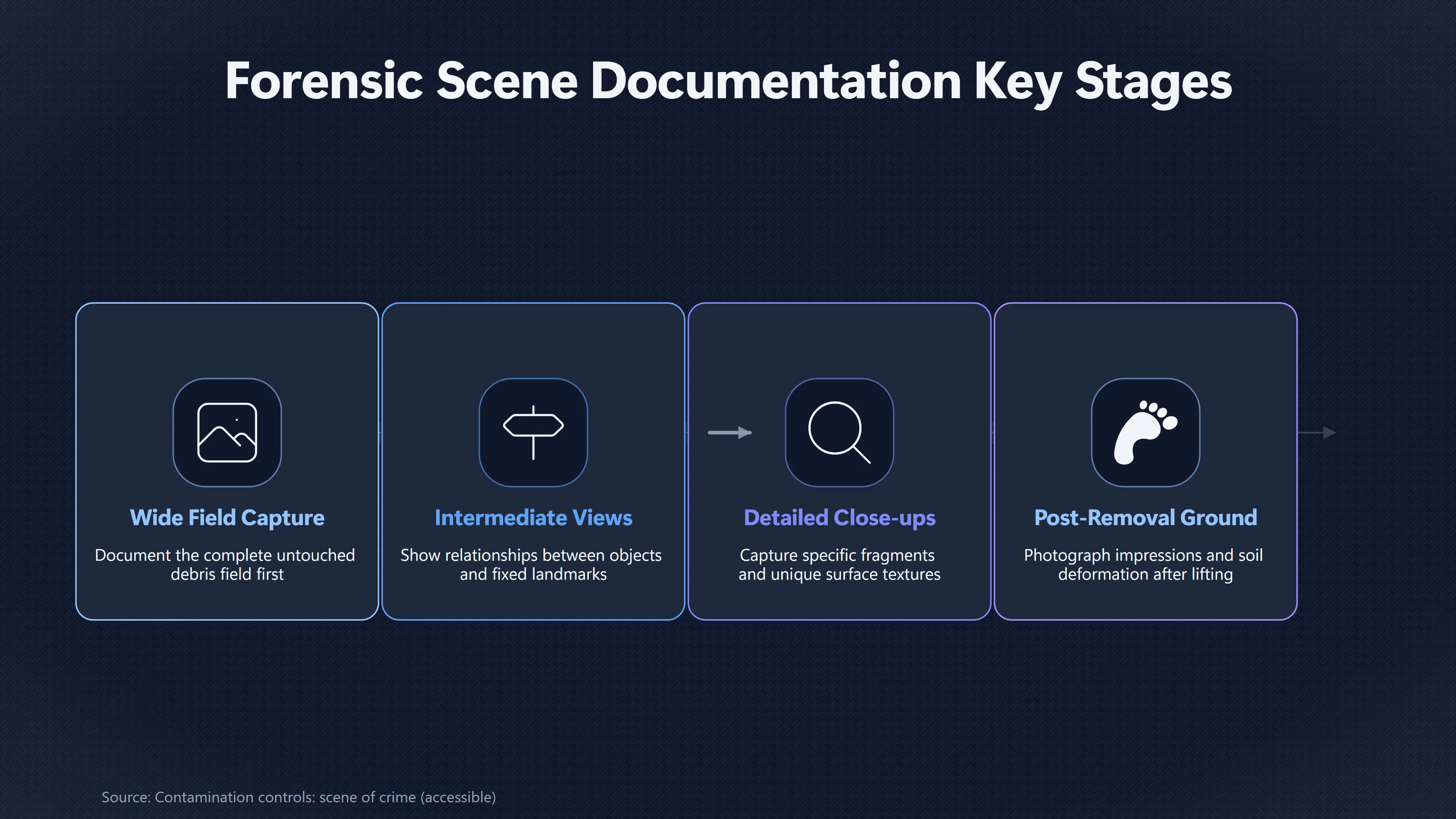
Forensic guidance consistently recommends photographing evidence before it is collected or altered. Overall photographs should document the complete scene, followed by intermediate views showing the relationship between individual objects and fixed landmarks, before detailed close-up photography begins. This sequence preserves spatial information that cannot be recreated afterwards.[National Institute of Justice]nij.ojp.govNational Institute of JusticeCrime Scene Investigation: Guides for Law Enforcement | National Institute of JusticeJuly 12, 2017…
For an alleged UFO crash, early photographs could potentially answer questions such as:
- Was there a continuous debris trail or isolated fragments?
- Did the distribution suggest an airborne breakup, a ground impact or later scattering?
- Were scorch marks, disturbed vegetation or soil deformation physically connected to the debris?
- Were unusual fragments concentrated around one point or spread over a much larger area?
If these relationships were never photographed before recovery, later claims about the original layout depend largely on witness recollections rather than preserved physical evidence.
What is lost when debris gets moved?
Moving debris destroys several kinds of information simultaneously.
Impact direction. The orientation of bent, embedded or partially buried fragments may indicate the direction from which they arrived. Rotating or lifting them removes that evidence unless it was documented beforehand.
Original spacing. The distance between fragments can reveal whether material remained together until impact or separated earlier. Gathering objects into piles eliminates this information.
Association with surrounding features. A fragment lying beside broken branches, compressed vegetation or disturbed soil may tell a different story from the same fragment displayed on a clean table. Once separated from its surroundings, that context is lost.
Stratigraphic relationships. If fragments penetrate soil or become covered by later sediment, their depth and position relative to surrounding material can help reconstruct timing. Recovery destroys these relationships unless carefully documented first.
These losses are irreversible. Investigators may accurately catalogue every recovered item yet still be unable to reconstruct the original scene with confidence.
How later footprints and tyre tracks confuse interpretation
The first people entering a scene inevitably begin altering it. Every boot print, vehicle track and equipment movement introduces new marks that may resemble evidence left by the original event.
Professional crime-scene procedures therefore emphasise controlling access, defining approach routes and documenting the scene before extensive movement occurs. Limiting unnecessary traffic reduces contamination and preserves the distinction between original evidence and investigator activity.[gov.uk]GOV.UKContamination controls: scene of crime (accessibleContamination controls: scene of crime (accessible
Without that documentation, later investigators may struggle to determine whether:
- tyre tracks were produced before or after discovery;
- footprints belonged to witnesses, recovery personnel or unrelated visitors;
- dragged vegetation reflects an impact sequence or people carrying recovered material;
- displaced stones and broken plants were caused by the alleged crash or subsequent searches.
This problem becomes especially significant in remote outdoor environments, where multiple days of recovery activity can substantially alter the landscape.
Before-and-after photographs that preserve necessary context
Some movement of evidence is often unavoidable. Hazardous materials, weather conditions or public safety concerns may require rapid recovery. Good documentation therefore records both the untouched scene and the recovery process.
Useful photographic sequences include:
- wide views showing the untouched debris field;
- closer photographs of each item exactly where found;
- images showing scales and identifying markers after the initial photographs;
- photographs during lifting to reveal concealed surfaces;
- photographs of the ground immediately after removal, showing impressions, embedded fragments or disturbed soil;
- wider “after” photographs documenting how the recovery altered the scene.
These paired images help distinguish unavoidable recovery activity from the original condition of the site. They also allow later reviewers to understand which changes resulted from investigators rather than from the alleged event itself.
Lessons from disputed UFO crash claims
Many alleged UFO crash cases illustrate the consequences of missing scene documentation. Public discussion frequently centres on photographs of individual fragments, recovered materials or reconstructed displays rather than comprehensive images of an undisturbed debris field.
The long-running debate surrounding the 1947 Roswell incident demonstrates this limitation. Although numerous accounts describe debris recovery, the surviving public record contains very little contemporaneous photography showing an untouched debris distribution before recovery operations. As a result, later interpretations rely heavily on testimony, later recollections and disputed reconstructions instead of a complete photographic record of the scene itself. Official investigations reached conventional explanations for the recovered material, while proponents of extraterrestrial hypotheses continue to argue that the available documentation is incomplete. Regardless of which interpretation is preferred, the absence of comprehensive in-place scene photography prevents modern investigators from independently reconstructing the original debris pattern.[WIRED]wired.comHere's the Proof There's No Government Alien Conspiracy Around RoswellHowever, an examination reveals a confluence of secret government projects and Cold War era activities rather than extraterrestrial invol…
This illustrates a broader evidential principle rather than proving or disproving any particular UFO claim. Once a scene has been cleared, later photographs of isolated objects cannot restore the spatial evidence that disappeared during recovery.
Why original scene layout matters more than dramatic close-ups
Close-up photographs often attract the most attention because they highlight unusual textures, symbols or materials. However, from an evidential perspective, those images are usually less informative than carefully documented wide and mid-range photographs taken before recovery.
A photograph of an unusual fragment may support later laboratory examination, but it cannot by itself establish where that object came from, how it arrived there or whether it formed part of a coherent impact pattern. Only photographs made before debris was moved can preserve those relationships.
For that reason, the earliest minutes of scene documentation often have the greatest long-term evidential value. Once debris has been repositioned and recovery activity has reshaped the landscape, an important layer of physical evidence has been permanently lost, regardless of how carefully the recovered objects are later photographed or analysed.
Amazon book picks
Further Reading
Books and field guides related to What Is Lost When Debris Gets Moved?. Use these as the next step if you want deeper reading beyond the article.
Criminalistics: An Introduction to Forensic Science
For introductory courses in Forensic Science and Crime Scene Investigation. This best-selling text, written for the non-scientist, is app...
Forensic Science: An Introduction to Scientific and Investiga...
Covering a range of fundamental topics essential to modern forensic investigation, the fourth edition of the landmark text Forensic Scien...
Crime Scene Photography
Crime Scene Photography is a book wrought from years of experience, with material carefully selected for ease of use and effectiveness in...
Forensic Photography: A Practitioner's Guide
Forensic photography plays a vitally important part in the investigation of crime and the subsequent administration of justice. Written b...
eBay marketplace picks
Marketplace Samples
Live-tested eBay searches with available results related to this page.
Selected fromUFO disclosure poster oneBay.co.uk.



Endnotes
1.
Source: GOV.UK
Title: Contamination controls: scene of crime (accessible)
Link:https://www.gov.uk/government/publications/crime-scene-dna-anti-contamination-guidance/contamination-controls-scene-of-crime-accessible
2.
Source: wired.com
Title: Here’s the Proof There’s No Government Alien Conspiracy Around Roswell
Link:https://www.wired.com/story/roswell-aliens-fermi-paradox
Source snippet
However, an examination reveals a confluence of secret government projects and Cold War era activities rather than extraterrestrial invol...
3.
Source: people.com
Title: “Unsolved Mysteries”: The True Story of the Roswell UFO Incident
Link:https://people.com/roswell-incident-true-story-unsolved-mysteries-8722935
Source snippet
"Mack" Brazel. Initially claimed by the U.S. Air Force to be a "flying saucer," this was quickly retracted, asserting it was a weather ba...
4.
Source: GOV.UK
Title: crime scene dna anti contamination guidance
Link:https://www.gov.uk/government/publications/crime-scene-dna-anti-contamination-guidance
5.
Source: nij.ojp.gov
Link:https://nij.ojp.gov/topics/articles/crime-scene-investigation-guides-law-enforcement
Source snippet
National Institute of JusticeCrime Scene Investigation: Guides for Law Enforcement | National Institute of JusticeJuly 12, 2017...
Published: July 12, 2017
6.
Source: nij.ojp.gov
Link:https://nij.ojp.gov/library/publications/crime-scene-investigation-guide-law-enforcement
7.
Source: nij.ojp.gov
Title: crime scene
Link:https://nij.ojp.gov/nij-hosted-online-training-courses/firearms-examiner-training/module-06/crime-scene
8.
Source: nij.ojp.gov
Title: documentation chain custody
Link:https://nij.ojp.gov/nij-hosted-online-training-courses/crime-scene-and-dna-basics-forensic-analysts/evidence-crime-scene/documentation-chain-custody
9.
Source: history.com
Link:https://www.history.com/articles/roswell
10.
Source: nij.ojp.gov
Title: crime scene investigation reference law enforcement training
Link:https://nij.ojp.gov/library/publications/crime-scene-investigation-reference-law-enforcement-training
11.
Source: ojp.gov
Link:https://www.ojp.gov/library/publications/crime-scene-investigation-guide-law-enforcement-0
13.
Source: muller.lbl.gov
Title: Roswell Incident
Link:https://muller.lbl.gov/teaching/physics10/Roswell/RoswellIncident.html
Additional References
14.
Source: nist.gov
Title: Forensics Science — Crime Scene | NIST
Link:https://www.nist.gov/forensic-science/nist-forensics-science-crime-scene
Source snippet
May 27, 2026 — NIST FORENSICS SCIENCE — CRIME SCENE Crime scene investigation includes everything that happens to document, locate, prese...
Published: May 27, 2026
15.
Source: forensicspot.com
Title: Forensic Archaeological Recovery | Forensic Spot
Link:https://forensicspot.com/topics/forensic-anthropology/forensic-archaeological-scene-recovery
Source snippet
Forensic Archaeological Recovery | ForensicSpotJune 18, 2026 — FORENSIC ARCHAEOLOGICAL SCENE RECOVERY How a skeletal scene is worked: sur...
Published: June 18, 2026
16.
Source: factually.co
Title: What Documentary Evidence Exists About the Roswell Inc
Link:https://factually.co/fact-checks/science/roswell-incident-documentary-evidence-pentagon-wreckage-handling-dc7ee2
Source snippet
Researched on June 18, 2026 Project Mogul United States Air Force Area 51 United States Government...
Published: June 18, 2026
17.
Source: youtube.com
Title: History’s Greatest Mysteries: Military Cleanup at Roswell Crash?!
Link:https://www.youtube.com/watch?v=TywPwJSosgc
Source snippet
The Top Secret Project That Spawned the Roswell UFO Incident...
18.
Source: youtube.com
Title: The Top Secret Project That Spawned the Roswell UFO Incident
Link:https://www.youtube.com/watch?v=h54XMccPH-Q
Source snippet
The Roswell Incident as Told by Thomas Snégaroff...
19.
Source: cambridge.org
Link:https://www.cambridge.org/core/journals/advances-in-archaeological-practice/article/cultural-resource-damage-assessment/5256E58A791028468B0660B5A35679EC
20.
Source: cambridge.org
Link:https://www.cambridge.org/core/journals/advances-in-archaeological-practice/article/how-to-prepare-for-geoforensic-fieldwork-to-investigate-archaeological-resource-crime/6CCDEBD082C333A0F08B4AF4EAEBB94E
21.
Source: ufoevidence.com
Link:https://ufoevidence.com/case/roswell-ufo-crash-retrieval-incident/
22.
Source: cambridge.org
Link:https://www.cambridge.org/core/journals/advances-in-archaeological-practice/article/abs/accuracy-and-adequacy-of-infield-artifact-analysis/5E9A0C32103635A680DB3BDDD3137BA6
23.
Source: journalofscientificexploration.org
Link:https://journalofscientificexploration.org/index.php/jse/article/view/2635