Within Unidentified
When Does a Disappearing Light Look Like a Crash?
A distant light can seem to descend into the ground when it merely passes behind a ridge or below the horizon.
On this page
- How terrain hides a distant light
- Why apparent descent does not reveal distance
- What triangulation would be needed
Page outline Jump by section
Introduction
A bright light that seems to descend into the ground is not, by itself, evidence that anything has crashed. One of the most common visual mechanisms behind reported “crash” sightings is that a distant light simply passes behind a ridge, hill, mountain, tree line or the Earth’s horizon. From a single viewing position, the observer usually cannot judge the light’s true distance, so its disappearance can easily be interpreted as an impact rather than an object continuing on its original path.
This distinction matters when evaluating alleged UFO crashes. Many reports begin with a brief visual impression rather than physical evidence of an impact site. Without independent measurements of distance, direction and altitude, a disappearing light establishes only that it was lost from view—not that it struck the ground.
When does a disappearing light look like a crash?
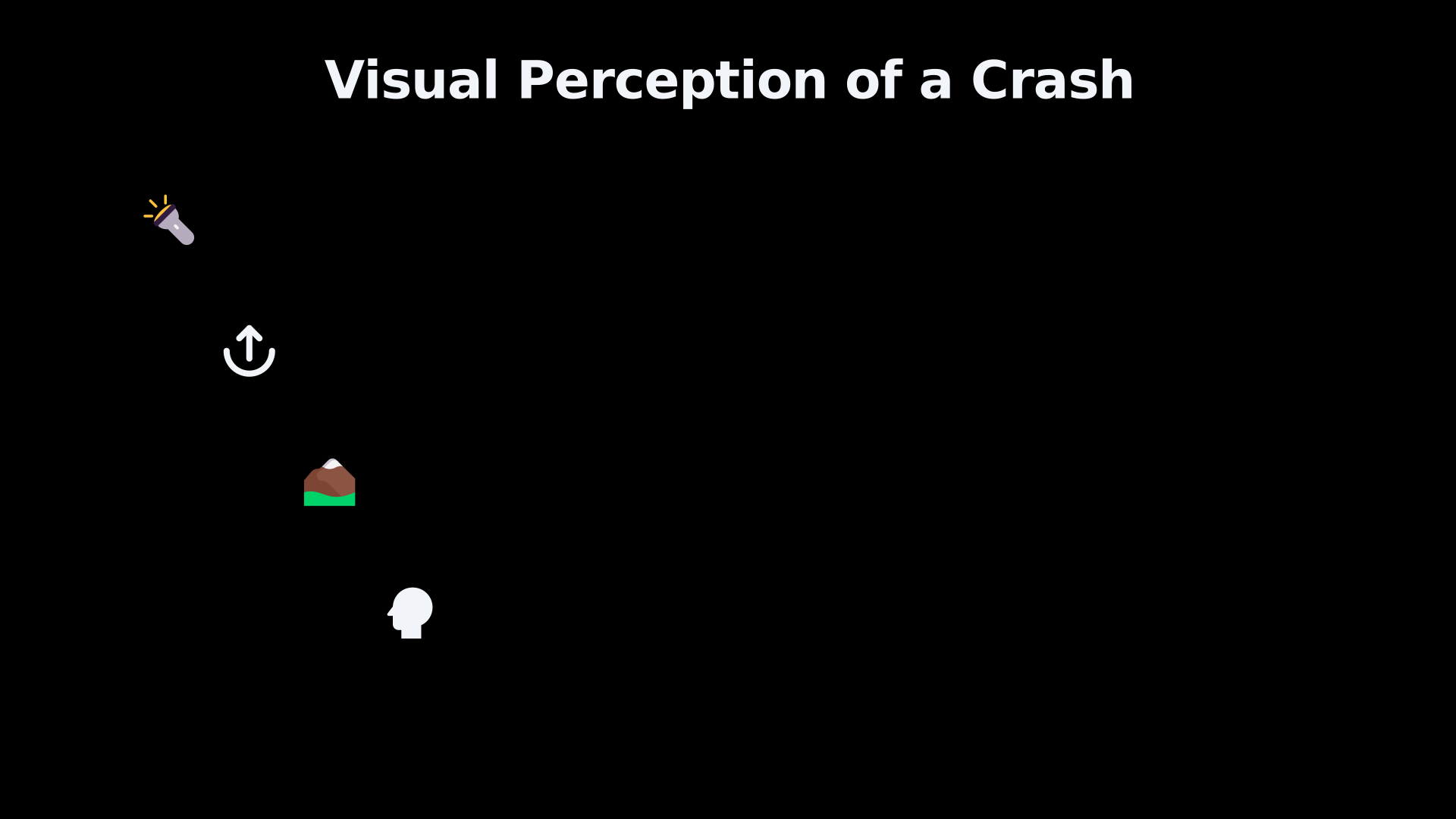
Human vision estimates the motion of distant lights surprisingly poorly, especially at night. During daylight, landscapes provide many cues about distance and depth. After dark, those cues largely disappear, leaving observers to infer an object’s position from its brightness and apparent motion.
If a light moves away from an observer while simultaneously passing behind rising terrain, the visible portion of its path often appears to angle downward. When the light suddenly vanishes behind the ridge, the brain naturally completes the sequence by assuming it reached the ground. In reality, the object may still be travelling at the same altitude on the far side of the hill.
This is particularly persuasive when:
- only a few seconds of the object’s path are visible;
- the terrain profile is unfamiliar;
- there are no nearby landmarks to indicate distance;
- the observation occurs at night or during twilight;
- the observer expects an unusual event.
Because the disappearance is abrupt rather than gradual, witnesses often remember it as an “impact” even though no impact was actually seen.
How terrain hides a distant light
The key mechanism is simple geometry rather than unusual physics.
Imagine an aircraft flying many kilometres beyond a mountain ridge. From the observer’s position, the aircraft appears just above the ridge line. As it continues on a level course, the line of sight between observer and aircraft eventually intersects the mountain. At that instant, the terrain completely blocks the light.
Nothing has descended into the hillside. Instead:
- the aircraft remains in level flight;
- the ridge progressively covers more of its apparent position;
- the final visible point happens to coincide with the skyline;
- the light disappears instantly once fully obscured.
The same effect occurs with meteors travelling beyond distant hills, satellites setting below the horizon, helicopters flying behind ridges and ordinary aircraft disappearing behind mountain ranges.
Professional aviation guidance recognises that terrain, darkness and reduced visual references can create powerful misjudgements of altitude, distance and apparent motion. The Federal Aviation Administration warns that featureless terrain, poor horizon definition and limited visual cues can produce convincing but inaccurate impressions of ascent, descent and closure rate.[Federal Aviation Administration]faa.govFederal Aviation Administration Chapter 8. Medical Facts for PilotsFederal Aviation Administration Chapter 8. Medical Facts for Pilots
Why apparent descent does not reveal distance
A common misconception is that a downward-looking path proves the object was descending towards nearby ground.
In reality, a single observer sees only an angular path across the sky. That angle contains no direct information about distance.
For example, a light moving horizontally 30 kilometres away may appear to sink rapidly because the intervening terrain rises relative to the observer’s line of sight. Another light only one kilometre away could trace almost the same apparent path while actually descending steeply. Visually, the two situations may be almost indistinguishable.
Brightness also provides little help. Many people instinctively assume brighter means closer, but apparent brightness depends on many variables, including:
- the light’s actual power;
- atmospheric clarity;
- viewing angle;
- haze or cloud;
- whether the source is directed towards the observer.
Without reliable range information, witnesses cannot accurately calculate the object’s true height or determine whether it ever approached the ground.
Why the disappearance feels like an impact
The brain naturally seeks complete explanations for incomplete observations.
A sequence such as:
- a bright moving light;
- an apparent downward path;
- sudden disappearance;
strongly resembles the pattern expected from a crash. Once the final light is gone, many observers mentally reconstruct the missing final moment as an impact, even though they never actually observed one.
The effect is reinforced if:
- another witness says they saw a crash;
- reports of emergency vehicles circulate afterwards;
- a loud unrelated sound is heard;
- local rumours identify a supposed crash location.
Memory research has shown that later information can reshape how people remember ambiguous events. Consequently, witnesses may later describe having “seen the object hit the ground” when their original observation ended with the light merely disappearing from view.

What triangulation would be needed?
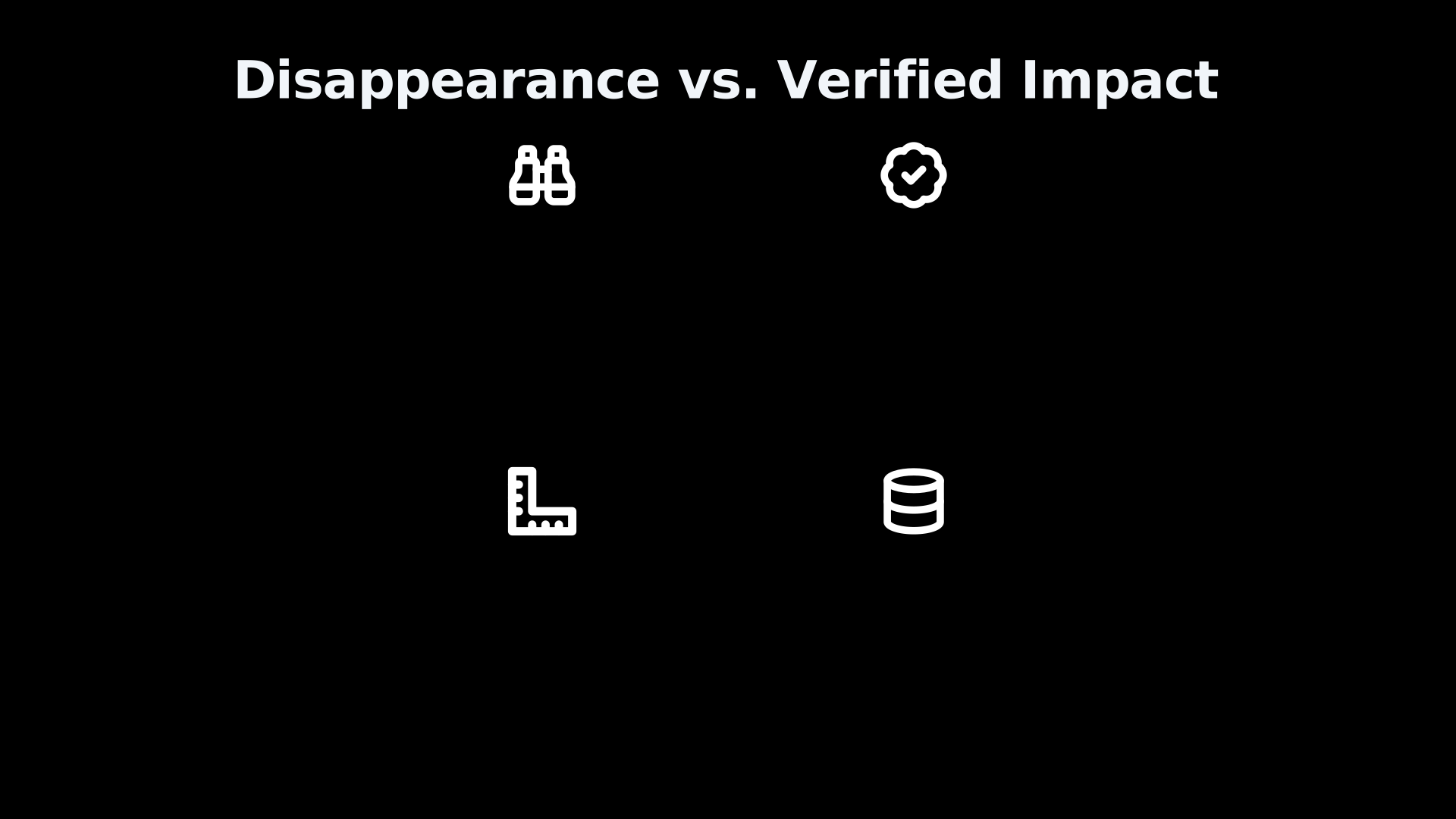
To establish that an object genuinely reached the ground, investigators need evidence beyond a single visual impression.
Useful confirmation would include:
- Independent observers viewing the event from widely separated locations, allowing the object’s three-dimensional position to be reconstructed.
- Accurate timing, synchronised between observers.
- Known observation points, so sight lines can be plotted on a map.
- Instrumental data, such as radar, tracking cameras or calibrated optical recordings.
- Physical evidence at the alleged impact location, including debris that can be verified as originating from the observed object.
If sight lines from multiple observers intersect above the terrain, the object remained airborne. If they converge at a specific ground location and are supported by physical evidence, a genuine impact becomes much more plausible.
Without this kind of triangulation, a witness can reliably report what they saw—a light descending and disappearing—but not whether the object actually reached the ground.
Why this matters when assessing UFO crash claims
Many alleged UFO crash stories begin with exactly this kind of observation: a bright object appears to descend behind distant terrain and is never seen again. On its own, that sequence demonstrates only that visual contact was lost.
Investigators therefore distinguish between a disappearance and a verified impact. A disappearing light may later prove to have been an aircraft flying beyond a ridge, a meteor passing behind distant hills, or another ordinary object whose path became hidden by terrain. The observation remains unidentified only until sufficient evidence establishes what happened. It does not, by itself, demonstrate that a vehicle crashed, nor does it support an extraterrestrial explanation.
Understanding how terrain can conceal distant lights helps explain why sincere witnesses may honestly report what looked like a crash even when the available evidence never confirms that any object actually struck the ground.[Federal Aviation Administration]faa.govFederal Aviation Administration Chapter 8. Medical Facts for PilotsFederal Aviation Administration Chapter 8. Medical Facts for Pilots
Amazon book picks
Further Reading
Books and field guides related to When Does a Disappearing Light Look Like a Crash?. Use these as the next step if you want deeper reading beyond the article.
The Demon-Haunted World
NEW YORK TIMES BESTSELLER • From the renowned astronomer and author of Cosmos comes a “powerful [and] stirring defense of informed ration...
Optics
For courses in Optics A Contemporary Approach to Optics with Practical Applications and New Focused Pedagogy Hecht Optics balances theory...
The UFO Experience
Cited by the New York Review of Books as “the best brief for visitation,” this classic study presents an analysis of UFO reports and conc...
The Report on Unidentified Flying Objects
Edward J. Ruppelt's "The Report on Unidentified Flying Objects" serves as a pivotal text in the study of UFO phenomena, blending personal...
eBay marketplace picks
Marketplace Samples
Live-tested eBay searches with available results related to this page.
Selected fromUFO landscape poster oneBay.co.uk.




Endnotes
1.
Source: faa.gov
Title: Federal Aviation Administration Chapter 8. Medical Facts for Pilots
Link:https://www.faa.gov/Air_traffic/publications/atpubs/aim_html/chap8_section_1.html
2.
Source: faa.gov
Title: Federal Aviation Administration Chapter 7. Safety of Flight
Link:https://www.faa.gov/air_traffic/publications/atpubs/aim_html/chap7_section_6.html
3.
Source: faa.gov
Link:https://www.faa.gov/pilots/safety/pilotsafetybrochures/SpatialD.pdf
4.
Source: faa.gov
Title: Chapter 8
Link:https://www.faa.gov/air_traffic/publications/atpubs/aim_html/chap8_section_1.html?pubDate=20250723
Source snippet
Medical Facts for PilotsJuly 23, 2025 — 8-1-2. EFFECTS OF ALTITUDE 1. Hypoxia. 1. Hypoxia is a state of oxygen deficiency in the body suf...
Published: July 23, 2025
5.
Source: faa.gov
Title: Chapter 8
Link:https://www.faa.gov/air_traffic/publications/atpubs/aim/aim0801.html
Source snippet
Medical Facts for PilotsJanuary 8, 2015 — 1. Various complex motions and forces and certain visual scenes encountered in flight can creat...
Published: January 8, 2015
6.
Source: faa.gov
Link:https://www.faa.gov/air_traffic/publications/atpubs/aip_html/part2_enr_section_5.3.html
7.
Source: faa.gov
Link:https://www.faa.gov/air_traffic/publications/atpubs/aip_html/chap7_section_6.html
Additional References
8.
Source: pmc.ncbi.nlm.nih.gov
Link:https://pmc.ncbi.nlm.nih.gov/articles/PMC3710190/
Source snippet
and disorientation in aviation - PMCJanuary 3, 2013 — THE VISUAL ENVIRONMENT OF FLIGHT It is said that 80% of the information that a pilo...
Published: January 3, 2013
9.
Source: scientificamerican.com
Title: Aviator’s Dilemma: Pilots Encounter Illusions Everywhere | Scientific American
Link:https://www.scientificamerican.com/article/aviator-s-dilemma-pilots-encounter-illusions-everywhere/
Source snippet
August 1, 2016 — IRAQI NIGHTLIFE Gosden survived his mission by virtue of using his aircraft's forward-looking infrared (FLIR) optical ar...
Published: August 1, 2016
10.
Source: medium.com
Title: Your Senses in the Shadows
Link:https://medium.com/faa/your-senses-in-the-shadows-5ed018e015b5
Source snippet
Nighttime Visual Illusions and Spatial… | by FAA Safety Briefing Magazine | Cleared for Takeoff | MediumJanuary 17, 2025 — Cleared for Ta...
Published: January 17, 2025
11.
Source: youtube.com
Title: Optical illusion creates ‘UFO mirage’ over sea in Alaska
Link:https://www.youtube.com/watch?v=iennvrKaAzQ
Source snippet
Mick West UFO visual illusions perspective terrain Terrifying Moon falling CAUGHT ON CAMERA InsanePatient2...
12.
Source: youtube.com
Title: Light Pillars: What Are Those Mysterious Light Beams From The Sky?
Link:https://www.youtube.com/watch?v=0ttboaR5X4Q
Source snippet
Why Do Airplanes Sometimes “STOP” in the Sky? (It's Not an Illusion)...
13.
Source: youtube.com
Title: Why Do Airplanes Sometimes “STOP” in the Sky? (It’s Not an Illusion)
Link:https://www.youtube.com/watch?v=aczDrrZQIBI
Source snippet
Optical illusion creates 'UFO mirage' over sea in Alaska...
14.
Source: youtube.com
Title: Breakdown of the Pentagon UFO videos with Mick West
Link:https://www.youtube.com/watch?v=Le7Fqbsrrm8
Source snippet
Light Pillars: What Are Those Mysterious Light Beams From The Sky?...
15.
Source: youtube.com
Title: The SHOCKING Math Error Behind Viral UFO Videos | Mick West
Link:https://www.youtube.com/watch?v=ypfbhfEXnBo
Source snippet
Breakdown of the Pentagon UFO videos with Mick West...
16.
Source: tsb-bst.gc.ca
Link:https://tsb-bst.gc.ca/eng/rapports-reports/aviation/2016/a16p0180/a16p0180.html
Source snippet
Aviation Investigation Report A16P0180 - Transportation Safety Board of CanadaJanuary 24, 2018 — SPATIAL ORIENTATION AND OPTICAL ILLUSION...
Published: January 24, 2018
17.
Source: eepistula.com
Link:https://eepistula.com/faa/aim/chapter-7/section-7-6-14.html