Within Field Protocol
What Will the Weather Destroy First?
Temperature, wind, rain and soil conditions can change odours, deposits, thermal readings, corrosion and fragile ground impressions.
On this page
- Capturing conditions at the time of arrival
- Linking weather to vulnerable evidence
- Documenting approaching changes and exposure
Page outline Jump by section
Introduction
A reported UFO crash scene, if treated as an unknown accident, should be documented before investigators attempt to explain it. One of the fastest-changing parts of that record is the weather. Temperature, wind, rain, humidity and soil moisture can alter a scene within minutes, changing odours, washing away residues, flattening vegetation, degrading thermal signatures and obscuring or creating ground impressions. For that reason, weather is not simply background information. It is evidence that helps explain why later observations may differ from those made on arrival.
Because environmental conditions can transform an outdoor scene so rapidly, investigators should record both the weather they encounter and the weather expected during the next several hours. This creates a timeline showing what evidence may have been preserved, degraded or lost before recovery begins. Outdoor forensic guidance consistently identifies rain, wind, heat and cold as major threats to fragile evidence and recommends giving vulnerable outdoor scenes immediate attention.[National Institute of Justice]nij.ojp.govNational Institute of JusticeArchived | Crime Scene and DNA Basics for Forensic Analysts | Outdoor | National Institute of JusticeJune 15…
What Will the Weather Destroy First?
Not every form of evidence changes at the same rate. Some traces survive for weeks, while others begin disappearing almost immediately after exposure.
Among the most weather-sensitive features are:
- Surface deposits, including dust, soot, ash, metallic particles or unidentified residues that may be dispersed by wind or washed away by rain.
- Ground impressions, such as depressions in soft soil, mud, snow or loose vegetation, which can soften, collapse or fill with water.
- Thermal anomalies, which naturally diminish as objects and surrounding ground exchange heat with the environment.
- Odours, whether from fuels, burning materials, vegetation or other volatile compounds, which weaken as temperature, humidity and wind change.
- Moisture-sensitive corrosion or staining, which may develop, spread or disappear depending on rainfall and humidity.
In a claimed UFO crash, these changes do not imply anything extraordinary about the object itself. They simply demonstrate that environmental conditions can modify whatever physical traces exist, making early documentation essential before interpretation begins.
Capturing Conditions at the Time of Arrival
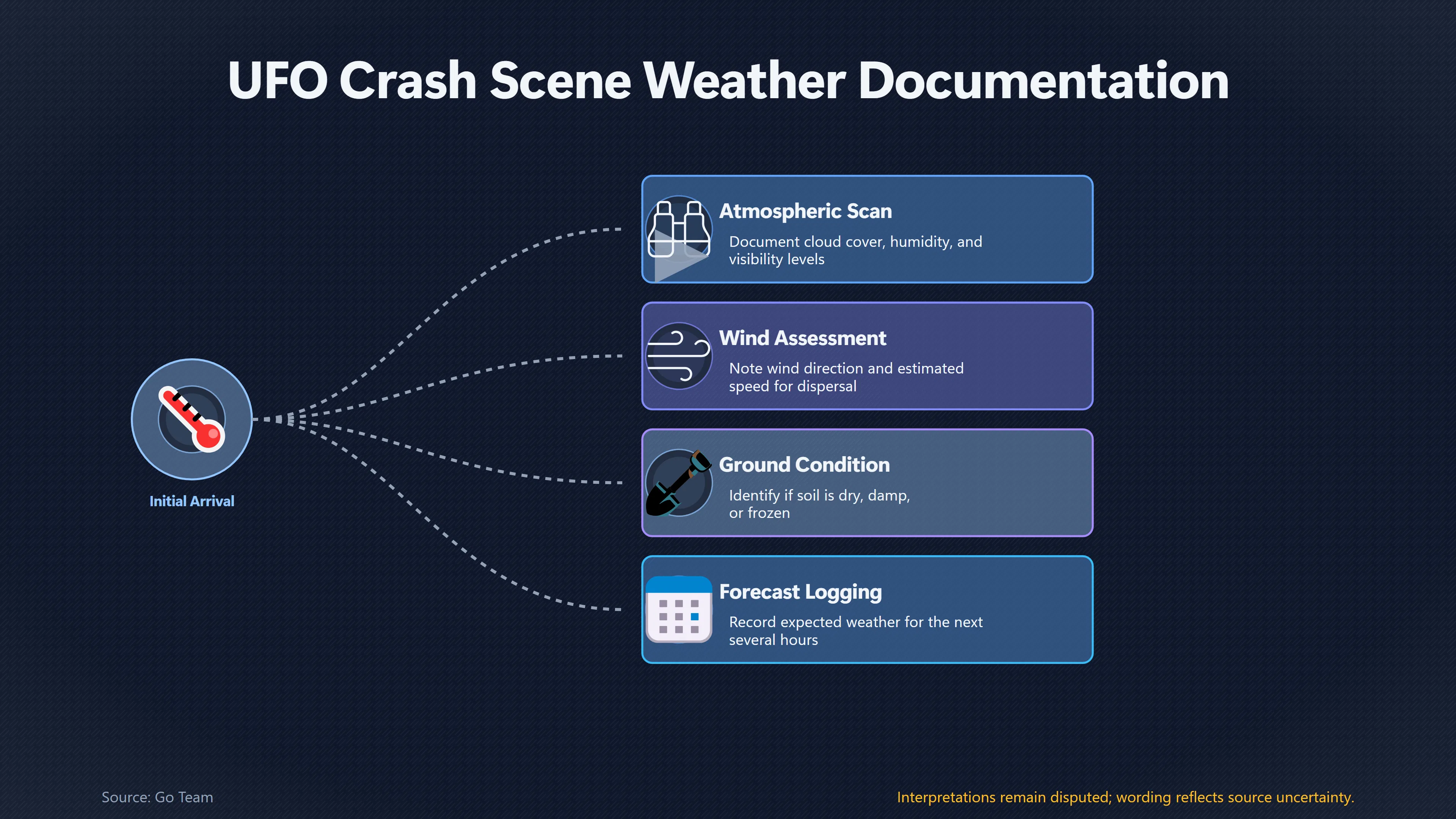
The first weather record should be created immediately after the scene is secured, before investigators concentrate on individual objects or fragments.
Useful observations include:
- exact arrival time
- air temperature
- cloud cover
- precipitation type and intensity
- wind direction and estimated speed
- humidity if available
- visibility
- recent weather remembered by witnesses or confirmed through nearby meteorological stations
- ground condition (dry, damp, saturated, frozen, snow-covered or dusty)
These observations should be accompanied by photographs showing the overall sky, shadows, cloud cover and the condition of the surrounding terrain. Images taken from fixed reference points become valuable later if the scene changes dramatically.
Where available, official meteorological observations from the nearest weather station can later supplement field notes. Aviation accident investigations routinely integrate weather observations into factual reconstruction rather than relying solely on investigators’ recollections. The US National Transportation Safety Board (NTSB) includes dedicated weather specialists who gather meteorological information relevant to the accident scene.[NTSB]ntsb.govGo TeamNTSB Go Team…
Linking Weather to Vulnerable Evidence
Weather records become most valuable when directly connected to specific observations instead of being stored separately.
For example:
- A dark stain photographed before rainfall may disappear completely after twenty minutes of heavy rain.
- Dust deposited on vegetation may be absent later because increasing winds removed it.
- A warm fragment identified during the first thermal scan may cool naturally, making later measurements appear inconsistent.
- Soft soil impressions may become deeper after rain or shallower as their edges collapse.
Recording these relationships prevents investigators from mistakenly treating natural environmental change as evidence of tampering or concealment.
This approach is particularly important when witnesses arrive at different times. One person may truthfully report a strong chemical smell, while another arriving an hour later notices nothing. Changes in wind direction, atmospheric mixing and temperature may explain the difference without requiring contradictory witness accounts.
Documenting Approaching Changes and Exposure
The initial weather record should not end with current conditions. Investigators should also document expected changes that could threaten the scene.
Examples include:
- approaching thunderstorms
- forecast heavy rainfall
- rising temperatures
- overnight freezing
- increasing winds
- incoming snowfall
- tidal movement if near water
Knowing that rain is expected within thirty minutes may justify prioritising photographs, residue sampling and impression recording before other lower-risk documentation.
Similarly, an approaching frost may preserve some impressions while obscuring others beneath ice, whereas intense afternoon sunlight may rapidly reduce temperature differences that were visible shortly after impact.
Rather than assuming the scene is static, investigators should treat weather as an active process continuously modifying evidence.
Why Soil Conditions Matter
Soil records deserve special attention because weather affects them differently depending on local conditions.
Investigators should note whether the ground is:
- loose or compact
- clay, sand or organic soil
- waterlogged
- frozen
- recently cultivated
- covered by leaf litter or grass
Rain falling onto dry sandy soil produces different effects from rain falling onto saturated clay. Footprints, tyre tracks, drag marks and impact depressions may enlarge, soften or disappear at different rates depending on the substrate.
Photographs should therefore capture both the impression itself and the surrounding soil texture before weather changes alter the context.
Weather Can Change the Meaning of Thermal Evidence
Infrared cameras are increasingly used during searches because they reveal temperature differences invisible to the eye. However, these differences are temporary.
Surface heating from sunlight, cooling after sunset, rainfall and wind all influence thermal patterns. A warm object placed on cool ground may become indistinguishable after sufficient time has passed, while direct sunlight may create apparent hotspots unrelated to the event under investigation.
Accordingly, thermal images should always be accompanied by records of:
- ambient air temperature
- approximate surface temperature if measured
- cloud cover
- recent sunlight exposure
- wind conditions
- time of image capture
Without this context, later reviewers cannot determine whether a thermal anomaly reflects the original event or ordinary environmental heating and cooling.
Preserving the Timeline of Environmental Change
Weather documentation should continue throughout scene processing rather than remaining a single arrival note.
Whenever significant conditions change, investigators should record:
- the time of change
- the new conditions
- which areas of the scene were affected
- which evidence had already been documented
- what remained exposed
This running environmental log allows later analysts to understand why evidence collected at different times may appear different even when nothing was moved or contaminated.
Outdoor forensic guidance consistently emphasises that environmental exposure rapidly degrades physical evidence through rain, wind, temperature and other natural processes, making prompt documentation and protection of vulnerable traces a priority.[National Institute of Justice]nij.ojp.govNational Institute of JusticeArchived | Crime Scene and DNA Basics for Forensic Analysts | Outdoor | National Institute of JusticeJune 15…
Amazon book picks
Further Reading
Books and field guides related to What Will the Weather Destroy First?. Use these as the next step if you want deeper reading beyond the article.
Practical Crime Scene Processing and Investigation
All too often, the weakest link in the chain of criminal justice is the crime scene investigation. Improper collection of evidence blocks...
Techniques of Crime Scene Investigation
"Techniques of Crime Scene Investigation is a staple for any forensic science library and is routinely referenced by professional organiz...
Forensic Taphonomy: The Postmortem Fate of Human Remains
Links have recently been established between the study of death assemblages by archaeologists and paleontologists (taphonomy) and the app...
Environmental Forensics: Contaminant Specific Guide
Environmental forensics is the application of scientific techniques for the purpose of identifying the source and age of a contaminant. O...
eBay marketplace picks
Marketplace Samples
Live-tested eBay searches with available results related to this page.
Selected fromRoswell UFO poster oneBay.co.uk.



Endnotes
1.
Source: ntsb.gov
Title: Go Team
Link:https://www.ntsb.gov/investigations/process/Pages/goteam.aspx
Source snippet
NTSB Go Team...
2.
Source: ntsb.gov
Title: The Investigative Process
Link:https://www.ntsb.gov/investigations/process/Pages/default.aspx
Source snippet
The Investigative Process...
3.
Source: data.ntsb.gov
Link:https://data.ntsb.gov/Docket?ProjectID=199662
Source snippet
Management SystemFebruary 11, 2026 — 21 | WEATHER ATTACHMENT 2 - PAOM MAINTENANCE LOGS | 2 | 0 | Text/Image | View 22 | WEATHER AT...
Published: February 11, 2026
4.
Source: ntsb.gov
Link:https://www.ntsb.gov/Pages/aviationreport.aspx/1000
5.
Source: ntsb.gov
Title: Media Resources
Link:https://www.ntsb.gov/news/Pages/media_resources.aspx
6.
Source: data.ntsb.gov
Link:https://data.ntsb.gov/Docket?ProjectID=99477
7.
Source: ntsb.gov
Title: Flight in Snow
Link:https://www.ntsb.gov/Advocacy/safety-alerts/Pages/SA-082.aspx
8.
Source: ntsb.gov
Link:https://www.ntsb.gov/news/Pages/cvr_fdr.aspx
9.
Source: nij.ojp.gov
Link:https://nij.ojp.gov/nij-hosted-online-training-courses/crime-scene-and-dna-basics-forensic-analysts/evidence-crime-scene/crime-scenes/outdoor
Source snippet
National Institute of JusticeArchived | Crime Scene and DNA Basics for Forensic Analysts | Outdoor | National Institute of JusticeJune 15...
10.
Source: nij.ojp.gov
Link:https://nij.ojp.gov/library/publications/crime-scene-investigation-guide-law-enforcement
11.
Source: nij.ojp.gov
Link:https://nij.ojp.gov/nij-hosted-online-training-courses/collecting-dna-evidence-at-property-crime-scenes/crime-scenes/outdoor-crime-scenes
Source snippet
National Institute of JusticeArchived | Collecting DNA Evidence at Property Crime Scenes | Outdoor Crime Scenes | National Institute of J...
12.
Source: nij.ojp.gov
Link:https://nij.ojp.gov/nij-hosted-online-training-courses/collecting-dna-evidence-at-property-crime-scenes/types-of-evidence/integrity-biological-evidence
Source snippet
National Institute of JusticeArchived | Collecting DNA Evidence at Property Crime Scenes | Integrity of Biological Evidence | National In...
13.
Source: GOV.UK
Title: www.gov.uk Forensic science activities: statutory code of practice
Link:https://www.gov.uk/government/publications/forensic-science-activities-statutory-code-of-practice-version-2/forensic-science-activities-statutory-code-of-practice-version-2-accessible
14.
Source: GOV.UK
Title: www.gov.uk Incident scene examination (accessible)
Link:https://www.gov.uk/government/publications/incident-scene-examination-fsr-gui-0006/incident-scene-examination-accessible
15.
Source: GOV.UK
Title: www.gov.uk [Contamination]({{ ‘contamination/’ | relative_url }}) controls: scene of crime (accessible)
Link:https://www.gov.uk/government/publications/crime-scene-dna-anti-contamination-guidance/contamination-controls-scene-of-crime-accessible
16.
Source: nij.ojp.gov
Link:https://nij.ojp.gov/redirect-legacy/evidence/more-evidence/Crime_Scenes/Outdoor/
17.
Source: nij.ojp.gov
Link:https://nij.ojp.gov/es/node/183266
18.
Source: nij.ojp.gov
Link:https://nij.ojp.gov/es/node/181401
19.
Source: ojp.gov
Link:https://www.ojp.gov/library/publications/crime-scene-investigation-guide-law-enforcement-0
21.
Source: law.lawstack.com
Title: com49 CFR §831.13 — Provision and dissemination of… | Law Stack
Link:https://law.lawstack.com/cfr/49/831.13/
Source snippet
Verified against eCFR.gov as of June 20, 2026View official text on eCFR.gov ↗[Button: Copy link] 1. (a)Applicability. This...
22.
Source: youtube.com
Title: Crime Scene Evidence | National Geographic
Link:https://www.youtube.com/watch?v=EQUE8IeVmpA
Source snippet
This video shows how forensic meteorologists analyze weather data to understand past environmental conditions, which directly explains ho...
23.
Source: youtube.com
Title: Protecting the Crime Scene, Recognizing and Searching For Evidence
Link:https://www.youtube.com/watch?v=UiOZ9simwHc
Source snippet
Documenting the Crime Scene Part 2: Photography and Videography...
24.
Source: nist.gov
Link:https://www.nist.gov/trace-evidence
25.
Source: youtube.com
Title: Documenting the Crime Scene Part 1: Notes and Sketches
Link:https://www.youtube.com/watch?v=QiSPfAA1aVU
Source snippet
Protecting the Crime Scene, Recognizing and Searching For Evidence...
26.
Source: store.astm.org
Link:https://store.astm.org/e3272-23.html
Source snippet
astm.orgE3272 Standard Guide for Collection of Soils and Other Geological Evidence for Criminal Forensic ApplicationsJuly 8, 2026 — ASTM...
Published: July 8, 2026
27.
Source: youtube.com
Title: Documenting the Crime Scene Part 2: Photography and Videography
Link:https://www.youtube.com/watch?v=mLCrofqANy0
Source snippet
Crime Scene Evidence | National Geographic...
28.
Source: youtube.com
Title: SITM: The History and Science of Forensic Meteorology
Link:https://www.youtube.com/watch?v=VcrFkeo6Kts
Source snippet
Documenting the Crime Scene Part 1: Notes and Sketches...
29.
Source: safetylit.org
Link:https://www.safetylit.org/citations/index.php?citationIds%5B%5D=citjournalarticle_631844_29&fuseaction=citations.viewdetails
30.
Source: canada.ca
Link:https://www.canada.ca/en/environment-climate-change/services/weather-manuals-documentation/manobs-surface-observations.html