Within UFO Crashes
The Strange Devices Found in Balloon Debris
Lightweight radar targets used foil, sticks and unusual assembly methods that could appear mysterious when found far from a launch site.
On this page
- How radar reflectors were constructed
- Why their materials confused witnesses
- Their role in the Roswell explanation
Page outline Jump by section
Introduction
The “exotic” wreckage associated with Roswell was most likely the remains of lightweight radar reflectors: collapsible, kite-like targets made from metallic foil, paper, adhesive tape and thin wooden struts. Their purpose was not to fly independently but to hang beneath balloons and produce a strong radar return, allowing technicians to track winds or experimental balloon trains. Once torn apart, weathered and scattered across an isolated ranch, the components could look far stranger than their humble ingredients suggest.
This matters because the reflector hypothesis explains several otherwise puzzling details in the earliest Roswell accounts: shiny sheets, tough paper, broken sticks, rubber fragments, geometric shapes and decorated tape. It also explains how a large-looking airborne device could collapse into a small, extremely light bundle. The precise balloon flight responsible remains disputed, but the physical character of radar-target debris closely matches the contemporary descriptions far better than later stories of indestructible extraterrestrial metal.
How radar reflectors were constructed
A 1940s radar reflector was essentially a deliberately conspicuous radar target built from materials chosen for low weight rather than strength. A balloon carried it into the upper atmosphere, while radar operators followed the reflected signal to calculate the balloon’s position and, from its movement, the speed and direction of high-altitude winds. This technique was known as “rawin”, a contraction of “radar wind”.[Glossary of Meteorology]glossary.ametsoc.orgGlossary of MeteorologyrawinGlossary of Meteorology# rawin… It is accomplished by tracking a balloon-borne radar target, responder, or radiosonde transmitter with…
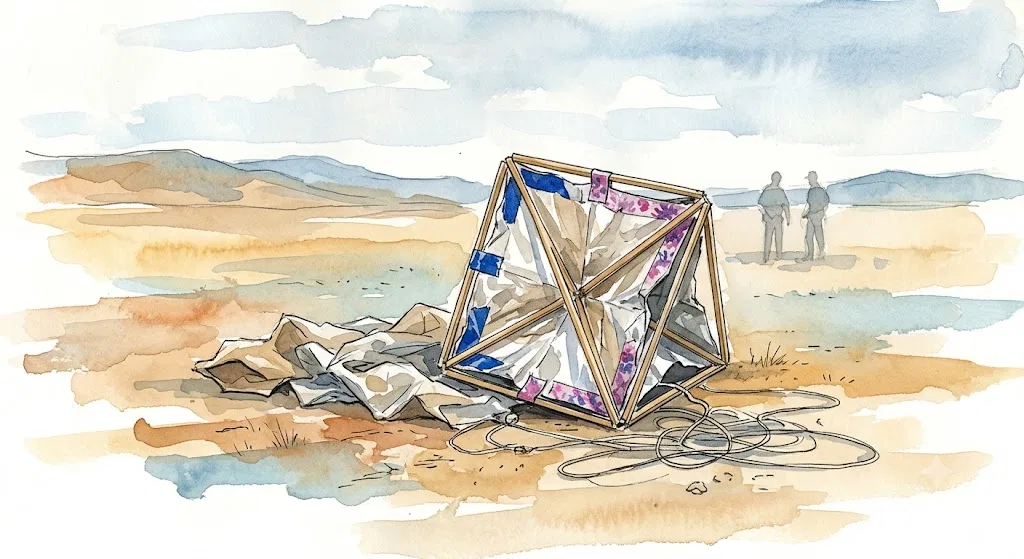
The familiar wartime and early post-war reflector resembled a box kite or a cluster of intersecting geometric panels. Thin balsa-wood members held sheets of paper-backed metallic foil at carefully arranged angles. The geometry formed corner reflectors: surfaces positioned so that incoming radar energy would be directed back towards its source over a useful range of orientations. The structure did not need an engine, substantial metal frame or electrical system. Its ability to appear prominently on radar came from shape and surface conductivity, not mass. Contemporary technical material describes balloon targets made from paper-backed laminated foil and lightweight ribs, while the Air Force’s Roswell investigation characterised the devices as multisided, kite-like structures of metallic paper and balsa wood.[NIST Publications]nvlpubs.nist.govreflector enclosed in a 350 gram balloon given a 1750 gram free liThe balsa wood ribs are removed and the target is held open by the…
The ML-307 family of rawin targets, often discussed in connection with Roswell, was designed to be packed compactly and opened for flight. When intact, its intersecting panels could produce a diamond-like or angular outline. When crushed, it ceased to resemble a coherent instrument at all. The result was a mixture of:
- crinkled reflective sheets;
- stiff or waxy paper backing;
- short, splintered wooden strips;
- adhesive tape and glue;
- cords, eyelets or attachment points;
- balloon rubber and rigging from the larger airborne assembly.
That combination is important. A conventional weather balloon alone would mostly leave rubber and perhaps a small instrument package. A balloon train fitted with several radar targets could leave a broad field of bright, angular debris whose function was not obvious to a rancher or even to military personnel unfamiliar with meteorological tracking equipment.

Why such flimsy devices worked
Radar reflectivity can be misleading to anyone judging an object by touch or weight. A large aircraft returns radar energy partly because of its conductive surfaces and geometry, but a much lighter object can be made conspicuous by arranging metallic panels as corner reflectors. The target therefore offered a large effective radar signature without requiring a heavy metal body.
This created a striking mismatch between appearance and substance. In the air, an expanded reflector might look broad, rigid and machine-like. On the ground, it could be folded, flattened or shredded into what seemed like foil from a confectionery wrapper attached to sticks. A 1949 popular account described rawin devices as six-cornered foil targets suspended beneath balloons and identified them as a common source of mistaken “flying saucer” reports.[Project 1947]project1947.comsatevepost 43049Dangling below each balloon, however, is a six-cornered "target" of aluminum foil, strung out on kitelike sticks…
Why the materials confused witnesses
The strongest reason to connect radar targets with the Roswell debris is not that every later recollection matches them. It is that the earliest detailed description does.
The 9 July 1947 account attributed to rancher W. W. “Mack” Brazel described a wide area of bright wreckage composed of rubber strips, tinfoil, tough paper and sticks. The gathered foil, paper, tape and sticks reportedly formed a relatively small bundle, while the rubber could also be rolled together. The account mentioned no engine, propeller, substantial machinery or heavy structural metal.[NSA]nsa.govreport af roswellreport af roswell
Those materials are ordinary when listed separately. Their assembly was not. A rancher encountering laminated foil stretched over a delicate framework, miles from an identifiable launch site, had little reason to recognise it as a radar device. Exposure to sun, wind and rain would further alter its appearance:
Foil could behave unlike household foil. Metallic material bonded to paper had more body than a loose kitchen sheet. It could resist tearing in one direction, spring back partly because of its backing, or seem unusually tough when folded as a laminate.
Glue could stiffen the wooden members. Balsa is extremely light, but a coating of adhesive and attached paper could make thin strips feel more like manufactured composite pieces than ordinary twigs.
Weathering could darken or distort balloon rubber. Neoprene left outdoors could become brittle, smoky-grey or degraded, making it less recognisable than a fresh weather balloon.
The reflector’s geometry could resemble symbols after destruction. Torn braces, printed tape and overlapping foil could leave short coloured markings or repeated shapes on fragments. Removed from the complete device, these details could be remembered as writing rather than decoration.
The unusual tape is the most memorable example. Brazel’s contemporary account referred to tape bearing a floral pattern. Decades later, members of Jesse Marcel’s family described purple or violet geometric markings that appeared somewhat like hieroglyphs. The Air Force investigation argued that some wartime radar targets were assembled with decorative tape produced by toy or novelty manufacturers, including purplish-pink patterns containing flowers or hearts.[Defense Logistics Agency]esd.whs.milDefense Logistics AgencyThe Roswell reportML-307B/AP Radar Target on Ground. Considerable srotch tape and some tape with flowers prlnted…
That comparison is suggestive rather than conclusive. No fragment with an unbroken chain of custody from the ranch survives for direct matching, and the patterned-tape explanation relies partly on interviews and reconstructed examples. Nevertheless, floral or decorative tape provides a mundane mechanism by which factory ornamentation could later become “unknown writing” in memory.
How ordinary debris became “memory metal”
The most dramatic descriptions of Roswell material did not appear in the surviving accounts from July 1947. Claims that the foil could not be cut, burned, dented or permanently folded became prominent decades later, particularly after former intelligence officer Jesse Marcel began discussing the incident publicly in the late 1970s. The Air Force review noted the contrast between the early record of paper, sticks, tape and foil and later stories involving exotic metals, fibre-like components and hieroglyphic markings.[NSA]nsa.govreport af roswellreport af roswell
This time gap does not prove that later witnesses were dishonest. Memory is reconstructive, especially when an event has been repeatedly discussed, illustrated and dramatised. Several processes can turn unfamiliar but ordinary wreckage into something more extraordinary:
- A foil-and-paper laminate may be remembered simply as “metal”, losing the paper component in retelling.
- Elastic recovery from creasing can become a claim that the material always returned perfectly to shape.
- Difficulty tearing reinforced material by hand can become “it could not be cut”.
- Printed decoration can become inscriptions or characters.
- A broad debris field can become evidence of a large vehicle even when the recovered material weighs very little.
The distinction between contemporary and retrospective testimony is therefore crucial. The 1947 description is not merely earlier; it is more mechanically specific. It names components that fit a broken airborne target. Later descriptions tend to emphasise extraordinary properties while becoming less precise about how the pieces were joined and what complete object they formed.
There is also a genuine point of dispute. Some Roswell advocates argue that the debris photographed in General Roger Ramey’s office was substituted for the material recovered at the ranch. Under that interpretation, the visible radar target proves only that officials displayed one, not that it was the original wreckage. The substitution claim, however, lacks contemporaneous documentation or a surviving second set of materials. The photographed debris, the July newspaper description and the FBI teletype all independently point towards a balloon-and-reflector assembly.[NSA]nsa.govreport af roswellreport af roswell
Their role in the Roswell explanation
The radar reflectors form the physical bridge between the 1947 “weather balloon” announcement and the later Project Mogul explanation. Project Mogul was an early Cold War effort that used high-altitude balloon trains and acoustic equipment in an attempt to detect evidence of Soviet nuclear tests. Its scientific purpose was sensitive, but much of its hardware consisted of recognisable, commercially available or military-standard balloon equipment, including balloons, lines, instruments and radar targets.[NSA]nsa.govreport af roswellreport af roswell
This distinction helps explain the confused official messaging. Calling the wreckage a weather balloon was broadly descriptive but incomplete. Officials could discuss the expendable balloon and radar hardware without revealing the classified purpose of the larger experimental programme. The secrecy concerned what the balloon train was intended to detect, not the invention of a revolutionary material.
The FBI teletype sent on 8 July 1947 is especially significant because it records the reflector interpretation before the event became a long-running UFO legend. It described the reported “disc” as hexagonal, suspended from a balloon by cable, and resembling a high-altitude weather balloon with a radar reflector. The message also noted that the material was being sent for further examination, showing that the first identification was not presented as entirely settled at the moment of transmission.[FBI]vault.fbi.gov— Federal Bureau of Investigation— Federal Bureau of Investigation
The Air Force’s 1994 investigation concluded that the recovered material most probably came from an unrecovered Mogul balloon device. It associated the Roswell debris with a June 1947 balloon cluster commonly labelled Flight No. 4, which may have carried multiple reflectors.[NSA]nsa.govreport af roswellreport af roswell
The exact flight attribution is less secure than the material comparison. Critics note that Project Mogul records are incomplete and that Albert Crary’s diary says formal balloon activity was curtailed by cloud on 4 June, although it also records a cluster of balloons carrying a sonobuoy. Researchers continue to dispute whether this improvised launch should be called Flight No. 4, how it was configured and whether it carried the required number of radar targets.[astronomyufo.com]astronomyufo.comOpen source on astronomyufo.com.
That uncertainty should not be blurred into certainty about an alien craft. Two different questions are involved:
- Can a particular documented Mogul launch be proven to have landed on the Foster ranch? Not with complete precision from the surviving records.
- Do 1940s balloon and radar-target materials explain the debris described in 1947? They provide a close and technically coherent match.
The second conclusion does not depend entirely on identifying a numbered flight. A missing or poorly documented balloon train could still shed the same kinds of rubber, foil-backed paper, tape and balsa. Conversely, uncertainty about the launch log does not transform those materials into evidence of extraterrestrial manufacture.
What the reflector explanation resolves
Radar reflectors account for the features of the Roswell debris that can otherwise seem contradictory. They were large in operation but tiny when collapsed; conspicuous to radar but nearly weightless; geometrically complex but built from paper, foil and wood; military in use but toy-like in construction. Their decorative assembly materials could also create marks that looked purposeful without being an unknown script.
Most importantly, the explanation fits evidence created before Roswell became a cultural story about alien bodies and recovered technology. The contemporary trail contains a rancher’s description of foil, paper, tape, sticks and rubber; a military assessment of balloon debris; an FBI message mentioning a radar reflector; and photographs showing a shattered foil-and-strut target. None establishes every detail of the object’s route or project identity, but together they describe a lightweight airborne apparatus rather than the wreckage of a powered spacecraft.[NSA]nsa.govreport af roswellreport af roswell
The enduring mystery is therefore less about an unknown substance than about perception. A specialised device can look exotic when its shape has been destroyed, its purpose is classified, its parts are found far from where it was launched and its story is retold for decades. At Roswell, the radar reflector was ordinary technology encountered under extraordinary circumstances—and that combination proved powerful enough to help build the world’s most famous UFO-crash legend.

Amazon book picks
Further Reading
Books and field guides related to The Strange Devices Found in Balloon Debris. Use these as the next step if you want deeper reading beyond the article.
Roswell: Inconvenient Facts and the Will to Believe
For over fifty years an incident near Roswell, New Mexico, has sparked the imaginations of UFO enthusiasts. Did the military recover a cr...
The Roswell Report: Case Closed
In "The Roswell Report: Case Closed," James McAndrew meticulously examines one of the most controversial events in UFO history: the alleg...
The Roswell Report: Fact versus Fiction in the New Mexico Desert
The Roswell Report: Fact Versus Fiction in the New Mexico Desert is the first of two reports discussing the supposed crash landing of an...
The Invention that Changed the World
The atomic bomb may have ended world War II, but in many ways it was radar that won it. Here is the compelling true story of the colorful...
eBay marketplace picks
Marketplace Samples
Live-tested eBay searches with available results related to this page.
Selected fromUFO poster oneBay.co.uk.


Current eBay listing
I Want To Believe UFO Poster Giclée Fine Art Heavyweight Print
Current eBay listing
VINTAGE UFO FLYING SAUCERS COMIC ADVERTISING A2 POSTER PRINT
Endnotes
1.
Source: nvlpubs.nist.gov
Link:https://nvlpubs.nist.gov/nistpubs/Legacy/crpl/crpl-2-1.pdf
Source snippet
reflector enclosed in a 350 gram balloon given a 1750 gram free liThe balsa wood ribs are removed and the target is held open by the...
2.
Source: project1947.com
Title: satevepost 43049
Link:https://www.project1947.com/fig/satevepost_43049.htm
Source snippet
Dangling below each balloon, however, is a six-cornered "target" of aluminum foil, strung out on kitelike sticks...
3.
Source: nsa.gov
Title: report af roswell
Link:https://www.nsa.gov/portals/75/documents/news-features/declassified-documents/ufo/report_af_roswell.pdf
4.
Source: vault.fbi.gov
Title: — Federal Bureau of Investigation
Link:https://vault.fbi.gov/Roswell%20UFO
5.
Source: media.defense.gov
Title: GENERAL ACCOUNTING OFFICE S SCHIFF
Link:https://media.defense.gov/2021/Jul/13/2002761373/-1/-1/0/GENERAL_ACCOUNTING_OFFICE_S_SCHIFF.PDF
6.
Source: astronomyufo.com
Link:https://www.astronomyufo.com/UFO/Mogul.htm
7.
Source: media.defense.gov
Title: AFD 101027 030
Link:https://media.defense.gov/2010/Oct/27/2001330219/-1/-1/0/AFD-101027-030.pdf
8.
Source: astronomyufo.com
Link:https://www.astronomyufo.com/UFO/flight4.htm
9.
Source: glossary.ametsoc.org
Title: Glossary of Meteorologyrawin
Link:https://glossary.ametsoc.org/wiki/rawin/
Source snippet
Glossary of Meteorology# rawin... It is accomplished by tracking a balloon-borne radar target, responder, or radiosonde transmitter with...
10.
Source: esd.whs.mil
Link:https://www.esd.whs.mil/Portals/54/Documents/FOID/Reading%20Room/UFOsandUAPs/RoswellReportCaseClosed.pdf
Source snippet
Defense Logistics AgencyThe Roswell reportML-307B/AP Radar Target on Ground. Considerable srotch tape and some tape with flowers prlnted...
11.
Source: Wikipedia
Title: Project Mogul
Link:https://en.wikipedia.org/wiki/Project_Mogul
12.
Source: sgp.fas.org
Link:https://sgp.fas.org/othergov/roswell.html
13.
Source: esd.whs.mil
Link:https://www.esd.whs.mil/Portals/54/Documents/FOID/Reading%20Room/UFOsandUAPs/rosswe1.pdf
14.
Source: library.metoffice.gov.uk
Link:https://library.metoffice.gov.uk/Portal/recordview/index/631806
15.
Source: abcnews.com
Link:https://abcnews.com/Technology/fbi-vault-reveals-ufo-roswell-files/story?id=13347754
16.
Source: journals.ametsoc.org
Title: 1520 0450 1965 004 0122 sbfwr 2 0 co 2.xml
Link:https://journals.ametsoc.org/view/journals/apme/4/1/1520-0450_1965_004_0122_sbfwr_2_0_co_2.xml
Additional References
17.
Source: muller.lbl.gov
Link:https://muller.lbl.gov/teaching/physics10/Roswell/USMogulReport.html
Source snippet
Muller LabProject MogulRawin is short for radar wind, a technique in which a single comer reflector is towed aloft by a single neoprene b...
18.
Source: youtube.com
Link:https://www.youtube.com/watch?v=vp36IwCs9_k
Source snippet
DECLASSIFIED ROSWELL REPORT 1994 Full Air Force Video | Mogul Balloons/Aliens– Holds Up in 2026?...
19.
Source: youtube.com
Link:https://www.youtube.com/watch?v=tK8oBA3X9uw
Source snippet
Roswell: The Real Cover-Up Wasn't Aliens...
20.
Source: youtube.com
Link:https://www.youtube.com/watch?v=qwgYcnatLm0
Source snippet
Roswell Unpacked: 1947 Debris, Project Mogul, 1994 Air Force Report...
21.
Source: youtube.com
Title: Roswell: The Real Cover-Up Wasn’t Aliens
Link:https://www.youtube.com/watch?v=pmCTVKbpnbw
Source snippet
Roswell radar reflectors balsa wood foil Project Mogul Roswell: The Real Cover-Up Wasn't Aliens Dust of Empires...
22.
Source: Wikipedia
Title: Roswell incident
Link:https://en.wikipedia.org/wiki/Roswell_incident
Source snippet
Debris found by a rancher in 1947 near Roswell, New Mexico, has become the basis for UFO conspiracy theories alleging that the United Sta...
23.
Source: dafhistory.af.mil
Link:https://www.dafhistory.af.mil/Portals/16/documents/AFD-101201-038.pdf
24.
Source: qsl.net
Link:https://www.qsl.net/py4sm/transistor-in.htm
25.
Source: reddit.com
Link:https://www.reddit.com/r/UFOs/comments/wgu7by/roswell_crash_wasnt_a_weather_balloon/
26.
Source: reddit.com
Link:https://www.reddit.com/r/UFOs/comments/1tfzswq/roswell_incident_after_reading_the_declassified/