Within Material Testing
Did the Layered Magnesium Sample Hide Alien Technology?
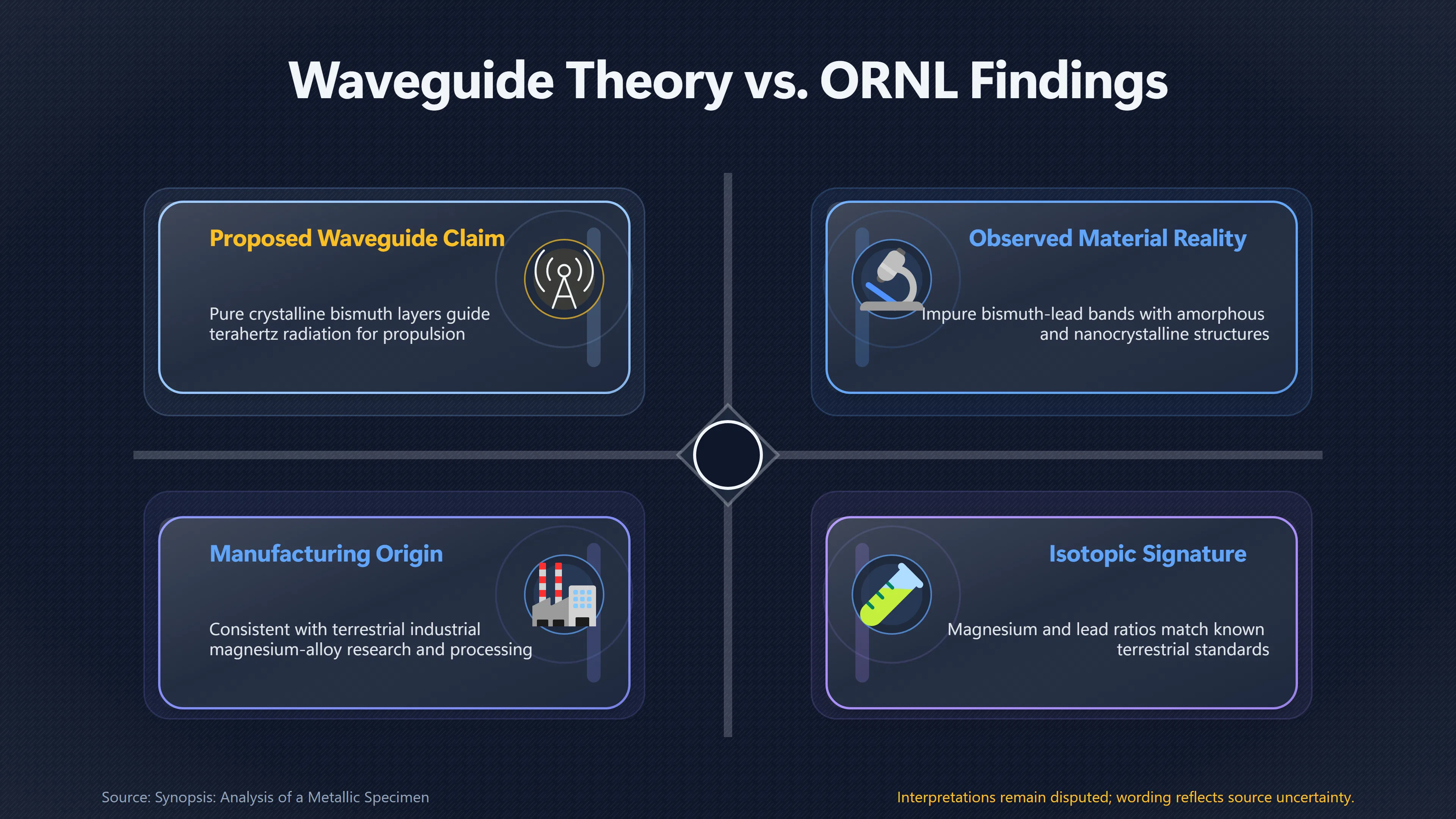
Oak Ridge found ordinary magnesium-alloy structures where advocates had proposed a precisely layered alien terahertz device.
On this page
- What the waveguide claim required
- What microscopy found inside the bands
- Why the terrestrial alloy explanation prevailed
Page outline Jump by section
Introduction
A layered magnesium specimen, sometimes nicknamed “Art’s Parts”, became one of the most discussed alleged pieces of UFO debris because advocates argued that its unusual internal structure was evidence of advanced engineering rather than an ordinary alloy. The central claim was not simply that the metal looked unusual, but that alternating layers of magnesium and bismuth formed a terahertz (THz) waveguide capable of enabling exotic effects such as inertial mass reduction or “antigravity”.

Independent laboratory testing has not supported that interpretation. After extensive examination for the U.S. All-domain Anomaly Resolution Office (AARO), scientists at Oak Ridge National Laboratory (ORNL) concluded that the specimen is consistent with a terrestrial magnesium alloy manufactured by conventional industrial methods. They also found that its microscopic structure does not satisfy the theoretical requirements proposed for a terahertz waveguide.[AARO]aaro.milSynopsis: Analysis of a Metallic SpecimenSynopsis: Analysis of a Metallic SpecimenJuly 10, 2024…
What the waveguide claim required
The waveguide hypothesis emerged from broader speculation that carefully engineered layered materials—sometimes described as metamaterials—might manipulate electromagnetic waves in unconventional ways. Within UFO literature, the magnesium specimen was presented as a possible example of such engineering.
The specific version of the claim proposed that:
- an extremely pure crystalline layer of bismuth was embedded within magnesium;
- the interfaces between the materials had been manufactured with exceptional precision;
- the resulting structure could guide terahertz-frequency electromagnetic radiation; and
- this hypothetical capability might contribute to propulsion or inertial effects beyond known aerospace technology.
These ideas attracted attention because layered artificial materials are genuine areas of materials science research. Engineers routinely manufacture structures with carefully controlled electromagnetic properties for applications ranging from antennas to photonics. However, demonstrating that a specimen is an engineered metamaterial requires direct physical evidence of the necessary structure and performance—not simply the presence of alternating metallic layers.[AARO]aaro.milSynopsis: Analysis of a Metallic SpecimenSynopsis: Analysis of a Metallic SpecimenJuly 10, 2024…
Importantly, no published experimental demonstration has shown that the proposed magnesium–bismuth configuration can generate the extraordinary propulsion effects attributed to it in UFO claims.
What microscopy found inside the bands
ORNL analysed the specimen using multiple complementary techniques, including optical microscopy, electron microscopy, elemental mapping, laser-ablation mass spectrometry and isotope measurements. Rather than relying on one instrument, researchers compared the specimen’s chemistry, crystal structure and microscopic architecture across several scales.[AARO]aaro.milSynopsis: Analysis of a Metallic SpecimenSynopsis: Analysis of a Metallic SpecimenJuly 10, 2024…
The investigation found several features that differed from the popular description of the material.
First, the dark bands were not composed of pure bismuth. Instead, they contained approximately equal amounts of bismuth and lead, together with additional trace elements. High-resolution elemental mapping showed repeated bismuth–lead bands running through the specimen rather than a single isolated bismuth layer.[AARO]aaro.mils Supplement to Oak Ridge National Laboratory's Analysis of a Metallic SpecimenAARO's Supplement to Oak Ridge National Laboratory's Analysis of a Metallic Specimen…
Second, transmission electron microscopy showed that the magnesium portion had an ordinary crystalline structure consistent with conventional magnesium alloys. The supposed bismuth layers were not large, continuous single crystals. Instead, they consisted largely of amorphous material containing numerous nanocrystalline regions.[DocumentCloud]s3.documentcloud.orgDocument Cloud SynopsisAnalysis of a Metallic SpecimenJanuary 28, 2026…
Third, researchers observed columnar magnesium grains extending perpendicular to the layered bands. Zinc concentrations also varied through the material, another characteristic compatible with manufactured alloy processing rather than a precisely fabricated electromagnetic device.[AARO]aaro.mils Supplement to Oak Ridge National Laboratory's Analysis of a Metallic SpecimenAARO's Supplement to Oak Ridge National Laboratory's Analysis of a Metallic Specimen…
The overall picture was of a layered industrial alloy with an unusual but understandable microstructure—not an object displaying previously unknown materials engineering.
Why the waveguide interpretation failed
The waveguide hypothesis depended on very specific physical assumptions about the specimen’s internal architecture.
According to ORNL’s assessment, those assumptions were not met.
The laboratory concluded that the observed structure lacked several properties required even by the theoretical model cited by proponents:
- The bismuth was not pure. It was extensively mixed with lead and other elements.
- The bismuth was not a single crystalline layer. Instead, it appeared largely amorphous with nanocrystalline pockets.
- The specimen contained multiple repeated bismuth-rich bands. Theoretical discussions had proposed a single bismuth layer between materials with different dielectric properties, not numerous repeated bands.
- Damage and heat stress were evident. Although this limited reconstruction of the specimen’s manufacturing history, the observed microstructure did not indicate that a pure crystalline bismuth layer had ever existed.[DocumentCloud]s3.documentcloud.orgDocument Cloud SynopsisAnalysis of a Metallic SpecimenJanuary 28, 2026…
ORNL therefore concluded that the layered architecture was incompatible with the claimed terahertz waveguide function. In fact, the repeated impure layers would likely interfere with the proposed mechanism rather than enhance it.[DocumentCloud]s3.documentcloud.orgDocument Cloud SynopsisAnalysis of a Metallic SpecimenJanuary 28, 2026…
Why the terrestrial-alloy explanation prevailed
The laboratory’s conclusion rested on several independent lines of evidence rather than a single observation.
Most importantly, isotope analysis showed that both the magnesium and lead isotopic compositions fell within expected terrestrial ranges. The magnesium exhibited fractionation consistent with known industrial processing, while the lead isotope ratios matched ordinary terrestrial lead. Nothing in the isotopic measurements suggested an extraterrestrial origin.[AARO]aaro.mils Supplement to Oak Ridge National Laboratory's Analysis of a Metallic SpecimenAARO's Supplement to Oak Ridge National Laboratory's Analysis of a Metallic Specimen…
The structural evidence also pointed towards conventional metallurgy. Magnesium alloys containing zinc, together with layered lead and bismuth phases, can arise during specialised manufacturing processes, experimental alloy development or segregation during solidification. Although the exact manufacturing history of this specimen cannot be reconstructed with certainty, its features fit within known mid-twentieth-century magnesium-alloy research rather than requiring unknown fabrication technology.[AARO]aaro.mils Supplement to Oak Ridge National Laboratory's Analysis of a Metallic SpecimenAARO's Supplement to Oak Ridge National Laboratory's Analysis of a Metallic Specimen…
AARO’s supplementary historical review further concluded that the material is consistent with documented magnesium-alloy research and experimental manufacturing methods from the post-war period. The office assessed the specimen as most likely representing a test object, manufacturing product or by-product, or a component associated with aerospace materials research.[AARO]aaro.mils Supplement to Oak Ridge National Laboratory's Analysis of a Metallic SpecimenAARO's Supplement to Oak Ridge National Laboratory's Analysis of a Metallic Specimen…

What this specimen demonstrates about alleged UFO materials
The layered magnesium specimen remains scientifically interesting because its microstructure is more complex than an ordinary commercial sheet of metal. Complexity alone, however, is not evidence of alien manufacture.
Its significance lies in showing how extraordinary technological claims can be tested. Researchers examined the proposed mechanism directly, measured the specimen’s chemistry and crystal structure, compared its isotope ratios with terrestrial standards, and asked whether its physical architecture actually matched the claimed function.
The result was a negative test of the waveguide hypothesis. ORNL found that the specimen’s layered structure, impurity content, crystal morphology and isotopic composition all supported a terrestrial explanation and did not support the idea that it concealed an advanced alien electromagnetic device.[AARO]aaro.milSynopsis: Analysis of a Metallic SpecimenSynopsis: Analysis of a Metallic SpecimenJuly 10, 2024…
Amazon book picks
Further Reading
Books and field guides related to Did the Layered Magnesium Sample Hide Alien Technology?. Use these as the next step if you want deeper reading beyond the article.
Introduction to Solid State Physics
This edition relates significant advances in the field, presenting detailed explanations of nanostructures, superlattices, Block-Wannier...
Materials Characterization: Introduction to Microscopic and S...
This book covers state-of-the-art techniques commonly used in modern materials characterization. Two important aspects of characterizatio...
Scanning Electron Microscopy and X-Ray Microanalysis
In the decade since the publication of the second edition of Scanning Electron Microscopy and X-Ray Microanalysis, there has been a great...
Foundations for Microwave Engineering
FOUNDATIONS FOR MICROWAVE ENGINEERING, Second Edition, covers the major topics of microwave engineering. Its presentation defines the acc...
eBay marketplace picks
Marketplace Samples
Live-tested eBay searches with available results related to this page.
Selected fromRoswell collectible oneBay.co.uk.




Endnotes
1.
Source: aaro.mil
Title: Synopsis: Analysis of a Metallic Specimen
Link:https://www.aaro.mil/Portals/136/PDFs/Information%20Papers/ORNL-Synopsis_Analysis_of_a_Metallic_Specimen.pdf?ver=V1rMXfRV-VUb2gjTd4DzVg%3D%3D
Source snippet
Synopsis: Analysis of a Metallic SpecimenJuly 10, 2024...
Published: July 10, 2024
2.
Source: aaro.mil
Title: ‘s Supplement to Oak Ridge National Laboratory’s Analysis of a Metallic Specimen
Link:https://www.aaro.mil/Portals/136/PDFs/Information%20Papers/AAROs_Supplement_to_ORNLs_Analysis_of_a_Metallic_Specimen.pdf?ver=sz9XCNLG8heNHWXWQJiLgw%3D%3D
Source snippet
AARO's Supplement to Oak Ridge National Laboratory's Analysis of a Metallic Specimen...
3.
Source: s3.documentcloud.org
Title: Document Cloud Synopsis
Link:https://s3.documentcloud.org/documents/24803108/ornl-synopsis_analysis_of_a_metallic_specimen_1720715276pdf.pdf?t=1720725107974
Source snippet
Analysis of a Metallic SpecimenJanuary 28, 2026...
Published: January 28, 2026
4.
Source: ornl.gov
Title: Materials — Ride, sample, ride
Link:https://www.ornl.gov/news/materials-ride-sample-ride
5.
Source: ornl.gov
Title: Precision machining produces tiny, light-guiding cubes for advancing info tech
Link:https://www.ornl.gov/news/precision-machining-produces-tiny-light-guiding-cubes-advancing-info-tech
6.
Source: impact.ornl.gov
Title: fabrication of nonlinear light guiding nanocomposite structures b
Link:https://impact.ornl.gov/en/publications/fabrication-of-nonlinear-light-guiding-nanocomposite-structures-b/
7.
Source: envisioning.com
Link:https://www.envisioning.com/research/xenotech/arts-parts-metamaterials
Additional References
8.
Source: medium.com
Link:https://medium.com/quantum-psychology-and-engineering/an-inquiry-into-the-material-evidence-of-non-human-intelligence-04dc38a85103
Source snippet
Isotopes of the same element differ only in their neutron count, yet this difference creates distinct signatures that reveal the cosmic envi...
9.
Source: medium.com
Link:https://medium.com/%40EscapeVelocity1/public-analysis-of-[roswell
Source snippet
ately debunking their initial findings | by Escape Velocity--Understanding UFO/UAP Disclosure | MediumAugust 8, 2025 — Two weeks later on...
Published: August 8, 2025
10.
Source: theoriesofanything.com
Link:https://theoriesofanything.com/research/uap-material-science-metamaterials-isotope-ratios-physical-evidence
Source snippet
VERIFIED CLAIMS (TIER 1 — PEER-REVIEWED / ESTABLISHED) * KEY FINDING Jacques Vallée, Garry Nolan, and colleagues published "Improved Inst...
11.
Source: theoriesofanything.com
Link:https://theoriesofanything.com/research/uap-materials-analysis-metamaterials-and-physical-evidence
Source snippet
March 11, 2026 — Image: Theories of Anything THEORIES OF ANYTHING WHERE ALL FIELDS CONNECT I_4_10 I_4_10 — UAP MATERIALS ANALYSIS: METAMA...
Published: March 11, 2026
12.
Source: youtube.com
Title: UFO Crash Debris! (Art’s Parts)
Link:https://www.youtube.com/watch?v=v4HWxOel7zw
Source snippet
APEC 9/28: Antigravitational Hydrogen, Art's Parts & Gravity Control...
13.
Source: youtube.com
Title: APEC 9/28: Antigravitational Hydrogen, Art’s Parts & Gravity Control
Link:https://www.youtube.com/watch?v=xe8UGesO9bY
Source snippet
Garry Nolan: UFOs and Aliens | Lex Fridman Podcast #262...
14.
Source: youtube.com
Title: Art’s Parts 3: UFO Crash Recovery Terahertz & Quasicrystals
Link:https://www.youtube.com/watch?v=lSlVD-qrpHc
Source snippet
Art's Parts UFO Metallurgy & Propulsion Experiments...
15.
Source: youtube.com
Title: Art’s Parts UFO Metallurgy & Propulsion Experiments
Link:https://www.youtube.com/watch?v=5tLN3K8rvfE
Source snippet
UFO Crash Debris! (Art's Parts) - Jimmy Akin's Mysterious World...
16.
Source: youtube.com
Title: Art’s Parts 1: UFO Crash Recovery Material Analysis
Link:https://www.youtube.com/watch?v=f1LylzKZC-U
Source snippet
Art's Parts 3: UFO Crash Recovery Terahertz & Quasicrystals...
17.
Source: theprojectbluebookarchive.org
Link:https://theprojectbluebookarchive.org/archive/UAP_Electronic_StillPictures_Archives/SecDef-UAP-Records/493468580/13_Supplement_to_Metallic_Specimen.pdf