Within Balloon Debris
Why Radar Reflectors Look Like UFO Wreckage
Collapsed radar targets can resemble faceted metal wreckage because foil panels, cords and light struts survive in unfamiliar shapes.
On this page
- How radar reflectors are built
- Why broken panels look engineered
- Clues that distinguish a reflector from a craft
Page outline Jump by section
Introduction
Radar reflectors are one of the most important reasons why the wreckage from some high-altitude balloon flights has been mistaken for fragments of an exotic aircraft. Unlike the balloon itself, which often bursts into unremarkable strips of rubber or plastic, a radar reflector can survive impact as a jumble of metallic-looking panels, lightweight structural members and taut cords. Once collapsed and torn apart, these components lose the geometric shape that made them recognisable before launch, leaving behind angular debris that can appear surprisingly engineered rather than meteorological. This mechanism is particularly relevant to discussions of alleged UFO crash sites because classified balloon programmes such as Project Mogul routinely carried radar targets whose unusual appearance was unfamiliar to most people in the 1940s.[Muller Lab]muller.lbl.govMuller Lab Project MogulMuller Lab Project Mogul
How radar reflectors are built
A radar reflector is not an electronic transmitter. Instead, it is a passive device designed to return incoming radar waves back towards the radar station, making an otherwise small balloon package much easier to track.
The most common balloon-borne designs used lightweight corner reflectors. These relied on several reflective surfaces arranged at right angles so that radio waves would bounce between them and be reflected back towards their source over a wide range of viewing angles. Achieving this did not require heavy metal. Instead, engineers used materials chosen almost entirely for their low weight:
- thin aluminium foil or metallised paper
- paper-backed laminated foil for added strength
- balsa wood struts or light cardboard frames
- paper, string, eyelets and adhesive tape to hold the structure together
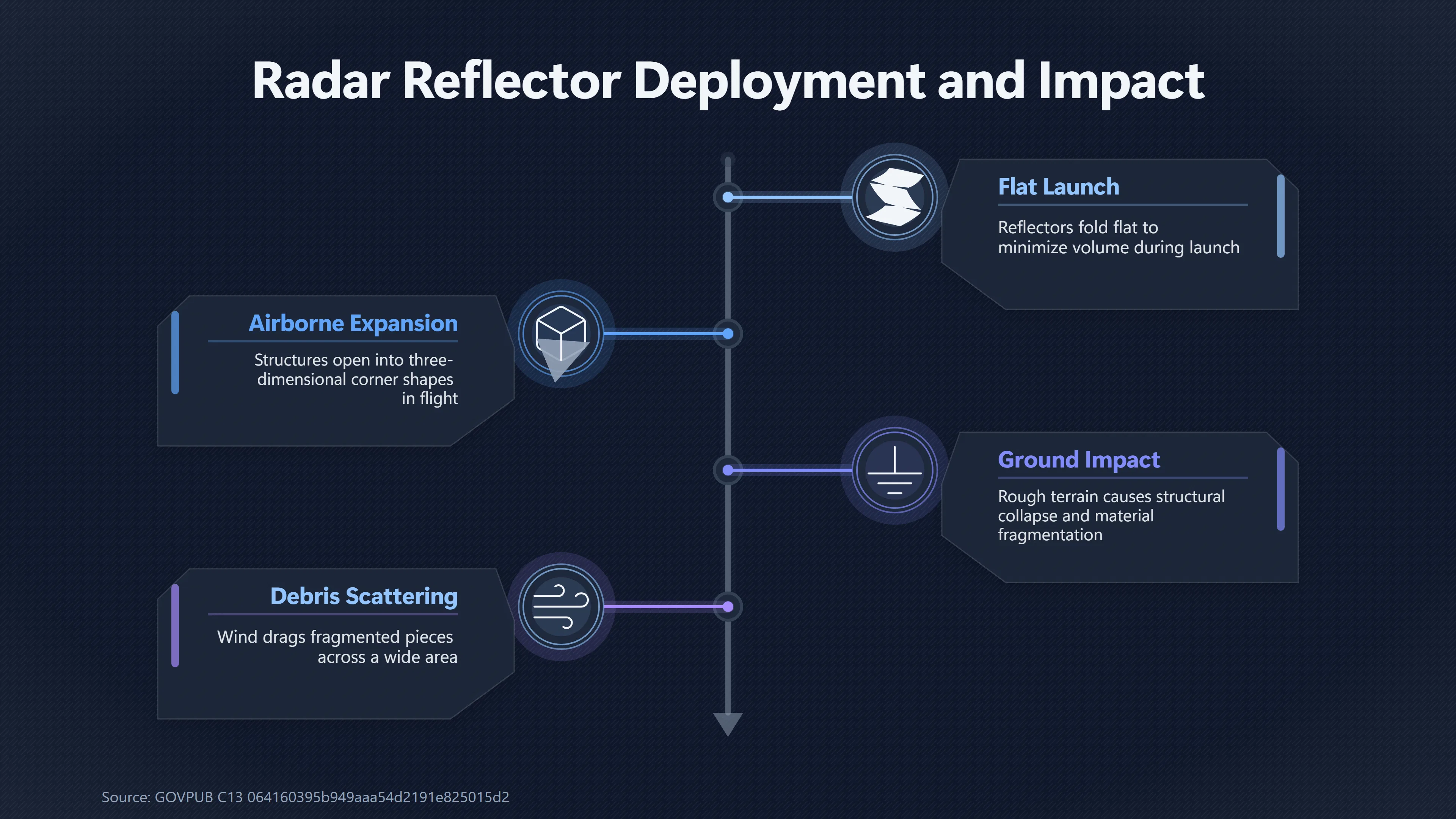
Military and meteorological manuals from the mid-twentieth century describe several collapsible radar targets built exactly this way. Some folded flat for launch before opening into three-dimensional corner-reflector shapes once airborne. Others were permanently assembled from intersecting balsa members carrying reflective foil panels.[govinfo.gov]govinfo.govGOVPUB C13 064160395b949aaa54d2191e825015d2Survey of meteorological instruments used in tropospheric propagation investigationsApril 19, 2022…
The choice of fragile materials was deliberate. Balloon payloads needed to remain as light as possible while still producing a strong radar return. Durability after landing was never the design priority.
Why broken panels look engineered
The appearance of a radar reflector changes dramatically after impact.
In flight, the reflector has an orderly three-dimensional geometry. After descending into rough terrain, however, the structure usually collapses. Foil creases, adhesive joints fail, balsa spars snap and cords twist the remaining pieces into irregular bundles.
To someone encountering only the debris field, several visual features can seem inconsistent with an ordinary balloon:
- Angular metallic fragments. Torn reflective panels often retain sharp triangular or diamond-like shapes rather than looking like household foil.
- Lightweight structural members. Broken balsa sticks remain attached to foil and tape, producing geometric assemblies that resemble fragments of a lightweight airframe.
- Multiple interconnected pieces. Reflectors rarely fail as a single object. Instead they separate into clusters joined by cords and tape, creating the impression of deliberate internal structure.
- Unusual combinations of materials. Metallic surfaces, wood, paper and specialised adhesives seem like an unexpected mixture unless the observer already knows how radar targets are constructed.
Because the reflector’s working geometry depends on flat reflective faces meeting at precise angles, even partial collapse can leave recognisable triangular and faceted shapes. These visual cues are exactly the kinds of features that encourage interpretations involving manufactured craft rather than weather equipment.[govinfo.gov]govinfo.govGOVPUB C13 064160395b949aaa54d2191e825015d2Survey of meteorological instruments used in tropospheric propagation investigationsApril 19, 2022…
Why Project Mogul radar targets became central to the Roswell debate
The best-known historical example involves the debris recovered near Roswell, New Mexico, in 1947.
According to the US Air Force’s later reconstruction, Project Mogul balloon trains carried several ML-307-series radar targets constructed from foil-faced material attached to balsa wood frames with tape, glue and string. When the balloon train struck the ground and was dragged by wind, these lightweight reflectors would have fragmented and scattered across a wide area while retaining distinctive metallic-looking components.[Muller Lab]muller.lbl.govMuller Lab Project MogulMuller Lab Project Mogul
This explanation also accounts for several details repeatedly mentioned in witness descriptions:
- foil-like reflective material[bom.gov.au]bom.gov.auSource details in endnotes.
- thin wooden sticks
- paper-backed construction
- adhesive tape joining structural members
- a broad debris field rather than a concentrated aircraft impact
Investigators later located surviving blueprints and examples of the radar targets used by Project Mogul. Examination showed that they consisted of aluminium-coloured foil laminated onto paper and mounted on balsa wood with twine, tape and eyelets—materials closely matching many contemporary descriptions of the recovered debris.[Scribd]scribd.comThe Roswell Report bookRoswell Incident Report: 1947 UFO Crash | PDF | Unidentified Flying ObjectJuly 27, 1994…
The historical debate is not completely settled. Some Roswell witnesses later described properties—such as extraordinary strength or “memory” behaviour—that critics argue are difficult to reconcile with ordinary foil and balsa construction. Supporters of the Project Mogul explanation respond that eyewitness memories changed substantially over decades and that the physical characteristics of the recovered radar targets match the earliest documented descriptions more closely than later recollections.[gutenberg.org]gutenberg.orgOpen source on gutenberg.org.
Clues that distinguish a reflector from a craft
Although collapsed radar targets can initially look mysterious, several characteristics distinguish them from genuine aircraft wreckage.
Consistent lightweight construction. Radar reflectors use extremely thin foil, paper laminates and balsa rather than machined aluminium, steel or composite structural members.
Repeated geometric modules. Multiple identical triangular or corner-shaped elements usually indicate a reflector assembled from repeating panels rather than fragments of a pressure hull or wing.
Simple mechanical joints. String, tape, glue and eyelets are typical of balloon-borne radar targets but uncommon in primary aircraft structures.
Association with balloon equipment. Parachute fabric, cords, latex or neoprene fragments, radiosonde components and suspension hardware often occur alongside reflector debris because they were all part of the same balloon train.
Low overall mass. Even large radar targets are surprisingly light. Their apparent complexity comes from geometry rather than heavy engineering.[govinfo.gov]govinfo.govGOVPUB C13 064160395b949aaa54d2191e825015d2Survey of meteorological instruments used in tropospheric propagation investigationsApril 19, 2022…
Why these reflectors were so easily misidentified
Radar reflectors occupy an unusual middle ground between familiar objects. They are neither conventional aircraft parts nor recognisable balloon envelopes. Their folded metallic surfaces, intersecting angles and lightweight framework produce debris that looks intentionally engineered but does not resemble everyday technology.
During the early Cold War this ambiguity was amplified by secrecy. Classified balloon programmes prevented straightforward public explanations, while relatively few civilians had ever seen a deployed radar target. As a result, collapsed reflectors recovered in isolation could plausibly be interpreted as fragments of an unknown craft, especially when the balloon itself had disintegrated or drifted away. That combination of unfamiliar engineering, fragmented geometry and limited public knowledge explains why radar reflectors became one of the most convincing sources of apparent “UFO wreckage” in several famous balloon-related incidents.[Muller Lab]muller.lbl.govMuller Lab Project MogulMuller Lab Project Mogul
Amazon book picks
Further Reading
Books and field guides related to Why Radar Reflectors Look Like UFO Wreckage. Use these as the next step if you want deeper reading beyond the article.
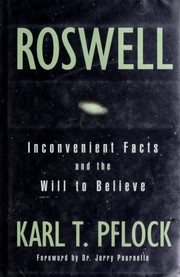
Roswell: Inconvenient Facts and the Will to Believe
Voici la solution du plus grand mystère de l'histoire des ovnis : l'affaire de Roswell dans le Nouveau Mexique. Après avoir annoncé à la...
Introduction to Radar Systems
Since the publication of the second edition of "Introduction to Radar Systems," there has been continual development of new radar capabil...
Radar Handbook
Publisher's Note: Products purchased from Third Party sellers are not guaranteed by the publisher for quality, authenticity, or access to...
Scientific Ballooning: Technology and Applications of Explora...
This introduction to scientific ballooning thoroughly covers large stratospheric balloons, planetary balloons, and rubber balloons used f...
eBay marketplace picks
Marketplace Samples
Live-tested eBay searches with available results related to this page.
Selected fromUFO poster oneBay.co.uk.

Current eBay listing
VINTAGE UFO FLYING SAUCERS COMIC ADVERTISING A2 POSTER PRINT
Current eBay listing
I Want To Believe UFO Poster Giclée Fine Art Heavyweight Print

Endnotes
1.
Source: gutenberg.org
Link:https://www.gutenberg.org/files/63659/old/63659-h/63659-h.htm
2.
Source: govinfo.gov
Title: GOVPUB C13 064160395b949aaa54d2191e825015d2
Link:https://www.govinfo.gov/content/pkg/GOVPUB-C13-064160395b949aaa54d2191e825015d2/pdf/GOVPUB-C13-064160395b949aaa54d2191e825015d2.pdf
Source snippet
Survey of meteorological instruments used in tropospheric propagation investigationsApril 19, 2022...
Published: April 19, 2022
3.
Source: patents.google.com
Link:https://patents.google.com/patent/US5457472A/en
Source snippet
Google PatentsUS5457472A - Corner reflector for use in a radar balloon - Google Patents...
4.
Source: scribd.com
Title: The Roswell Report book
Link:https://www.scribd.com/document/529806374/The-Roswell-Report-book
Source snippet
Roswell Incident Report: 1947 UFO Crash | PDF | [Unidentified]({{ 'unidentified/' | relative_url }}) Flying ObjectJuly 27, 1994...
Published: July 27, 1994
5.
Source: scribd.com
Title: Roswell Incident Report Overview | PDF | Unidentified Flying Object
Link:https://www.scribd.com/document/239712223/roswell-pdf
6.
Source: patents.google.com
Link:https://patents.google.com/patent/WO1991009434A1
7.
Source: patents.google.com
Link:https://patents.google.com/patent/CA2005715A1/en
8.
Source: patents.google.com
Link:https://patents.google.com/patent/DE1218023B/en
9.
Source: patents.google.com
Link:https://patents.google.com/patent/US2463517A/en
10.
Source: muller.lbl.gov
Title: Muller Lab Project Mogul
Link:https://muller.lbl.gov/teaching/physics10/Roswell/USMogulReport.html
11.
Source: overlookhorizon.com
Link:https://overlookhorizon.com/how-to-launch-weather-balloons/radar-reflectors/
12.
Source: newspaceeconomy.ca
Link:https://newspaceeconomy.ca/2026/01/04/challenges-to-the-project-mogul-explanation-for-the-roswell-incident/?amp=1
13.
Source: history.com
Link:https://www.history.com/articles/roswell
14.
Source: muller.lbl.gov
Title: Roswell Incident
Link:https://muller.lbl.gov/teaching/physics10/Roswell/RoswellIncident.html
15.
Source: library.metoffice.gov.uk
Link:https://library.metoffice.gov.uk/Portal/recordview/index/631806
16.
Source: bom.gov.au
Link:https://www.bom.gov.au/resources/learn-and-explore/radar-and-equipment-knowledge-centre/weather-balloons
Additional References
17.
Source: youtube.com
Title: Balloons over Ukraine: New Russian Tactics. Cheap Balloons with Radar Reflectors
Link:https://www.youtube.com/watch?v=0BHrWg8o6Tk
Source snippet
Project Mogul radar reflector Roswell balloon crash debris Technical Analysis of the Roswell Incident: What Really Crashed in 1947?...
18.
Source: theexclusionzone.com
Title: roswell 1947 ufo incident
Link:https://www.theexclusionzone.com/roswell-1947-ufo-incident/
Source snippet
Roswell 1947: The Official Explanation vs the EvidenceMay 19, 2026 — THE INITIAL MILITARY ANNOUNCEMENT AND IMMEDIATE RETRACTION On July 8...
Published: May 19, 2026
19.
Source: kiddofspeed.com
Title: the roswell ufo incident of 1947 explained
Link:https://www.kiddofspeed.com/the-roswell-ufo-incident-of-1947-explained/
Source snippet
In 1994, the United States Air Force published “The Roswell Report: Fact vs. Fiction in the N...
20.
Source: youtube.com
Title: The Roswell Incident: Part 1
Link:https://www.youtube.com/watch?v=oyBjhAbuLKw
Source snippet
Balloons over Ukraine: New Russian Tactics. Cheap Balloons with Radar Reflectors...
21.
Source: youtube.com
Link:https://www.youtube.com/watch?v=vp36IwCs9_k
Source snippet
Technical Analysis of the Roswell Incident: What Really Crashed in 1947?...
22.
Source: youtube.com
Link:https://www.youtube.com/watch?v=qwgYcnatLm0
Source snippet
Roswell: The Real Cover-Up Wasn't Aliens...
23.
Source: youtube.com
Title: Roswell: The Real Cover-Up Wasn’t Aliens
Link:https://www.youtube.com/watch?v=pmCTVKbpnbw
Source snippet
The Roswell Incident: Part 1 - What Really Crashed in the Desert...
24.
Source: futureengineers.org
Link:https://www.futureengineers.org/weatherballoon/gallery/2756
25.
Source: asios.org
Link:https://asios.org/reports/roswell
26.
Source: ufotransparency.com
Title: decade 1990s roswell report fact vs fiction 1994 dtic ada326148
Link:https://ufotransparency.com/files/decade-1990s-roswell-report-fact-vs-fiction-1994-dtic-ada326148