Within Balloon Debris
Why Project Mogul Wreckage Looked So Unusual
Long balloon trains carrying reflectors, sensors, parachutes and ballast created debris far more varied than a routine weather sounding.
On this page
- What a Mogul train carried
- How its parts differed from routine balloons
- Why secrecy increased confusion
Page outline Jump by section
Introduction
Project Mogul produced unusually complex wreckage because it was never intended to be a simple weather balloon. The classified programme relied on long, multi-component balloon trains designed to carry acoustic detection equipment over great distances while remaining light enough to reach high altitude. Instead of a single balloon and instrument package, a typical Mogul launch combined numerous neoprene balloons, multiple radar reflectors, parachutes, ballast devices, suspension cords and experimental electronics into one elongated system. When such a train broke apart and was dragged across the ground, it left behind a wide, varied debris field that looked very different from the remains of an ordinary meteorological sounding balloon. This combination of unfamiliar hardware and Cold War secrecy helped make Mogul wreckage appear far more mysterious than its individual parts warranted.[Muller Lab]lbl.govMuller Lab Project MogulMuller Lab Project Mogul

What a Mogul train carried
Project Mogul’s mission was to detect low-frequency sound waves from possible Soviet nuclear tests. Achieving that goal required far more equipment than conventional weather observations.
Early Mogul flights typically combined:
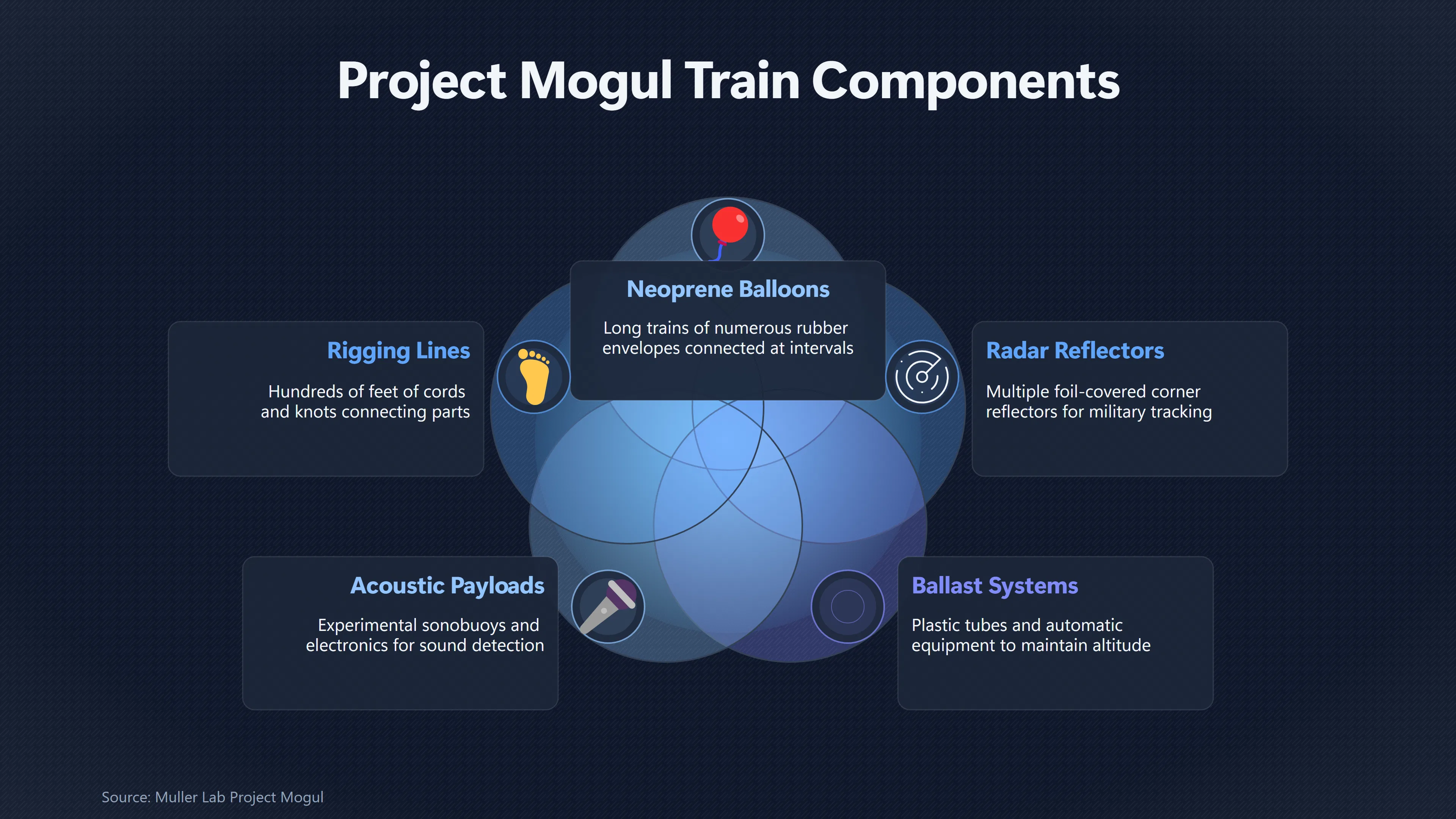
- Long trains of numerous neoprene weather balloons connected at intervals.
- Several radar reflectors (also called corner reflectors or Rawin targets) to allow tracking by military radar.
- Lightweight parachutes.
- Plastic ballast tubes and automatic ballast equipment used to help maintain altitude.
- Experimental acoustic payloads, including early sonobuoys and associated electronic equipment.
- Pressure switches, batteries and wiring housed in lightweight instrument boxes.[Muller Lab]lbl.govMuller Lab Project MogulMuller Lab Project Mogul
Rather than descending as one compact object, these components were spread along hundreds of feet of suspension line. If the balloon train burst or became tangled, individual parts could separate while remaining linked by cords, producing an extensive scatter of unrelated-looking materials.
How its parts differed from routine balloons
A standard weather balloon in 1947 usually consisted of one balloon carrying a small radiosonde and, where radar tracking was required, a single reflector. Such systems were comparatively simple and left limited debris if they failed.[Muller Lab]lbl.govMuller Lab Project MogulMuller Lab Project Mogul
Project Mogul deliberately multiplied the number of components because its engineering requirements were different.
Several design features made the wreckage appear unusually elaborate:
- Multiple balloons instead of one. Early Mogul flights often used clusters or long trains of neoprene balloons because large polyethylene balloons were still under development. This greatly increased the amount of rubber fragments after the envelopes burst.
- Several radar reflectors. Instead of a single reflector, Mogul trains could carry multiple lightweight reflector assemblies. Their foil-covered faces and wooden frames produced numerous geometric fragments rather than one recognisable device.
- Distributed payloads. Electronics, ballast systems and parachutes were positioned along the train rather than concentrated in one instrument package.
- Extensive rigging. Hundreds of feet of cords, knots, tape and attachment points connected the system into one flexible structure. After impact these links often snapped or became tangled, making reconstruction difficult.[Muller Lab]lbl.govMuller Lab Project MogulMuller Lab Project Mogul
The result was debris that resembled the remains of a complex manufactured object rather than the simple remains of a weather balloon familiar to most observers.
Why the debris looked stranger after landing
The appearance of Mogul wreckage changed significantly once it reached the ground.
Neoprene balloons rapidly deteriorated under intense sunlight, becoming dark, brittle fragments that could resemble burnt material rather than balloon rubber. Charles Moore, one of the project’s principal engineers, later recalled that exposed balloon remains could appear like grey or black flakes after only a few days in the desert.[Muller Lab]muller.lbl.govMuller Lab ROSWELL INCIDENT REPORTMuller Lab ROSWELL INCIDENT REPORT
Radar reflectors were built from extremely light materials to minimise weight. Their thin foil surfaces crumpled easily, while their wooden supports snapped into numerous short sticks. If partially inflated balloons retained some buoyancy after landing, winds could drag the remaining train across open ground, tearing reflector panels apart and distributing pieces over a considerable distance. The Air Force’s later reconstruction specifically argued that this process would naturally create a broad field containing foil, sticks, tape, cords and instrument fragments.[Muller Lab]lbl.govMuller Lab Project MogulMuller Lab Project Mogul
Because different components failed in different ways, observers encountered an assortment of materials rather than one recognisable object.
Why secrecy increased confusion
The physical complexity of the debris alone does not fully explain why it became associated with a crashed “flying disc.” Classification also played an important role.
Project Mogul’s purpose—long-range detection of Soviet nuclear tests—was Top Secret, even though many of its individual components were commercially available or closely resembled ordinary meteorological equipment. Personnel outside the project often knew only that balloons were involved, not why unusually elaborate balloon trains were being launched.[Muller Lab]lbl.govMuller Lab Project MogulMuller Lab Project Mogul
This distinction mattered because:
- Observers could correctly recognise familiar materials such as rubber, foil or wood without understanding why they had been assembled in such an unusual configuration.
- Military personnel not briefed on Mogul’s specialised equipment might reasonably identify some pieces as weather-balloon hardware while remaining uncertain about the complete system.
- Public explanations could not immediately describe the programme’s true objective without revealing sensitive Cold War intelligence work.[Muller Lab]lbl.govMuller Lab Project MogulMuller Lab Project Mogul
The secrecy therefore amplified the mystery created by the hardware rather than replacing it.
A combination of ordinary materials that appeared extraordinary
One of the most misunderstood aspects of Project Mogul is that none of its principal components was individually exotic. Neoprene balloons, wooden radar-target frames, aluminium foil, paper-backed reflective surfaces, tape and electronic instruments were all conventional technologies of the period.
What made the wreckage unusual was their combination into a single experimental airborne system stretching hundreds of feet in length. After breakup, those familiar materials no longer resembled the organised balloon train from which they came. Instead they appeared as scattered metallic sheets, broken wooden members, rubber fragments, cords, parachutes and electronics spread over a large area.
This helps explain why descriptions of the recovered debris often emphasised its diversity rather than any single remarkable object. The apparent complexity reflected the architecture of Project Mogul itself: a classified engineering system assembled from lightweight, individually familiar parts whose arrangement—and not their composition—made the wreckage seem unusually mysterious.[Muller Lab]lbl.govMuller Lab Project MogulMuller Lab Project Mogul
Amazon book picks
Further Reading
Books and field guides related to Why Project Mogul Wreckage Looked So Unusual. Use these as the next step if you want deeper reading beyond the article.
The Roswell Incident
Fully illustrated, "The Roswell Incident" is the definitive book on America's most documented alien encounter. It not only explores every...
Roswell: Inconvenient Facts and the Will to Believe
Voici la solution du plus grand mystère de l'histoire des ovnis : l'affaire de Roswell dans le Nouveau Mexique. Après avoir annoncé à la...
Roswell: The Ultimate Cold Case
"[The authors] have, like each whistleblower before them, paid a price for their . . . amplification of the truth. . . . The most profoun...
UFOs and Government: A Historical Inquiry
Governments around the world have had to deal with the UFO phenomenon for a good part of a century. How and why they did so is the subjec...
eBay marketplace picks
Marketplace Samples
Live-tested eBay searches with available results related to this page.
Selected fromUFO collectible oneBay.co.uk.

Endnotes
1.
Source: muller.lbl.gov
Title: Muller Lab Project Mogul
Link:https://muller.lbl.gov/teaching/physics10/[Roswell
2.
Source: muller.lbl.gov
Title: Muller Lab ROSWELL INCIDENT REPORT
Link:https://muller.lbl.gov/teaching/physics10/Roswell/RoswellIncident.html
3.
Source: altmystery.com
Title: roswell 1947
Link:https://www.altmystery.com/article/roswell-1947/
Source snippet
& Area 51 · AltMysteryMay 26, 2026 — The program's instrumentation consisted of balloon-launched microphone arrays, each suspended on a m...
Published: May 26, 2026
4.
Source: history.com
Link:https://www.history.com/articles/roswell
5.
Source: sgp.fas.org
Link:https://sgp.fas.org/othergov/roswell.html
Additional References
6.
Source: wired.com
Link:https://www.wired.com/story/roswell-aliens-fermi-paradox
Source snippet
However, an examination reveals a confluence of secret government projects and Cold War era activities rather than extraterrestrial invol...
7.
Source: theoriesofanything.com
Title: Roswell Incident: Historical Analysis | Theories of Anything
Link:https://theoriesofanything.com/research/roswell-incident-historical-analysis
Source snippet
VERIFIED CLAIMS (TIER 1 — PEER-REVIEWED / SCHOLARLY CONSENSUS) 1.1 THE CORE EVENTS * Mack Brazel discovered debris on the J.B. Foster ran...
8.
Source: kiddofspeed.com
Title: the roswell ufo incident of 1947 explained
Link:https://www.kiddofspeed.com/the-roswell-ufo-incident-of-1947-explained/
Source snippet
The Air Force concluded that this was the most likely source of the debris Brazel discovered on the Foster ranch. The debris field descri...
9.
Source: curiolink.net
Title: roswell incident 1947 cover up explained
Link:https://www.curiolink.net/2026/06/roswell-incident-1947-cover-up-explained.html
Source snippet
government went looking for an entirely different set of records. In response to a 1994 Congressional inquiry from th...
10.
Source: theexclusionzone.com
Title: roswell 1947 ufo incident
Link:https://www.theexclusionzone.com/roswell-1947-ufo-incident/
Source snippet
PROJECT MOGUL: THE CLASSIFIED TRUTH In 1994, the U.S. Air Force released official documentation establishing the...
11.
Source: youtube.com
Title: What really happened at Roswell: the sound channel and sky whales
Link:https://www.youtube.com/watch?v=DdSX-7vWyS8
Source snippet
Project Mogul, the secret operation behind the UFO crash in Rodwell...
12.
Source: youtube.com
Title: Project Mogul, the secret operation behind the UFO crash in Rodwell!!!
Link:https://www.youtube.com/watch?v=K3MlXHFm6m8
Source snippet
Roswell UFO: What Really Happened? Conspiracy Theory Section I...
13.
Source: youtube.com
Title: Roswell UFO: What Really Happened? Conspiracy Theory Section I
Link:https://www.youtube.com/watch?v=8ua33uwRTMM
Source snippet
The Roswell Incident as Told by Thomas Snégaroff...
14.
Source: youtube.com
Title: The Roswell Incident Mystery Finally Solved
Link:https://www.youtube.com/watch?v=Pz0vYcc4KiI
Source snippet
What really happened at Roswell: the sound channel and sky whales...
15.
Source: thisunexplaineduniverse.com
Link:https://www.thisunexplaineduniverse.com/articles/roswell-incident