Within Chain of Custody
Can Anonymous UFO Debris Ever Be Verified?
Anonymous samples require corroborating records, interviews and comparison material before any crash story can be treated as credible.
On this page
- What anonymity prevents investigators from checking
- Corroboration that could strengthen a claim
- When a sample should remain unidentified
Page outline Jump by section
Introduction
Anonymous UFO debris can sometimes be tested scientifically, but anonymity prevents investigators from answering the most important question: whether the tested material actually came from the claimed recovery site. Laboratory analysis can establish composition, manufacturing methods, age in some circumstances, or evidence of weathering. It cannot independently verify an undocumented origin story. For that reason, anonymous fragments should be treated as unidentified samples unless independent evidence connects them to a specific event and location.
In the context of alleged UFO crashes, the most productive approach is not to accept or reject anonymous claims outright, but to examine whether they can be corroborated through records, witnesses, physical comparisons and documented handling. A specimen with an unknown history may become more credible if new evidence emerges, but the burden of proof remains high because provenance cannot simply be reconstructed from the material itself.[Smithsonian Provenance]smithsonianprovenance.si.eduOpen source on si.edu.
What anonymity prevents investigators from checking
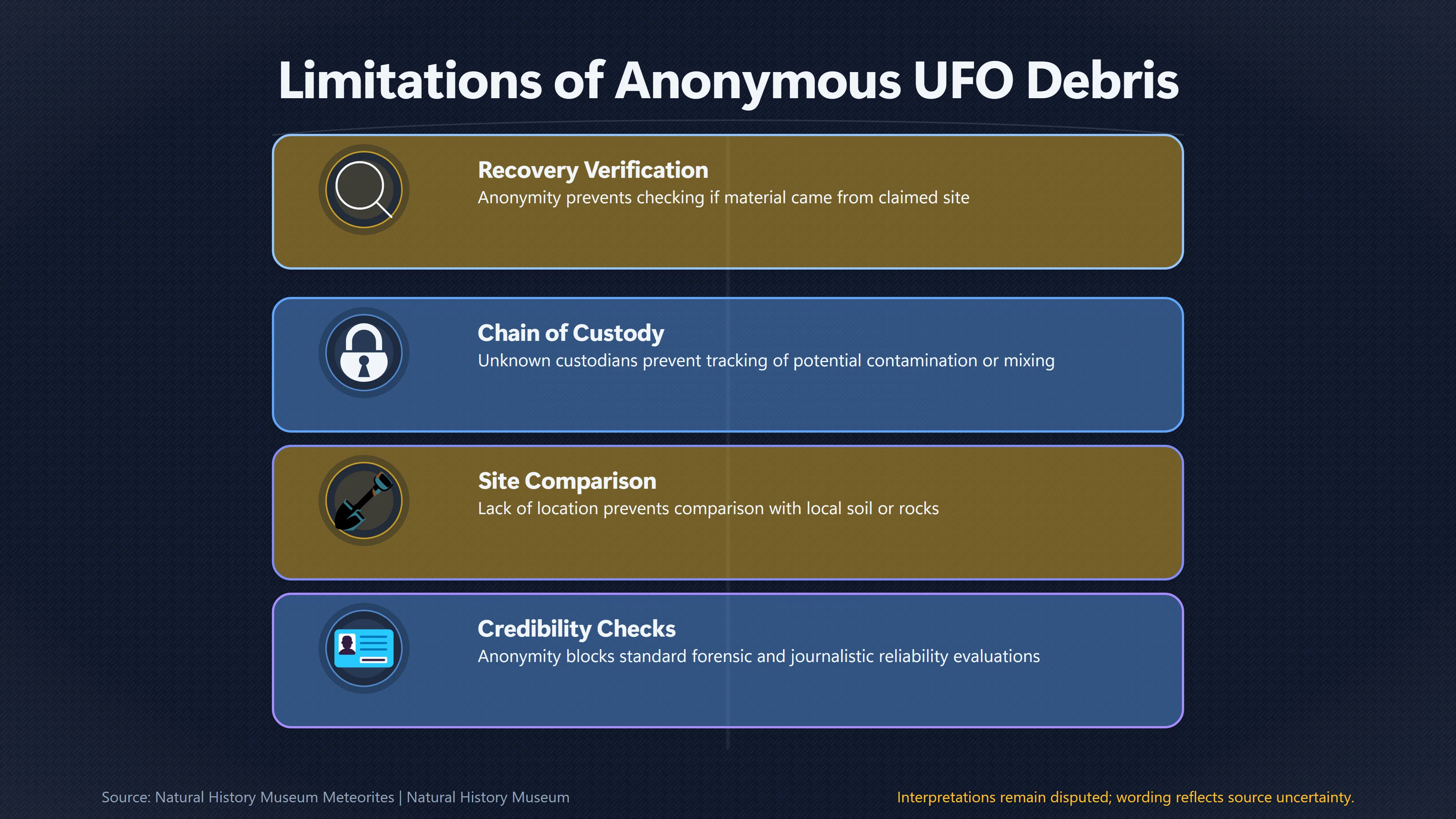
Anonymous submissions create several practical problems that cannot be solved by laboratory testing alone.
First, investigators cannot establish whether the person providing the material actually recovered it from the claimed location. Without knowing who collected the object, there is no opportunity to compare contemporary notes, photographs, GPS records or other documentation with the physical specimen.
Second, anonymity prevents investigators from interviewing everyone who handled the sample. A complete chain of custody normally records each transfer from collector to laboratory. When one or more custodians are unknown, there is no way to determine whether fragments were mixed, substituted, cleaned, altered or contaminated before scientific examination.
Third, anonymous claims usually eliminate opportunities to revisit the alleged recovery site. If no precise location is available, investigators cannot compare the specimen with surrounding soils, industrial debris, aircraft materials or naturally occurring rocks that might explain its origin.
Finally, anonymity makes it difficult to evaluate motivation or reliability. While anonymity may sometimes protect a legitimate witness, it also prevents routine credibility checks that are standard in journalism, historical research and forensic investigations.
These limitations do not prove a claim is false. They simply leave critical questions unanswered.
Corroboration that could strengthen a claim
Although missing provenance cannot be fully repaired, independent evidence can increase confidence that an anonymous specimen deserves further investigation.
Useful corroboration includes:
- Contemporary documentation. Diaries, letters, photographs, dated notebooks or archived correspondence created close to the alleged recovery are generally more valuable than recollections written decades later.
- Independent witnesses. Separate individuals who can consistently describe the recovery, transfer or storage of the material without relying on one another’s accounts strengthen the historical record.
- Documented ownership history. Receipts, estate inventories, museum accession records or laboratory submission forms can establish that a specific object existed before public controversy developed.
- Comparison with known materials. Investigators should compare the sample against documented aircraft alloys, industrial waste, meteorites and terrestrial geological materials before considering extraordinary explanations.
- Retained comparison specimens. If multiple fragments reportedly originated from the same event, they should be examined independently to determine whether they share consistent composition, manufacturing features and weathering histories.
- Independent laboratory replication. Multiple laboratories using different analytical techniques should obtain compatible results. Agreement about composition is valuable even if it does not establish provenance.
Each additional, independently verified record reduces uncertainty. None, by itself, establishes that a fragment originated from an alleged UFO crash.[si.edu]smithsonianprovenance.si.eduOpen source on si.edu.
Why laboratory agreement is not enough
A common misunderstanding is that unusual laboratory findings automatically validate an anonymous recovery story.
In reality, scientific testing answers questions about the material itself rather than its history. For example, spectroscopy, microscopy or isotope measurements may identify an uncommon alloy or reveal sophisticated manufacturing methods. Those findings cannot demonstrate where the object was recovered or how it entered private possession.
This distinction is well recognised in fields such as museum curation and meteorite science, where provenance and physical analysis are treated as complementary but separate forms of evidence. Museums routinely continue provenance research even after an object’s authenticity or composition has been established because ownership history and recovery history remain independent questions.[Smithsonian Provenance]smithsonianprovenance.si.eduOpen source on si.edu.
Practical ways to evaluate an anonymous claim
Rather than asking whether an anonymous fragment “proves” anything, investigators can assess it against a series of practical questions.
- Can the earliest documented owner be identified?
- Is there any record showing the specimen existed before public claims about it?
- Does the physical condition match the reported recovery circumstances?
- Have ordinary explanations, including industrial materials or known aerospace alloys, been systematically excluded?
- Can independent researchers reproduce the analytical results?
- Does every new piece of evidence fit consistently with the existing record, or are important details changing over time?
This incremental approach avoids treating the specimen or the accompanying narrative as all-or-nothing propositions. Instead, each new piece of evidence either strengthens or weakens confidence in the overall claim.
When a sample should remain unidentified
Some anonymous specimens will never acquire sufficient supporting evidence to move beyond an “unidentified” classification.
That outcome is scientifically appropriate when major gaps remain, such as an unknown original collector, missing recovery location, conflicting ownership accounts or the absence of independent documentation. In such cases, the material may still be worth preserving because future evidence could emerge, but the associated crash story cannot be considered verified.
This cautious approach mirrors practice in other areas involving historical specimens and unusual materials. Collections often retain objects with incomplete provenance rather than assigning unsupported origins, recognising that uncertainty is preferable to overconfident conclusions. Similarly, organisations involved in meteorite authentication emphasise that scientific analysis and provenance documentation are complementary, and that incomplete provenance should be explicitly acknowledged rather than concealed.[Global Meteorite Association]gmeta.orgGlobal Meteorite Association Code of Ethics » Global Meteorite AssociationGlobal Meteorite AssociationCode of Ethics » Global Meteorite AssociationJanuary 10, 2021…
The central lesson for alleged UFO debris
Anonymous debris claims are best viewed as starting points for investigation rather than evidence of a UFO crash. A laboratory may determine what a fragment is made of with considerable precision, but verifying the story attached to it depends on independent records, identifiable witnesses, documented ownership, comparison materials and a traceable history from recovery to examination.
When those supporting elements cannot be established, the most defensible conclusion is that the specimen’s composition may be known while its claimed origin remains unverified. That distinction preserves the integrity of both scientific analysis and historical investigation.

Amazon book picks
Further Reading
Books and field guides related to Can Anonymous UFO Debris Ever Be Verified?. Use these as the next step if you want deeper reading beyond the article.
UFOs and Government: A Historical Inquiry
Governments around the world have had to deal with the UFO phenomenon for a good part of a century. How and why they did so is the subjec...
Practical Crime Scene Processing and Investigation
All too often, the weakest link in the chain of criminal justice is the crime scene investigation. Improper collection of evidence blocks...
The Demon-Haunted World: Science as a Candle in the Dark
NEW YORK TIMES BESTSELLER • From the renowned astronomer and author of Cosmos comes a “powerful [and] stirring defense of informed ration...
eBay marketplace picks
Marketplace Samples
Live-tested eBay searches with available results related to this page.
Selected fromUFO poster oneBay.co.uk.

Current eBay listing
I Want To Believe UFO Poster Giclée Fine Art Heavyweight Print

Current eBay listing
VINTAGE UFO FLYING SAUCERS COMIC ADVERTISING A2 POSTER PRINT


Endnotes
1.
Source: smithsonianprovenance.si.edu
Link:https://smithsonianprovenance.si.edu/
2.
Source: gmeta.org
Link:https://gmeta.org/discover-meteorites/authenticity-of-meteorites/
3.
Source: nhm.ac.uk
Title: Natural History Museum Meteorites | Natural History Museum
Link:https://www.nhm.ac.uk/our-science/services/collections/mineralogy/meteorites.html
4.
Source: gmeta.org
Title: Global Meteorite Association Code of Ethics » Global Meteorite Association
Link:https://gmeta.org/about/code-of-ethics
Source snippet
Global Meteorite AssociationCode of Ethics » Global Meteorite AssociationJanuary 10, 2021...
Published: January 10, 2021
5.
Source: artefactumgallery.com
Link:https://artefactumgallery.com/authenticity/
Additional References
6.
Source: meteoritetesting.org
Title: This testing service is an educational outreach program fro
Link:https://www.meteoritetesting.org/
Source snippet
Meteorite Identification and TestingJanuary 11, 2026 — Updated and current - January 11, 2026 MeteoriteTesting.org Laboratory testing and...
Published: January 11, 2026
7.
Source: factually.co
Link:https://factually.co/fact-checks/science/buga-sphere-forensic-material-analysis-xrf-sem-ms-findings-a41691
Source snippet
Researched on April 20, 2026 Science Disclaimer: Factually can make mistakes. Please verify important information or bre...
Published: April 20, 2026
8.
Source: onlinelibrary.wiley.com
Title: The ICC has a mandate to (1) appro
Link:https://onlinelibrary.wiley.com/doi/full/10.1111/maps.70163
Source snippet
wiley.comImpact‐diagnostic criteria for use in confirming a meteorite impact origin of terrestrial geological structures: Recommendations...
9.
Source: youtube.com
Title: “The Beings Walked Through the Wall”
Link:https://www.youtube.com/watch?v=g3bk1UXjKLI
Source snippet
How To Scientifically Test & Analyze Potential UAP/UFO Material How To Scientifically Test & Analyze Potential UAP/UFO Material To The St...
10.
Source: youtube.com
Title: How To Scientifically Test & Analyze Potential UAP/UFO Material
Link:https://www.youtube.com/watch?v=SbAtCzZIIsk
Source snippet
Metal Piece From 1947 [Roswell]({{ 'roswell/' | relative_url }}) Incident Analyzed By a Government Lab...
11.
Source: usgs.gov
Link:https://www.usgs.gov/publications/chain-custody-recommendations-acceptance-and-analysis-evidentiary-geochemical-samples
12.
Source: ojp.gov
Link:https://ojp.gov/ncjrs/virtual-library/abstracts/evaluation-significance-transfers-debris-criteria-association-and
13.
Source: store.astm.org
Link:https://store.astm.org/e1492-25.html
Source snippet
astm.orgE1492 Standard Practice for Receiving, Documenting, Storing, and Retrieving Evidence by a Forensic Service ProviderJuly 8, 2026 —...
Published: July 8, 2026
14.
Source: content.govdelivery.com
Link:https://content.govdelivery.com/accounts/USNIST/bulletins/419d984
Source snippet
Standards Bulletin - June 2026June 2, 2026 — OSAC STANDARDS BULLETIN - JUNE 2026 National Institute of Standards and Technology (NIST) se...
Published: June 2, 2026
15.
Source: britishmuseum.org
Link:https://www.britishmuseum.org/our-work/departments/britain-europe-and-prehistory