Within UFO Crashes
Can Alleged UFO Debris Be Traced?
Material cannot prove a crash story unless its path from recovery site to laboratory is documented, secure and independently reviewable.
On this page
- What a secure recovery history requires
- Common breaks in provenance
- How independent testing should be organised
Page outline Jump by section
Introduction
A laboratory can establish what a metal fragment is made of, how it was manufactured and whether its isotope ratios are unusual. It cannot establish where the fragment was recovered unless that history has been documented separately. For alleged UFO crash debris, this distinction is decisive: an intriguing alloy without a secure chain of custody remains an unidentified sample, not evidence of a crashed craft.
A credible recovery history must link the material to a specific place and time, record every person who handled it, guard against substitution and contamination, and preserve enough material for independent retesting. Many celebrated fragments fail near the beginning of that chain. They arrive through anonymous letters, private collections or transfers made years after the alleged event. Later scientific testing may be competent, but it cannot repair the missing connection between specimen and crash story.
What a secure recovery history requires
Chain of custody is the chronological record showing that an item tested in a laboratory is the same item collected at a scene and that it remained accounted for throughout collection, transport, storage and analysis. In forensic practice, it supports authenticity by recording who possessed the evidence, when custody changed and what was done to it. Quality systems also require controlled procedures, validated methods, competent personnel and auditable records.[nih.gov]ncbi.nlm.nih.govNCBIChain of CustodyIt is necessary to assure the court of law that the evidence is authentic, ie…Read more…
For alleged crash debris, a defensible chain should begin before anyone knows whether the material is exotic. Investigators should document the recovery as they would an aircraft accident, meteorite fall or contamination-sensitive forensic scene.
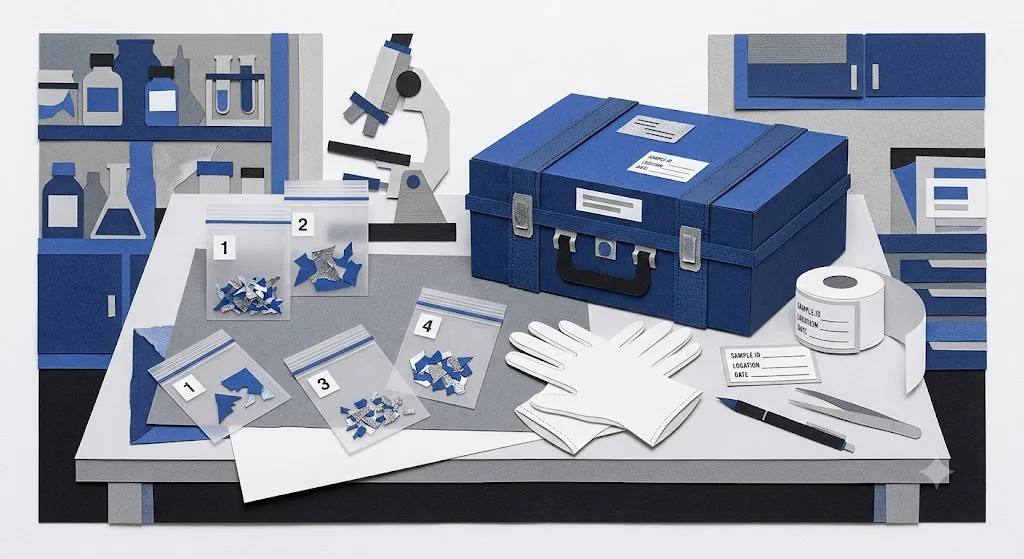
A strong record would include:
- A fixed recovery location. Coordinates, maps, scene photographs and the fragment’s precise position should be recorded before it is moved. Images need scale markers and enough surrounding detail to show that the object was genuinely present at the site.
- Contemporary collection notes. The collector’s identity, date, time, weather, ground conditions and observations should be written down immediately. A statement produced decades later is not equivalent to a field record.
- Unique sample identification. Each fragment should receive a tamper-evident label or container number that follows it throughout the investigation. Photographs, dimensions, mass and distinctive surface features help detect substitution.
- Controlled packaging. Separate fragments should be packaged individually in materials appropriate to the intended tests. Soil, fingerprints, adhesives, moisture and metal tools can all introduce contaminants that complicate surface or trace-element analysis.
- A complete transfer log. Every handover should state the identities of the giver and recipient, the date and time, the sample’s condition, seal numbers and the reason for transfer. Unexplained periods in a private home, office or collection create opportunities for accidental mixing, alteration or deliberate replacement.
- Documented sampling. Cutting, polishing, dissolving or otherwise consuming part of the specimen must be recorded. The location of each subsample within the parent fragment should be mapped, because different regions may contain different layers, corrosion products or contaminants.
- Secure storage and preserved controls. Access should be restricted and logged. An untouched reserve should remain available, together with environmental blanks and samples of nearby soil, industrial material or wreckage that may provide ordinary comparisons.
This documentation does not establish that a fragment came from a UFO. It establishes the narrower fact that the laboratory result applies to material demonstrably recovered at the claimed site. Only then can composition, manufacturing marks and environmental residues meaningfully test the crash account.
Where provenance usually breaks
The most damaging break is often not inside the laboratory but before the laboratory ever receives the specimen. A technician can accurately measure a piece of magnesium while having no scientific basis for accepting the story attached to it.
Anonymous recovery claims are particularly weak. Without a named collector who can be interviewed and whose route from scene to recipient can be checked, investigators cannot exclude hoaxing, mistaken attribution or the attachment of an extraordinary story to ordinary scrap.
Delayed emergence creates a similar problem. A fragment said to have been retained for decades may have passed through several homes, collections or commercial transactions. Even honest custodians may not know whether labels were switched, pieces were divided or the story changed as it was retold.
Unrecorded destructive testing can leave later laboratories with a tiny subsample whose relationship to the original object is uncertain. It may also remove the most informative surfaces, fracture edges or residues before specialists in impact damage, corrosion or manufacturing examine them.
Informal ownership and publicity incentives can further complicate review. When a specimen is controlled by a claimant, broadcaster, collector or commercial organisation, independent researchers may receive only selected pieces or limited access. The analytical work can still be valid, but outsiders may be unable to verify that all laboratories tested equivalent material.
The result is a recurring evidential mismatch: the laboratory report may be strong evidence about composition but weak evidence about origin. Saying that a sample contains unusual layers, high-purity metal or an uncommon trace element does not establish that it came from the reported event, still less that the event involved non-human technology.
Ubatuba: extensive testing, missing first link
The Ubatuba fragments illustrate how sophisticated analysis can coexist with uncertain provenance. In 1957, a Brazilian newspaper columnist reportedly received an anonymous letter and metal pieces said to have been collected after an aerial object exploded near Ubatuba. The samples were subsequently divided and sent through investigators and laboratories, but the original sender was not securely identified and the fragments were not documented in place at the alleged recovery site. Even researchers sympathetic to continued study have acknowledged that the samples are not conclusively tied to a UFO event.[Journal of Scientific Exploration]journalofscientificexploration.orgJournal of Scientific Exploration
Early tests described the material as exceptionally pure magnesium, encouraging claims that contemporary industry could not have produced it. Later, more sensitive measurements detected trace elements that the earlier instruments could not resolve. A 2022 reassessment reported that the main magnesium isotope ratios were within terrestrial limits, while trace-element isotope findings were inconsistent between laboratories and therefore inconclusive. The authors also noted that surface chemistry could not be relied upon because of handling and ground contamination.[Journal of Scientific Exploration]journalofscientificexploration.orgJournal of Scientific Exploration
The Ubatuba history demonstrates three separate uncertainties:
- whether the tested fragment was truly collected at the alleged scene;
- whether every later subsample came from the same original pieces;
- whether differences among tests reflect genuine material variation, contamination or changing analytical sensitivity.
None of those questions is resolved merely by conducting another high-precision isotope test. A terrestrial result can weaken an extraterrestrial interpretation, but an anomalous result would still require proof that the analysed specimen was genuinely connected to the reported incident.
The layered metal sample: good laboratory control, poor event provenance
A more recent example concerns a layered bismuth-and-magnesium specimen sometimes associated with Roswell-era crash claims. Its public history began with pieces sent anonymously to radio presenter Art Bell in the 1990s, accompanied by a story that a relative of the sender had recovered them during a military operation. The material later moved through UFO researchers and a private organisation before becoming the subject of US Army and government laboratory work. The anonymous origin means there is no independently documented path from a 1947 recovery site to the first known recipient.[The Wall Street Journal]wsj.comThe Wall Street Journal Was It Scrap Metal or an Alien Spacecraft?The Army Asked an Elite Defense Lab to InvestigateJune 22, 2025 — In 2022, the Pentagon assigned Sean Kirkpatrick to investigate claims o…
Once the specimen entered formal testing, its immediate laboratory custody was much better controlled. The US Department of Defense’s All-domain Anomaly Resolution Office, known as AARO, arranged for Oak Ridge National Laboratory to examine a parent sample and three derived subsamples. The work used microscopy, computed tomography, spectroscopy and mass spectrometry to assess structure, composition, isotope ratios and a claim that the bismuth layers might function as a terahertz waveguide. Oak Ridge concluded that the material was terrestrial and that its structure did not have the proposed waveguiding properties.[aaro.mil]aaro.milSynopsis: Analysis of a Metallic SpecimenSynopsis: Analysis of a Metallic Specimen
This case exposes an important distinction between two chains:
- The analytical chain—from the specimen supplied by its custodian to Oak Ridge and through the laboratory procedures—was documented sufficiently for the laboratory to characterise that specimen.
- The historical chain—from an alleged Roswell recovery to the anonymous package received roughly half a century later—was not independently established.
The Oak Ridge work therefore answers “What is this submitted material?” far better than “Where was it originally found?” Its terrestrial composition undercuts claims that the specimen itself displays off-world characteristics, but even a different laboratory result would not validate the anonymous recovery story.
How independent testing should be organised
Independent testing is most persuasive when the study design prevents any party from choosing only favourable laboratories, fragments or interpretations. The process should be agreed before results are known.
Begin with provenance review, not expensive instruments
A small review team should first assess the documentation linking the specimen to the alleged incident. Its members should include a scene-recovery specialist, a materials scientist and an archivist or evidence manager. They should reconstruct a dated custody table and distinguish documented facts from oral claims.
A specimen with no verifiable link to the scene may still merit materials research, but it should be described accurately as a sample of unknown provenance. Laboratory paperwork should not repeat “crash debris” as though that were an established classification.
Divide the sample under observation
The parent object should be weighed, photographed and scanned before cutting. Division should take place in a controlled facility in the presence of representatives for the custodian and participating laboratories. Each subsample should be sealed, uniquely numbered and documented against a diagram showing where it came from.
At least one reserve portion should remain unopened. This protects against the possibility that early tests consume the material or that later questions require a technique not initially considered.
Use blinded and replicated analysis
Laboratories should receive coded specimens where practical, including ordinary comparison materials with similar appearance or composition. Blinding reduces the risk that analysts interpret borderline findings in line with the sample’s dramatic history.
Key measurements should be replicated by at least two suitably accredited laboratories using validated methods. For isotope work, reports need calibration standards, blanks, measurement uncertainty and the complete numerical data—not merely statements that a value is “unusual”. The Ubatuba reassessment showed why this matters: two laboratories produced inconsistent trace-isotope deviations, preventing a confident conclusion.[Journal of Scientific Exploration]journalofscientificexploration.orgJournal of Scientific Exploration
Test competing terrestrial explanations
A good investigation does not ask only whether the material looks strange. It asks what known process could have made it. Relevant comparisons may include aerospace alloys, welding by-products, industrial laminates, metallurgical test coupons, munitions, furnace waste and corrosion-altered scrap.
Useful analyses can include:
- elemental and isotope composition;
- crystal structure and grain boundaries;
- machining, rolling, extrusion or deposition marks;
- oxidation and heat history;
- adhesives, coatings and surface residues;
- fracture morphology and impact damage;
- soil, pollen or mineral particles that might connect the fragment to a recovery environment.
No single “anomalous” number should carry the conclusion. An unusual isotope ratio, for example, can result from industrial fractionation, contamination, instrumental bias or an inappropriate comparison range. The result must be reproducible and assessed alongside the specimen’s structure, manufacturing history and provenance.
Release enough information for review
Independent scrutiny requires more than a press release. A useful public record would include the custody chronology, photographs of seals and sample division, analytical protocols, instrument settings, calibration data, uncertainties, raw or minimally processed results and the reasoning used to exclude ordinary sources.
Personal details or sensitive locations may sometimes need redaction, but secrecy about the specimen’s ownership or transfer history should be treated as a limitation, not as evidence that the material is important. A claim cannot gain scientific strength from information that independent reviewers are forbidden to inspect.
A practical credibility test
When confronted with alleged UFO crash debris, the first question should not be “Is the alloy unusual?” It should be “Can this exact piece be traced to the alleged event?”
A high-credibility specimen would have scene photographs, named collectors, contemporaneous records, sealed transfers, preserved reference material and reproducible analysis by independent laboratories. A medium-credibility specimen might have a plausible early history but gaps in storage or handling. A low-credibility specimen typically appears long after the event, arrives anonymously, lacks records of cutting and transfer, or depends on one custodian’s narrative.
This grading separates two conclusions that are often blurred together. A laboratory may determine that a low-provenance fragment has unusual properties. That finding can justify further materials research. It does not upgrade the fragment into verified crash debris.
What would change the assessment?
A genuinely persuasive case would combine provenance and physical analysis rather than asking one to substitute for the other. The strongest possible evidence would be material recovered during a well-documented incident by identifiable personnel, recorded in situ by multiple cameras or sensors, secured immediately, and tested under an open protocol by laboratories with no dependence on the claimant.
Historical material faces a harder test, but its credibility could still improve through the discovery of authenticated contemporary inventories, photographs, sealed evidence containers, laboratory notebooks or official transfer records that match the surviving specimen by mass, dimensions, markings or composition. Multiple independently held fragments with documented separation from the same parent object would be especially valuable.
Without that bridge, alleged crash debris remains evidence of a material object and of the history of claims surrounding it—not reliable evidence that a UFO crashed. The chain of custody is therefore not a procedural detail added after an exciting laboratory result. It is the structure that determines whether the result can be connected to the event at all.
Amazon book picks
Further Reading
Books and field guides related to Can Alleged UFO Debris Be Traced?. Use these as the next step if you want deeper reading beyond the article.
Practical Crime Scene Processing and Investigation
All too often, the weakest link in the chain of criminal justice is the crime scene investigation. Improper collection of evidence blocks...
Criminalistics: An Introduction to Forensic Science
For introductory courses in Forensic Science and Crime Scene Investigation. This best-selling text, written for the non-scientist, is app...
Forensic Science: An Introduction to Scientific and Investiga...
Covering a range of fundamental topics essential to modern forensic investigation, the fourth edition of the landmark text Forensic Scien...
eBay marketplace picks
Marketplace Samples
Live-tested eBay searches with available results related to this page.
Selected fromUFO collectible oneBay.co.uk.




Endnotes
1.
Source: ncbi.nlm.nih.gov
Title: NCBIChain of Custody
Link:https://www.ncbi.nlm.nih.gov/books/NBK551677/
Source snippet
It is necessary to assure the court of law that the evidence is authentic, ie...Read more...
2.
Source: journalofscientificexploration.org
Title: Journal of Scientific Exploration
Link:https://journalofscientificexploration.org/index.php/jse/article/view/2415/1565
3.
Source: aaro.mil
Title: Synopsis: Analysis of a Metallic Specimen
Link:https://www.aaro.mil/Portals/136/PDFs/Information%20Papers/ORNL-Synopsis_Analysis_of_a_Metallic_Specimen.pdf
4.
Source: aaro.mil
Link:https://www.aaro.mil/
Source snippet
AARO HomeHas the Department found any evidence of extraterrestrial technology? No. Examination of UAP sightings is ongoing. AARO uses a r...
5.
Source: aaro.mil
Title: UAP Records
Link:https://www.aaro.mil/UAP-Records/
6.
Source: media.defense.gov
Title: DOPSR 2024 0263 AARO HISTORICAL RECORD REPORT VOLUME 1 2024
Link:https://media.defense.gov/2024/Mar/08/2003409233/-1/-1/0/DOPSR-2024-0263-AARO-HISTORICAL-RECORD-REPORT-VOLUME-1-2024.PDF
7.
Source: medium.com
Link:https://medium.com/the-idea-of-reality/the-department-of-wars-uap-release-batch-3-e936a14fb993
8.
Source: medium.com
Link:https://medium.com/quantum-psychology-and-engineering/an-inquiry-into-the-material-evidence-of-non-human-intelligence-04dc38a85103
9.
Source: youtube.com
Title: Garry Nolan
Link:https://www.youtube.com/watch?v=GQr2c3f8Wg8
Source snippet
Art Bell - The Roswell Crash Arc...
10.
Source: youtube.com
Title: Art Bell
Link:https://www.youtube.com/watch?v=pXUmPB7tVNE
Source snippet
The CIA's UAP & Alien Research! 'Their Brains Looked Fried' | Stanford's Garry Nolan...
11.
Source: pmc.ncbi.nlm.nih.gov
Title: Pub Med Central (PMC)The Chain of Custody in the Era of Modern Forensics
Link:https://pmc.ncbi.nlm.nih.gov/articles/PMC10000967/
Source snippet
PubMed Central (PMC)The Chain of Custody in the Era of Modern Forensics - PMCby T D’Anna · 2023 · Cited by 70 — The purpose of this work...
12.
Source: GOV.UK
Title: [Withdrawn] Forensic Science Regulator: Code of Practice (accessible)
Link:https://www.gov.uk/government/publications/statutory-code-of-practice-for-forensic-science-activities/forensic-science-regulator-code-of-practice-accessible
13.
Source: wsj.com
Title: The Wall Street Journal Was It Scrap Metal or an Alien Spacecraft?
Link:https://www.wsj.com/politics/national-security/pentagon-ufo-investigation-lockheed-martin-1bac3d41
Source snippet
The Army Asked an Elite Defense Lab to InvestigateJune 22, 2025 — In 2022, the Pentagon assigned Sean Kirkpatrick to investigate claims o...
Published: June 22, 2025
14.
Source: Wikipedia
Title: Chain of custody
Link:https://en.wikipedia.org/wiki/Chain_of_custody
15.
Source: GOV.UK
Title: forensic science regulator guidance
Link:https://www.gov.uk/government/collections/forensic-science-regulator-guidance
16.
Source: pmc.ncbi.nlm.nih.gov
Link:https://pmc.ncbi.nlm.nih.gov/articles/PMC9053028/
Additional References
17.
Source: kevinrandle.blogspot.com
Title: ubatuba ufo sample
Link:https://kevinrandle.blogspot.com/2010/05/ubatuba-ufo-sample.html
Source snippet
Kevin Randle's BlogA Different Perspective: The Ubatuba UFO Sample1 May 2010 — The Ubatuba UFO Sample · The very first problem is that th...
Published: May 2010
18.
Source: war.gov
Link:https://www.war.gov/medialink/ufo/061226/release_03/documents/DOW-UAP-D077_Unresolved-Case-Analysis-Update_Western-United-States-Event.pdf
19.
Source: nist.gov
Link:https://www.nist.gov/forensic-science/interdisciplinary-topics/evidence-management/biological-evidence-guidance
20.
Source: war.gov
Link:https://www.war.gov/ufo/
21.
Source: youtube.com
Title: UFO Crash Debris! (Art’s Parts)
Link:https://www.youtube.com/watch?v=v4HWxOel7zw
Source snippet
Garry Nolan: UFOs and Aliens | Lex Fridman Podcast #262...
22.
Source: war.gov
Title: department of defense releases the annual report on unidentified anomalous phen
Link:https://www.war.gov/News/Releases/Release/Article/3964824/department-of-defense-releases-the-annual-report-on-unidentified-anomalous-phen/
23.
Source: youtube.com
Title: Garry Nolan: UFOs and Aliens | Lex Fridman Podcast #262
Link:https://www.youtube.com/watch?v=uTCc2-1tbBQ
Source snippet
Garry Nolan - UAP Phenomena: A Serious Look...
24.
Source: researchgate.net
Link:https://www.researchgate.net/publication/369940913_Maintaining_the_chain_of_custody_Anti-contamination_measures_for_trace_DNA_evidence
25.
Source: aui.edu
Link:https://aui.edu/aaro-releases-report-on-unidentified-anomalous-phenomena-uap/
26.
Source: ijsra.net
Link:https://ijsra.net/content/maintaining-chain-custody-anti-contamination-measures-trace-dna-evidence