Within Balloon Debris
When Balloon Rubber No Longer Looks Like Rubber
Sunlight, oxidation and temperature swings can turn pale balloon material into brittle grey or brown shreds that look manufactured.
On this page
- How latex and neoprene change
- What weathering does to colour and texture
- Why old fragments are easily misidentified
Page outline Jump by section
Introduction
One reason balloon debris has repeatedly been mistaken for the remains of an unusual craft is that aged balloon material often ceases to resemble a balloon at all. After days, weeks or months outdoors, natural latex or synthetic rubber envelopes lose their bright colour, glossy surface and elastic feel. Instead, they become dull, brittle, cracked and irregular, with grey, brown or black fragments that resemble weathered manufactured composites rather than soft rubber. In remote locations where only fragments survive, this transformation makes visual identification surprisingly difficult and has contributed to mistaken interpretations of recovered debris in some reported UFO crash cases.[PubMed Central (PMC)]pmc.ncbi.nlm.nih.govPub Med Central (PMC)Discoloration Mechanisms of Natural Rubber and Its ControlPubMed Central (PMC)Discoloration Mechanisms of Natural Rubber and Its Control - PMCFebruary 16, 2022…
How latex and neoprene change
Most meteorological balloons have traditionally been made from natural latex, while some specialised high-altitude balloons and earlier military systems also used synthetic rubber materials such as neoprene. Although these materials differ chemically, both are vulnerable to long-term environmental exposure.
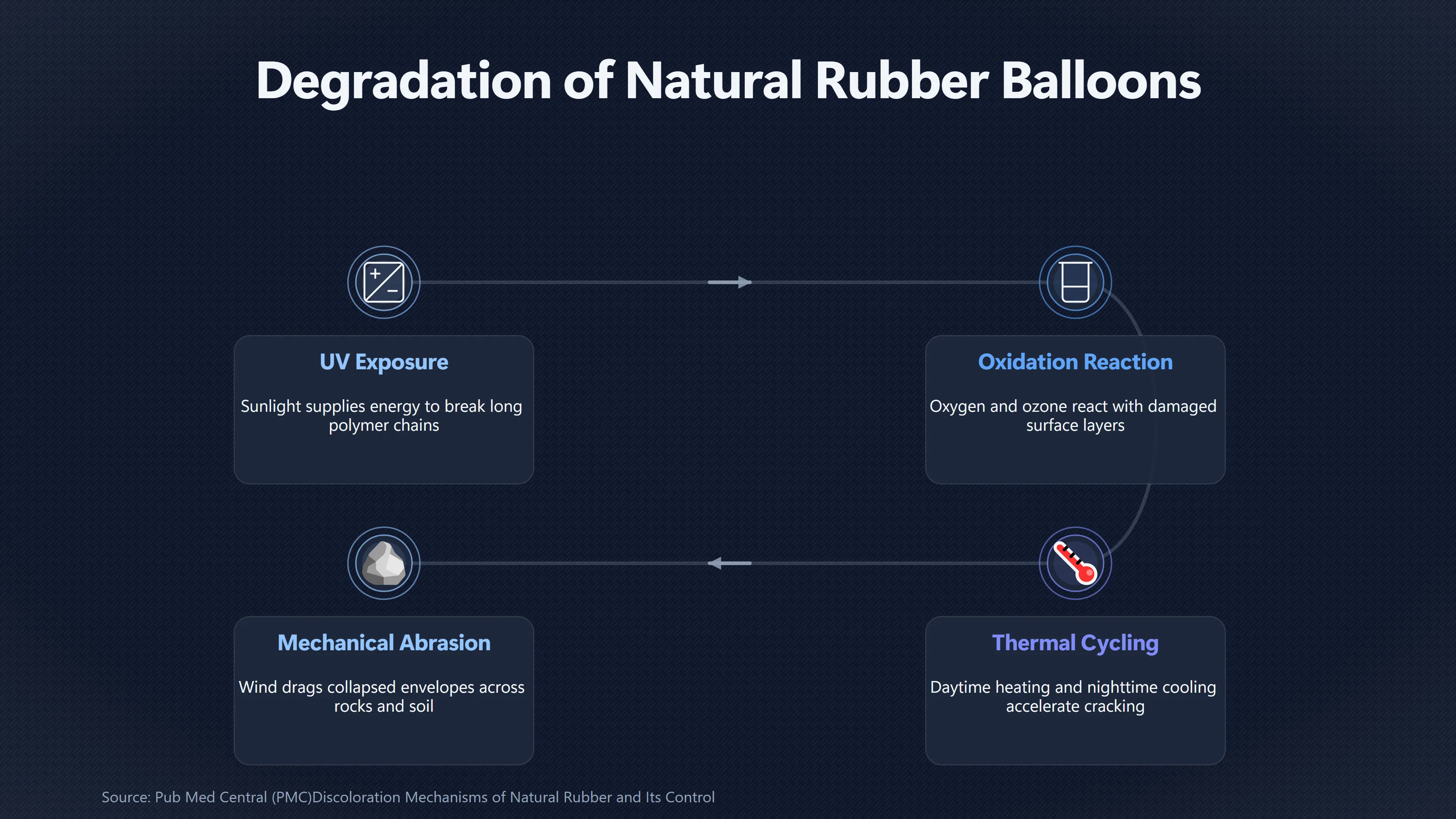
Natural rubber contains long chains of polyisoprene. Sunlight, particularly ultraviolet (UV) radiation, supplies enough energy to break these chains and trigger oxidation. Oxygen and ozone react with the damaged surface, creating new oxygen-containing compounds while progressively weakening the material. As the polymer network breaks down, the rubber loses flexibility, becomes harder and eventually fractures instead of stretching.[nih.gov]pmc.ncbi.nlm.nih.govPub Med Central (PMC)Discoloration Mechanisms of Natural Rubber and Its ControlPubMed Central (PMC)Discoloration Mechanisms of Natural Rubber and Its Control - PMCFebruary 16, 2022…
Manufacturers have long recognised this weakness. Patents for balloon coatings specifically describe how ordinary natural-rubber balloons rapidly become dull and discoloured because of oxidation driven by atmospheric oxygen, ozone and ultraviolet light.[Google Patents]patents.google.comGoogle PatentsUS5492500A - Balloons having improved resistance to oxidation - Google PatentsFebruary 20, 1996…
Neoprene generally resists weathering better than natural latex, but prolonged UV exposure, heat, oxygen and repeated expansion and contraction still produce oxidation, surface cracking and embrittlement. Rather than remaining smooth and flexible, aged neoprene also develops a dry, weathered appearance that obscures its original identity.[Sage Journals]journals.sagepub.comSage JournalsAgeing Behaviour of Natural Rubber and High Damping Rubber Materials Used in Bridge Rubber Bearings - H.S. Gu, Y. Itoh, 2010…
What weathering does to colour and texture
The most obvious change is visual. Fresh balloon material is smooth, glossy and uniformly coloured. After prolonged exposure outdoors it commonly develops:
- faded or bleached colours;
- dull grey, brown or black surfaces;
- chalky or powdery patches;
- wrinkles and shrinkage;
- fine surface cracks that grow into tears; and
- stiff, brittle edges that snap rather than stretch.[nih.gov]pmc.ncbi.nlm.nih.govPub Med Central (PMC)Discoloration Mechanisms of Natural Rubber and Its ControlPubMed Central (PMC)Discoloration Mechanisms of Natural Rubber and Its Control - PMCFebruary 16, 2022…
These changes arise because oxidation alters both the chemistry and the microscopic structure of the surface. UV radiation generates free radicals within the rubber, initiating chain scission and producing oxygen-containing compounds. Simultaneously, repeated heating during the day and cooling at night causes continual expansion and contraction, accelerating cracking. Laboratory ageing studies consistently show that combined UV exposure and thermal oxidation produce more severe degradation than either process alone, including darker colours, rougher surfaces and sharply reduced mechanical strength.[De Gruyter Brill]degruyterbrill.comOpen source on degruyterbrill.com.
Mechanical damage compounds the process. After a balloon bursts at high altitude, the collapsed envelope is dragged across rocks, vegetation and soil by wind. Abrasion removes already-weakened surface layers, leaving irregular strips with frayed edges rather than recognisable balloon panels. By the time fragments are recovered, little remains of the smooth elastic membrane that originally left the launch site.

Why old fragments are easily misidentified
People generally expect rubber to feel soft, flexible and recognisable. Weathered balloon debris violates those expectations.
Instead of a complete envelope, investigators often encounter scattered strips ranging from a few centimetres to several tens of centimetres long. Their surfaces may appear fibrous, leathery or almost paper-like because weathering has destroyed the original elastic texture. Without an intact neck, seam or inflation opening, these fragments provide few visual clues that they once formed part of a balloon.
The effect is particularly pronounced after prolonged exposure in open terrain. National Weather Service guidance notes that weather balloon equipment may remain undiscovered for weeks or months before being found, by which time only shreds of the balloon may remain attached to the recovered instrument package.[VLab]vlab.noaa.govVLab The Trusty Weather BalloonThe Trusty Weather Balloon - National Weather Service Heritage - Virtual LabDecember 8, 2019…
Environmental exposure also explains why recovered balloon material can appear inconsistent. Fragments lying face-up in full sunlight weather much faster than pieces sheltered beneath vegetation, rocks or folded layers of rubber. A single debris field may therefore contain flexible pieces alongside brittle grey fragments, making it less obvious that all originated from one balloon.
A lesson from reported UFO debris
Descriptions associated with several alleged UFO wreckage sites—including the Roswell incident—refer to rubber-like strips found alongside foil, tape, cords and lightweight structural materials. While debate over the broader incident continues, the physical behaviour of balloon rubber itself is well understood. Long exposure to sunlight, oxygen, ozone, wind and temperature cycling can transform ordinary balloon envelopes into fragments that no longer resemble familiar balloons.[noaa.gov]vlab.noaa.govVLab The Trusty Weather BalloonThe Trusty Weather Balloon - National Weather Service Heritage - Virtual LabDecember 8, 2019…
That transformation helps explain why eyewitnesses encountering isolated debris in remote areas may focus on unfamiliar appearance rather than ordinary origin. The more completely weathered the rubber becomes, the less likely casual observers are to recognise it as balloon material.
Why appearance alone is unreliable
For investigators, the condition of recovered rubber is a reminder that appearance is a poor guide to origin. Identification depends more reliably on contextual evidence such as attached cords, parachute remnants, valves, radiosondes, radar reflector components or documented balloon launches than on the colour or texture of isolated fragments.
The weathering process does not create exotic materials; it disguises ordinary ones. A balloon envelope that once looked unmistakably like stretched latex can, after prolonged environmental exposure, resemble brittle industrial debris or fragments of an unknown manufactured object, illustrating how environmental ageing has contributed to some of the most enduring misunderstandings surrounding reported UFO crash debris.[degruyterbrill.com]degruyterbrill.comOpen source on degruyterbrill.com.

Amazon book picks
Further Reading
Books and field guides related to When Balloon Rubber No Longer Looks Like Rubber. Use these as the next step if you want deeper reading beyond the article.

Engineering with Rubber: How to Design Rubber Components
This book provides the beginning engineer with the principles of rubber science and technology: what rubber is, how it behaves, and how t...
The Science and Technology of Rubber
The 4e of The Science and Technology of Rubber provides a broad survey of elastomers with special emphasis on materials with a rubber-lik...

Rubber Technology: Compounding and Testing for Performance
First published 2001. Subjects: Rubber chemistry, Rubber, Testing, Rubber industry and trade.
Scientific Ballooning: Technology and Applications of Explora...
This introduction to scientific ballooning thoroughly covers large stratospheric balloons, planetary balloons, and rubber balloons used f...
eBay marketplace picks
Marketplace Samples
Example marketplace items related to this page. Use the search link to explore similar finds on eBay.
Selected fromUFO decal oneBay.co.uk.


Current eBay listing
Alien UFO Glow In The Dark Sticker (Small) - Peel and Stick!
Endnotes
1.
Source: patents.google.com
Link:https://patents.google.com/patent/US5492500A/en
Source snippet
Google PatentsUS5492500A - Balloons having improved resistance to oxidation - Google PatentsFebruary 20, 1996...
Published: February 20, 1996
2.
Source: weather.gov
Link:https://www.weather.gov/gjt/education_corner_balloon
3.
Source: pmc.ncbi.nlm.nih.gov
Title: Pub Med Central (PMC)Discoloration Mechanisms of Natural Rubber and Its Control
Link:https://pmc.ncbi.nlm.nih.gov/articles/PMC8875958/
Source snippet
PubMed Central (PMC)Discoloration Mechanisms of Natural Rubber and Its Control - PMCFebruary 16, 2022...
Published: February 16, 2022
4.
Source: degruyterbrill.com
Link:https://www.degruyterbrill.com/document/doi/10.1515/epoly-2023-0016/pdf
5.
Source: journals.sagepub.com
Link:https://journals.sagepub.com/doi/10.1260/1369-4332.13.6.1105
Source snippet
Sage JournalsAgeing Behaviour of Natural Rubber and High Damping Rubber Materials Used in Bridge Rubber Bearings - H.S. Gu, Y. Itoh, 2010...
6.
Source: vlab.noaa.gov
Title: VLab The Trusty Weather Balloon
Link:https://vlab.noaa.gov/web/nws-heritage/-/the-trusty-weather-balloon
Source snippet
The Trusty Weather Balloon - National Weather Service Heritage - Virtual LabDecember 8, 2019...
Published: December 8, 2019
7.
Source: csl.noaa.gov
Link:https://csl.noaa.gov/news/2026/442_0423.html
8.
Source: oceanservice.noaa.gov
Link:https://oceanservice.noaa.gov/facts/degrade.html/1000
9.
Source: marinedebris.noaa.gov
Title: shoreline monitoring faqs
Link:https://marinedebris.noaa.gov/monitoring/shoreline-monitoring-faqs
10.
Source: degruyterbrill.com
Title: Synergistic effect of thermal oxygen and UV aging on natu
Link:https://www.degruyterbrill.com/document/doi/10.1515/epoly-2023-0016/html
11.
Source: repository.library.noaa.gov
Link:https://repository.library.noaa.gov/view/noaa/60593
12.
Source: marinedebris.noaa.gov
Title: why does datasheet have balloons listed under both plastic and rubber items
Link:https://marinedebris.noaa.gov/why-does-datasheet-have-balloons-listed-under-both-plastic-and-rubber-items
13.
Source: pubmed.ncbi.nlm.nih.gov
Link:https://pubmed.ncbi.nlm.nih.gov/32846264/
14.
Source: response.restoration.noaa.gov
Link:https://response.restoration.noaa.gov/node/2243
15.
Source: response.restoration.noaa.gov
Title: debunking myths about garbage patches
Link:https://response.restoration.noaa.gov/about/media/debunking-myths-about-garbage-patches.html
16.
Source: ncei.noaa.gov
Title: weather balloon
Link:https://www.ncei.noaa.gov/products/weather-balloon
17.
Source: repository.library.noaa.gov
Link:https://repository.library.noaa.gov/view/noaa/22136
Additional References
18.
Source: sciencedirect.com
Link:https://www.sciencedirect.com/science/article/abs/pii/S1385894726059462
Source snippet
latex films - ScienceDirectSeptember 15, 2026 — KEYWORDS Natural rubber latex; Mechanical performance; Strain-induced crystallization...
Published: September 15, 2026
19.
Source: ixirpro.com
Title: How to Keep Balloons Shiny for Days | Balloon Shine Tips – ixirpro
Link:https://ixirpro.com/en-us/blogs/news/how-to-keep-balloons-shiny-for-days
Source snippet
July 15, 2026 — HOW TO KEEP BALLOONS SHINY FOR DAYS: PROFESSIONAL TIPS FOR LONG-LASTING BALLOON DECORATIONS 15 Jul 2026 byixirpro - Summa...
Published: July 15, 2026
20.
Source: gointernational.co.uk
Title: Which Balloons Work Outdoors Best?
Link:https://www.gointernational.co.uk/blog/which-balloons-work-outdoors/
Source snippet
GO International BlogJune 24, 2026 — WHICH BALLOONS WORK OUTDOORS BEST? by on 24 June 2026 Image: Which Balloons Work Outdoors Best? A ba...
Published: June 24, 2026
21.
Source: youtube.com
Link:https://www.youtube.com/watch?v=vp36IwCs9_k
Source snippet
The Very Real Top Secret Cold War Project That Gave Us the Roswell Incident...
22.
Source: youtube.com
Title: Degradation of Polymers
Link:https://www.youtube.com/watch?v=6oabGZ4D2t8
Source snippet
Roswell balloon debris Project Mogul Air Force report Roswell Unpacked: 1947 Debris, Project Mogul, 1994 Air Force Report Conspiracy Exam...
23.
Source: youtube.com
Title: The Very Real Top Secret Cold War Project That Gave Us the Roswell Incident
Link:https://www.youtube.com/watch?v=vP43ny3q0V8
Source snippet
Roswell The Balloon Theory Nobody Wants To Talk About...
24.
Source: youtube.com
Title: Roswell The Balloon Theory Nobody Wants To Talk About
Link:https://www.youtube.com/watch?v=HAZ_n6swNvg
Source snippet
How Does UV Degrade Plastic Polymers? - How Things Break...
25.
Source: researchgate.net
Link:https://www.researchgate.net/publication/343653696_Latex_balloons_do_not_degrade_uniformly_in_freshwater_marine_and_composting_environments
26.
Source: kaymont.com
Link:https://www.kaymont.com/environment
27.
Source: colab.ws
Link:https://colab.ws/articles/10.1007/s42464-024-00249-3