Within Field Protocol
Do the Photos Prove Where Each Fragment Was?
Wide, mid-range and close images linked to fixed landmarks can preserve context that dramatic isolated photographs lose.
On this page
- Moving from overall views to close details
- Connecting each image to the scene map
- Using scales and references without disturbing objects
Page outline Jump by section
Introduction
Photographs of a reported UFO crash site are most valuable when they allow another investigator to reconstruct the scene independently rather than simply admire dramatic images. A sequence of wide, mid-range and close photographs, each tied to fixed landmarks and supported by mapping, preserves the spatial relationships between fragments long after the site has been cleared. This approach does not attempt to prove what an object is. Instead, it preserves where every observable item was found so later analysis can test competing explanations against the original scene. That distinction is especially important in alleged UFO crashes, where extraordinary interpretations often emerge before reliable documentation exists. NASA’s review of unidentified anomalous phenomena has similarly emphasised that missing metadata, inadequate contextual information and poor documentation severely limit scientific assessment of unusual reports.[NASA Science]science.nasa.govScience UAPNASA ScienceUAP - NASA ScienceFebruary 23, 2026…
Do the Photos Prove Where Each Fragment Was?
A photograph alone rarely proves the original position of an object. It becomes evidential when it forms part of a documented sequence showing the object within progressively wider context.
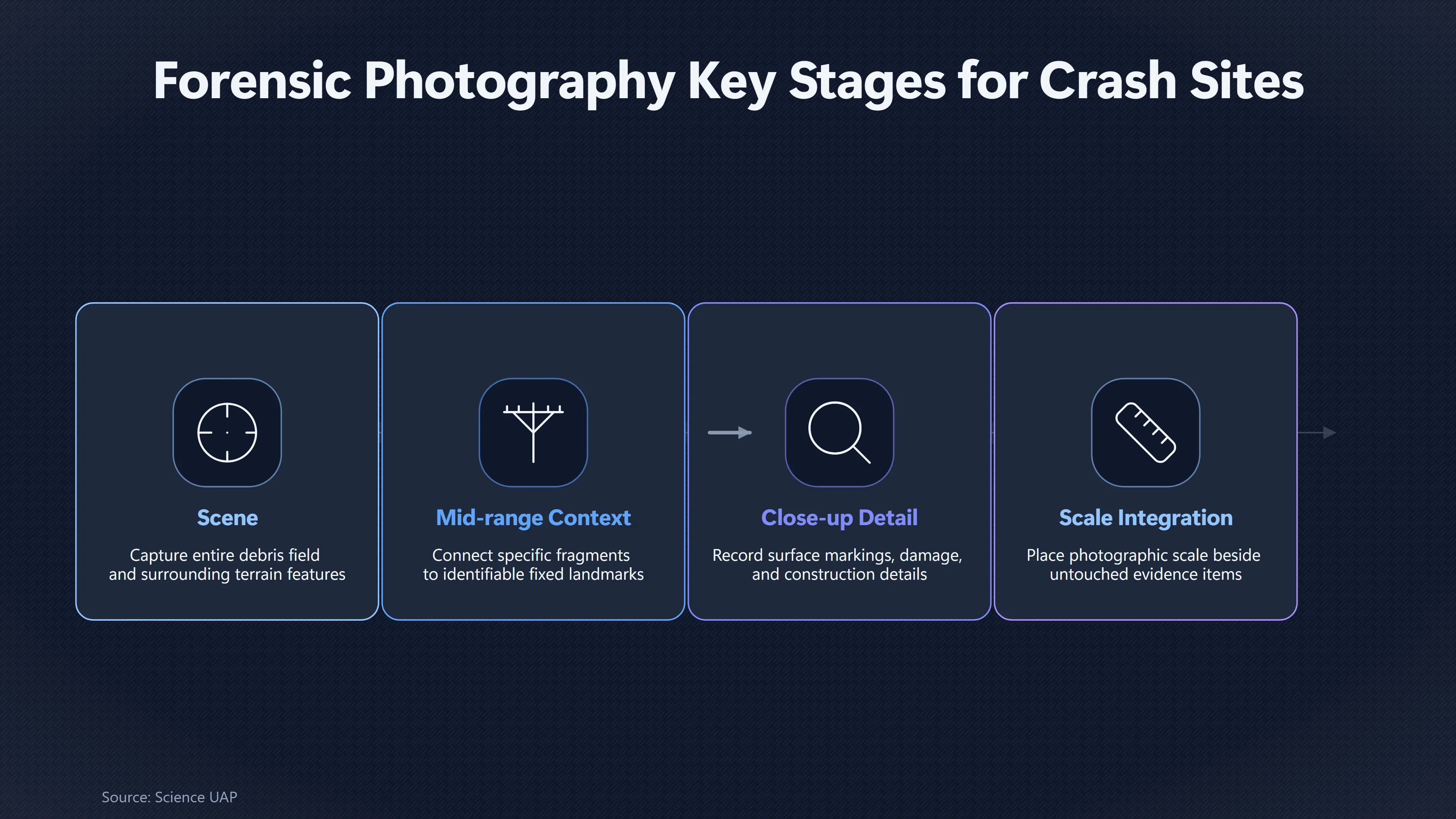
Standard forensic photography follows a three-stage process:
- Overall photographs establish the entire crash area and its surroundings.
- Mid-range photographs connect individual fragments to identifiable landmarks within the wider scene.
- Close-up photographs record construction details, damage, markings and surface condition.
Each stage answers a different question. Overall views answer, “Where is this object within the site?” Mid-range images answer, “How does it relate to nearby features?” Close-ups answer, “What exactly does it look like?” Removing any one stage weakens later reconstruction because investigators lose either context or detail.[National Institute of Justice]nij.ojp.govNational Institute of Justice CRIME SCENE PROCEDURES IINational Institute of JusticeCRIME SCENE PROCEDURES II.August 19, 2024…
For an alleged UFO crash, this disciplined sequence also protects against later accusations that fragments were moved, selectively photographed or presented without sufficient context.
Moving from Overall Views to Close Details
The photography should follow the natural progression through the scene rather than jumping randomly between interesting objects.
Begin with the complete scene
The first images should capture the entire debris field before investigators enter it wherever practical. This includes:
- surrounding terrain
- roads or tracks
- trees
- fences
- buildings
- impact scars
- visible debris limits
These photographs establish the original condition before footprints, equipment and recovery operations alter the area. They also preserve environmental features that may later disappear through weather or clean-up.[National Institute of Justice]nij.ojp.govNational Institute of JusticeCrime Scene Investigation: A Guide for Law Enforcement | National Institute of JusticeSeptember 1, 2013…
Narrow progressively
After the establishing photographs, the camera moves steadily closer.
Rather than isolating a fragment immediately, each successive image should still contain recognisable reference features visible in the previous photograph. For example:
- Entire debris field.
- Southern section of the field.
- Individual cluster of fragments.
- Single fragment beside a distinctive rock.
- Close-up of the fragment’s surface.
Viewed together, another investigator can follow the visual path from the landscape to the object without guessing where the final close-up was taken.
Forensic photography standards specifically recommend mid-range photographs that relate evidence to known landmarks or fixed objects, providing the bridge between overview images and detailed examination.[NIST]nist.govStandard Guide for CrimeStandard Guide for Crime…
Connecting Every Photograph to the Scene Map
Even excellent photographs cannot replace measured mapping because perspective compresses distance and hides relative positions.
Each photographed object should therefore correspond to an identifier on the scene sketch or survey map. A simple numbering system allows photographs, notes and recovered items to refer to the same location.
For example:
- Fragment 12 appears on the scene sketch.
- Photograph DSC_0415 shows Fragment 12 from the north.
- Photograph DSC_0416 shows Fragment 12 beside a fence post.
- Photograph DSC_0417 records its serial markings.
- Evidence bag 12 contains the recovered object.
This cross-reference allows investigators reviewing the case months or years later to reconstruct both the visual appearance and physical location of every documented item.
Crime-scene guidance consistently recommends using sketches alongside photography because photographs alone often fail to show precise spatial relationships between objects.[National Institute of Justice]nij.ojp.govNational Institute of JusticeArchived | Crime Scene and DNA Basics for Forensic Analysts | Documentation - Chain of Custody | National In…

Why Fixed Landmarks Matter More Than Dramatic Angles
Spectacular close-ups often circulate widely after unusual incidents, yet they may contribute little to reconstruction if their original location cannot be determined.
Useful fixed references include:
- buildings
- utility poles
- fence corners
- large boulders
- distinctive trees
- permanent road markings
- surveyed reference points
Temporary features such as parked vehicles, investigators or equipment should not become the primary reference because they may move during the investigation.
Mid-range photographs should deliberately include both the evidence and one or more permanent landmarks visible elsewhere in the sequence. This allows later reviewers to orient themselves without relying solely on written notes.[NIST]nist.govStandard Guide for CrimeStandard Guide for Crime…
Using Scales Without Disturbing Objects
Scales provide size information but should never replace contextual photographs.
A practical sequence is:
- photograph the item exactly as found;
- capture additional close-ups without touching it;
- where appropriate, place a photographic scale beside—but not on—the object;
- photograph again with the scale visible.
Introducing a scale before documenting the untouched scene risks obscuring small features or creating uncertainty about whether the object was moved first.
Modern forensic guidance notes that scales are particularly valuable when relative size, tool marks, manufacturing details or surface damage may later become significant, but the original unscaled photograph remains equally important because it records the untouched condition.[NIST]nist.govStandard Guide for CrimeStandard Guide for Crime…

Preserve Orientation as Well as Appearance
Every photograph should preserve directional information whenever practical.
Investigators should avoid rotating objects merely to make labels easier to read or obtain a more attractive composition. Instead, the camera position changes while the object remains undisturbed.
Consistent orientation across the photographic sequence allows analysts to compare:
- fracture edges
- scorch patterns
- embedded vegetation
- deformation
- directional scraping
- impact marks
If an object must later be moved for safety or recovery, the photographs preserve its original orientation for future reconstruction.
Common Failures That Prevent Later Reconstruction
Several recurring mistakes make crash photographs far less useful:
- isolated close-ups with no wider context;
- missing links between overall and detailed images;
- photographs taken after fragments have already been collected or rearranged;
- lack of fixed landmarks;
- inconsistent numbering between photographs, notes and evidence bags;
- selective photography of unusual objects while ignoring ordinary debris;
- failure to record the direction from which photographs were taken.
These errors can create uncertainty even when hundreds of photographs exist because reviewers cannot reliably place individual images back into the original scene.
Why Sequence Matters in Alleged UFO Crash Reports
Claims involving unconventional craft often generate intense public attention, encouraging selective publication of the most visually striking images. From an evidential perspective, however, dramatic photographs detached from their surroundings have limited value.
A complete photographic sequence allows later investigators to ask objective questions:
- Did fragment distribution match a single impact?
- Were objects concentrated naturally or manually assembled?
- Do scorch marks align with debris orientation?
- Are nearby ground disturbances consistent with the photographed fragment positions?
- Can independent analysts locate every photographed object using only the images and scene map?
This reconstructable approach keeps documentation separate from interpretation. Regardless of whether later analysis concludes the wreckage originated from conventional aircraft, balloons, space hardware, experimental technology or remains unidentified, the photographic record preserves the original scene in a form that others can independently examine and test.
Amazon book picks
Further Reading
Books and field guides related to Do the Photos Prove Where Each Fragment Was?. Use these as the next step if you want deeper reading beyond the article.
Practical Crime Scene Processing and Investigation
All too often, the weakest link in the chain of criminal justice is the crime scene investigation. Improper collection of evidence blocks...
Techniques of Crime Scene Investigation
"Techniques of Crime Scene Investigation is a staple for any forensic science library and is routinely referenced by professional organiz...
Crime Scene Photography
Crime Scene Photography is a book wrought from years of experience, with material carefully selected for ease of use and effectiveness in...
Forensic Photography: The Importance of Accuracy
Designed specifically for the forensic professional, this up-to-date, state-of-the art manual offers a complete look at forensic photogra...
eBay marketplace picks
Marketplace Samples
Live-tested eBay searches with available results related to this page.
Selected fromcamera accessory oneBay.co.uk.
Endnotes
1.
Source: science.nasa.gov
Title: Science UAP
Link:https://science.nasa.gov/uap/
Source snippet
NASA ScienceUAP - NASA ScienceFebruary 23, 2026...
Published: February 23, 2026
2.
Source: nist.gov
Title: Standard Guide for Crime
Link:https://www.nist.gov/document/standard-guide-crime-scene-photography
Source snippet
Standard Guide for Crime...
3.
Source: nasa.gov
Link:https://www.nasa.gov/nasa-brand-center/images-and-media/
Source snippet
Guidelines for using NASA Images and Media GuidelinesJune 23, 2026 — NASA Brand and Collaborations The NASA Insignia, Logotype, identifie...
Published: June 23, 2026
4.
Source: data.nasa.gov
Title: uavsar polsar metadata cafdd
Link:https://data.nasa.gov/dataset/uavsar-polsar-metadata-cafdd
5.
Source: data.nasa.gov
Title: astronomy picture of the day api
Link:https://data.nasa.gov/dataset/astronomy-picture-of-the-day-api
6.
Source: standards.nasa.gov
Title: NASA STD 2822
Link:https://standards.nasa.gov/standard/NASA/NASA-STD-2822
7.
Source: nasa.gov
Title: UPDAT E: NASA Shares UAP Independent Study Report; Names Director
Link:https://www.nasa.gov/news-release/update-nasa-shares-uap-independent-study-report-names-director/
8.
Source: nasa.gov
Title: NAS A to Release, Discuss Unidentified Anomalous Phenomena Report
Link:https://www.nasa.gov/news-release/nasa-to-release-discuss-unidentified-anomalous-phenomena-report/
9.
Source: nodis3.gsfc.nasa.gov
Title: display Dir.cfm
Link:https://nodis3.gsfc.nasa.gov/displayDir.cfm?Internal_ID=N_PR_1441001E&page_name=Chapter1
10.
Source: data.nasa.gov
Title: uavsar insar metadata
Link:https://data.nasa.gov/dataset/uavsar-insar-metadata
11.
Source: nodis3.gsfc.nasa.gov
Title: display All.cfm
Link:https://nodis3.gsfc.nasa.gov/displayAll.cfm?Internal_ID=N_PR_86210001&page_name=ALL
12.
Source: software.nasa.gov
Title: GSC 19152 1
Link:https://software.nasa.gov/software/GSC-19152-1
13.
Source: data.nasa.gov
Link:https://data.nasa.gov/dataset/
14.
Source: ntrs.nasa.gov
Link:https://ntrs.nasa.gov/citations/20220017254
15.
Source: nij.ojp.gov
Title: National Institute of Justice CRIME SCENE PROCEDURES II
Link:https://nij.ojp.gov/sites/g/files/xyckuh171/files/media/document/Crime_Scene_Procedures_II.pdf
Source snippet
National Institute of JusticeCRIME SCENE PROCEDURES II.August 19, 2024...
Published: August 19, 2024
16.
Source: nij.ojp.gov
Link:https://nij.ojp.gov/library/publications/crime-scene-investigation-guide-law-enforcement
Source snippet
National Institute of JusticeCrime Scene Investigation: A Guide for Law Enforcement | National Institute of JusticeSeptember 1, 2013...
Published: September 1, 2013
17.
Source: nij.ojp.gov
Link:https://nij.ojp.gov/nij-hosted-online-training-courses/crime-scene-and-dna-basics-forensic-analysts/evidence-crime-scene/documentation-chain-custody
Source snippet
National Institute of JusticeArchived | Crime Scene and DNA Basics for Forensic Analysts | Documentation - [Chain of Custody]({{ 'chain-of-custody/' | relative_url }}) | National In...
18.
Source: nij.ojp.gov
Title: crime scene investigation reference law enforcement training
Link:https://nij.ojp.gov/library/publications/crime-scene-investigation-reference-law-enforcement-training
19.
Source: ojp.gov
Title: photographing crime scene
Link:https://www.ojp.gov/ncjrs/virtual-library/abstracts/photographing-crime-scene
20.
Source: ojp.gov
Link:https://www.ojp.gov/ncjrs/virtual-library/abstracts/fundamental-principles-and-theory-crime-scene-photography
21.
Source: ojp.gov
Title: MARYLAN D
Link:https://ojp.gov/ncjrs/virtual-library/abstracts/maryland-collision-management-procedures-part-8-photographing
Additional References
22.
Source: wired.com
Link:https://www.wired.com/story/nasa-ufos-aliens-report-2023
Source snippet
The agency stressed the need to shift the conversation from sensationalism to science and eliminate the stigma associated with reporting...
23.
Source: youtube.com
Link:https://www.youtube.com/watch?v=Y2YKYUIcGao
Source snippet
This video explains how forensic photography establishes a sequence using overall, mid-range, and close-up views to reconstruct a scene a...
24.
Source: forensiccsi.com
Title: crime scene photography evidence scales setup
Link:https://forensiccsi.com/crime-scene-photography-evidence-scales-setup/
Source snippet
Crime Scene Photography: Setting Up Evidence Scales Properly – ForensicCSIMay 31, 2026 — CRIME SCENE PHOTOGRAPHY: SETTING UP EVIDENCE SCA...
Published: May 31, 2026
25.
Source: youtube.com
Title: How Pearland PD investigates crash scenes using DJI Mavic 3 Enterprise
Link:https://www.youtube.com/watch?v=ITaKMA0jnkw
Source snippet
Drone U & Pix4D Teach Accident Scene Reconstruction Hosted at the NTSB Training Academy...
26.
Source: ntsb.gov
Link:https://www.ntsb.gov/investigations/process/Pages/goteam.aspx
27.
Source: ntsb.gov
Link:https://www.ntsb.gov/investigations/process/Pages/default.aspx
28.
Source: youtube.com
Title: How to Photograph a Crime Scene
Link:https://www.youtube.com/watch?v=tOWOnYb71_0
Source snippet
How an expert photographs a crime scene | The Forensic Photographer...
29.
Source: youtube.com
Title: Importance of Crime Scene Photography
Link:https://www.youtube.com/watch?v=_2ruLArvSbU
Source snippet
How Pearland PD investigates crash scenes using DJI Mavic 3 Enterprise...
30.
Source: pinnacleforensics.co
Link:https://pinnacleforensics.co/crime-scene-photography-field-review-guide/
31.
Source: forensicpocketguide.com
Link:https://forensicpocketguide.com/?p=8867