Within UFO Crashes
When Space Junk Looks Like a Crashed UFO
Re-entering satellites can create fireballs and scattered fragments, but linking a particular spacecraft to a famous case requires precise orbital evidence.
On this page
- How satellites break up during re entry
- What genuine space debris looks like
- Why orbital matches are often uncertain
Page outline Jump by section
Introduction
Re-entering satellites and rocket stages can produce many of the features associated with an alleged UFO crash: a slow-moving fireball, multiple glowing fragments, sonic booms, emergency searches and pieces of unfamiliar metal found far apart. Some recovered “mystery objects” have later proved to be pressure tanks, engine hardware or other spacecraft components. Yet this explanation cannot be applied merely because an incident happened during the Space Age. Linking a particular recovery to a particular spacecraft requires orbital data that place the object above the right region at the right time, followed by a physically plausible re-entry path and, ideally, identifiable wreckage.
That distinction is crucial in famous cases such as Kecksburg, Pennsylvania. A failed Soviet probe has often been proposed as the source, but the published timing and trajectory evidence do not produce a secure match. Space debris is therefore both a genuine source of UFO-like incidents and an explanation that is sometimes invoked more confidently than the evidence allows.
How satellites break up during re-entry
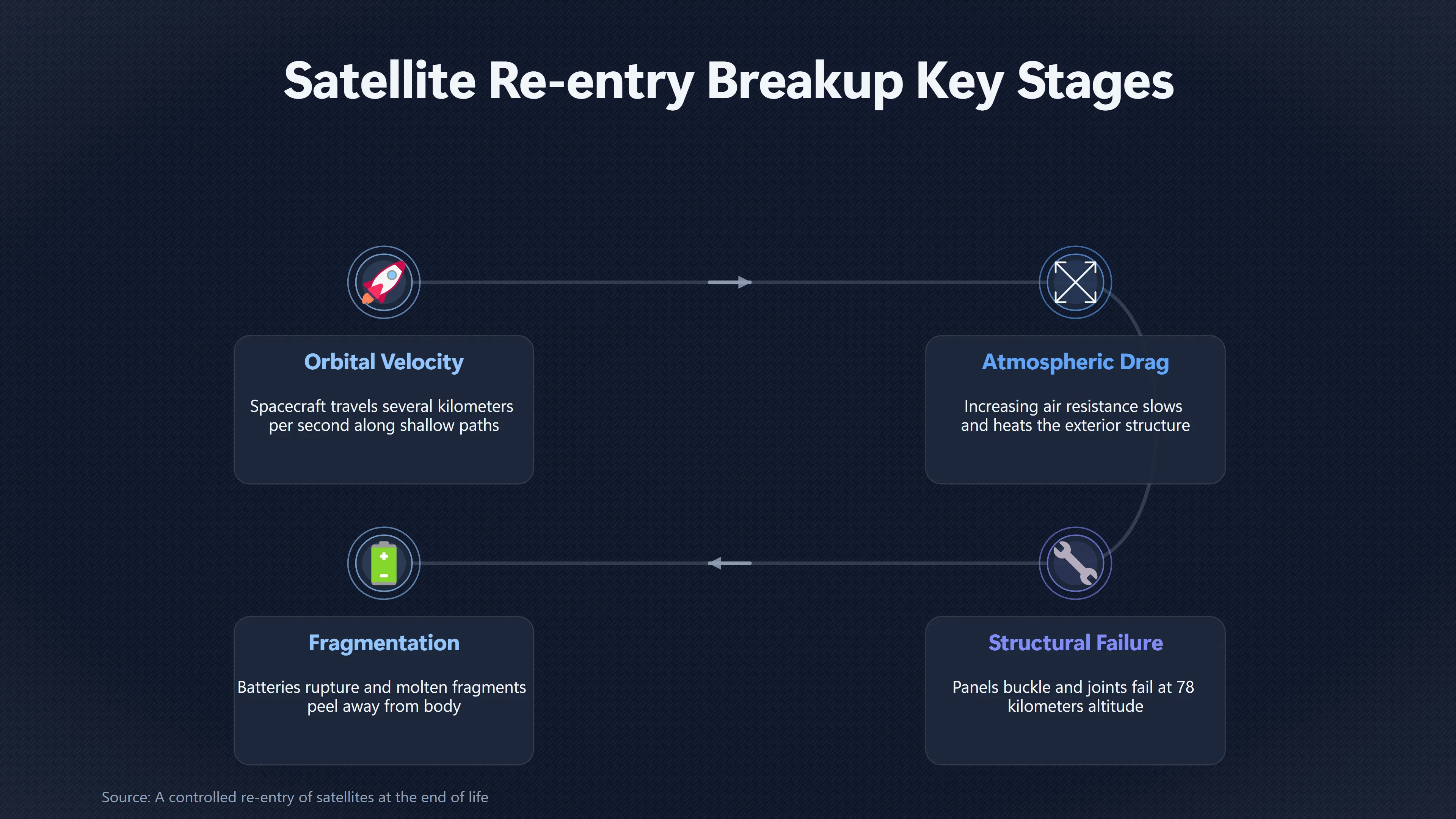
A satellite returning from orbit does not simply fall straight down from a fixed point in the sky. It initially travels at orbital speed—roughly several kilometres per second—along a shallow path through the upper atmosphere. Increasing air resistance slows it, heats its exterior and subjects its structure to rapidly growing aerodynamic forces.
NASA’s Orbital Debris Program Office says spacecraft commonly break apart at altitudes of about 72 to 84 kilometres, with 78 kilometres used as a nominal breakup altitude. Large solar panels can detach even higher, at around 90 to 95 kilometres, before the main body fails. The pieces then follow separate paths, creating a long debris footprint rather than a neat pile at one “crash site”.[Orbital Debris Program Office]orbitaldebris.jsc.nasa.govOrbital Debris Program OfficeARES | Orbital Debris Program Office | Debris ReentryLarge, sturdy, and dense satellites generally break up…
The dramatic light is not produced solely by surface friction in the everyday sense. The object compresses the air in front of it, generating extreme temperatures. Panels buckle, joints fail, batteries rupture and molten or burning fragments peel away. To an observer on the ground, the result may resemble a formation of luminous objects manoeuvring together. The apparent motion can be deceptive because the observer usually has no reliable measure of distance, height or speed.
Human-made re-entries also tend to last longer than ordinary meteors. The Aerospace Corporation gives a useful rule of thumb: natural meteors usually remain visible for only a few seconds, whereas re-entering spacecraft can cross the sky for 20 to 90 seconds or more. This is not a definitive test—a slow natural fireball or a poorly observed re-entry can defeat the rule—but duration, fragmentation and a relatively shallow path are valuable clues.[Aerospace Corporation]aerospace.orgAerospace CorporationWhat Does a Reentry Look LikeThe general rule-of-thumb is that natural meteor reentries happen quickly and typically…
Why fragments land far from the fireball
A witness may see a glowing object apparently descend behind nearby trees and reasonably conclude that it landed in the next field. In reality, the luminous breakup may be tens or hundreds of kilometres away. Perspective makes a distant object seem to meet the horizon, while the surviving pieces continue downrange after the visible light has faded.
Different components also slow at different rates. Light panels and insulation lose speed quickly; compact tanks, engine parts and dense metal fittings retain momentum for longer. Winds at several atmospheric levels further separate the pieces. The result may be a recovery area extending over hundreds of kilometres, especially when the parent object breaks up high in the atmosphere.
This scattering mechanism complicates UFO crash reports. A search close to the apparent descent point may find nothing, while unrelated scrap discovered nearby can be drawn into the story. Conversely, genuine spacecraft fragments may be recovered without witnesses connecting them to a fireball seen much farther away.
What genuine space debris looks like
Recovered spacecraft debris rarely resembles an intact satellite. Aluminium structures often melt or fragment, leaving the parts most able to withstand heat: titanium or stainless-steel tanks, engine chambers, thick rings, valves, plumbing and composite-overwrapped pressure vessels. The latter are strong containers reinforced with carbon or glass fibres and are used to store helium, fuel or other pressurised substances.
ESA notes that tank-like components made from heat-resistant materials, including titanium, are among the parts most likely to survive. Its re-entry records include recovered stainless-steel and titanium tanks as well as motor thrust chambers and other recognisable spacecraft hardware.[blogs.esa.int]blogs.esa.intA controlled re-entry of satellites at the end of lifeESA's blogsNov 12, 2018 — Some parts of the satellites or upper-stages (especially tanks resistant materials like titanium) can survive a…
Common indicators include:
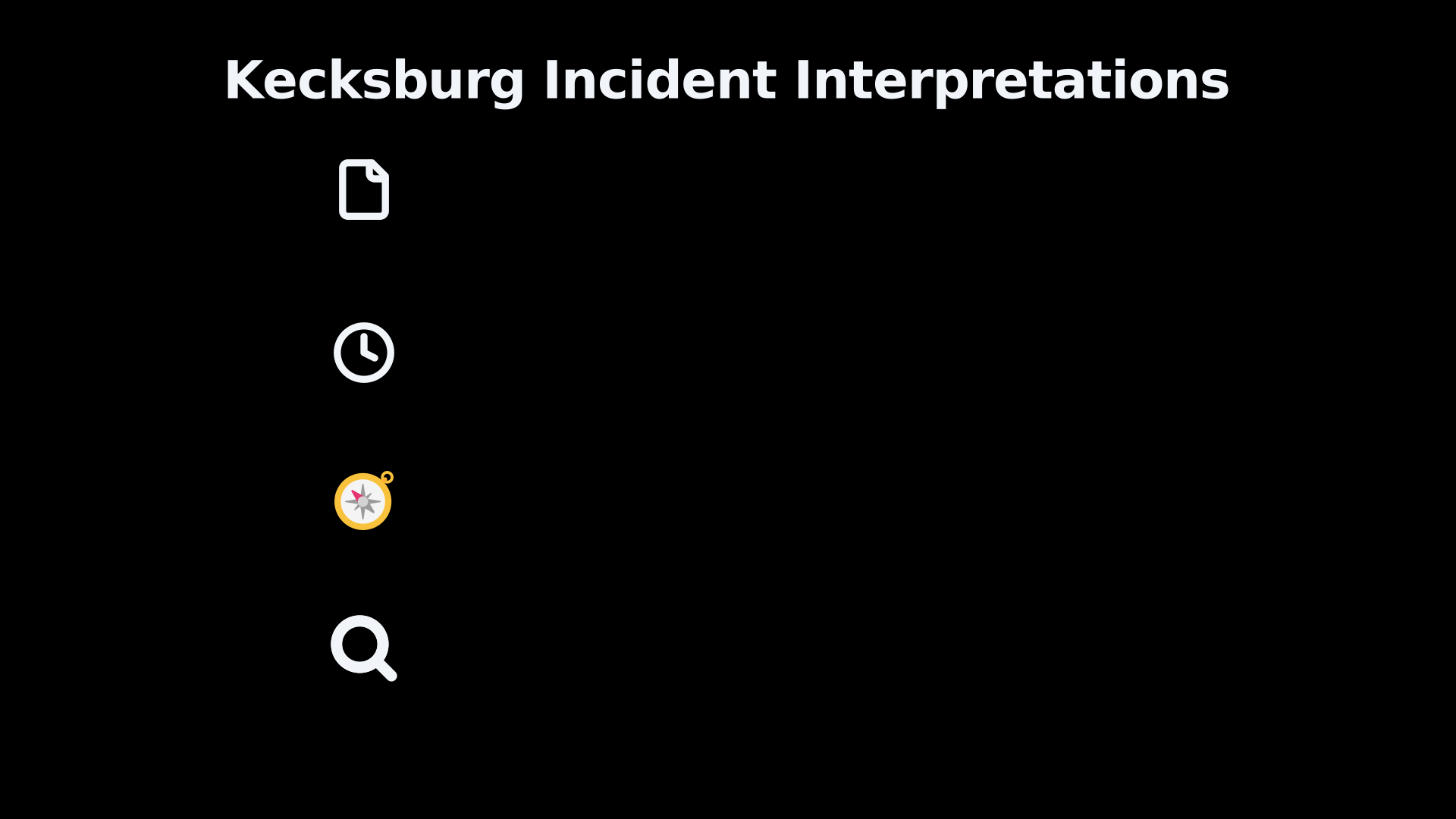
- Rounded tanks or spheres. Their shape distributes stress efficiently, while thick walls and high-melting-point alloys help them survive.
- Carbon-fibre wrapping. A scorched, hairy or woven exterior may come from a composite pressure vessel rather than an exotic material.
- Severe but uneven heating. One side may be blackened, melted or stripped while recessed areas retain paint, labels or manufactured finishes.
- Plumbing attachments and mounting points. Valves, threaded ports, brackets and broken pipes reveal an engineered function.
- Serial numbers or part markings. These can sometimes identify a manufacturer, launch vehicle or production batch.
- Ordinary terrestrial alloys. Laboratory analysis generally finds aerospace-grade aluminium, steel, titanium or composite materials rather than unknown elements.
A convincing identification usually combines several of these features. Shape alone is weak evidence: a metal sphere might be a spacecraft tank, an industrial vessel, marine equipment or debris carried from elsewhere. Investigators also need the discovery location, condition of the surrounding ground, witness timeline and possible re-entry events.
Recoveries with traceable origins
The “Merkanooka ball”, a metal sphere found in Western Australia in 1965, was initially discussed as a possible UFO-related object but was subsequently identified as a water tank from NASA’s Gemini 5 spacecraft. The case is a compact example of how genuinely unusual aerospace debris can appear alien until its design and mission history are recognised.[TIME]time.comThe Sky Is FallingRemarkably, she was unhurt and remains the sole documented individual to be struck by re-entering space debris. In Canada, the Soviet sat…
Archival records provide another example from Saudi Arabia. Debris that fell there in late 1967 was identified as American space hardware, prompting diplomatic efforts by the United States to recover it. The episode illustrates why official interest or rapid removal is not, by itself, evidence of an extraterrestrial retrieval. Governments may want hardware returned because it is hazardous, technically sensitive, legally significant or useful for studying how a spacecraft failed.[The Text Message]text-message.blogs.archives.govgive us back our junk space debris 1968The Text MessageGive Us Back Our Junk: Space Debris, 1968 - The Text MessageAugust 9, 2022 — 9 Aug 2022 — When space debris identified as…
A more recent case shows how attribution can be established with multiple lines of evidence. On 8 March 2024, a metal object struck a house in Naples, Florida. NASA connected the event to the uncontrolled return of a 2.9-tonne battery pallet released from the International Space Station; weather radar also detected falling material over the Gulf of Mexico towards Naples. Here, the timing, tracked orbit, debris field and component analysis supported the same explanation.[ARES]ares.jsc.nasa.govnaples fl debris deorbitMeteorite Falls | Naples, FL Debris Deorbit8 Mar 2024 — This is the deorbit of a 2.9 ton battery pallet from the International Space…
These cases differ sharply from alleged crash recoveries in which the object disappeared, no sample has a documented history, or the proposed spacecraft was never shown to have passed over the region.
Why orbital matches are often uncertain
Orbital tracking can establish whether a satellite explanation is possible, but an uncontrolled re-entry is difficult to predict precisely. Atmospheric density changes with solar activity, time of day and other conditions. Small errors in estimated drag accumulate rapidly as an object completes its final orbits.
ESA warns that even shortly before re-entry there is generally an uncertainty of several hours. Because an orbiting spacecraft travels thousands of kilometres during that interval, a predicted time window can correspond to numerous passes over different continents and oceans. A forecast saying that an object might return “that day” is therefore not enough to connect it with a report in one town.[European Space Agency]esa.intOpen source on esa.int.
Historical cases are harder still. Older tracking networks produced less complete data, Soviet and American missions were sometimes secret, and surviving orbital records may use estimates rather than direct observations. Researchers reconstructing an event decades later must distinguish between:
- The last confirmed orbit, based on tracking observations.
- The predicted decay time, which may carry a large uncertainty.
- The observed fireball path, ideally calculated from several accurately located witnesses or photographs.
- The possible ground footprint, which lies downrange of the luminous breakup.
- The recovered material, which must be consistent with the candidate spacecraft.
A match that satisfies only the date is weak. Thousands of objects have re-entered since the beginning of the Space Age, and coincidental overlap becomes increasingly likely when the time window is broad.
The opposite problem also occurs: a re-entry may be recognised as artificial while the exact parent object remains unknown. In 2015, astronomers tracked an object designated WT1190F into the atmosphere over the Indian Ocean. Its low density and response to sunlight indicated that it was hollow, human-made rocket hardware, but available records did not securely identify which earlier lunar or planetary mission had left it behind. The event demonstrates that “space debris” can be a strong classification even when a specific launch attribution remains uncertain.[WIRED]wired.comLast Week's Downed UFO? A Rocket, But No One Knows WhichLast Week's Downed UFO? A Rocket, But No One Knows Which
Kecksburg and the limits of the Soviet-probe theory
The Kecksburg incident of 9 December 1965 is frequently cited as a possible satellite-debris recovery. Witnesses across parts of the United States and Canada reported a bright fireball, while later accounts described an acorn- or bell-shaped object in woods near Kecksburg and a military operation that removed it. The most familiar artificial explanation identifies the supposed object as Kosmos 96, a failed Soviet Venus mission.
The proposal has superficial appeal. Kosmos 96 was a real spacecraft, it had failed in Earth orbit, and Soviet planetary descent vehicles used compact, rounded forms that could resemble later descriptions of the Kecksburg object. A secretive recovery of Soviet hardware would also offer an ordinary reason for military interest.
The orbital evidence, however, is a major obstacle. Published tracking information placed the decay of Kosmos 96 many hours before the late-afternoon North American fireball, reportedly over Canada. Studies of photographs and the event’s timing described the observed fireball as following a steep path more consistent with a natural meteoroid than with an object completing a shallow orbital re-entry. Contemporary reports also stated that searchers found no object in the woods.[Wikipedia]WikipediaKecksburg UFO incidentKecksburg UFO incident
NASA complicated the history in 2005 when a spokesman said that fragments associated with the incident had once been examined and identified as a Soviet satellite, but that the relevant records had been lost. Subsequent document searches did not produce a technical report establishing that identification. The statement therefore cannot substitute for the missing orbital and material evidence, and later NASA-related commentary was less supportive of a Soviet-spacecraft connection.[Wikipedia]WikipediaKecksburg UFO incidentKecksburg UFO incident
Kecksburg remains useful precisely because it shows how a plausible category can become confused with a demonstrated identification. Satellite debris is not impossible in principle, but the specific Kosmos 96 claim requires more than resemblance and a shared calendar date. It would need tracking data compatible with the fireball, a viable descent corridor to Pennsylvania and securely documented debris matching the Soviet vehicle. Those elements have not been publicly assembled.
A practical test for satellite-debris claims
A spacecraft explanation should become stronger as independent evidence is added. It should not depend on continually widening the re-entry window or altering the reported trajectory to preserve a preferred candidate.
The most reliable assessment asks:
Was an artificial re-entry independently tracked? Radar catalogues, astronomical observations or contemporary space-agency notices should place a decaying object in the relevant time window.
Did its ground track cross the correct region? An object cannot land far outside the latitude range and downrange corridor permitted by its orbit.
Does the observed motion resemble re-entry? A prolonged, shallow, fragmenting procession favours artificial debris; a brief, steep fireball often favours a meteoroid.
Was anything actually recovered? An eyewitness impression that an object went behind a ridge is not proof of ground impact.
Is there a chain of custody? The location and date of recovery should be recorded before the material enters private collections or UFO folklore.
Does the hardware identify itself? Tanks, valves, composites, welds, inscriptions and alloy composition may connect a fragment to a known aerospace system.
Do the timings survive precise comparison? “The same week” or even “the same day” may be inadequate when an orbital object circles Earth in roughly 90 minutes.
Space debris deserves serious consideration in UFO crash investigations because it is a documented mechanism capable of producing spectacular lights and unfamiliar wreckage. But it is not a universal answer. The strongest identifications join orbital tracking, atmospheric observations and physical analysis into one continuous account. Where that chain is broken—as in many celebrated recovery stories—the responsible conclusion is not that the object was alien, nor that it was definitely a satellite, but that the proposed identification remains unproved.
Amazon book picks
Further Reading
Books and field guides related to When Space Junk Looks Like a Crashed UFO. Use these as the next step if you want deeper reading beyond the article.
Space Debris: Models and Risk Analysis
In Space Debris Models and Risk Analysis the authors will provide the reader with a comprehensive background to understand the various so...
Orbital Debris: A Technical Assessment
Since the beginning of space flight, the collision hazard in Earth orbit has increased as the number of artificial objects orbiting the E...
Fundamentals of Astrodynamics and Applications
First published 1997. Subjects: Astrodynamik.
Spacecraft Systems Engineering
Following on from the hugely successful previous editions, the third edition of Spacecraft Systems Engineering incorporates the most rece...
eBay marketplace picks
Marketplace Samples
Live-tested eBay searches with available results related to this page.
Selected fromspace poster oneBay.co.uk.


Endnotes
1.
Source: orbitaldebris.jsc.nasa.gov
Link:https://orbitaldebris.jsc.nasa.gov/reentry/
Source snippet
Orbital Debris Program OfficeARES | Orbital Debris Program Office | Debris ReentryLarge, sturdy, and dense satellites generally break up...
2.
Source: aerospace.org
Link:https://aerospace.org/article/what-does-reentry-look-like
Source snippet
Aerospace CorporationWhat Does a Reentry Look LikeThe general rule-of-thumb is that natural meteor reentries happen quickly and typically...
3.
Source: blogs.esa.int
Title: A controlled re-entry of satellites at the end of life
Link:https://blogs.esa.int/cleanspace/2018/11/12/a-controlled-re-entry-of-satellites-at-the-end-of-life/
Source snippet
ESA's blogsNov 12, 2018 — Some parts of the satellites or upper-stages (especially tanks resistant materials like titanium) can survive a...
4.
Source: reentry.esoc.esa.int
Link:https://reentry.esoc.esa.int/
Source snippet
ESA's re-entry predictions... identified as space debris, but also in this case there was no injury. [a] Stainless steel tank (250kg). [b...
5.
Source: time.com
Title: The Sky Is Falling
Link:https://time.com/4574520/the-sky-is-falling/
Source snippet
Remarkably, she was unhurt and remains the sole documented individual to be struck by re-entering space debris. In Canada, the Soviet sat...
6.
Source: ares.jsc.nasa.gov
Title: naples fl debris deorbit
Link:https://ares.jsc.nasa.gov/meteorite-falls/events/naples-fl-debris-deorbit
Source snippet
Meteorite Falls | Naples, FL Debris Deorbit8 Mar 2024 — This is the deorbit of a 2.9 ton battery pallet from the International Space...
7.
Source: ares.jsc.nasa.gov
Link:https://ares.jsc.nasa.gov/meteorite-falls/events/
8.
Source: esa.int
Link:https://www.esa.int/Space_Safety/Space_Debris/ESA_reentry_expertise
9.
Source: wired.com
Title: Last Week’s Downed UFO? A Rocket, But No One Knows Which
Link:https://www.wired.com/2015/11/last-weeks-downed-ufo-a-rocket-but-no-one-knows-which
10.
Source: Wikipedia
Title: Kecksburg UFO incident
Link:https://en.wikipedia.org/wiki/Kecksburg_UFO_incident
11.
Source: orbitaldebris.jsc.nasa.gov
Link:https://www.orbitaldebris.jsc.nasa.gov/quarterly-news/pdfs/odqnv25i1.pdf
12.
Source: s3vi.ndc.nasa.gov
Title: Endorsement of Best Practices for Sustainability v42
Link:https://s3vi.ndc.nasa.gov/ssri-kb/static/resources/Endorsement-of-Best-Practices-for-Sustainability_v42.pdf
13.
Source: ntrs.nasa.gov
Link:https://ntrs.nasa.gov/api/citations/20190025208/downloads/20190025208.pdf
14.
Source: soma.larc.nasa.gov
Link:https://soma.larc.nasa.gov/SIMPLEx/pdf_files/871914.pdf
15.
Source: orbitaldebris.jsc.nasa.gov
Title: iadc space debris guidelines revision 2
Link:https://orbitaldebris.jsc.nasa.gov/library/iadc-space-debris-guidelines-revision-2.pdf
16.
Source: orbitaldebris.jsc.nasa.gov
Link:https://orbitaldebris.jsc.nasa.gov/quarterly-news/pdfs/ODQNv4i4.pdf
17.
Source: orbitaldebris.jsc.nasa.gov
Link:https://orbitaldebris.jsc.nasa.gov/faq/
18.
Source: ntrs.nasa.gov
Link:https://ntrs.nasa.gov/api/citations/20190033904/downloads/20190033904.pdf
19.
Source: nasa.gov
Title: spacecraft components
Link:https://www.nasa.gov/reference/spacecraft-components/
20.
Source: nasa.gov
Link:https://www.nasa.gov/wp-content/uploads/2018/12/692076main_orbital_debris_management_and_risk_mitigation.pdf?emrc=e20460
21.
Source: orbitaldebris.jsc.nasa.gov
Title: quarterly news
Link:https://orbitaldebris.jsc.nasa.gov/quarterly-news/
22.
Source: heasarc.gsfc.nasa.gov
Title: Beppo SAX FAQs
Link:https://heasarc.gsfc.nasa.gov/docs/sax/BeppoSAX_FAQs.html
23.
Source: orbitaldebris.jsc.nasa.gov
Link:https://orbitaldebris.jsc.nasa.gov/quarterly-news/pdfs/ODQNv16i4.pdf
24.
Source: nasa.gov
Link:https://www.nasa.gov/wp-content/uploads/2024/11/sullivankd-3-12-08.pdf?emrc=d6a449
25.
Source: ntrs.nasa.gov
Link:https://ntrs.nasa.gov/api/citations/19920010006/downloads/19920010006.pdf
26.
Source: technology.esa.int
Link:https://technology.esa.int/page/re-entry-safety
27.
Source: esa.int
Link:https://www.esa.int/Space_Safety/Space_Debris/Hypervelocity_impacts_and_protecting_spacecraft
28.
Source: indico.esa.int
Link:https://indico.esa.int/event/450/contributions/8936/attachments/5708/9464/Methodologies%20and%20Tools%20to%20Ensure%20the%20Safe%20and%20Sustainable%20Reentry%20of%20Spacecrafts.pdf
29.
Source: conference.sdo.esoc.esa.int
Link:https://conference.sdo.esoc.esa.int/proceedings/sdc7/paper/489
30.
Source: conference.sdo.esoc.esa.int
Title: SDC4 paper44
Link:https://conference.sdo.esoc.esa.int/proceedings/sdc4/paper/44/SDC4-paper44.pdf
31.
Source: esa.int
Link:https://www.esa.int/Space_Safety/Space_Debris/Reentry_and_collision_avoidance
32.
Source: conference.sdo.esoc.esa.int
Link:https://conference.sdo.esoc.esa.int/proceedings/sdc9/paper/251/SDC9-paper251.pdf
33.
Source: blogs.esa.int
Title: how do materials behave during atmospheric re entry
Link:https://blogs.esa.int/cleanspace/2017/03/02/how-do-materials-behave-during-atmospheric-re-entry/
34.
Source: esa.int
Link:https://www.esa.int/Science_Exploration/Space_Science/Cluster/Frequently_asked_questions_Cluster_s_Salsa_reentry
35.
Source: esa.int
Link:https://www.esa.int/Space_Safety/Space_Debris/Space_Debris_FAQ_Frequently_asked_questions
36.
Source: blogs.esa.int
Title: a new method to reduce the casualty risks of space debris during re entry
Link:https://blogs.esa.int/cleanspace/2019/10/22/a-new-method-to-reduce-the-casualty-risks-of-space-debris-during-re-entry/
37.
Source: indico.esa.int
Link:https://indico.esa.int/event/493/timetable/?view=standard_inline_minutes
38.
Source: esa.int
Link:https://www.esa.int/Space_Safety/Clean_Space/Space_debris_feel_the_burn
39.
Source: blogs.esa.int
Title: ers 2 reentry frequently asked questions
Link:https://blogs.esa.int/rocketscience/2024/02/05/ers-2-reentry-frequently-asked-questions/
40.
Source: esa.int
Link:https://www.esa.int/Space_Safety/Space_Debris/Moving_satellites_to_meet_a_plane_for_rare_reentry_data
41.
Source: conference.sdo.esoc.esa.int
Link:https://conference.sdo.esoc.esa.int/proceedings/sdc7/paper/191
42.
Source: technology.esa.int
Title: Space Debris Mitigation Requirements ESSB ST U 007 Issue1
Link:https://technology.esa.int/upload/media/ESA-Space-Debris-Mitigation-Requirements-ESSB-ST-U-007-Issue1.pdf
43.
Source: conference.sdo.esoc.esa.int
Link:https://conference.sdo.esoc.esa.int/proceedings/sdc4/paper/125/SDC4-paper125.pdf
44.
Source: conference.sdo.esoc.esa.int
Link:https://conference.sdo.esoc.esa.int/proceedings/sdc6/paper/148/SDC6-paper148.pdf
45.
Source: conference.sdo.esoc.esa.int
Link:https://conference.sdo.esoc.esa.int/proceedings/sdc2/paper/55/SDC2-paper55.pdf
46.
Source: reentry.esoc.esa.int
Title: GEN REN MAN 00232 OPS GR ESA Re entry Prediction Front end User Guide
Link:https://reentry.esoc.esa.int/files/public/GEN-REN-MAN-00232-OPS-GR%20ESA%20Re-entry%20Prediction%20Front-end%20User%20Guide.pdf
47.
Source: esa.int
Link:https://www.esa.int/gsp/ACT/doc/ARI/ARI%20Study%20Report/ACT-RPT-MAD-ARI-10-6411-Pisa-Active_Removal_of_Space_Debris-Foam.pdf
48.
Source: conference.sdo.esoc.esa.int
Title: SDC7 paper672
Link:https://conference.sdo.esoc.esa.int/proceedings/sdc7/paper/672/SDC7-paper672.pdf
49.
Source: conference.sdo.esoc.esa.int
Link:https://conference.sdo.esoc.esa.int/proceedings/sdc8/paper/131/SDC8-paper131.pdf
50.
Source: sdup.esoc.esa.int
Title: int ESS B-HB-U-003
Link:https://sdup.esoc.esa.int/documents/download/ESSB-HB-U-003_Issue_1_8September2025.pdf
51.
Source: conference.sdo.esoc.esa.int
Link:https://conference.sdo.esoc.esa.int/proceedings/sdc4/paper/96/SDC4-paper96.pdf
52.
Source: conference.sdo.esoc.esa.int
Link:https://conference.sdo.esoc.esa.int/proceedings/sdc7/paper/367/SDC7-paper367.pdf
53.
Source: conference.sdo.esoc.esa.int
Link:https://conference.sdo.esoc.esa.int/proceedings/sdc9/paper/226/SDC9-paper226.pdf
54.
Source: space.com
Link:https://www.space.com/space-exploration/launches-spacecraft/[unidentified
55.
Source: space.com
Link:https://www.space.com/space-exploration/launches-spacecraft/metal-spheres-found-in-australia-show-how-little-we-still-know-about-falling-space-debris-experts-say
56.
Source: Wikipedia
Title: Pressure (2026 film)
Link:https://en.wikipedia.org/wiki/Pressure_%282026_film%29
57.
Source: Wikipedia
Title: Atmospheric entry
Link:https://en.wikipedia.org/wiki/Atmospheric_entry
58.
Source: Wikipedia
Link:https://en.wikipedia.org/wiki/Pressure
59.
Source: Wikipedia
Title: Kosmos 96
Link:https://en.wikipedia.org/wiki/Kosmos_96
60.
Source: Wikipedia
Title: List of space debris fall incidents
Link:https://en.wikipedia.org/wiki/List_of_space_debris_fall_incidents
61.
Source: aerospace.org
Title: space debris 101
Link:https://aerospace.org/article/space-debris-101
62.
Source: text-message.blogs.archives.gov
Title: give us back our junk space debris 1968
Link:https://text-message.blogs.archives.gov/2022/08/09/give-us-back-our-junk-space-debris-1968/
Source snippet
The Text MessageGive Us Back Our Junk: Space Debris, 1968 - The Text MessageAugust 9, 2022 — 9 Aug 2022 — When space debris identified as...
Published: August 9, 2022
63.
Source: shadowarchive.agency
Title: kecksburg incident
Link:https://shadowarchive.agency/investigations/kecksburg-incident
64.
Source: keeptrack.space
Link:https://keeptrack.space/space-terms/reentry
65.
Source: focusfeatures.com
Link:https://www.focusfeatures.com/pressure
66.
Source: sciencedirect.com
Link:https://www.sciencedirect.com/topics/social-sciences/reentry
Additional References
67.
Source: youtube.com
Link:https://www.youtube.com/watch?v=HX_RrO7ZQaU
Source snippet
Episode 184 Kecksburg Revisited with Stan Gordon...
68.
Source: youtube.com
Title: Kosmos 954: The Soviet Nuclear Satellite Disaster
Link:https://www.youtube.com/watch?v=Dpuk6cyw4mE
Source snippet
What were the mysterious [fireballs]({{ 'fireballs/' | relative_url }}) that crashed in Chile?...
69.
Source: youtube.com
Title: The Kecksburg Incident: What Really Happened Here?
Link:https://www.youtube.com/watch?v=BXh2zTD9Kug
Source snippet
Kosmos 954: The Soviet Nuclear Satellite Disaster...
70.
Source: facebook.com
Link:https://www.facebook.com/AccuWeather/posts/a-mysterious-burning-object-believed-to-have-fallen-from-space-was-found-at-a-mi/1195895782395066/
71.
Source: instagram.com
Link:https://www.instagram.com/reel/Dacr6ZVD3o2/
72.
Source: facebook.com
Link:https://www.facebook.com/australianspaceagency/posts/the-australian-space-agency-is-advising-queensland-authorities-and-the-national-/1472050041633929/
73.
Source: facebook.com
Link:https://www.facebook.com/7NEWSQld/posts/four-mysterious-metallic-canisters-have-washed-ashore-at-forrest-beach-in-north-/1453175370174418/
74.
Source: facebook.com
Link:https://www.facebook.com/historyoasis/posts/on-the-evening-of-december-9-1965-a-massive-brilliant-fireball-blazed-across-the/831788759955399/
75.
Source: enigmalabs.io
Link:https://enigmalabs.io/library/f45bb19d-5803-4ab6-a373-8799f64095c0
76.
Source: scribd.com
Link:https://www.scribd.com/document/39530664/kecksburg2