Within UFO Crashes
What Would Prove a UFO Crash?
A convincing case would need secure debris, authenticated records, precise scene documentation and repeatable tests excluding ordinary causes.
On this page
- Physical evidence and secure provenance
- Contemporary records and scene documentation
- Independent tests that exclude known causes
Page outline Jump by section
Introduction
Real proof of a UFO crash would require a connected body of evidence, not merely an unusual fragment, compelling testimony or an incident that remains unexplained. Investigators would need securely recovered debris whose history can be traced from a precisely documented impact site to controlled storage; records, photographs and sensor data created at the time; and repeatable laboratory results that independent specialists can verify. The evidence would also have to exclude aircraft, balloons, rockets, satellites, meteorites, industrial waste, hoaxes and classified terrestrial technology.
No publicly documented case has yet met that combined standard. NASA has identified poor calibration, missing metadata and inconsistent collection as central weaknesses in existing unidentified anomalous phenomena data, while the US All-domain Anomaly Resolution Office, or AARO, reports finding no verifiable evidence of recovered extraterrestrial technology. These conclusions do not prove that every reported incident has an ordinary explanation. They show why “still unidentified” falls far short of “crashed non-human spacecraft”.[nasa.gov]nasa.govUPDATE: NASA Shares UAP Independent Study Report; Names DirectorWe found that NASA can help the whole-of-government UAP effort through systematic data calibration, multiple measurements and ensuring th…
Physical evidence must come with secure provenance
Debris would be the foundation of a convincing crash case, but an object’s composition cannot establish where it was found. A remarkable-looking alloy bought from a collector, received anonymously or linked to a crash only through later testimony may be worth analysing, yet it cannot reliably prove that a vehicle struck a particular location. The missing element is provenance: a documented history connecting the specimen to the event.
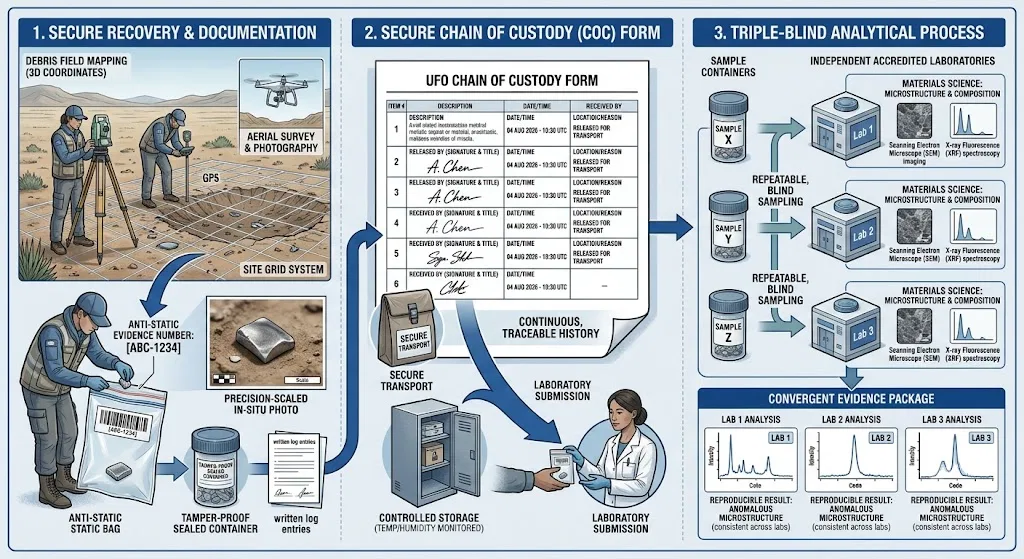
A defensible recovery would record who found each item, its exact position, when and how it was collected, what packaging was used, where it was stored and every person or institution that subsequently handled it. In forensic practice, this continuing record is the chain of custody. NIST-linked guidance stresses chronological documentation, traceability, evidence security and protection against contamination from the scene through laboratory examination.[NIST]nist.govBest Practice Manual for the Forensic Comparison of SoilBest Practice Manual for the Forensic Comparison of Soil…July 26, 2021 — Every step taken in the process must be documented to ens…
For an alleged UFO crash, the minimum physical-evidence package would include:
- exact coordinates and a mapped debris field;
- photographs of each significant object before it was moved;
- unique evidence numbers, sealed containers and tamper records;
- written logs of every transfer, opening, sampling and destructive test;
- untreated reference material retained for future examination;
- soil, vegetation and control samples collected away from the apparent impact;
- documented storage conditions, particularly for reactive, biological or easily contaminated material.
These requirements are not bureaucratic extras. A sample can acquire cutting residue, fingerprints, soil, corrosion products or modern chemicals after recovery. Even recognised meteorites can be chemically altered by terrestrial weathering and storage, meaning that later measurements may describe part of the object’s history on Earth rather than its original state.[arXiv]arxiv.orgOpen source on arxiv.org.
Why a curious metal fragment is not enough
A useful caution comes from the magnesium–bismuth specimen sometimes associated with a purported 1947 UAP recovery. Oak Ridge National Laboratory examined its elemental composition, isotope ratios and layered structure after claims that it might possess exotic properties. The laboratory concluded that the material was terrestrial and did not have the structure required for the proposed terahertz-waveguide function. AARO agreed that the sample did not demonstrate extraterrestrial origin or “antigravity” technology.[AARO]aaro.milSynopsis: Analysis of a Metallic SpecimenSynopsis: Analysis of a Metallic Specimen
The analysis was valuable because it tested specific claims rather than judging the material by appearance. It also illustrates the limits of a detached specimen: even when laboratories identify an unusual manufacturing history, they cannot reconstruct a credible crash location without reliable provenance. “We do not know exactly who manufactured this” is not equivalent to “it came from a non-human vehicle”.
The scene must be documented before it changes
A genuine crash would be an event in space and time, not simply a collection of objects. Investigators would expect physical relationships among wreckage distribution, ground scars, heat effects, structural deformation, environmental disturbance and the object’s apparent direction of travel. Those relationships begin disappearing as soon as responders, weather, vehicles and spectators alter the site.
Transport-accident practice provides a practical model. US National Transportation Safety Board guidance calls for a security perimeter, prevention of unnecessary disturbance, preservation of ground marks, photographs before entry or recovery, and records of people entering the scene. Its investigations combine the wreckage with weather information, operational records, interviews and other external data rather than treating individual fragments in isolation.[NTSB]ntsb.govResponding to a Transportation AccidentResponding to a Transportation Accident
A properly documented alleged UFO crash would therefore require more than dramatic close-up photographs. Investigators would need wide views showing the entire site, scaled images, accurate timestamps, aerial mapping and three-dimensional measurements. They should record the orientation and condition of debris, disturbed soil, vegetation damage, fires, chemical residues and any marks suggesting impact or excavation. Observations should be made before wreckage is gathered into piles or transported elsewhere.
The pattern would then have to make physical sense. Analysts could ask whether the debris distribution is consistent with an object arriving at the claimed angle and speed; whether fractures are characteristic of impact, explosion, weathering or deliberate cutting; and whether heat damage occurred before recovery rather than during later handling. A collection of unrelated scraps placed at a site would be unlikely to produce a coherent sequence of deformation, deposition and environmental effects.
Multiple sensors should describe the same event
Scene evidence would become much stronger if it could be matched to independent observations. Useful data might include calibrated radar tracks, satellite imagery, weather radar, astronomical fireball detections, air-traffic records, seismic signals, mobile-phone recordings and fixed security cameras. The key is not the sheer number of files but whether their clocks, locations and measurement limits are known.
NASA’s UAP study emphasised calibrated instruments, multiple measurements and complete sensor metadata. Without information about exposure, field of view, platform motion, processing and timing, an apparently extraordinary image may be impossible to interpret. Research programmes developing ground-based UAP observatories likewise use several sensor types so that optical artefacts, radar anomalies and environmental effects can be cross-checked rather than accepted in isolation.[nasa.gov]smd-cms.nasa.govScience NASAUNIDENTIFIED ANOMALOUS PHENOMENA IndependentApril 14, 2026 — well-calibrated sensors is paramount, and NASA should leverage its consider…
For a crash claim, the observations should converge on the recovery site. A luminous object filmed in the sky is weak evidence if no reliable trajectory reaches the alleged debris field. Conversely, a radar track ending near a documented impact site at the same time would materially strengthen the connection, especially if independent instruments recorded compatible speed, direction and altitude.
Contemporary records must survive authentication
Documents can connect physical material to organisations, witnesses and decisions, but their evidential value depends heavily on when and why they were created. A dated dispatch log, laboratory request or field notebook written during the incident usually carries more weight than a memoir produced decades later. Contemporary records are not automatically accurate, yet they are less exposed to memory convergence, publicity and retrospective reinterpretation.
A strong documentary file would include original emergency calls, duty logs, radio traffic, photographs, maps, evidence receipts, transport manifests, medical reports and laboratory submissions. Investigators would seek originals or authenticated institutional copies, not repeated screenshots or transcriptions whose source cannot be established. Paper, ink, typeface, classification markings, file numbering and archival history could all be examined where authenticity is disputed.
The records must also agree with one another. Times should correspond to witness locations, aircraft movements and sensor data. Named personnel should have held the stated posts. Vehicles and units should have been capable of reaching the scene. Contradictions would not necessarily destroy the case—real emergencies produce mistakes—but unexplained conflicts about dates, locations or custody would weaken the claimed chain.
Roswell demonstrates why contemporaneous documentation matters. The US Army Air Forces briefly announced recovery of a “flying disc” in July 1947, but an FBI teletype created that day described an object resembling a high-altitude balloon with a suspended radar reflector. Whatever one thinks of later testimony, the near-contemporary record provides a concrete description that must be addressed rather than bypassed.[FBI]vault.fbi.govRoswell UFOOnRoswell UFOOn

Testimony supports evidence but cannot replace it
First-hand witnesses could establish who entered the site, what was removed and how officials behaved. Their accounts would be strongest when taken promptly, recorded separately and compared with objective records before witnesses discussed the event collectively. Investigators should distinguish direct observation—“I placed three fragments in this container”—from inference or hearsay—“I was told the fragments came from an alien craft”.
Late testimony can still reveal overlooked records or identify locations, but memory alone cannot authenticate debris. The central question is whether a witness supplies information that can be independently checked: an unpublicised evidence number, an archive location, a photograph with verifiable metadata or a sample whose custody can be reconstructed. A sincere account that produces no testable lead remains testimony, not physical proof.
This distinction is particularly important in secret-program claims. Genuine classification can explain why some records are unavailable, but secrecy cannot itself serve as evidence of extraterrestrial origin. AARO’s historical review found that some alleged UAP programmes were misidentifications of authentic sensitive activities or arose through circular reporting among people repeating overlapping claims. Critics may dispute the completeness of that review, but any stronger crash-retrieval case must overcome the underlying problem by producing independently verifiable material and records rather than additional layers of assertion.[U.S. Department of War]media.defense.govAARO Historical Record Report VolDepartment of WarAARO Historical Record Report Volume 1Former CIA Official Involvement in Movement of Alleged Material Recovered from a U…
Independent tests must exclude known causes
Laboratory work should begin with ordinary identification, not with a search for “alien” characteristics. Investigators would first determine whether the debris matches known aircraft alloys, balloon components, rocket hardware, satellites, military countermeasures, electrical equipment, geological material, meteorites, industrial slag or consumer products.
The examination would probably involve several disciplines:
- Materials science: elemental composition, microstructure, coatings, welds, machining marks, fractures and heat history.
- Isotope analysis: ratios that may help establish geological, industrial or extraterrestrial sources.
- Engineering: whether components form a functional system and whether alleged performance is physically demonstrated.
- Geochemistry: comparison with local soil, minerals, meteorites and industrial contamination.
- Biology and medicine: controlled examination of any claimed tissue, with strict contamination and sequencing protocols.
- Digital forensics: validation of photographs, videos, instrument files, timestamps and processing histories.
No single “strange” measurement would settle the matter. High purity, unfamiliar layering, unusual isotope values or a composition absent from a convenient database may simply reflect specialised manufacturing, incomplete reference collections, contamination or analytical error. Isotope results in particular require careful interpretation: extraterrestrial rocks can overlap terrestrial values for some elements, while weathering and sample preparation can alter others. The persuasive finding would be a coherent combination of properties incompatible with both natural Solar System material and known human manufacture—not merely one anomalous number.[usra.edu]hou.usra.eduOpen source on usra.edu.
Repeatability is the decisive safeguard
The original laboratory should publish enough information for qualified outsiders to evaluate the work: sampling locations, instrument settings, calibration records, detection limits, raw spectra, processing steps, uncertainty estimates and reference standards. Unused portions of the evidence should then be provided under controlled conditions to independent laboratories that were not told what result to expect.
NIST terminology defines reproducibility in terms of agreement between repeated results obtained under differing conditions. Open-science practice similarly values accessible data, protocols and materials because conclusions become more trustworthy when other researchers can inspect and reproduce the analysis.[nist.gov]nist.govOSAC Lexicon | NISTThe OSAC Lexicon is a compendium of forensic science terms and definitions. Chain Of Custody document icon. Tracea…
Replication matters especially in a UFO crash claim because the conclusion would be vulnerable to contamination, instrument artefacts and expectation bias. One laboratory reporting an unprecedented alloy would justify more investigation. Several accredited laboratories, using different methods, finding the same unexplained structure and properties in separately sampled pieces would be substantially stronger.
Functional claims require functional demonstrations. If debris is said to alter inertia, generate energy or withstand extreme conditions, the effect must occur under controlled testing, with suitable comparison samples and instrumentation. A theoretical suggestion that a layer “might” act as a waveguide is not proof that it does so, still less that it powered a vehicle.
Ordinary alternatives must be tested as competing hypotheses
A rigorous investigation would not frame the choice as “alien craft or total mystery”. It would rank specific alternatives and ask what observations each one predicts. A balloon explanation, for example, predicts lightweight membranes, cords, reflectors or payload components and weather-dependent movement. A meteorite predicts characteristic mineralogy, fusion crust and a debris pattern governed by atmospheric breakup. An aircraft accident predicts identifiable manufactured systems, fuel or battery hazards, and records of a missing vehicle.
Investigators would then compare those predictions with the full evidence. An explanation should account not only for the most dramatic fragment but also for timing, trajectory, debris distribution, damage, witness observations and institutional response. A theory that explains one detail while conflicting with five others is weak, regardless of whether it is conventional or extraordinary.
“Unexplained” remains an acceptable conclusion when data are insufficient. It means that the available evidence cannot distinguish reliably among possibilities. It does not transfer the burden of proof to sceptics or make a non-human origin the default. The extraterrestrial—or more broadly non-human—interpretation would become compelling only when ordinary alternatives fail despite complete, high-quality evidence and when the remaining material positively demonstrates a form of technology that cannot reasonably be attributed to nature or known terrestrial engineering.
What a convincing proof package would look like
No isolated item is likely to prove a UFO crash. The persuasive case would be a mutually reinforcing package in which each evidence stream authenticates the others:
- A secured site: authorities or independent investigators preserve an apparent impact location before it is substantially disturbed.
- Mapped wreckage: debris, ground damage and environmental effects are photographed, measured and geolocated in place.
- Continuous custody: sealed evidence moves through a fully documented chain from named collectors to accredited laboratories.
- Contemporary corroboration: radar, imagery, communications and records describe the same object, trajectory, time and location.
- Authenticated documentation: original records can be verified through archives, institutional systems or physical examination.
- Independent analysis: multiple laboratories reproduce the composition, structure and any claimed functional properties.
- Exclusion of ordinary causes: specialists systematically rule out natural material, conventional aerospace hardware, industrial products, classified terrestrial systems, contamination and fabrication.
- Transparent review: data, methods and representative samples become available for serious external scrutiny, subject only to narrowly justified safety or privacy restrictions.
The standard is cumulative. Secure debris without scene records might prove only that an unusual object exists. Excellent photographs without recovered material might document an unidentified event but not a crash. Extraordinary laboratory results without chain of custody might reveal an interesting specimen while saying nothing about where it came from. Testimony without records could justify a search but could not complete the proof.
The threshold is positive identification, not lasting mystery
A real breakthrough would do more than resist explanation. It would establish, through converging physical, documentary and experimental evidence, that a manufactured object crashed; that the analysed material came from it; and that its origin or capabilities cannot be reconciled with known natural processes or human technology.
That standard is demanding because the claim is unusually specific and consequential. Yet it is also achievable in principle. Modern accident investigation, forensic evidence handling, planetary-material analysis and open scientific testing already provide most of the necessary methods. The principal requirement is to apply them from the moment of discovery, before the scene is disturbed and before debris becomes separated from its history.
Until a case supplies that complete evidential chain, the responsible classifications remain conventional, unresolved or inadequately documented. A mystery may be genuine and worth investigating. Proof begins only when the evidence can survive authentication, competing explanations and independent repetition.
Amazon book picks
Further Reading
Books and field guides related to What Would Prove a UFO Crash?. Use these as the next step if you want deeper reading beyond the article.
The UFO Experience: A Scientific Inquiry
Cited by the New York Review of Books as "the best brief for visitation," this classic study presents an analysis of UFO reports and conc...
UFOs: Generals, Pilots, and Government Officials Go on the Re...
NEW YORK TIMES BESTSELLER • Impeccably researched, this riveting journalistic investigation separates fact from fiction, and documents th...
Forensic Science: An Introduction to Scientific and Investiga...
Covering a range of fundamental topics essential to modern forensic investigation, the fourth edition of the landmark text Forensic Scien...
The Demon-Haunted World
NEW YORK TIMES BESTSELLER • From the renowned astronomer and author of Cosmos comes a “powerful [and] stirring defense of informed ration...
eBay marketplace picks
Marketplace Samples
Live-tested eBay searches with available results related to this page.
Selected fromflying saucer model oneBay.co.uk.

Endnotes
1.
Source: nasa.gov
Title: UPDATE: NASA Shares UAP Independent Study Report; Names Director
Link:https://www.nasa.gov/news-release/update-nasa-shares-uap-independent-study-report-names-director/
Source snippet
We found that NASA can help the whole-of-government UAP effort through systematic data calibration, multiple measurements and ensuring th...
2.
Source: media.defense.gov
Title: AARO Historical Record Report Vol 1 2024
Link:https://media.defense.gov/2024/Mar/08/2003409233/-1/-1/0/AARO_Historical_Record_Report_Vol_1_2024.pdf
Source snippet
Department of WarAARO Historical Record Report Volume 1Former CIA Official Involvement in Movement of Alleged Material Recovered from a U...
3.
Source: defense.gov
Title: media engagement with acting aaro director tim phillips on the historical recor
Link:https://www.defense.gov/News/Transcripts/Transcript/Article/3702219/media-engagement-with-acting-aaro-director-tim-phillips-on-the-historical-recor/
Source snippet
Department of WarMedia Engagement With Acting AARO Director Tim Phillips on the Historical Record Report Volume 1 > U.S. Department of De...
4.
Source: nist.gov
Title: Best Practice Manual for the Forensic Comparison of Soil
Link:https://www.nist.gov/document/best-practice-manual-comparison-soil-traces
Source snippet
Best Practice Manual for the Forensic Comparison of Soil...July 26, 2021 — Every step taken in the process must be documented to ens...
Published: July 26, 2021
5.
Source: nist.gov
Link:https://www.nist.gov/document/osac-2025-s-0014-guidelines-quality-assurance-program-forensic-anthropology-version-10
Source snippet
OSAC 2025-S-0014 Guidelines for a Quality Assurance...The written procedure includes documentation of evidence transfers (i.e., appr...
6.
Source: nist.gov
Link:https://www.nist.gov/glossary/osac-lexicon?committee=All&items_per_page=50&k=&name=&preferred=1&standard=
Source snippet
OSAC Lexicon | NISTThe OSAC Lexicon is a compendium of forensic science terms and definitions. Chain Of Custody document icon. Tracea...
7.
Source: nist.gov
Link:https://www.nist.gov/document/astm-3255-21sc-response-comment-adjudication
Source snippet
Casework documentation shall be retained according to the forensic science service provider's...
8.
Source: arxiv.org
Link:https://arxiv.org/abs/1909.13064
9.
Source: hou.usra.edu
Link:https://www.hou.usra.edu/meetings/lpsc2024/pdf/2055.pdf
10.
Source: aaro.mil
Title: Synopsis: Analysis of a Metallic Specimen
Link:https://www.aaro.mil/Portals/136/PDFs/Information%20Papers/ORNL-Synopsis_Analysis_of_a_Metallic_Specimen.pdf
11.
Source: aaro.mil
Title: s Supplement to ORNLs Analysis of a Metallic Specimen
Link:https://www.aaro.mil/Portals/136/PDFs/Information%20Papers/AAROs_Supplement_to_ORNLs_Analysis_of_a_Metallic_Specimen.pdf
12.
Source: ntsb.gov
Title: Responding to a Transportation Accident
Link:https://www.ntsb.gov/Documents/2023%20Transportation%20Accident%20Response%20Guide.pdf
13.
Source: ntsb.gov
Link:https://www.ntsb.gov/tda/TDADocuments/SPC2001.pdf
14.
Source: ntsb.gov
Link:https://www.ntsb.gov/investigations/process/Pages/default.aspx
15.
Source: smd-cms.nasa.gov
Title: Science NASA
Link:https://smd-cms.nasa.gov/wp-content/uploads/2023/09/uap-independent-study-team-final-report.pdf
Source snippet
UNIDENTIFIED ANOMALOUS PHENOMENA IndependentApril 14, 2026 — well-calibrated sensors is paramount, and NASA should leverage its consider...
Published: April 14, 2026
16.
Source: arxiv.org
Link:https://arxiv.org/abs/2305.18566
17.
Source: arxiv.org
Link:https://arxiv.org/abs/2506.00125
18.
Source: vault.fbi.gov
Title: Roswell UFOOn
Link:https://vault.fbi.gov/Roswell%20UFO
19.
Source: osti.gov
Link:https://www.osti.gov/pages/servlets/purl/1959551
20.
Source: science.nasa.gov
Title: satellite data evaluation
Link:https://science.nasa.gov/earth-science/csda/satellite-data-evaluation/
21.
Source: science.nasa.gov
Link:https://science.nasa.gov/science-research/earth-science/joint-earth-observation-mission-quality-assessment-framework-optical-guidelines-documents-released/
22.
Source: science.nasa.gov
Link:https://science.nasa.gov/uap/faqs/
23.
Source: science.nasa.gov
Link:https://science.nasa.gov/uap/
24.
Source: science.nasa.gov
Title: calibration and validation
Link:https://science.nasa.gov/mission/nisar/calibration-and-validation/
25.
Source: standards.nasa.gov
Title: NASA STD 2822
Link:https://standards.nasa.gov/standard/NASA/NASA-STD-2822
26.
Source: archives.gov
Link:https://www.archives.gov/records-mgmt/uap-guidance
27.
Source: nasa.gov
Title: NAS A to Release, Discuss Unidentified Anomalous Phenomena Report
Link:https://www.nasa.gov/news-release/nasa-to-release-discuss-unidentified-anomalous-phenomena-report/
28.
Source: archives.fbi.gov
Link:https://archives.fbi.gov/archives/about-us/lab/forensic-science-communications/fsc/oct1999/trace.htm
29.
Source: aaro.mil
Link:https://www.aaro.mil/Portals/136/PDFs/FOIA/2023%20FOIAs/23-F-1423.pdf
30.
Source: ntsb.gov
Title: i AVIATION INVESTIGATION MANUAL
Link:https://www.ntsb.gov/about/Documents/MajorInvestigationsManualApp.pdf
31.
Source: ntsb.gov
Link:https://www.ntsb.gov/Pages/aviationreport.aspx
32.
Source: ntsb.gov
Link:https://www.ntsb.gov/about/Documents/MajorInvestigationsManual.pdf
33.
Source: ntsb.gov
Title: DCA25MA108 Prelim
Link:https://www.ntsb.gov/investigations/Documents/DCA25MA108%20Prelim.pdf
34.
Source: ntsb.gov
Link:https://www.ntsb.gov/about/Documents/Aviation_Engineering_Investigator_Roles.pdf
35.
Source: ntsb.gov
Link:https://www.ntsb.gov/investigations/accidentreports/reports/aar1001.pdf
36.
Source: ntsb.gov
Title: Preliminary Report DCA26MA024
Link:https://www.ntsb.gov/investigations/Documents/Preliminary%20Report%20DCA26MA024.pdf
37.
Source: ntrs.nasa.gov
Link:https://ntrs.nasa.gov/citations/19960050114
38.
Source: nvlpubs.nist.gov
Link:https://nvlpubs.nist.gov/nistpubs/ir/2024/NIST.IR.8503.pdf
39.
Source: csrc.nist.gov
Title: draft nistir 8006
Link:https://csrc.nist.gov/csrc/media/publications/nistir/8006/draft/documents/draft_nistir_8006.pdf
40.
Source: nist.gov
Link:https://www.nist.gov/document/osac-organizational-priorities-documentv3sept2021
41.
Source: nvlpubs.nist.gov
Link:https://nvlpubs.nist.gov/nistpubs/SpecialPublications/NIST.SP.1206.pdf
42.
Source: nist.gov
Title: osac organizational priorities
Link:https://www.nist.gov/document/osac-organizational-priorities
43.
Source: nist.gov
Link:https://www.nist.gov/document/osac-2024-s-0001-guidance-document-understanding-and-implementing-minimal-components
44.
Source: science.osti.gov
Link:https://science.osti.gov/Isotope-Research-Development-and-Production/Science-Highlights/2024/8a
45.
Source: nature.com
Link:https://www.nature.com/articles/s41562-024-01961-1
46.
Source: catalog.archives.gov
Link:https://catalog.archives.gov/id/326996858
47.
Source: archive.org
Title: gov.archives.341 roswell 1
Link:https://archive.org/details/gov.archives.341-roswell-1
48.
Source: archives.fbi.gov
Link:https://archives.fbi.gov/archives/about-us/lab/forensic-science-communications/fsc/april2006/standards/2006_04_standards02.htm
49.
Source: media.defense.gov
Title: AFD 101027 030
Link:https://media.defense.gov/2010/Oct/27/2001330219/-1/-1/0/AFD-101027-030.pdf
50.
Source: royalsociety.org
Link:https://royalsociety.org/journals/open-access/open-science/
51.
Source: defense.gov
Link:https://www.defense.gov/News/News-Stories/Article/Article/3701297/dod-report-discounts-sightings-of-extraterrestrial-technology/
52.
Source: pubs.usgs.gov
Link:https://pubs.usgs.gov/publication/ofr20231033/full
53.
Source: ornl.gov
Title: 2024 review ornls top science news stories
Link:https://www.ornl.gov/news/2024-review-ornls-top-science-news-stories
Additional References
54.
Source: youtube.com
Title: Art’s Parts 1: UFO Crash Recovery Material Analysis
Link:https://www.youtube.com/watch?v=f1LylzKZC-U
Source snippet
NASA UAP Independent Study Report with Chairman Dr. David Spergel Event Horizon · 39K views...
55.
Source: science.org
Link:https://www.science.org/content/page/science-journals-editorial-policies
56.
Source: youtube.com
Title: NASA UAP Independent Study Report with Chairman Dr. David Spergel
Link:https://www.youtube.com/watch?v=rjPpv1do4j8
Source snippet
Neil deGrasse Tyson: Unfiltered on UFOs & Whistleblower Grusch...
57.
Source: youtube.com
Title: Neil de Grasse Tyson: Unfiltered on UFOs & Whistleblower Grusch
Link:https://www.youtube.com/watch?v=HhWWlJFwTqs
Source snippet
UFO Crash Debris! (Art's Parts) - Jimmy Akin's Mysterious World...
58.
Source: youtube.com
Title: Garry Nolan: UFOs and Aliens | Lex Fridman Podcast #262
Link:https://www.youtube.com/watch?v=uTCc2-1tbBQ
Source snippet
NASA UAP Independent Study Report with Chairman Dr. David Spergel...
59.
Source: youtube.com
Title: UFO Crash Debris! (Art’s Parts)
Link:https://www.youtube.com/watch?v=v4HWxOel7zw
Source snippet
Art's Parts 1: UFO Crash Recovery Material Analysis...
60.
Source: [uap-archive]({{ ‘uap-archive/’ | relative_url }}). org
Link:https://uap-archive.org/uap/records/aaro-historical-record-report-vol1/
61.
Source: cos.io
Link:https://www.cos.io/initiatives/badges
62.
Source: podme.com
Link:https://podme.com/fi/jakso/4627125/
63.
Source: scribd.com
Link:https://www.scribd.com/document/671256731/UAP-Independent-Study-Team-Final-Report