Within Field Protocol
Who Entered the Scene Before Evidence Recovery?
A precise entry log can reveal when responders, equipment or bystanders may have moved, introduced or contaminated material.
On this page
- Creating one controlled entry point
- Recording people, times and carried equipment
- Using the log to trace possible contamination
Page outline Jump by section
Introduction
A reported UFO crash scene should be documented as an unknown incident rather than as evidence of an extraordinary event. One of the simplest but most valuable records is a detailed access log showing exactly who entered the controlled area, when they entered, why they entered, what they carried, and when they left. That record allows investigators to distinguish original scene conditions from changes introduced by emergency responders, investigators, journalists or bystanders. If unusual materials, footprints, fibres, tool marks or electronic traces are later discovered, the access log provides a factual basis for asking whether they could have been introduced after the initial event rather than originating from the object itself. Established forensic guidance consistently treats controlled scene access as a fundamental contamination-control measure.[gov.uk]GOV.UKContamination controls: scene of crime (accessibleContamination controls: scene of crime (accessible

Why an access log matters more than memory
In the first hours after a reported crash, numerous people may legitimately enter the scene. Firefighters may extinguish fires, paramedics may search for casualties, police officers may establish cordons, hazardous-material specialists may assess risks and investigators may begin documentation. Each of these actions can alter the original scene.
Without a contemporaneous record, later investigators may struggle to answer basic questions such as:
- Who first approached the central debris?
- Was a suspected fragment already moved before photography?
- Which boots created a particular set of footprints?
- Was a sampling kit or survey instrument brought into the scene before an unusual residue appeared?
- Did members of the media or unauthorised individuals gain access?
An access log therefore becomes part of the evidential record rather than merely an administrative document. It allows investigators to reconstruct how the scene evolved over time instead of assuming every observed feature belongs to the original incident. This approach reflects long-established forensic practice for preserving the integrity of physical evidence.[National Institute of Justice]nij.ojp.govOpen source on ojp.gov.
Creating one controlled entry point
The value of an access log depends on disciplined scene management. If people enter through multiple uncontrolled routes, no written record can reliably reconstruct later contamination.
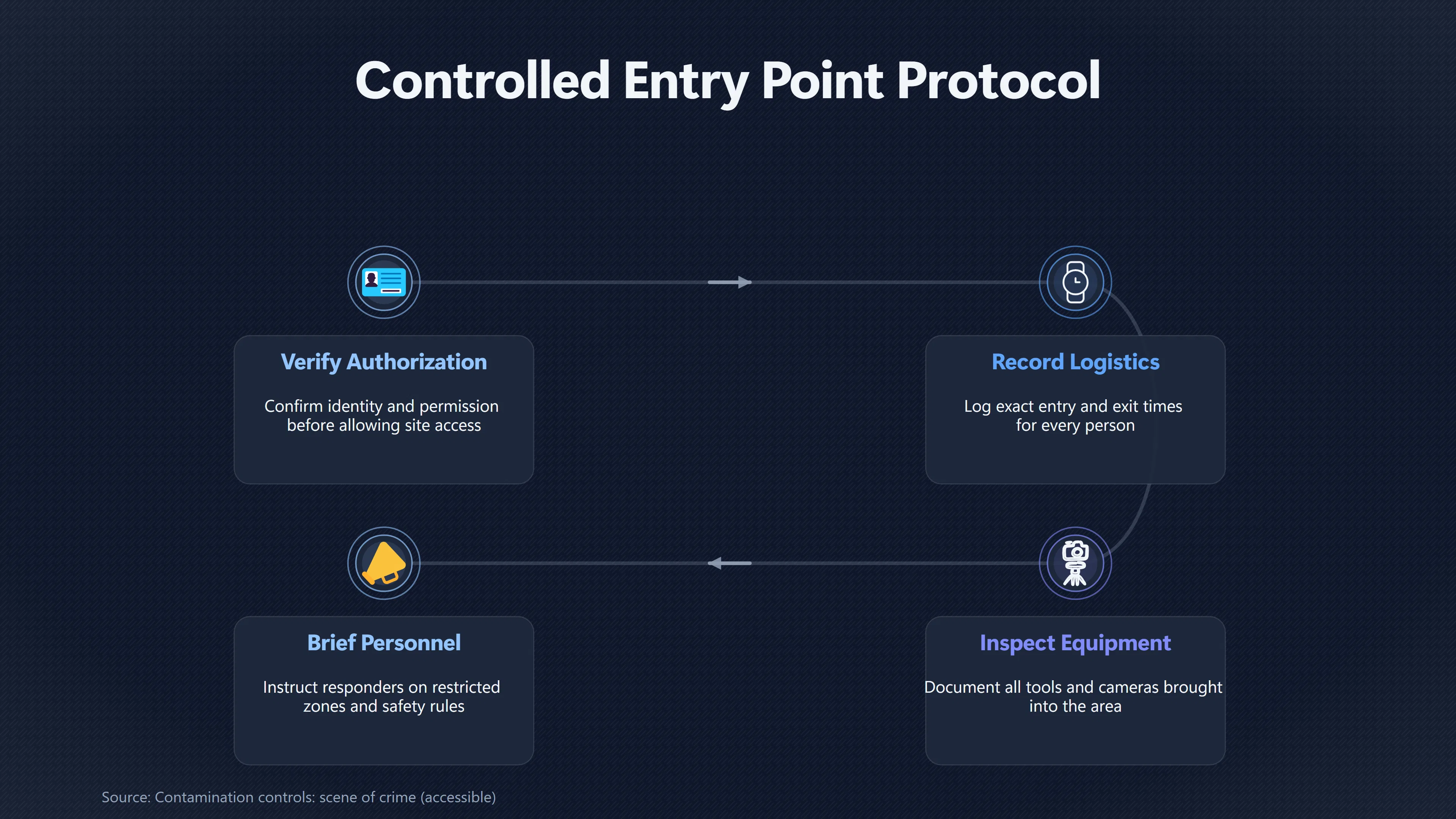
UK forensic contamination guidance recommends controlling access through a single entry point wherever practical, establishing a common approach path and limiting admission to the minimum number of personnel required for effective scene examination. It also recommends designated areas for donning and removing personal protective equipment to reduce the transfer of contamination between the outside environment and the scene.[GOV.UK]GOV.UKContamination controls: scene of crime (accessibleContamination controls: scene of crime (accessible
A controlled entry point should therefore serve several functions simultaneously:
- verify authorisation before entry;
- record every arrival and departure;
- confirm required protective equipment;
- document carried equipment;
- brief personnel about restricted areas; and
- identify any items leaving the scene.
Using one entry route also reduces uncertainty. If every authorised person followed the same approach path, investigators can more confidently distinguish expected disturbance from unexplained tracks elsewhere within the debris field.
Recording people, times and carried equipment
An effective access log captures information that can later explain contamination rather than simply identifying visitors.
Useful entries typically include:
- full name;
- organisation and role;
- reason for entry;
- exact entry and exit times;
- route taken if different from the standard path;
- personal protective equipment worn;
- equipment carried into the scene;
- equipment removed from the scene; and
- notable actions performed.
Equipment deserves particular attention because contamination is not introduced only by people. Cameras, drones, evidence markers, measuring poles, sampling tools, lighting systems, tripods, generators and vehicles may all disturb vegetation, transfer fibres, deposit residues or leave impressions.
Recording these details allows later investigators to distinguish between marks created during documentation and marks potentially associated with the reported crash itself. For example, a tripod leg impression found beside an object is less likely to be misinterpreted if the log records that a photographer worked in that location at the relevant time.
Using the log to trace possible contamination
The greatest value of the log often appears days or weeks later during evidence review.
Suppose laboratory testing identifies synthetic fibres on an unusual fragment. Rather than immediately treating them as significant, investigators can compare laboratory findings with the access record.
Questions that become answerable include:
- Which personnel handled that item?
- Did anyone wear clothing capable of shedding similar fibres?
- Was the object photographed before or after handling?
- Did sampling tools move between locations?
- Was the fragment exposed during rescue activity?
- Were multiple investigators examining the same object simultaneously?
Likewise, if unexpected footprints appear around a crater, the log may identify the individuals working in that area during the relevant period. If a residue is found only after a hazardous-material team entered carrying specialised equipment, investigators have an objective basis for considering contamination alongside other explanations.
The access log therefore supports exclusion as much as identification. Eliminating innocent sources of contamination strengthens confidence in evidence that survives those checks.
Recognising common contamination pathways
An access log is most effective when investigators understand what it is intended to detect.
Typical contamination sources include:
- responders walking through soft ground before photographs are completed;
- vehicles compressing soil or vegetation;
- gloves touching multiple objects without replacement;
- sampling tools reused between locations;
- clothing fibres, hair or biological material shed by personnel;
- equipment cases placed on evidence-bearing surfaces;
- temporary lighting or generators altering burn patterns or depositing residues; and
- curious bystanders entering before effective scene control.
Many of these changes are unavoidable during life-saving operations. The purpose of the log is not to prevent every alteration but to document when, why and by whom those alterations occurred so they are not later mistaken for original evidence. Forensic guidance consistently emphasises that investigators should anticipate contamination risks and minimise unnecessary access rather than assuming scenes remain pristine.[gov.uk]GOV.UKContamination controls: scene of crime (accessibleContamination controls: scene of crime (accessible

The access log as evidence rather than administration
A common mistake is treating the scene register as a sign-in sheet for personnel management. In reality, it functions as evidence supporting later reconstruction.
When combined with photographs, maps, timestamps and chain-of-custody records, the access log helps establish:
- whether observations pre-date investigative activity;
- whether scene changes occurred before evidence recovery;
- whether competing interpretations rely on features introduced after the initial incident; and
- whether laboratory findings could reasonably result from documented handling rather than from the reported crash itself.
This is especially important for alleged UFO crash investigations, where unusual claims may attract large numbers of observers and intense public attention. Extraordinary interpretations become easier to test when investigators can show precisely who entered the scene, what they did and whether any supposedly anomalous evidence first appeared only after documented human activity.
An accurate access log cannot determine what caused a reported crash. It can, however, prevent later investigators from confusing contamination introduced during the response with evidence that genuinely originated at the scene, making it one of the most valuable records created before evidence recovery begins.
Amazon book picks
Further Reading
Books and field guides related to Who Entered the Scene Before Evidence Recovery?. Use these as the next step if you want deeper reading beyond the article.
Practical Crime Scene Processing and Investigation
All too often, the weakest link in the chain of criminal justice is the crime scene investigation. Improper collection of evidence blocks...
Techniques of Crime Scene Investigation
"Techniques of Crime Scene Investigation is a staple for any forensic science library and is routinely referenced by professional organiz...
Forensic Science: An Introduction to Scientific and Investiga...
Covering a range of fundamental topics essential to modern forensic investigation, the fourth edition of the landmark text Forensic Scien...
Crime Scene Management: Scene Specific Methods
Crime Scene Management is an accessible introduction to the common forms of evidence that may be encountered at a scene of crime and the...
eBay marketplace picks
Marketplace Samples
Live-tested eBay searches with available results related to this page.
Selected fromcrime scene sign oneBay.co.uk.



Endnotes
1.
Source: GOV.UK
Title: Contamination controls: scene of crime (accessible)
Link:https://www.gov.uk/government/publications/crime-scene-dna-anti-contamination-guidance/contamination-controls-scene-of-crime-accessible
2.
Source: GOV.UK
Title: crime scene dna anti contamination guidance
Link:https://www.gov.uk/government/publications/crime-scene-dna-anti-contamination-guidance
Source snippet
Crime scene DNA: anti-contamination (FSR-GUI-0016) - GOV.UK...
3.
Source: GOV.UK
Title: www.gov.uk Incident scene examination (accessible)
Link:https://www.gov.uk/government/publications/incident-scene-examination-fsr-gui-0006/incident-scene-examination-accessible
Source snippet
2. Scope 2. 3. Competency (Code section 27 and 90.2) 3. 4. Initial request to attend an incident scene (Code 90.3) 4. 5. F...
4.
Source: atsb.gov.au
Title: hazards aviation accident sites
Link:https://www.atsb.gov.au/publications/safety-education-material/2022/aviation/hazards-aviation-accident-sites
5.
Source: atsb.gov.au
Title: TS I Act
Link:https://www.atsb.gov.au/tsi-act-questions-and-answers
6.
Source: nij.ojp.gov
Link:https://nij.ojp.gov/library/publications/crime-scene-investigation-guide-law-enforcement
7.
Source: nij.ojp.gov
Link:https://nij.ojp.gov/topics/articles/crime-scene-investigation-guides-law-enforcement
8.
Source: nij.ojp.gov
Title: guide investigating fire and arson
Link:https://nij.ojp.gov/topics/articles/guide-investigating-fire-and-arson
9.
Source: nij.ojp.gov
Title: electronic crime scene investigation guide first responders second edition
Link:https://nij.ojp.gov/library/publications/electronic-crime-scene-investigation-guide-first-responders-second-edition
10.
Source: nij.ojp.gov
Title: crime scene investigation reference law enforcement training
Link:https://nij.ojp.gov/library/publications/crime-scene-investigation-reference-law-enforcement-training
11.
Source: nij.ojp.gov
Title: guide explosion and bombing scene investigation
Link:https://nij.ojp.gov/library/publications/guide-explosion-and-bombing-scene-investigation
12.
Source: nij.ojp.gov
Title: fire and arson scene evidence guide public safety personnel
Link:https://nij.ojp.gov/library/publications/fire-and-arson-scene-evidence-guide-public-safety-personnel
13.
Source: ojp.gov
Link:https://www.ojp.gov/library/publications/crime-scene-investigation-guide-law-enforcement-0
15.
Source: nist.gov
Title: forensics science crime scene
Link:https://www.nist.gov/forensic-science/nist-forensics-science-crime-scene
Source snippet
NIST Forensics Science — Crime Scene | NISTMay 27, 2026 — NIST FORENSICS SCIENCE — CRIME SCENE Crime scene investigation includes everyth...
Published: May 27, 2026
16.
Source: ntsb.gov
Link:https://www.ntsb.gov/Pages/aviationreport.aspx/1000
Source snippet
Report an [Aircraft Accident]({{ 'aircraft-accidents/' | relative_url }}) to the NTSBApril 9, 2025 — REPORT AN AIRCRAFT ACCIDENT TO THE NTSB Page Content If you are an air...
Published: April 9, 2025
17.
Source: ntsb.gov
Title: GENERAL AVIATI
Link:https://www.ntsb.gov/tda/family/Pages/tda-aviation.aspx
Source snippet
Aviation AccidentMay 1, 2025 — AVIATION ACCIDENT Page Content General Aviation Accident Investigations | Passenger...
Published: May 1, 2025
18.
Source: ntsb.gov
Title: Media Resources
Link:https://www.ntsb.gov/news/Pages/media_resources.aspx
Source snippet
March 10, 2025 — MEDIA RESOURCES Page Content NTSB COMMUNICATIONS DURING MAJOR ACCIDENTS The NTSB is communicating investigative inf...
Published: March 10, 2025
19.
Source: youtube.com
Title: How is a forensic scene protected & initially examined?
Link:https://www.youtube.com/watch?v=kVqr-taIS14
Source snippet
The Forensic Process Explained | Step-by-Step Crime Scene Investigation...
20.
Source: ntsb.gov
Link:https://www.ntsb.gov/about/organization/AS/Pages/air.aspx
21.
Source: faa.gov
Link:https://www.faa.gov/air_traffic/publications/atpubs/aim_html/chap7_section_7.html
22.
Source: ntsb.gov
Link:https://www.ntsb.gov/investigations/process/Pages/goteam.aspx
23.
Source: ntsb.gov
Link:https://www.ntsb.gov/investigations/process/Pages/default.aspx
24.
Source: youtube.com
Title: 5 Crime Scene Mistakes to Avoid
Link:https://www.youtube.com/watch?v=kJB3aSbKHs8
Source snippet
Learn forensics: The basics of working a crime scene without you contaminating it...