Within Witnesses
How Many Witnesses Does a Crash Location Need?
Reports from separated observers can narrow a flight path, while a single witness direction rarely identifies a reliable crash coordinate.
On this page
- Why one bearing produces a broad search corridor
- How separated sightlines constrain a possible trajectory
- What timing and landmark details make triangulation useful
Page outline Jump by section
Introduction
When people report an apparent UFO crash, the most useful question is often not whether any individual witness is convincing, but whether multiple independent witnesses observed the same event from different locations. A single observer can usually identify only a broad direction in which an object appeared to descend. That direction alone rarely identifies a reliable crash site because distance is difficult to judge, especially at night or when viewing a bright light against the sky. By contrast, reports from geographically separated observers can be compared to determine whether they are consistent with a single flight path, whether the object remained airborne beyond one observer’s horizon, or whether the apparent descent was a perspective illusion rather than an impact. This principle is widely used in meteor investigations and provides a practical framework for evaluating alleged UFO crash reports without assuming that any individual account is either entirely accurate or entirely mistaken.[NASA Technical Reports Server]ntrs.nasa.govNASA Technical Reports ServerComparing Eyewitness-Derived Trajectories of Bright Meteors to Instrumentally-Observed Data - NASA Technical…
Why One Bearing Produces a Broad Search Corridor
An eyewitness normally reports an apparent direction rather than a measured position. Statements such as “it went down behind the trees”, “it disappeared over the ridge”, or “it dropped beyond the hills” describe a line of sight from one viewing location. They do not establish where, or even whether, an object reached the ground.
The geometric limitation is straightforward. From one observation point, every location lying somewhere along the reported bearing remains possible unless the witness can accurately determine range. Human observers are generally poor at estimating distance to isolated aerial lights because the sky contains few reliable depth cues. As a result, an object many kilometres away can appear to descend just beyond nearby terrain.
In practical investigations, this uncertainty produces a search corridor rather than a point. The corridor becomes even wider if the witness is uncertain about compass direction, observed the object only briefly, or viewed it while moving in a vehicle. Research by NASA comparing eyewitness-derived meteor trajectories with instrumentally measured paths demonstrates how much uncertainty remains when relying primarily on visual reports, particularly when only limited observations are available.[NASA Technical Reports Server]ntrs.nasa.govNASA Technical Reports ServerComparing Eyewitness-Derived Trajectories of Bright Meteors to Instrumentally-Observed Data - NASA Technical…
How Separated Sightlines Constrain a Possible Trajectory
Independent witnesses become valuable when they observe the same event from substantially different locations and provide their accounts without influencing one another.
Each observer contributes a separate line of sight. Where those observations are mutually consistent, investigators can estimate a three-dimensional trajectory far more accurately than from any single account. If the reported bearings fail to intersect plausibly, this may indicate that different phenomena were observed or that one or more observers substantially misjudged direction.
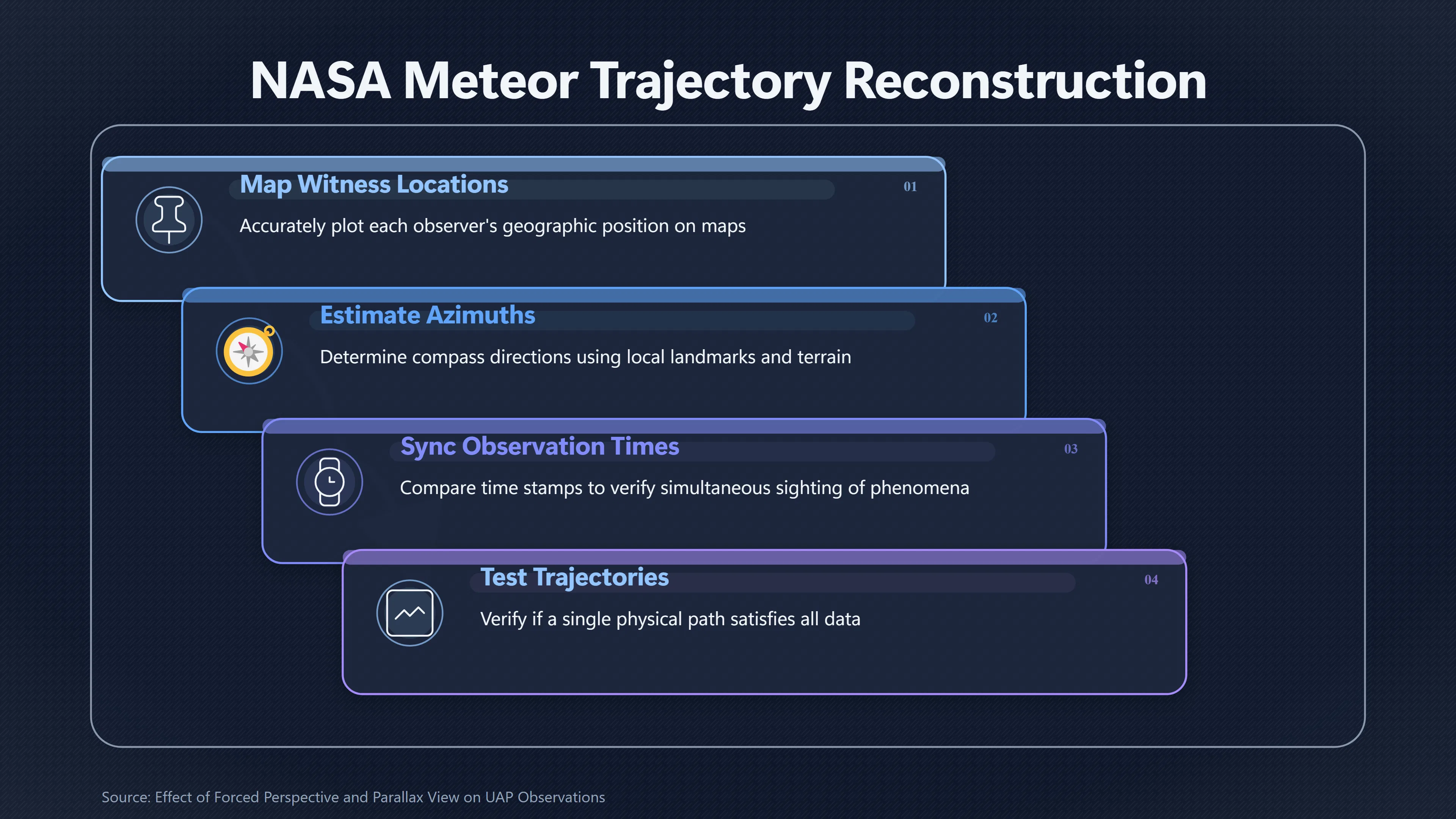
The process resembles triangulation used in meteor science:
- Each witness location is accurately mapped.
- The reported azimuth, or compass direction, is estimated from landmarks or maps.
- Observation times are compared.
- Apparent elevation and disappearance points are examined.
- A trajectory is tested against all observations simultaneously.
The important point is that investigators do not simply average witness statements. Instead, they test whether one physical path could reasonably satisfy every independent observation.
Meteor observing networks routinely apply this principle because bright fireballs frequently appear to land nearby even when they remain tens or hundreds of kilometres distant. Multiple viewing stations or large numbers of geographically distributed eyewitnesses allow analysts to reconstruct trajectories that no individual observer could determine alone.[nasa.gov]ntrs.nasa.govNASA Technical Reports ServerComparing Eyewitness-Derived Trajectories of Bright Meteors to Instrumentally-Observed Data - NASA Technical…
Why Timing Matters as Much as Direction
Direction alone cannot fully constrain a trajectory. Accurate timing often provides equally important information.
Even approximate estimates of when an object passed particular landmarks can reveal whether two witnesses actually observed the same event. For example:
- One observer may report the object disappearing behind a ridge at 21:14:10.
- Another, 40 kilometres away, may report it passing above a church tower at 21:14:18.
If these observations fit a physically reasonable path and speed, confidence increases that both accounts describe the same object. If the reported timings require impossible speeds or contradictory directions, investigators have evidence that the reports cannot describe a single trajectory.
Timing also helps distinguish continuous flight from separate unrelated events, particularly during periods when multiple aircraft, satellites or meteors may be visible.
Which Landmark Details Improve Reconstruction?
The most useful witness reports contain references that can later be measured rather than interpreted.
Helpful details include:
- Known buildings, hills or towers crossed by the object.
- Compass directions instead of relative descriptions such as “left” or “ahead”.
- Whether the observer was stationary or moving.
- The order in which landmarks were crossed.
- Whether the object disappeared behind terrain or faded gradually.
- The presence of sound, including any delay between the visual event and reported noise.
These details allow investigators to recreate the viewing geometry. Vague statements such as “it crashed over there” provide far less analytical value because they cannot easily be converted into measurable observations.
Importantly, delayed sounds do not necessarily identify an impact location. If an aerial event produced a loud report, the travel time of sound depends on atmospheric conditions and distance. Without careful analysis, witnesses may incorrectly associate a later sound with the point where they last saw the object.
What Meteor Investigations Demonstrate
Although meteors and alleged UFO crashes are different subjects, meteor investigations provide one of the clearest demonstrations of how independent witness geometry works in practice.
NASA and associated meteor researchers routinely combine hundreds of public eyewitness reports with camera records, satellite observations and other sensors. Individual witnesses often believe the fireball descended close to their own location, yet combined observations reveal a trajectory that may extend across several states or provinces.
For example, analyses of widely observed fireballs have successfully reconstructed atmospheric paths by combining numerous independent reports with all-sky camera data, showing that eyewitness collections become substantially more useful when observers are geographically dispersed rather than clustered in one area. NASA’s evaluation of eyewitness-derived trajectories likewise found that reconstructions improved markedly when more than roughly 75 independent reports were available, although even then significant positional uncertainty remained compared with instrumented measurements.[NASA]nasa.govFireball over Jacksonville, Florida on Feb. 21Fireball over Jacksonville, Florida on Feb. 21 - NASA…
The lesson for UFO crash investigations is methodological rather than explanatory: independent observations reduce uncertainty, whereas repeated versions of the same story do not.
Independence Is More Valuable Than Agreement
Witnesses who discuss an event before formal interviews may unintentionally converge on details that none originally observed. Memory research shows that confidence can increase after discussion even when accuracy does not.
For this reason, investigators place particular value on:
- Statements recorded before media coverage.
- Witnesses interviewed separately.
- Notes, photographs or recordings made immediately after the event.
- Independent agreement on measurable features rather than dramatic interpretations.
Two witnesses who independently identify the same landmark crossing contribute stronger evidence than several people who later agree on an estimated crash location after extensive conversation.
What Witness Geometry Can—and Cannot—Establish
Multiple independent observations can substantially narrow a possible flight path, but they cannot by themselves prove that a crash occurred.
Even an accurately reconstructed trajectory may indicate that:
- the object continued beyond the witnesses’ view;
- it remained airborne;
- it fragmented at altitude;
- it passed behind terrain without descending to the surface; or
- perspective caused observers in different locations to misinterpret its apparent motion.
Modern analyses of apparent high-speed unidentified aerial objects likewise demonstrate how viewing geometry and parallax can create misleading impressions when only a single viewpoint is available. Independent observations provide an important check against these effects by testing whether the same trajectory is supported from multiple locations rather than inferred from one observer’s perspective alone.[AARO]aaro.milEffect of Forced Perspective and Parallax View on UAP ObservationsEffect of Forced Perspective and Parallax View on UAP Observations…
In alleged UFO crash investigations, therefore, the most reliable search strategy begins not with selecting the most persuasive witness but with assembling the greatest number of independent, geographically separated observations. Their combined geometry offers the best opportunity to distinguish a genuine common trajectory from the powerful visual illusions that frequently accompany unusual aerial events.
Amazon book picks
Further Reading
Books and field guides related to How Many Witnesses Does a Crash Location Need?. Use these as the next step if you want deeper reading beyond the article.
The Seven Sins of Memory
Rating: 3.5/5 from 5 Google Books ratings
A New York Times Notable Book: A psychologist's "gripping and thought-provoking" look at how and why our brains sometimes fail us (Steven...
The Backyard Astronomer's Guide
Discusses the practical aspects of stargazing, including how to choose appropriate equipment, contending with light pollution, taking suc...
NightWatch: A Practical Guide to Viewing the Universe
A practical guide to viewing the universe.
UFOs: Generals, Pilots, and Government Officials Go on the Re...
NEW YORK TIMES BESTSELLER • Impeccably researched, this riveting journalistic investigation separates fact from fiction, and documents th...
eBay marketplace picks
Marketplace Samples
Live-tested eBay searches with available results related to this page.
Selected fromRoswell UFO patch oneBay.co.uk.



Endnotes
1.
Source: ntrs.nasa.gov
Link:https://ntrs.nasa.gov/citations/20170009052
Source snippet
NASA Technical Reports ServerComparing Eyewitness-Derived Trajectories of Bright Meteors to Instrumentally-Observed Data - NASA Technical...
2.
Source: aaro.mil
Title: Effect of Forced Perspective and Parallax View on UAP Observations
Link:https://www.aaro.mil/Portals/136/PDFs/Information%20Papers/AARO_Effect_of_Forced_Perspective_and_Parallax_View_on_UAP_Observations_2024.pdf?ver=WTwJtQaCvC3BkRlBJCGLzg%3D%3D
Source snippet
Effect of Forced Perspective and Parallax View on UAP Observations...
3.
Source: nasa.gov
Title: Fireball over Jacksonville, Florida on Feb. 21
Link:https://www.nasa.gov/blogs/watch-the-skies/2015/02/23/fireball-over-jacksonville-florida-on-feb-21/
Source snippet
Fireball over Jacksonville, Florida on Feb. 21 - NASA...
4.
Source: nasa.gov
Title: Fireball Leaves Persistent Train over Western Skies
Link:https://www.nasa.gov/blogs/watch-the-skies/2018/12/20/fireball-leaves-persistent-train-over-western-skies/
Source snippet
Fireball Leaves Persistent Train over Western Skies - NASA...
5.
Source: nasa.gov
Title: Bright Fireball Spotted Over Michigan
Link:https://www.nasa.gov/blogs/watch-the-skies/2018/01/18/bright-fireball-spotted-over-michigan/
Source snippet
Bright Fireball Spotted Over Michigan - NASA...
6.
Source: aaro.mil
Link:https://www.aaro.mil/Next-AARO-Home-redesign/Next-Parent/Next-AARO-UAP-Imagery-Acc-Table/
Source snippet
AARO UAP Imagery Acc TableMay 8, 2026 — UAP IMAGERY DATATABLE FOR NEXT RELEASE UAP Imagery Imagery | Release Date | Release Number | Titl...
Published: May 8, 2026
7.
Source: fireballs.ndc.nasa.gov
Link:https://fireballs.ndc.nasa.gov/skyfalls/events/20260429-071216
Source snippet
20260429-071216April 29, 2026 — EVENT: 20260429-071216 iframe Well over a hundred eyewitnesses in the states of Oregon and Washington and...
Published: April 29, 2026
8.
Source: fireballs.ndc.nasa.gov
Link:https://fireballs.ndc.nasa.gov/skyfalls/events/20251210-004206
9.
Source: fireballs.ndc.nasa.gov
Link:https://fireballs.ndc.nasa.gov/skyfalls/events/20180629-043520
10.
Source: ntrs.nasa.gov
Link:https://ntrs.nasa.gov/citations/20160008889
11.
Source: ntrs.nasa.gov
Link:https://ntrs.nasa.gov/citations/20160008877
12.
Source: nasa.gov
Title: Bright Fireball Over North Carolina
Link:https://www.nasa.gov/blogs/watch-the-skies/2013/07/16/bright-fireball-over-north-carolina/
13.
Source: cneos.jpl.nasa.gov
Link:https://cneos.jpl.nasa.gov/fireballs/
14.
Source: aaro.mil
Link:https://www.aaro.mil/UAP-Cases/Official-UAP-Imagery/4/
15.
Source: aaro.mil
Link:https://www.aaro.mil/FAQ/
Additional References
16.
Source: ufopress.com
Link:https://www.ufopress.com/articles/aaro-releases-four-information-papers-on-uap-classification-satellite-flaring-se/
Source snippet
AARO Releases Four Information Papers on UAP Classification, Satellite Flaring, Sensor Distortion, and Narrative Data — UFOPressJune 29...
17.
Source: aatip.com
Title: UAP Case Files & Official Reports | AATIP.com
Link:https://www.aatip.com/inpage/case-files/
Source snippet
Eight widely discussed incidents, checked against official imagery, resolution reports and primary government records. What was reported...
18.
Source: faa.gov
Link:https://www.faa.gov/data_research/research/med_humanfacs/oamtechreports/1960s/1966/196624
19.
Source: defense.gov
Link:https://www.defense.gov/News/News-Stories/Article/Article/3701297/dod-report-discounts-sightings-of-extraterrestrial-technology/
20.
Source: ojp.gov
Title: Eyewitness Evidence: A Guide for Law Enforcement | Office of Justice Programs
Link:https://www.ojp.gov/library/publications/eyewitness-evidence-guide-law-enforcement
21.
Source: [uap-archive]({{ ‘uap-archive/’ | relative_url }}). org
Link:https://uap-archive.org/uap/learn/aaro-case-resolution-reports-overview/
22.
Source: sciencedirect.com
Link:https://www.sciencedirect.com/science/article/abs/pii/S0032063316302288
23.
Source: imo.net
Link:https://www.imo.net/observations/methods/visual-observation/minor/
24.
Source: nhinewsnetwork.com
Link:https://nhinewsnetwork.com/government-records/united-states/secretary-of-defense/viewer/
25.
Source: imo.net
Link:https://www.imo.net/observations/methods/visual-observation/major/observation/