Within Satellite Debris
What Makes a Space Debris Match Convincing?
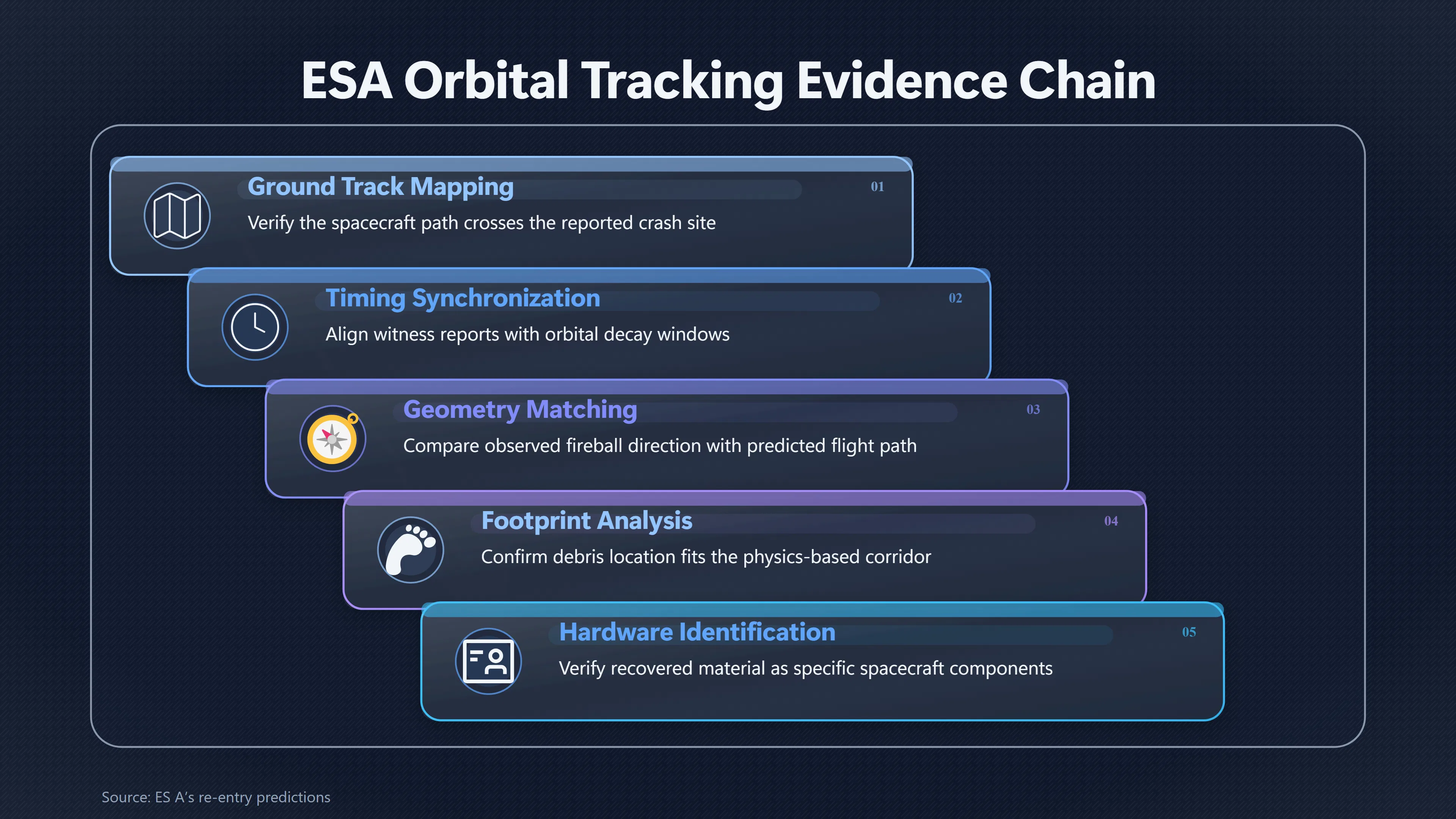
A credible match needs the right orbit, timing, fireball path, ground footprint and wreckage rather than a shared calendar date.
On this page
- The five evidence links investigators need
- Why re entry forecasts carry large uncertainties
- Common ways weak matches become overstated
Page outline Jump by section
Introduction
A satellite or rocket-body explanation for an alleged UFO crash becomes credible only when orbital evidence does far more than show that a spacecraft happened to re-enter on the same date. A convincing match requires multiple independent lines of evidence to converge: the object must have been in the correct orbit, passed over the relevant area at the right time, produced an observed trajectory consistent with its predicted re-entry, left a debris footprint where physics predicts, and, ideally, yielded recoverable hardware identifiable as spaceflight material. If one of these links fails, the case weakens sharply. This is why professional investigators treat orbital tracking as a process of evidence matching rather than coincidence matching, and why many widely repeated claims of satellite-related UFO recoveries remain unconfirmed despite superficial similarities.[reentry.esoc.esa.int]reentry.esoc.esa.intES A’s re-entry predictionsESA’s re-entry predictionsMay 6, 2025…

The five evidence links investigators need
Orbital tracking is strongest when several independent datasets reinforce one another rather than relying on a single prediction.
1. The orbit must place the object over the reported location.
The first question is whether the tracked spacecraft’s ground track actually crossed the relevant region. Modern tracking data can often reconstruct an object’s orbital path accurately before atmospheric drag dominates. If the reported crash site lies well outside the orbital ground track, the explanation is usually ruled out immediately.[reentry.esoc.esa.int]reentry.esoc.esa.intES A’s re-entry predictionsESA’s re-entry predictionsMay 6, 2025…
2. The timing must agree within realistic uncertainties.
A claimed match cannot depend merely on both events occurring on the same day. Witness reports, radar observations and orbital predictions must overlap after allowing for known uncertainty in re-entry forecasts. Because an uncontrolled satellite circles Earth roughly every 90 minutes, a timing error of several hours may place it over completely different continents during that interval.[European Space Agency]esa.intEuropean Space Agency ESAEuropean Space AgencyESA - ESA reentry expertise…
3. The observed flight path must match the predicted geometry.
Witnesses often report a fireball travelling in a particular direction. Orbital calculations can predict the expected direction of travel, entry angle and approximate speed. If witnesses consistently describe movement from west to east while orbital reconstruction requires the opposite, the proposed identification becomes difficult to defend.
Conversely, agreement between independently reported sight lines and calculated trajectories substantially strengthens the case, especially when observations come from multiple locations.[arXiv]arxiv.orgUsing fireball networks to track more frequent reentries: Falcon 9 upper stage orbit determination from video recordingsSeptember 2…
4. The debris footprint must be physically plausible.
Spacecraft rarely leave a single impact point. Surviving components separate during breakup and continue downrange, often producing a debris corridor extending tens or hundreds of kilometres. A claimed recovery should therefore fit the expected footprint rather than assuming everything landed exactly beneath the brightest fireball.
Finding isolated fragments far outside a physically reasonable corridor is usually evidence against the proposed identification rather than for it.[reentry.esoc.esa.int]reentry.esoc.esa.intES A’s re-entry predictionsESA’s re-entry predictionsMay 6, 2025…
5. The recovered material should resemble spacecraft hardware.
The strongest confirmation comes when recovered objects can be identified as specific spacecraft components through construction methods, alloys, serial markings or engineering design. Pressure vessels, titanium fittings and engine parts are among the components most likely to survive atmospheric re-entry.
Without identifiable hardware, orbital coincidence alone rarely establishes that a UFO recovery involved space debris.[reentry.esoc.esa.int]reentry.esoc.esa.intES A’s re-entry predictionsESA’s re-entry predictionsMay 6, 2025…
Why re-entry forecasts carry large uncertainties
One of the most common misunderstandings is assuming orbital tracking can predict an uncontrolled re-entry to a precise location days in advance.
In reality, atmospheric drag changes continually because the upper atmosphere expands and contracts with solar activity and space weather. Small uncertainties in atmospheric density accumulate over many orbits, making the exact decay time difficult to predict until shortly before re-entry. ESA notes that even in the final days, prediction windows commonly remain several hours wide, during which an object travelling at orbital speed can cross thousands of kilometres.[European Space Agency]esa.intEuropean Space Agency ESAEuropean Space AgencyESA - ESA reentry expertise…
For this reason, investigators should distinguish between:
- An orbital pass over a region.
- A predicted atmospheric entry somewhere along that orbit.
- The actual breakup location, which may differ significantly.
- The final debris field, which extends further downrange.
Collapsing these into a single “crash location” oversimplifies how re-entry actually occurs.[reentry.esoc.esa.int]reentry.esoc.esa.intES A’s re-entry predictionsESA’s re-entry predictionsMay 6, 2025…
Common ways weak matches become overstated
Many proposed explanations rely on reasoning that appears persuasive until the orbital evidence is examined more closely.
A frequent error is treating a shared calendar date as meaningful. Since numerous satellites and rocket bodies have re-entered throughout the Space Age, the existence of a re-entry somewhere on the same day as a UFO report is not, by itself, strong evidence of a connection. The relevant question is whether that specific object occupied the correct position in space at the reported time.[reentry.esoc.esa.int]reentry.esoc.esa.intES A’s re-entry predictionsESA’s re-entry predictionsMay 6, 2025…
Another mistake is ignoring witness geometry. Observers may estimate that an object landed nearby when it was actually many tens or hundreds of kilometres away because of perspective. If investigators reconstruct the trajectory without accounting for this effect, they may incorrectly associate unrelated debris with the event.
A further weakness is relying on later retellings instead of contemporary records. Early newspaper reports, tracking data, military observations and astronomical records generally provide firmer evidence than recollections recorded decades afterwards.
Finally, some proposed identifications work only by selectively accepting favourable details while dismissing contradictory timing, direction or recovery evidence. Robust orbital matching requires the entire dataset to remain internally consistent rather than choosing whichever elements support a preferred explanation.
What a genuinely convincing orbital match looks like
The most persuasive identifications of re-entering spacecraft typically combine several independent sources:
- Space-surveillance tracking showing the object’s orbit.
- Re-entry modelling consistent with the reported time window.
- Multiple eyewitness observations defining a common trajectory.
- A debris corridor matching expected breakup physics.
- Laboratory identification of recovered components as spacecraft hardware.
Modern fireball networks illustrate this approach well. Researchers have successfully reconstructed artificial re-entries by combining calibrated video observations with orbital tracking data, demonstrating that independent observations can identify specific rocket stages and estimate likely debris zones with considerably greater confidence than eyewitness testimony alone.[arXiv]arxiv.orgUsing fireball networks to track more frequent reentries: Falcon 9 upper stage orbit determination from video recordingsSeptember 2…
Within investigations of alleged UFO crashes, orbital tracking therefore functions best as a rigorous elimination and confirmation tool rather than a shortcut explanation. A satellite-debris hypothesis becomes genuinely persuasive only when timing, orbital mechanics, atmospheric modelling, observed flight path and recovered material all point to the same conclusion independently. Where one or more of these evidence links is absent, the apparent match is usually weaker than it first appears.[esa.int]reentry.esoc.esa.intES A’s re-entry predictionsESA’s re-entry predictionsMay 6, 2025…

Amazon book picks
Further Reading
Books and field guides related to What Makes a Space Debris Match Convincing?. Use these as the next step if you want deeper reading beyond the article.
Fundamentals of Astrodynamics and Applications
First published 1997. Subjects: Astrodynamik.
Orbital Mechanics for Engineering Students
Orbital Mechanics for Engineering Students, Second Edition, provides an introduction to the basic concepts of space mechanics. These incl...
Satellite Orbits: Models, Methods and Applications
Satellite Orbits -Models, Methods, and Applications has been written as a compre hensive textbook that guides the reader through the theo...
Space Mission Analysis and Design
This volume, appropriate as a textbook for either advanced undergraduate or beginning graduate courses, or as a reference for those alrea...
eBay marketplace picks
Marketplace Samples
Live-tested eBay searches with available results related to this page.
Selected fromsatellite model oneBay.co.uk.

Endnotes
1.
Source: reentry.esoc.esa.int
Title: ES A’s re-entry predictions
Link:https://reentry.esoc.esa.int/
Source snippet
ESA’s re-entry predictionsMay 6, 2025...
Published: May 6, 2025
2.
Source: esa.int
Title: European Space Agency ESA
Link:https://www.esa.int/Space_Safety/Space_Debris/ESA_reentry_expertise
Source snippet
European Space AgencyESA - ESA reentry expertise...
3.
Source: blogs.esa.int
Title: Why it’s tough to predict reentries – Rocket Science
Link:https://blogs.esa.int/rocketscience/2018/03/28/why-its-tough-to-predict-reentries/
4.
Source: arxiv.org
Link:https://arxiv.org/abs/2109.01004
Source snippet
Using fireball networks to track more frequent reentries: Falcon 9 upper stage orbit determination from video recordingsSeptember 2...
5.
Source: blogs.esa.int
Link:https://blogs.esa.int/rocketscience/2025/05/07/reentry-prediction-soviet-era-venera-venus-lander-cosmos-482-descent-craft/
Source snippet
prediction Soviet-era Venera Venus lander (Cosmos-482 descent craft) – Rocket ScienceMay 7, 2025 — REENTRY PREDICTION SOVIET-ERA VENERA V...
Published: May 7, 2025
6.
Source: reentry.esoc.esa.int
Title: Public release will follow soon! release UNCONTROLLED REENTRY OF SOVIET
Link:https://reentry.esoc.esa.int/home/blog/cosmos-482-reentry
Source snippet
esa.intESA’s re-entry predictionsMay 6, 2025 — non-reentry 2016-11-09 13:00:00 Pre-release The ESA Re-entry Frontend is pre-released toda...
Published: November 9, 2016
7.
Source: reentry.esoc.esa.int
Title: int ES A’s re-entry predictions
Link:https://reentry.esoc.esa.int/home/blog/cluster-reentry
8.
Source: reentry.esoc.esa.int
Title: int ES A’s re-entry predictions
Link:https://reentry.esoc.esa.int/home/blog/ers-2-reentry
9.
Source: reentry.esoc.esa.int
Title: int ES A’s re-entry predictions
Link:https://reentry.esoc.esa.int/home/blog/long-march-5b-reentry
10.
Source: esa.int
Link:https://www.esa.int/Space_Safety/Reentry_data_will_help_improve_prediction_models
11.
Source: nebula.esa.int
Link:https://nebula.esa.int/content/benchmarking-re-entry-prediction-uncertainties-parallel
12.
Source: esa.int
Link:https://www.esa.int/content/view/full/413425
13.
Source: conference.sdo.esoc.esa.int
Link:https://conference.sdo.esoc.esa.int/proceedings/sdc7/paper/191
14.
Source: orbitaldebris.jsc.nasa.gov
Link:https://orbitaldebris.jsc.nasa.gov/reentry/
Additional References
15.
Source: wired.com
Link:https://www.wired.com/story/how-scientists-predict-if-a-spacecraft-will-fall-and-kill-you
Source snippet
Most of it will burn up on reentry, but up to 220-pound chunks could reach the ground. Experts assess the risk of these chunks hitting so...
16.
Source: youtube.com
Title: Safer Space for All~Space Situational Awareness(SSA)in JAXA ~
Link:https://www.youtube.com/watch?v=zcYE9JH5_UY
Source snippet
This video Cluster reentry explained: world's first targeted reentry explains how space agencies track spacecraft trajectory, orbital par...
17.
Source: nasa.gov
Title: 13.0 Deorbit Systems
Link:https://www.nasa.gov/smallsat-institute/sst-soa/deorbit-systems/
Source snippet
May 7, 2026 — 13.0 DEORBIT SYSTEMS May 7, 2026 PDF (1.49 MB) CHAPTER CONTENTS * Chapter Glossary * 13.1 Introduction * 13.2 Orbital D...
Published: May 7, 2026
18.
Source: youtube.com
Title: Cluster reentry explained: world’s first targeted reentry
Link:https://www.youtube.com/watch?v=KFNLzU3GItE
Source snippet
ANSS Seminar: Seismoacoustic tracking of re-entering space debris, Benjamin Fernando...
19.
Source: youtube.com
Title: Aeolus reentry | How we made history
Link:https://www.youtube.com/watch?v=KzDy_hQDztA
Source snippet
Space-to-Space (S2S) “Above-the-Horizon” Surveillance & Visual Checkup of Space Objects...
20.
Source: aerospace.org
Link:https://aerospace.org/reentries/16495
Source snippet
COSMOS 1726 (ID 16495) | The Aerospace CorporationOctober 30, 2024 — COSMOS 1726 (ID 16495) REENTERED Reentry Prediction --- Predicted Re...
Published: October 30, 2024
21.
Source: youtube.com
Link:https://www.youtube.com/watch?v=WWgHoIpGB5U
Source snippet
Aeolus reentry | How we made history...
22.
Source: sma.nasa.gov
Title: updates to nasa procedural requirements for limiting orbital debris
Link:https://sma.nasa.gov/news/articles/newsitem/2017/04/24/updates-to-nasa-procedural-requirements-for-limiting-orbital-debris
23.
Source: youtube.com
Link:https://www.youtube.com/watch?v=EL0ao08D5gk
Source snippet
ATV-1 reentry...
24.
Source: nasa.gov
Title: Space Debris: Understanding the Risks to NASA Spacecraft
Link:https://www.nasa.gov/centers-and-facilities/nesc/space-debris-understanding-the-risks-to-nasa-spacecraft/