Within Balloon Debris
What Actually Falls From a Research Balloon?
A recovered site may contain radiosondes, batteries, antennas, cords and parachutes even when almost none of the balloon envelope remains.
On this page
- The parts of a balloon train
- Which components survive impact
- How to reconstruct the original system
Page outline Jump by section
Introduction
When people imagine a balloon crash, they often picture scraps of torn latex or plastic. In practice, that is usually the least important part of what reaches the ground. Research and military balloons suspend a payload train beneath the lifting envelope: a sequence of cords, parachutes, electronics, antennas, batteries, sensors and structural fittings designed to survive the flight. After the balloon bursts at high altitude, these durable components frequently become the most visible remains. In several historical UFO incidents—including the debris associated with the Roswell controversy—the unfamiliar appearance of this suspended hardware contributed far more to eyewitness confusion than the balloon itself.[Muller Lab]muller.lbl.govMuller Lab Project MogulMuller Lab Project Mogul
Understanding what survives, how the pieces become scattered, and how investigators reconstruct the original system helps explain why apparently exotic debris can originate from an entirely terrestrial balloon programme.
The parts of a balloon train
A research balloon is best understood as a suspended system rather than a single object. The balloon merely provides lift; almost everything of scientific or operational value hangs beneath it.
Typical payload trains include:
- The balloon envelope, made from latex, neoprene or polyethylene depending on the mission.
- Load lines and suspension cords, connecting each stage of the system.
- A parachute, intended to slow the descent once the balloon bursts or is separated.
- A radiosonde or scientific payload, containing instruments, processors, sensors and transmitters.
- Power supplies, commonly lithium batteries designed to function in extremely cold upper-atmosphere conditions.
- Antennas and GPS equipment, allowing the payload to transmit its position and measurements.
- Mission-specific hardware, such as cameras, atmospheric sampling devices, acoustic sensors, radar reflectors or recovery beacons.[National Weather Service]weather.govNational Weather Service Radiosonde ObservationNational Weather Service Radiosonde Observation
Specialised research programmes can add further equipment. NASA scientific balloon missions, for example, suspend large experiment packages with computers, radios, batteries, telemetry systems and recovery hardware beneath balloons that may remain aloft for weeks before controllers deliberately separate the payload for parachute recovery.[Columbia Scientific Balloon Facility]csbf.nasa.govColumbia Scientific Balloon Facility NASAColumbia Scientific Balloon FacilityNASA - Columbia Scientific Balloon Facility…
The important point is that the payload train often weighs many times more than the remnants of the balloon envelope after burst.
Which components survive impact
The balloon itself is surprisingly fragile after completing its mission.
Latex balloons usually burst into long, thin strips. Thin polyethylene balloons tear into extensive sheets that can become tangled in vegetation or carried away by wind. These materials degrade relatively quickly under sunlight and mechanical abrasion.
By contrast, the suspended hardware is intentionally built to survive.
The components most likely to remain recognisable include:
- Instrument housings, often made from foam, lightweight composites or plastic to protect electronics.
- Circuit boards and radio transmitters, which may remain largely intact even if external casings fracture.
- Batteries, which are designed to continue powering transmitters throughout descent.
- GPS antennas and radio aerials, whose unusual shapes may appear unfamiliar to casual observers.
- Parachute fittings, swivels and connectors, manufactured from metal or reinforced polymers.
- Recovery labels or identification plates, although these may tear away or become weathered over time.[National Weather Service]weather.govNational Weather Service Weather Balloon Instrument/Radiosonde InformationNational Weather Service Weather Balloon Instrument/Radiosonde Information
Because these pieces are engineered rather than naturally occurring, they can resemble fragments of an aircraft or other manufactured vehicle, especially when discovered without the shredded balloon nearby.
Why the wreckage often appears larger than expected
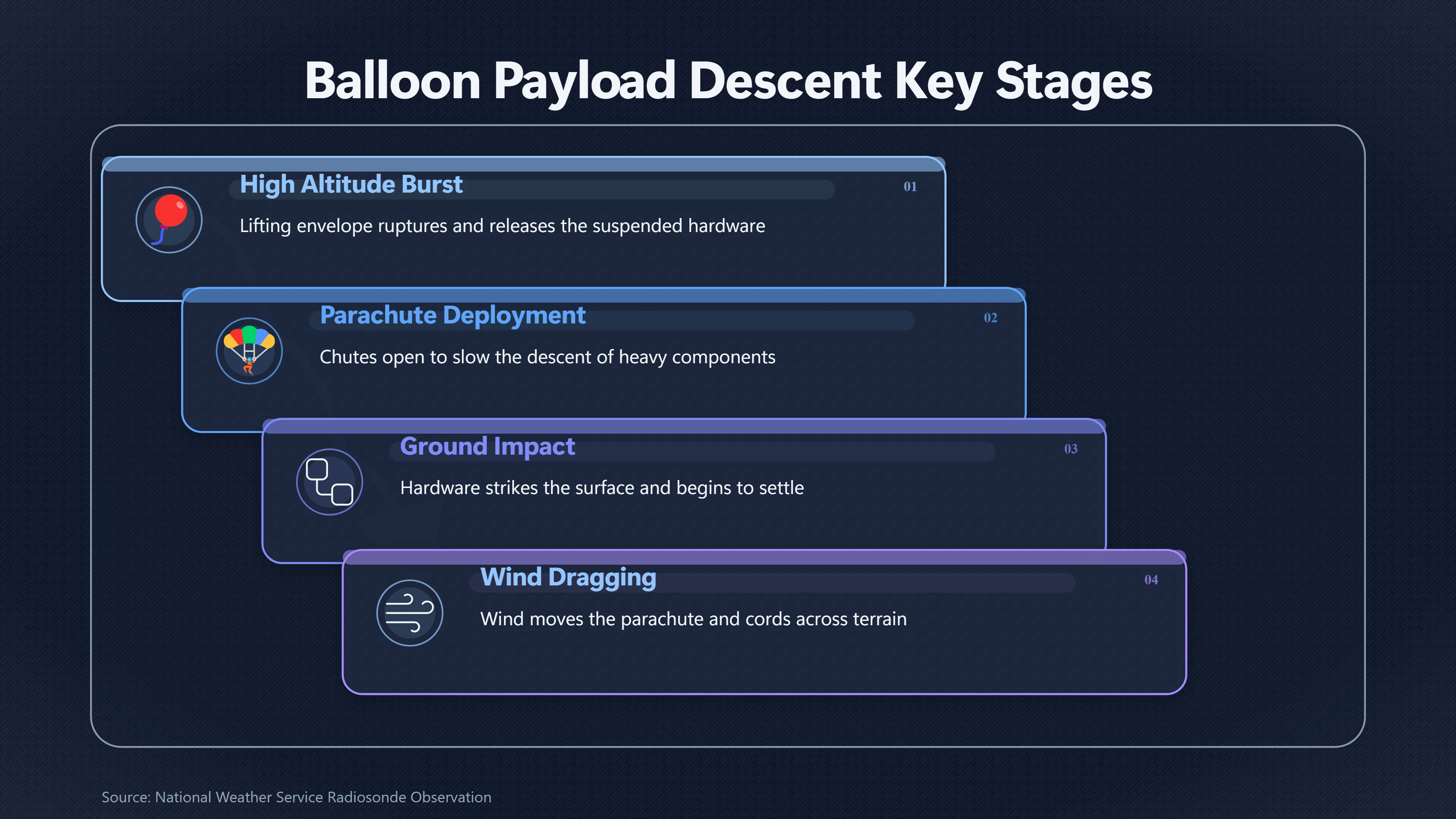
A balloon payload does not usually strike the ground as a compact object.
After the envelope bursts, the remaining system descends beneath a parachute. During and after landing, wind can continue dragging the parachute, cords and attached equipment across open terrain. Lightweight components may detach at different moments, producing a debris field extending hundreds of metres rather than a single impact point.
This process explains why witnesses sometimes describe:
- debris spread over a broad area;
- pieces connected by lengths of cord;
- isolated electronic boxes found well away from balloon fragments;
- tangled strings apparently linking unrelated objects.
Such distributions differ from aircraft crash patterns because there is little kinetic fragmentation. Instead, the field develops gradually through dragging, snagging and separation after touchdown. NASA’s balloon recovery procedures similarly rely on controlled parachute descent and subsequent retrieval rather than expecting all components to land as a compact unit.[Columbia Scientific Balloon Facility]csbf.nasa.govColumbia Scientific Balloon Facility NASAColumbia Scientific Balloon FacilityNASA - Columbia Scientific Balloon Facility…
How investigators reconstruct the original system
Finding a balloon payload rarely begins with identifying the balloon itself. Investigators instead work backwards from the surviving hardware.
Typical reconstruction involves matching:
- Cord lengths and attachment points, revealing the order of suspended components.
- Connector types, showing where parachutes, payloads and lifting lines joined.
- Electronics, whose model numbers identify radiosondes or research instruments.
- Battery configurations, which often correspond to specific radiosonde designs.
- Radio frequencies or serial numbers, allowing operators to identify the flight.
- Recovered parachutes, indicating the orientation of the descending system.[National Weather Service]weather.govNational Weather Service Radiosonde ObservationNational Weather Service Radiosonde Observation
Modern weather services simplify this process because radiosondes are standardised and many carry labels explaining their purpose. NOAA notes that recovered radiosondes are commonly found still attached to cotton line, remnants of the balloon and an orange parachute, while the electronics are typically protected inside insulated housings.[National Weather Service]weather.govNational Weather Service Weather Balloon Instrument/Radiosonde InformationNational Weather Service Weather Balloon Instrument/Radiosonde Information
Research programmes often include GPS tracking, satellite communication and recovery beacons, enabling teams to locate payloads directly rather than relying solely on reports from members of the public.[arXiv]arxiv.orgOpen source on arxiv.org.
Why classified payloads created greater confusion
Historical military balloon programmes introduced another complication: observers recognised the hardware as manufactured but could not identify its purpose.
Project Mogul, developed to detect long-range acoustic signals from Soviet nuclear tests, illustrates the problem. Rather than carrying only a simple radiosonde, its balloon trains incorporated multiple balloons, radar reflectors, parachutes, ballast tubes, electronic cut-off devices and acoustic equipment suspended in a long sequence. When this arrangement struck the ground, lightweight radar targets and associated hardware could be dragged apart, leaving scattered engineered debris unlike the remains of an ordinary weather balloon.[Muller Lab]muller.lbl.govMuller Lab Project MogulMuller Lab Project Mogul
For someone encountering isolated electronics, foil-covered radar targets, cords and unfamiliar structural pieces without knowledge of the classified programme, the debris could reasonably appear to come from an unknown machine rather than an atmospheric experiment.
What a payload train tells investigators
Forensic examination of balloon debris focuses less on the missing envelope than on the surviving payload train. The pattern of cords, parachute attachments, electronics, batteries and antennas can reveal:
- the type of balloon flown;
- whether the descent occurred under parachute;
- whether the payload separated normally or experienced failure;
- the approximate order of suspended components;
- whether the equipment belonged to a routine weather sounding or a more specialised research mission.
In the context of reported UFO crashes, this distinction is important. The most convincing “wreckage” often consists not of mysterious materials but of durable payload hardware that has outlasted the fragile balloon supporting it. Once the complete payload train is reconstructed, apparently disconnected fragments usually resolve into a coherent atmospheric research system rather than the remains of an unknown craft.[lbl.gov]muller.lbl.govMuller Lab Project MogulMuller Lab Project Mogul
Amazon book picks
Further Reading
Books and field guides related to What Actually Falls From a Research Balloon?. Use these as the next step if you want deeper reading beyond the article.
Scientific Ballooning: Technology and Applications of Explora...
This introduction to scientific ballooning thoroughly covers large stratospheric balloons, planetary balloons, and rubber balloons used f...

Roswell: Inconvenient Facts and the Will to Believe
Voici la solution du plus grand mystère de l'histoire des ovnis : l'affaire de Roswell dans le Nouveau Mexique. Après avoir annoncé à la...
Space Mission Analysis and Design
This volume, appropriate as a textbook for either advanced undergraduate or beginning graduate courses, or as a reference for those alrea...
The Cambridge Aerospace Dictionary
The Cambridge Aerospace Dictionary is an authoritative and accessible reference useful to scholars and enthusiasts alike. This dictionary...
eBay marketplace picks
Marketplace Samples
Live-tested eBay searches with available results related to this page.
Selected fromUFO poster oneBay.co.uk.

Current eBay listing
I Want To Believe UFO Poster Giclée Fine Art Heavyweight Print

Current eBay listing
VINTAGE UFO FLYING SAUCERS COMIC ADVERTISING A2 POSTER PRINT


Endnotes
1.
Source: weather.gov
Title: National Weather Service Radiosonde Observation
Link:https://www.weather.gov/upperair/factsheet
2.
Source: weather.gov
Title: National Weather Service Weather Balloon Instrument/Radiosonde Information
Link:https://www.weather.gov/upperair/radiosonde
3.
Source: csbf.nasa.gov
Title: Columbia Scientific Balloon Facility NASA
Link:https://www.csbf.nasa.gov/balloons-txt.html
Source snippet
Columbia Scientific Balloon FacilityNASA - Columbia Scientific Balloon Facility...
4.
Source: arxiv.org
Link:https://arxiv.org/abs/1904.04321
5.
Source: arxiv.org
Title: arXiv Download by Parachute: Retrieval of Assets from High Altitude Balloons
Link:https://arxiv.org/abs/2004.10764
6.
Source: nasa.gov
Title: NAS A Safely Ends Second Super Pressure Balloon Test Flight
Link:https://www.nasa.gov/blogs/wallops/2025/05/13/nasa-safely-ends-second-super-pressure-balloon-test-flight/
7.
Source: nasa.gov
Title: Scientific Balloons Glossary
Link:https://www.nasa.gov/scientificballoons/balloons-glossary/
8.
Source: ntrs.nasa.gov
Link:https://ntrs.nasa.gov/citations/20240000154
9.
Source: ntrs.nasa.gov
Link:https://ntrs.nasa.gov/citations/20190002349
10.
Source: nasa.gov
Title: NAS A-Funded Balloon Recovered a Year After Flight Over Antarctica
Link:https://www.nasa.gov/science-research/heliophysics/nasa-funded-balloon-recovered-a-year-after-flight-over-antarctica/
11.
Source: science.nasa.gov
Title: payload recovery key capability for nasa balloons
Link:https://science.nasa.gov/blogs/super-pressure-balloon/2016/03/21/payload-recovery-key-capability-for-nasa-balloons/
12.
Source: ntrs.nasa.gov
Link:https://ntrs.nasa.gov/search.jsp?R=19930027386
13.
Source: weather.gov
Link:https://www.weather.gov/rev/upperair
14.
Source: preview.weather.gov
Link:https://preview.weather.gov/upperair
15.
Source: weather.gov
Link:https://www.weather.gov/gjt/education_corner_balloon
16.
Source: weather.gov
Link:https://www.weather.gov/ilx/ua-tour?trk=public_post_comment-text
17.
Source: weather.gov
Title: NW S Amarillo Upper Air Tour – Balloon Preparation & Launch Image
Link:https://www.weather.gov/ama/upperair2
18.
Source: nssl.noaa.gov
Link:https://www.nssl.noaa.gov/projects/glidersonde/report/
19.
Source: prod-01-alb-www-noaa.woc.noaa.gov
Link:https://prod-01-alb-www-noaa.woc.noaa.gov/jetstream/upperair/radiosondes
20.
Source: muller.lbl.gov
Title: Muller Lab Project Mogul
Link:https://muller.lbl.gov/teaching/physics10/Roswell/USMogulReport.html
21.
Source: history.com
Link:https://www.history.com/articles/roswell
Source snippet
Roswell - New Mexico, Alien & UFOs | HISTORY...
Additional References
22.
Source: youtube.com
Title: Ham radio weather balloon radiosonde hunting!
Link:https://www.youtube.com/watch?v=EffpLslyT3c
Source snippet
This collection of videos is relevant because it covers both the historical Project Mogul balloon train debris associated with famous UFO...
23.
Source: curiolink.net
Title: roswell incident 1947 cover up explained
Link:https://www.curiolink.net/2026/06/roswell-incident-1947-cover-up-explained.html
Source snippet
government went looking for an entirely different set of records. In response to a 1994 Congressional inquiry from th...
24.
Source: wikidisc.org
Title: Roswell incident | Wiki Disc
Link:https://www.wikidisc.org/wiki/Roswell_incident
Source snippet
Army Air Forces investigation in July 1947 quickly concluded that the debris originated from...
Published: July 1947
25.
Source: amt.copernicus.org
Link:https://amt.copernicus.org/articles/19/3231/2026/
Source snippet
"This work is distributed under the Creative Commons Attribution 4.0 License. [https://doi.org/10.5194/amt-1..."](https://doi.org/10.5194/amt-1...")...
26.
Source: youtube.com
Title: A Comprehensive Guide to Launching a High-Altitude Balloon
Link:https://www.youtube.com/watch?v=E7JSeQEjvnY
Source snippet
How to track & recover a NWS weather balloon & radiosonde Ham Radio DIY...
27.
Source: youtube.com
Title: How to track & recover a NWS weather balloon & radiosonde Ham Radio DIY
Link:https://www.youtube.com/watch?v=-2x-Jwu43Mg
Source snippet
Ham radio weather balloon radiosonde hunting...
28.
Source: nlr.gov
Link:https://www.nlr.gov/wind/radiosonde-information
29.
Source: thisunexplaineduniverse.com
Link:https://www.thisunexplaineduniverse.com/articles/roswell-incident
30.
Source: youtube.com
Title: I Found the REAL Roswell UFO Crash Site
Link:https://www.youtube.com/watch?v=UAnLgCga3Yg
Source snippet
A Comprehensive Guide to Launching a High-Altitude Balloon...
31.
Source: gutenberg.org
Title: The Roswell Report: Case Closed, by James Mc Andrew—A Project Gutenberg e Book
Link:https://www.gutenberg.org/files/63659/old/63659-h/63659-h.htm