Within Crash Photos
Is This the Original Crash Photograph?
Original camera files preserve far and processing history than screenshots, social-media downloads or photographs of prints.
On this page
- What information disappears during copying and reposting
- How compression artefacts can mimic damage or editing
- Which file versions investigators should preserve and compare
Page outline Jump by section
Introduction
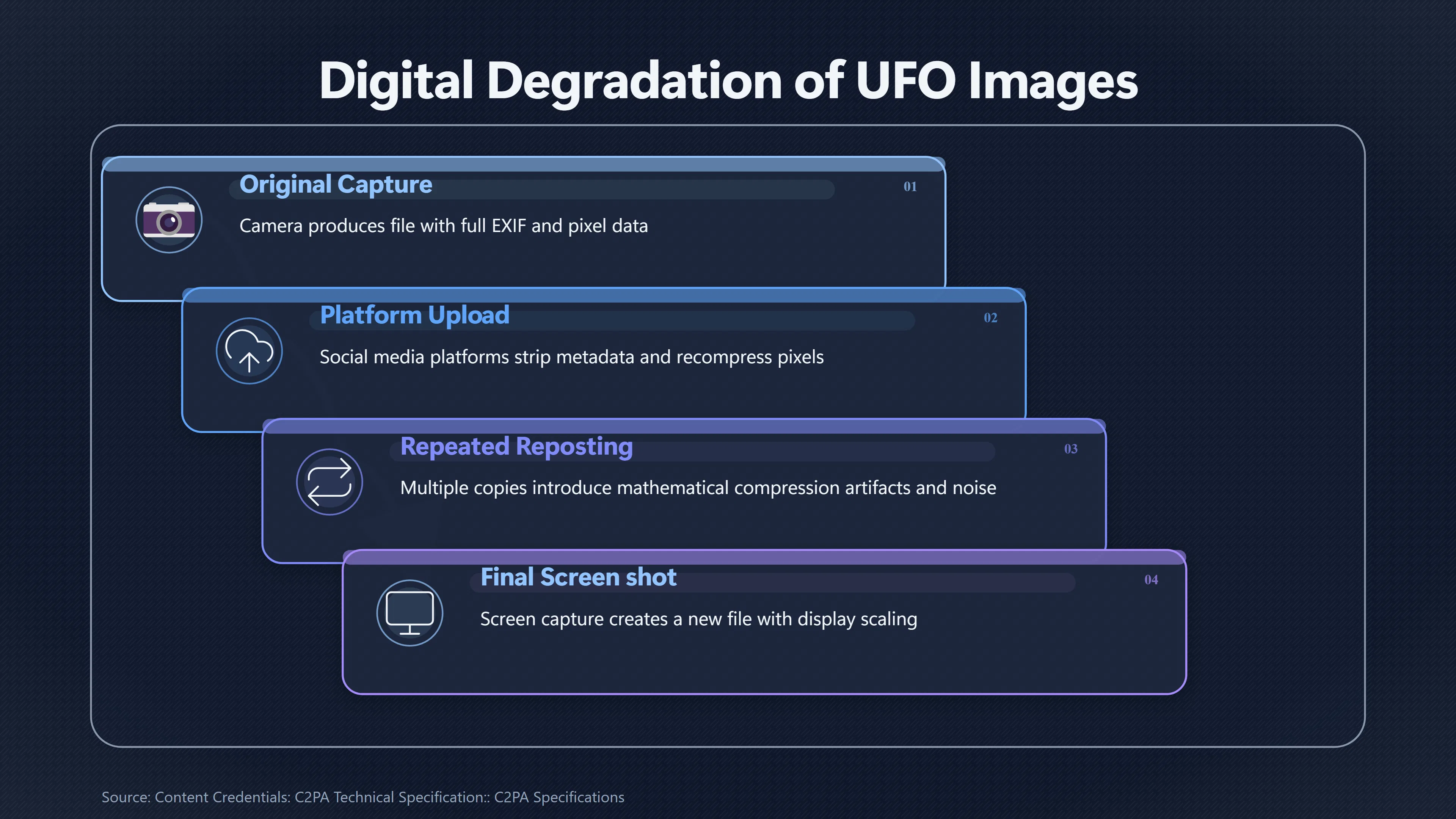
When evaluating photographs that allegedly document a UFO crash scene, the original camera file is almost always more valuable than a screenshot, a social-media repost, or a photograph of a printed image. The difference is not merely image quality. Original files often preserve metadata, compression history, file structure and, increasingly, cryptographic provenance information that can help investigators determine when an image was created, how it has been processed and whether it has been altered. By contrast, screenshots and repeatedly copied images usually discard much of that information while introducing new compression artefacts that can complicate forensic analysis.[C2PA]spec.c2pa.orgContent Credentials: C2PA Technical Specification:: C2PA SpecificationsContent Credentials: C2PA Technical Specification:: C2PA Specifications…
This does not mean that every original file is authentic or that every repost is false. An original image can still depict a staged scene, while a repost may accurately reproduce a genuine photograph. However, if only a compressed or repeatedly shared version survives, many independent checks become impossible. For alleged UFO crash photographs, that loss of information significantly weakens the image’s evidential value.
Is This the Original Crash Photograph?
A useful first question is not whether an image looks convincing, but whether it is the earliest available digital version.
The strongest evidence normally comes from the original file produced directly by the camera or mobile phone. Such files may contain:
- Original pixel data before social-media recompression.
- Exchangeable Image File Format (EXIF) metadata, including camera model, lens, exposure settings and timestamps where available.
- File naming sequences that can be compared with neighbouring photographs taken on the same device.
- Manufacturer-specific data that may survive only in the camera’s original output.
- In some modern workflows, cryptographically signed provenance information documenting capture or subsequent edits.[C2PA]spec.c2pa.orgContent Credentials: C2PA Technical Specification:: C2PA SpecificationsContent Credentials: C2PA Technical Specification:: C2PA Specifications…
Each step away from that original generally removes information rather than adding it. A screenshot records what appeared on one display at one moment, not the underlying image file. Likewise, downloading an image from a messaging application or social-media platform often produces a newly encoded copy with altered dimensions, reduced quality and stripped metadata.
Investigators therefore seek the earliest obtainable version rather than the version that has circulated most widely online.
What Information Disappears During Copying and Reposting?
Repeated copying affects both the visible image and the hidden information stored alongside it.
Important losses commonly include:
- Metadata removal. Many online platforms remove or rewrite EXIF metadata for privacy, storage or performance reasons. Camera details, timestamps and location information may disappear even when the picture itself looks unchanged.[C2PA]c2pa.organd Content Credentials Explainer:: C2PA SpecificationsC2PA and Content Credentials Explainer:: C2PA Specifications…
- Compression history. Each recompression changes the image mathematically, making later forensic interpretation more difficult.
- Colour information. Repeated JPEG encoding can subtly alter colour gradients and fine texture.
- Resolution. Platforms frequently resize uploaded images, eliminating small details that might otherwise distinguish genuine physical damage from photographic noise.
- File provenance. Modern provenance standards such as C2PA Content Credentials can document an image’s origin and editing history when supported, but screenshots and many online services remove these records entirely.[C2PA]spec.c2pa.orgContent Credentials: C2PA Technical Specification:: C2PA SpecificationsContent Credentials: C2PA Technical Specification:: C2PA Specifications…
A repost therefore becomes a new digital object rather than a perfect duplicate of the original capture.
How Compression Artefacts Can Mimic Damage or Editing
One reason investigators prefer original files is that JPEG compression introduces patterns that can be mistaken for evidence of manipulation.
Heavy compression may create:
- Block-like structures around edges.
- Ringing or halo effects surrounding bright objects.
- False texture in smooth areas such as skies.
- Colour banding in gradual tonal transitions.
- Blurred fine detail that resembles deliberate retouching.
These artefacts are normal consequences of repeated JPEG encoding rather than proof that an image has been falsified.
Conversely, genuine editing can also leave compression inconsistencies. Digital forensic techniques sometimes examine variations in JPEG block structure, double-compression patterns and other statistical features to identify possible manipulation. However, these methods become less reliable after multiple rounds of copying because every additional save alters the compression signature. Modern research continues to improve detection methods, but investigators generally treat compression artefacts as indicators requiring further examination rather than definitive proof of editing.[arXiv]arxiv.orgLearning JPEG Compression Artifacts for Image Manipulation Detection and LocalizationAugust 30, 2021…
For alleged UFO crash photographs that have circulated for years as low-resolution internet images, it may no longer be possible to distinguish confidently between genuine editing traces and artefacts created by repeated reposting.
Screenshots Create New Evidence Rather Than Preserving Old Evidence
Screenshots deserve particular caution because they generate an entirely new image.
Instead of copying the original pixels, a screenshot captures whatever was displayed on a screen, including:
- Display scaling.
- User interface elements.
- Colour management applied by the operating system.
- Screen brightness and rendering.
- Any prior compression already present in the displayed image.[boxentriq.com]boxentriq.comC2PA Content Credentials Viewer | Boxentriq#Metadata #Image Analysis #File Analysis #Image Steganography C2PA Content Credentials c…
The resulting file contains information about the display session rather than the original camera capture.
A screenshot may still document that a particular image appeared on a website or social-media account at a certain time, which can be valuable for reconstructing publication history. It should not, however, be treated as equivalent to the original photograph itself.
Which File Versions Should Investigators Preserve and Compare?
Where possible, investigators should retain every stage in the image’s history rather than keeping only the most visually appealing version.
A robust preservation strategy includes:
- The untouched original camera file.
- Any manufacturer-specific raw file, if available.
- Camera-generated JPEGs alongside raw images.
- Edited versions created during legitimate processing.
- Social-media uploads and downloaded copies.
- Screenshots documenting online publication.
- Photographs of prints only when no digital version survives.
Comparing these versions can reveal whether changes resulted from ordinary publishing workflows or from deliberate alteration.
Maintaining hashes (digital fingerprints) for each preserved file also helps demonstrate that copies remained unchanged during investigation.
Modern Provenance Data Can Help—but Only If the Original Survives
An increasing number of cameras, software tools and publishing systems support provenance standards such as C2PA (Coalition for Content Provenance and Authenticity). These standards can attach cryptographically signed records describing the origin of an image and authorised edits, allowing compatible software to verify whether the provenance chain remains intact.[C2PA]spec.c2pa.orgContent Credentials: C2PA Technical Specification:: C2PA SpecificationsContent Credentials: C2PA Technical Specification:: C2PA Specifications…
These technologies improve the ability to establish image history, but they are not a substitute for careful investigation. Provenance metadata can be stripped accidentally or intentionally during ordinary sharing, particularly through screenshots and many social-media platforms. A missing provenance record therefore does not prove an image is fabricated; it often reflects how the image was distributed rather than how it was created. Likewise, provenance systems describe the history of the file, not whether the photographed scene itself was genuine.[openai.com]help.openai.comOpen AI Help Center C2PA in Chat GPT Images | Open AI Help CenterOpen AI Help Center C2PA in Chat GPT Images | Open AI Help Center
For alleged UFO crash photographs, provenance information is therefore most useful when it accompanies the earliest available original file rather than a heavily circulated internet copy.
Why Original Files Matter for Alleged UFO Crash Photographs
Many famous alleged UFO crash images circulate only as scans, screenshots or repeatedly reposted JPEGs whose original sources are unknown. Once the original files have been lost, investigators can no longer independently verify many important characteristics of the images.
As a result, the evidential value shifts away from the pixels alone and towards the documented chain of custody. A dramatic photograph without its original file may still have historical or cultural interest, but it provides a much weaker foundation for claims about an actual crash scene than a complete photographic record preserved from the moment of capture.
Amazon book picks
Further Reading
Books and field guides related to Is This the Original Crash Photograph?. Use these as the next step if you want deeper reading beyond the article.
Digital Image Forensics: There Is More to a Picture than Meet...
Photographic imagery has come a long way from the pinhole cameras of the nineteenth century. Digital imagery, and its applications, devel...
Forensic Photography: A Practitioner's Guide
Forensic photography plays a vitally important part in the investigation of crime and the subsequent administration of justice. Written b...
eBay marketplace picks
Marketplace Samples
Live-tested eBay searches with available results related to this page.
Selected fromUFO photo print oneBay.co.uk.



Endnotes
1.
Source: spec.c2pa.org
Title: Content Credentials: C2PA Technical Specification:: C2PA Specifications
Link:https://spec.c2pa.org/specifications/specifications/2.4/specs/C2PA_Specification.html
Source snippet
Content Credentials: C2PA Technical Specification:: C2PA Specifications...
2.
Source: c2pa.org
Title: and Content Credentials Explainer:: C2PA Specifications
Link:https://c2pa.org/specifications/specifications/2.2/explainer/Explainer.html
Source snippet
C2PA and Content Credentials Explainer:: C2PA Specifications...
3.
Source: help.openai.com
Title: Open AI Help Center C2PA in Chat GPT Images | Open AI Help Center
Link:https://help.openai.com/en/articles/8912793-c2pa-in-dall-e-3%23.otf
4.
Source: arxiv.org
Link:https://arxiv.org/abs/2108.12947
Source snippet
Learning JPEG Compression Artifacts for Image Manipulation Detection and LocalizationAugust 30, 2021...
Published: August 30, 2021
5.
Source: arxiv.org
Link:https://arxiv.org/abs/2607.06615
6.
Source: arxiv.org
Title: arXiv Is JPEG AI going to change image forensics?
Link:https://arxiv.org/abs/2412.03261
7.
Source: arxiv.org
Link:https://arxiv.org/abs/2604.24890
8.
Source: spec.c2pa.org
Link:https://spec.c2pa.org/specifications/specifications/2.2/specs/C2PA_Specification
9.
Source: spec.c2pa.org
Link:https://spec.c2pa.org/specifications/specifications/2.0/specs/C2PA_Specification.html
10.
Source: spec.c2pa.org
Link:https://spec.c2pa.org/specifications/specifications/2.1/specs/C2PA_Specification.html
11.
Source: help.openai.com
Title: 8912793 c2pa and synthid in openai generated images
Link:https://help.openai.com/en/articles/8912793-c2pa-and-synthid-in-openai-generated-images
12.
Source: OpenAI
Link:https://openai.com/research/verify/
13.
Source: theverge.com
Title: The Verge This system can sort real pictures from AI fakes
Link:https://www.theverge.com/2024/8/21/24223932/c2pa-standard-verify-ai-generated-images-content-credentials
Source snippet
The C2PA authentication standard, supported by companies such as Microsoft, Adobe, Google, and others, provides a technical solution by a...
Additional References
14.
Source: youtube.com
Link:https://www.youtube.com/watch?v=A_itRNhbgZk
Source snippet
EXIF metadata image forensics photo verification OSINT At Home #2 - Five ways to find EXIF/metadata in a photo or video Bendobrown...
15.
Source: fakeimagedetector.com
Title: This guide explains
Link:https://www.fakeimagedetector.com/blog/how-jpeg-compression-works/
Source snippet
How JPEG Compression Works, and Why It Betrays Edited PhotosJuly 20, 2026 — HOW JPEG COMPRESSION WORKS, AND WHY IT BETRAYS EDITED PHOTOS...
Published: July 20, 2026
16.
Source: youtube.com
Title: How photo forensics can help you detect manipulated images
Link:https://www.youtube.com/watch?v=52ZV8HO0wrA
Source snippet
Extract iPhone and Android EXIF metadata from online photos using PYTHON // OSINT with Kali Linux...
17.
Source: boxentriq.com
Title: C2PA Content Credentials Viewer | Boxentriq
Link:https://www.boxentriq.com/imaging/c2pa-metadata-viewer
Source snippet
#Metadata #Image Analysis #File Analysis #Image Steganography C2PA Content Credentials c...
18.
Source: ojp.gov
Link:https://www.ojp.gov/library/publications/detection-jpeg-double-compression-and-identification-smartphone-image-source
19.
Source: nist.gov
Link:https://www.nist.gov/publications/media-forensics-challenge-image-provenance-evaluation-and-state-art-analysis-large
20.
Source: nist.gov
Link:https://www.nist.gov/publications/media-forensics-challenge-image-provenance-evaluation-and-state-art-analysis-large-0
21.
Source: youtube.com
Title: Digital Photo Forensics: How To analyze Fake Photos
Link:https://www.youtube.com/watch?v=G1Y0UTMTF7o
Source snippet
OSINT At Home #2 - Five ways to find EXIF/metadata in a photo or video...
22.
Source: sciencedirect.com
Link:https://www.sciencedirect.com/science/article/pii/S0167404826000404
23.
Source: forensicspot.com
Link:https://forensicspot.com/glossary/error-level-analysis-ela