Within Missing Records
When Were the UFO Files Destroyed, and Why?
Files destroyed routinely decades earlier carry a different implication from records removed after scrutiny, requests or public controversy began.
On this page
- Routine disposal before public controversy
- Destruction after requests or investigations
- Building a reliable disposal timeline
Page outline Jump by section
Introduction
The timing of destroyed or missing UFO-related records is often more important than the fact of their destruction. In debates over alleged UFO crash recoveries, an archival gap by itself does not establish that evidence was concealed. However, when records disappeared—and under what administrative or legal circumstances—can substantially strengthen or weaken competing explanations.
A file destroyed under an approved records schedule decades before public interest arose usually fits ordinary government records management. By contrast, records destroyed after a Freedom of Information Act (FOIA) request, congressional inquiry, official investigation or intense public controversy raise more difficult questions. The distinction does not prove a cover-up, but it changes the burden of explanation and the credibility of competing narratives.
When routine destruction is the more likely explanation
Government agencies routinely dispose of temporary records. Under the US Federal Records Act and National Archives and Records Administration (NARA) regulations, agencies must follow approved records schedules that specify how long different classes of records are retained before destruction. Temporary operational files, duplicate copies and administrative paperwork may be lawfully destroyed once their retention period expires.[Legal Information Institute]law.cornell.eduLegal Information Institute36 CFR § 1225.16 - How do agencies schedule temporary records? | Electronic Code of Federal Regulations (e-CFR…
For UFO crash investigations, this means that the destruction of a document decades after an alleged incident is not inherently suspicious if:
- the record belonged to a temporary records series;
- the destruction occurred under an approved schedule;
- comparable records from the same period were destroyed in the same manner; and
- no litigation, investigation or legal preservation requirement existed at the time.
The timing matters because such destruction reflects a records-management decision made before anyone regarded the material as historically significant. A records clerk following a routine disposal schedule in the 1960s or 1970s is operating in a very different context from an official deciding what to retain after the event has become nationally controversial.
This distinction is especially relevant to Cold War military paperwork. Many routine operational files, message traffic and administrative records were never intended to become permanent archives, regardless of whether they mentioned unusual aerial incidents.[Congress.gov]congress.govFederal Records: Types and Treatments | Congress.gov | Library of CongressFederal Records: Types and Treatments | Congress.gov | Library of Congress
Why destruction after requests attracts greater scrutiny
The picture changes if records disappear after they become the subject of official interest.
US records-management rules recognise that agencies cannot simply destroy records whenever a retention schedule would otherwise permit it. Records may need to be preserved because of pending litigation, FOIA processing, congressional oversight or other legal obligations. Agencies can also extend retention periods when special circumstances arise.[Legal Information Institute]law.cornell.eduLegal Information Institute36 CFR § 1226.18 - When may agencies temporarily extend retention periods? | Electronic Code of Federal Regula…
Consequently, investigators pay particular attention to situations in which destruction allegedly occurred:
- after FOIA requests were submitted;
- during or after lawsuits;
- while inspectors or Congress were examining the matter;
- after agencies publicly acknowledged searching for the files; or
- once a case had become the subject of sustained public controversy.
In these situations, the disappearance of records does not automatically imply deliberate concealment. Administrative errors, misapplied schedules, misplaced files or incomplete searches remain possible explanations. Nevertheless, the chronology becomes part of the evidence because later destruction is harder to dismiss as ordinary housekeeping.
Roswell illustrates why chronology matters
The Roswell case demonstrates the importance of reconstructing disposal timelines rather than merely identifying missing files.
During the 1990s, the US General Accounting Office (now the Government Accountability Office) investigated concerns about missing Air Force records connected with the 1947 Roswell incident. The investigation found that certain administrative records had been destroyed in accordance with approved records disposition schedules, while other potentially relevant records could not be located because they had already been legally destroyed or were otherwise unavailable. The inquiry criticised weaknesses in documentation but did not conclude that records had been intentionally destroyed to hide evidence of extraterrestrial technology.[Congress.gov]congress.govFederal Records: Types and Treatments | Congress.gov | Library of CongressFederal Records: Types and Treatments | Congress.gov | Library of Congress
What matters analytically is that many questioned records disappeared long before Roswell became the focus of modern UFO investigations. That timing generally supports a routine archival explanation more readily than a theory of targeted destruction in response to later public scrutiny.
This does not eliminate all uncertainties. Investigators may still question whether the correct records schedules were applied or whether additional permanent records should have survived. However, the chronology reduces the force of arguments that the files were destroyed specifically to obstruct modern inquiries.
Kecksburg shows why later searches complicate interpretation
The Kecksburg incident presents a different type of timing problem.
Years after the alleged 1965 event, journalists and researchers used FOIA requests and litigation to seek NASA and other federal records. Court-supervised searches eventually produced additional documents, while agencies also acknowledged that some potentially relevant records no longer existed or had previously been destroyed under applicable records-management practices. These developments fuelled debate because document searches occurred only after decades of public interest and legal pressure.[Reddit]reddit.comDo you think NASA will find their "lost data" for the 1965 Kecksburg UFO incident now that they are studying this brand newly disco…
The important point is not that missing files prove concealment. Rather, later searches make it necessary to determine:
- whether destruction occurred before anyone anticipated future interest;
- whether records were already scheduled for disposal;
- whether legal preservation obligations existed at the relevant time; and
- whether documentation exists showing exactly when and why the destruction occurred.
Without this chronology, claims of either innocent disposal or deliberate suppression remain difficult to evaluate.
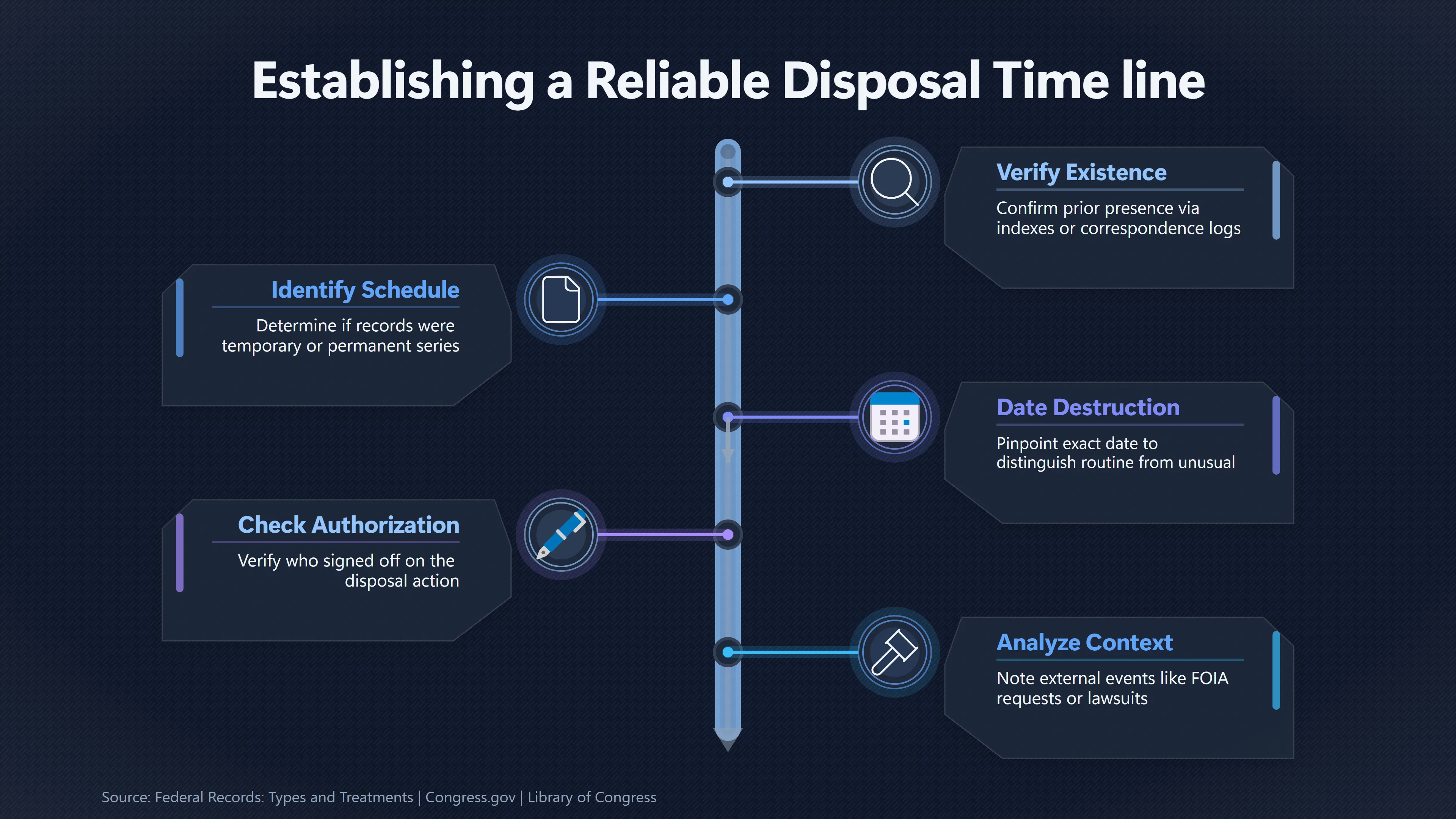
Building a reliable disposal timeline
Determining whether destruction is suspicious requires more than noting that records are absent. Investigators instead try to establish a sequence of documented events.
Useful questions include:
- Did the records unquestionably exist? References in indexes, correspondence or inventories may confirm their prior existence.
-
What records schedule governed them? Temporary and permanent records are treated differently under federal records law. Congress.gov
- When were they destroyed? A documented destruction date may distinguish routine disposal from unusual circumstances.
- Who authorised the destruction? Proper authorisation supports ordinary records management, while undocumented disposal raises additional questions.
-
What external events had already occurred? FOIA requests, litigation, congressional inquiries or public investigations can change agencies’ preservation responsibilities. Legal Information Institute
- Did similar records survive? Selective disappearance of only one category of documents deserves closer examination than the routine destruction of an entire records series.
Only after answering these questions can researchers assess whether missing records reflect administrative practice or something more unusual.
What destruction timing can and cannot prove
Chronology is an evidential multiplier rather than proof in itself.
Routine destruction that predates public controversy generally supports the view that records disappeared through ordinary archival processes. Destruction occurring after official requests, lawsuits or investigations may justify greater scepticism and more intensive scrutiny, especially if agencies cannot clearly document why the records were removed.
Even then, the timing alone does not establish that destroyed files contained evidence of a recovered extraterrestrial craft. It demonstrates only that the circumstances surrounding the loss deserve closer examination. To support a cover-up claim, additional evidence would still be needed showing that the missing records actually concerned the alleged UFO crash and were intentionally removed to prevent later discovery, rather than being lost through routine administration, error or unrelated records-management decisions.
Amazon book picks
Further Reading
Books and field guides related to When Were the UFO Files Destroyed, and Why?. Use these as the next step if you want deeper reading beyond the article.
The UFO Files: The Inside Story of Real-Life Sightings
'What does all this stuff about flying saucers amount to? What can it mean? What is the truth?' Winston Churchill, prime minister's perso...
Records and Information Management
Benefiting LIS students and professionals alike, Franks presents complete coverage of the records and information lifecycle model.
Managing Records: A Handbook of Principles and Practice
Many organizations do not yet have a formal programme of records management, but increasingly they are recognizing the benefits of well m...
Archives: Principles and Practices
This new and extensively revised second edition offers an international perspective on archives management, providing authoritative guida...
eBay marketplace picks
Marketplace Samples
Live-tested eBay searches with available results related to this page.
Selected fromUFO poster oneBay.co.uk.


Current eBay listing
VINTAGE UFO FLYING SAUCERS COMIC ADVERTISING A2 POSTER PRINT

Current eBay listing
I Want To Believe UFO Poster Giclée Fine Art Heavyweight Print

Endnotes
2.
Source: reddit.com
Link:https://www.reddit.com/r/UFOs/comments/13b6q00
Source snippet
Do you think NASA will find their "lost data" for the 1965 Kecksburg UFO incident now that they are studying this brand newly disco...
3.
Source: reddit.com
Title: Leslie Kean v NASA
Link:https://www.reddit.com/r/UFOs/comments/osz4ja
Source snippet
Leslie Kean v NASA - 220+ Pages JUST Released - Project Moon Dust Documents and much more in the batch...
4.
Source: nasa.gov
Title: NAS A Records Management
Link:https://www.nasa.gov/nasa-records-management/
Source snippet
Records document the Agency’s business: its organizations, policies, decisions, achievements, and operations. Records that document those...
5.
Source: nasa.gov
Title: Headquarters FOIA Library
Link:https://www.nasa.gov/foia/nasa-e-libraries/headquarters-foia-library/
6.
Source: nasa.gov
Title: FOI A Guidance
Link:https://www.nasa.gov/foia/foia-guidance/
7.
Source: congress.gov
Link:https://www.congress.gov/crs-product/R48423
8.
Source: archives.gov
Title: Project [BLUE BOOK]({{ ‘blue-book/’ | relative_url }})
Link:https://www.archives.gov/research/military/air-force/ufos
9.
Source: archives.gov
Title: Freedom of Information Act (FOIA) | National Archives
Link:https://www.archives.gov/foia
10.
Source: congress.gov
Link:https://www.congress.gov/crs-product/R43072
11.
Source: nodis3.gsfc.nasa.gov
Title: display All.cfm
Link:https://nodis3.gsfc.nasa.gov/displayAll.cfm?Internal_ID=N_PR_1441001D&page_name=all
12.
Source: archives.gov
Link:https://www.archives.gov/records-mgmt/policy/inquiry-records-disposal.html
13.
Source: ntrs.nasa.gov
Link:https://ntrs.nasa.gov/citations/19960009438
14.
Source: ntrs.nasa.gov
Link:https://ntrs.nasa.gov/citations/19940003974
15.
Source: law.cornell.edu
Link:https://www.law.cornell.edu/cfr/text/36/1225.16
Source snippet
Legal Information Institute36 CFR § 1225.16 - How do agencies schedule temporary records? | Electronic Code of Federal Regulations (e-CFR...
16.
Source: law.cornell.edu
Link:https://www.law.cornell.edu/cfr/text/36/1226.18
Source snippet
Legal Information Institute36 CFR § 1226.18 - When may agencies temporarily extend retention periods? | Electronic Code of Federal Regula...
17.
Source: law.cornell.edu
Link:https://www.law.cornell.edu/cfr/text/36/1226.20
Source snippet
Legal Information Institute36 CFR § 1226.20 - How do agencies temporarily extend retention periods? | Electronic Code of Federal Regulati...
19.
Source: law.cornell.edu
Link:https://www.law.cornell.edu/cfr/text/14/1206.403
20.
Source: law.cornell.edu
Link:https://www.law.cornell.edu/cfr/text/14/1206.307
21.
Source: law.cornell.edu
Link:https://www.law.cornell.edu/cfr/text/14/1206.305
22.
Source: law.cornell.edu
Link:https://www.law.cornell.edu/cfr/text/36/1226.14
23.
Source: law.cornell.edu
Link:https://www.law.cornell.edu/cfr/text/36/1230.16
24.
Source: law.cornell.edu
Link:https://www.law.cornell.edu/cfr/text/14/1206.401
Additional References
25.
Source: youtube.com
Title: Explosive Proof the Government Hid UFOs for 80 Years
Link:https://www.youtube.com/watch?v=X7gh-4gM-AE
Source snippet
We Found Missing Evidence from the Weirdest UFO Encounter | Episode 21 | Haunted Objects Podcast...
26.
Source: youtube.com
Title: The Roswell Incident Explained: Crash, Cover-Up, [Witnesses]({{ ‘witnesses/’ | relative_url }}) & What We Know
Link:https://www.youtube.com/watch?v=vRnOUO7TMJo
Source snippet
Explosive Proof the Government Hid UFOs for 80 Years...
27.
Source: fws.gov
Link:https://www.fws.gov/policy-library/283fw1
28.
Source: youtube.com
Link:https://www.youtube.com/watch?v=MaKZPy9NPYk
Source snippet
UFO Files Declassified: The Full Story...
29.
Source: youtube.com
Title: Roswell: Three Stories
Link:https://www.youtube.com/watch?v=MjdgbX2-ntw
Source snippet
The Roswell Incident Explained: Crash, Cover-Up, Witnesses & What We Know...
30.
Source: ufotransparency.com
Title: 1995 07 28 gao roswell report nsiad 95 187 gao nsiad 95 187 roswell 1995
Link:https://ufotransparency.com/files/1995-07-28-gao-roswell-report-nsiad-95-187-gao-nsiad-95-187-roswell-1995
31.
Source: foia.state.gov
Title: FOIA State Department Records Disposition Schedules
Link:https://foia.state.gov/RecordsManagement/RecordsDisposition2.aspx
32.
Source: irs.gov
Title: IR S records schedules | Internal Revenue Service
Link:https://www.irs.gov/privacy-disclosure/irs-records-schedules
33.
Source: gao.justia.com
Title: government records nsiad 95 187
Link:https://gao.justia.com/department-of-defense/1995/7/government-records-nsiad-95-187/
34.
Source: gao.justia.com
Title: records management nsiad 94 155
Link:https://gao.justia.com/executive-office-of-the-president/1994/7/records-management-nsiad