Within Balloon Debris
How One Balloon Creates a Huge Debris Field
Wind can drag parachutes, rubber and foil across rough ground, turning one compact payload into a broad and misleading wreckage field.
On this page
- What happens during descent
- How wind drags lightweight hardware
- Why field size exaggerates the original craft
Page outline Jump by section
Introduction
One reason balloon recoveries have repeatedly been mistaken for the remains of a crashed unidentified object is that the apparent “crash site” often bears little resemblance to the original balloon system. Unlike an aircraft accident, where debris is usually created by a high-energy impact, a balloon landing can continue to evolve for minutes or even hours after touchdown. Wind catches the collapsed balloon envelope, parachute and suspension lines, dragging lightweight components across the ground, tearing them apart and distributing them over a surprisingly large area. This process can transform one compact payload into what appears to be an extensive wreckage field, exaggerating both the size and complexity of the original object.[nasa.gov]csbf.nasa.govColumbia Scientific Balloon FacilityFebruary 25, 2026…
What Happens After the Balloon Reaches the Ground?
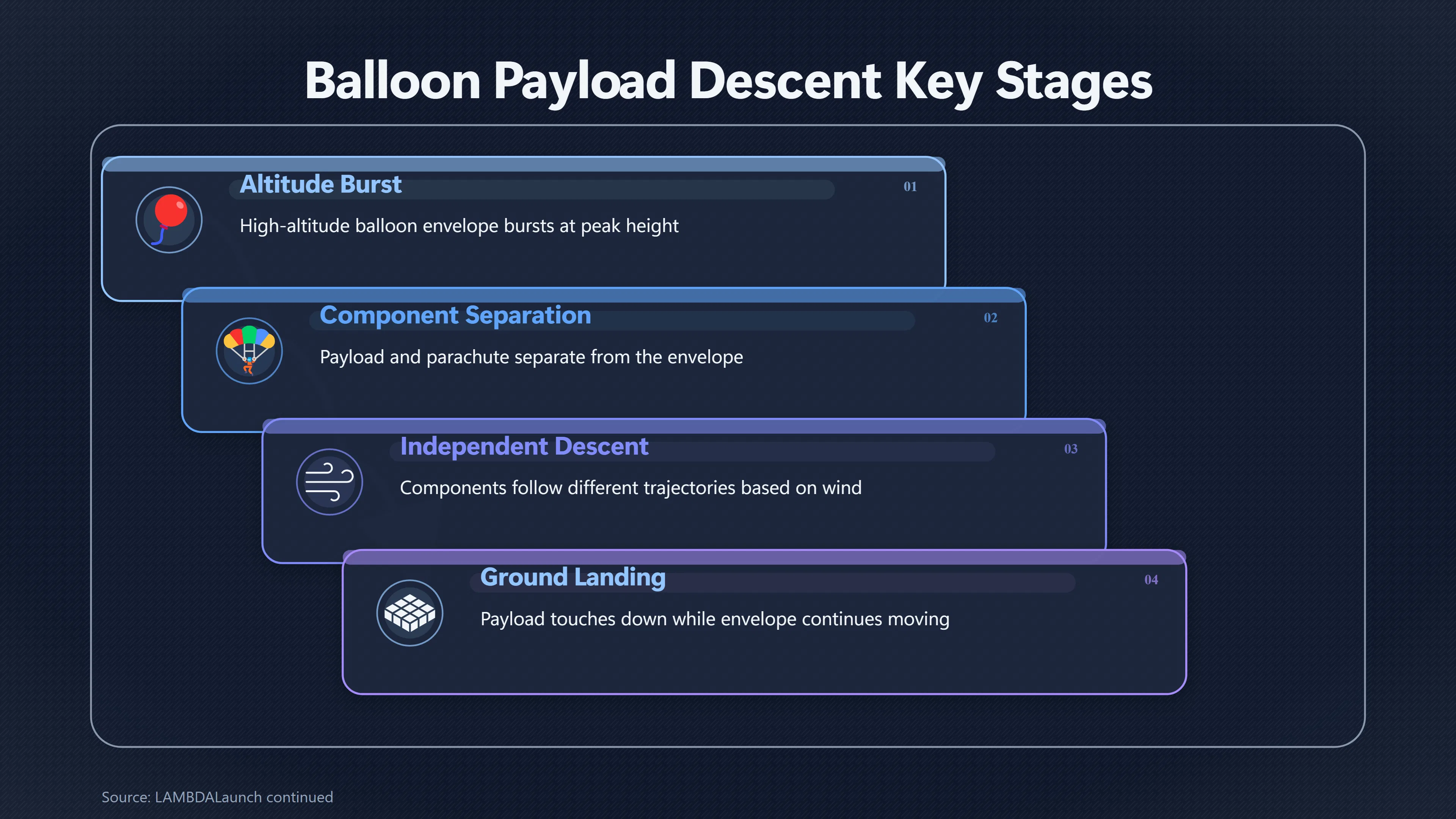
A high-altitude balloon rarely ends its journey with a single dramatic impact. After the balloon bursts at altitude, the payload normally descends beneath a parachute while the balloon envelope separates and falls independently. Depending on wind conditions, these components may already be kilometres apart before either reaches the ground. NASA recovery operations routinely plan for separate landing locations because the balloon material and the scientific payload follow different trajectories after separation.[NASA]nasa.govDetails Super Pressure Balloon Recovery Plans in the Australian OutbackNASA Details Super Pressure Balloon Recovery Plans in the Australian Outback - NASAMay 6, 2015…
Once the payload touches down, several things may occur:
- The parachute remains inflated by surface winds.
- The collapsed balloon envelope behaves like a giant sheet of plastic or rubber.
- Suspension lines continue transmitting force between components.
- Lightweight accessories such as antennae, reflectors or insulation snag on vegetation before breaking free.
Instead of remaining where they first landed, many parts continue moving across the landscape until friction, obstacles or calmer winds finally stop them.
How Wind Drags Lightweight Hardware
The key mechanism is simple: objects that have a large surface area but very little weight behave like sails.
Even moderate winds can repeatedly re-inflate an open parachute or partially collapsed balloon envelope. As the fabric catches gusts, it pulls against the payload through cords and rigging. If the payload is relatively light—or if individual components have already separated—they can be dragged considerable distances across grassland, scrub, snow or desert surfaces.[LAMBDA]lambda.gsfc.nasa.govLAMBDALaunch continuedLAMBDALaunch continued
Dragging produces several effects that make the debris field appear more mysterious:
- Rubber tears into irregular strips. Instead of finding one recognisable balloon, investigators may discover scattered fragments over hundreds of metres.
- Foil wrinkles and folds. Metallised films develop sharp creases and unusual shapes that no longer resemble their original construction.
- Wooden or composite struts snap. Lightweight structural members break into many similar-looking pieces.
- Cordage tangles and separates. Long suspension lines can wrap around bushes or rocks before breaking under repeated loading.
- Small items become detached. Batteries, electronics, antennas or reflectors may stop independently after snagging on vegetation.
None of these changes require a violent impact. They result from repeated low-force dragging rather than a catastrophic crash.
Terrain Makes the Debris Spread Unevenly
Ground conditions strongly influence how large the final debris field becomes.
Open desert allows lightweight material to travel long distances before stopping. Dense scrub, fences and rocky outcrops repeatedly catch and release pieces, creating clusters of debris separated by relatively empty ground. Snowfields can preserve long drag marks, while forests tend to intercept components high in trees, making the field appear vertically distributed as well as spread across the ground.
Recovery teams for scientific balloon missions account for these effects when planning retrievals because the balloon envelope, parachute and payload are not always recovered from the same location.[NASA]nasa.govDetails Super Pressure Balloon Recovery Plans in the Australian OutbackNASA Details Super Pressure Balloon Recovery Plans in the Australian Outback - NASAMay 6, 2015…
Why the Field Looks Larger Than the Original Craft
Human observers naturally assume that a broad debris field indicates a large, fast-moving vehicle breaking apart during impact. Balloon systems violate that intuition.
A balloon train may consist of only a handful of connected components before landing, yet dragging can distribute those parts over an area far larger than the object’s original dimensions. As pieces snag, detach and continue moving independently, the resulting pattern resembles fragmentation rather than gradual redistribution.
This can create several misleading impressions:
- The original object appears much larger than it really was.
- Multiple clusters suggest several separate structures.
- Broken components look as though they failed under extreme force.
- Missing pieces encourage speculation that additional wreckage remains undiscovered.
In reality, the apparent size of the field reflects post-landing movement as much as the size of the balloon system itself.
Why Debris Fields Can Mislead UFO Investigations
Historical reports associated with alleged UFO crashes often describe scattered foil, sticks, cords, rubber fragments and lightweight metallic material spread across fields rather than concentrated around a single impact point. Those descriptions are consistent with the way balloon equipment behaves after landing, particularly when winds continue moving the remains across rough terrain.
Importantly, the existence of a large debris field does not by itself distinguish between an aircraft, an experimental balloon or another object. Investigators instead look for diagnostic evidence such as identifiable balloon material, parachute hardware, suspension rigging, radiosondes, radar reflectors or other recognisable flight components. The overall distribution of debris is only one clue and can easily exaggerate the apparent scale of what originally descended.
This explains why balloon recoveries have sometimes appeared surprisingly extensive despite involving relatively small payloads. The field records not only where the equipment first landed, but also everything that happened afterwards as wind, terrain and fragile materials continued reshaping the site.[nasa.gov]lambda.gsfc.nasa.govLAMBDALaunch continuedLAMBDALaunch continued
Amazon book picks
Further Reading
Books and field guides related to How One Balloon Creates a Huge Debris Field. Use these as the next step if you want deeper reading beyond the article.
The Roswell Incident
Fully illustrated, "The Roswell Incident" is the definitive book on America's most documented alien encounter. It not only explores every...

Roswell: Inconvenient Facts and the Will to Believe
Voici la solution du plus grand mystère de l'histoire des ovnis : l'affaire de Roswell dans le Nouveau Mexique. Après avoir annoncé à la...
Scientific Ballooning: Technology and Applications of Explora...
This introduction to scientific ballooning thoroughly covers large stratospheric balloons, planetary balloons, and rubber balloons used f...
eBay marketplace picks
Marketplace Samples
Live-tested eBay searches with available results related to this page.
Selected fromUFO memorabilia oneBay.co.uk.


Endnotes
1.
Source: csbf.nasa.gov
Link:https://www.csbf.nasa.gov/balloons-txt.html
Source snippet
Columbia Scientific Balloon FacilityFebruary 25, 2026...
Published: February 25, 2026
2.
Source: lambda.gsfc.nasa.gov
Title: LAMBDALaunch continued
Link:https://lambda.gsfc.nasa.gov/product/websites/TOPHAT/topweb.gsfc.nasa.gov/balloon/launch2.html
3.
Source: nasa.gov
Title: Details Super Pressure Balloon Recovery Plans in the Australian Outback
Link:https://www.nasa.gov/news-release/nasa-details-super-pressure-balloon-recovery-plans-in-the-australian-outback/
Source snippet
NASA Details Super Pressure Balloon Recovery Plans in the Australian Outback - NASAMay 6, 2015...
Published: May 6, 2015
4.
Source: nasa.gov
Title: NAS A Safely Ends Second Super Pressure Balloon Test Flight
Link:https://www.nasa.gov/blogs/wallops/2025/05/13/nasa-safely-ends-second-super-pressure-balloon-test-flight/
Source snippet
Littleton May 13, 2025 8:07AM CATEGORIES Scientific BalloonsWallops Flight Facility NASA SAFELY ENDS SECOND SUPER PRESSURE BALLOON TEST F...
Published: May 13, 2025
5.
Source: science.nasa.gov
Title: finds likely cause of osiris rex parachute deployment sequence
Link:https://science.nasa.gov/blogs/osiris-rex/2023/12/05/nasa-finds-likely-cause-of-osiris-rex-parachute-deployment-sequence/
Source snippet
Finds Likely Cause of OSIRIS-REx Parachute Deployment Sequence - NASA ScienceDecember 5, 2023 — OSIRIS-REX (ORIGINS, SPECTRAL INTERPRETAT...
Published: December 5, 2023
6.
Source: airbornescience.nasa.gov
Link:https://airbornescience.nasa.gov/content/Controlled_weather_balloon_ascents_and_descents_for_atmospheric_research_and_climate
7.
Source: nasa.gov
Title: Searching with Sasquatch: Recovering Orion
Link:https://www.nasa.gov/missions/artemis/orion/searching-with-sasquatch-recovering-orion/
8.
Source: nasa.gov
Title: NAS A-Funded Balloon Recovered a Year After Flight Over Antarctica
Link:https://www.nasa.gov/science-research/heliophysics/nasa-funded-balloon-recovered-a-year-after-flight-over-antarctica/
9.
Source: science.nasa.gov
Title: payload recovery key capability for nasa balloons
Link:https://science.nasa.gov/blogs/super-pressure-balloon/2016/03/21/payload-recovery-key-capability-for-nasa-balloons/
10.
Source: ntrs.nasa.gov
Link:https://ntrs.nasa.gov/citations/20160010274
11.
Source: ntrs.nasa.gov
Link:https://ntrs.nasa.gov/search.jsp?R=19930027386
12.
Source: mark4sun.jpl.nasa.gov
Link:https://mark4sun.jpl.nasa.gov/balloon.html
13.
Source: atmos.jpl.nasa.gov
Link:https://atmos.jpl.nasa.gov/oms/board.htm
14.
Source: weather.gov.hk
Link:https://www.weather.gov.hk/en/education/meteorological-instruments/automatic-weather-stations/00709-The-whereabouts-of-radiosondes-after-lifting-off.html
15.
Source: bom.gov.au
Link:https://www.bom.gov.au/resources/learn-and-explore/radar-and-equipment-knowledge-centre/weather-balloons
16.
Source: prod-01-alb-www-noaa.woc.noaa.gov
Title: Radiosondes | National Oceanic and Atmospheric Administration
Link:https://prod-01-alb-www-noaa.woc.noaa.gov/jetstream/upperair/radiosondes
Source snippet
Radiosondes | National Oceanic and Atmospheric Administration...
Additional References
17.
Source: discovermagazine.com
Title: In the event, a crucial part of this plan went wrong. After the telescope touc
Link:https://www.discovermagazine.com/the-dramatic-data-rescue-from-a-doomed-balloon-borne-telescope-45566
Source snippet
The Dramatic Data Rescue From a Doomed Balloon-Borne Telescope | Discover MagazineNovember 17, 2023 — By simulating windspeeds and weathe...
Published: November 17, 2023
18.
Source: newspaceeconomy.ca
Link:https://newspaceeconomy.ca/2026/01/04/challenges-to-the-project-mogul-explanation-for-the-[roswell
Source snippet
January 4, 2026 — Space Economy CHALLENGES TO THE PROJECT MOGUL EXPLANATION FOR THE ROSWELL INCIDENT Author: NSE Staff |...
Published: January 4, 2026
19.
Source: nist.gov
Title: tuning weather forecasting
Link:https://www.nist.gov/nist-museum/tuning-weather-forecasting
Source snippet
Tuning into Weather Forecasting | NISTSeptember 19, 2022 — TUNING INTO WEATHER FORECASTING Image: Tuning into Weather Forecasting Exhibit...
Published: September 19, 2022
20.
Source: youtube.com
Title: Ham radio weather balloon radiosonde hunting!
Link:https://www.youtube.com/watch?v=EffpLslyT3c
Source snippet
High-Altitude Balloon Failure | Tangled Parachute Descent John Powell · 1.4K views Features Not Standard: Weather Balloon Launch and Reco...
21.
Source: weather.gov
Link:https://www.weather.gov/upperair/radiosonde
22.
Source: nlr.gov
Link:https://www.nlr.gov/wind/radiosonde-information
23.
Source: youtube.com
Title: A Comprehensive Guide to Launching a High-Altitude Balloon
Link:https://www.youtube.com/watch?v=E7JSeQEjvnY
Source snippet
Features Not Standard: Weather Balloon Launch and Recovery...
24.
Source: youtube.com
Title: High-Altitude Balloon Failure | Tangled Parachute Descent
Link:https://www.youtube.com/watch?v=RxfBpV_diUU
Source snippet
A Comprehensive Guide to Launching a High-Altitude Balloon...
25.
Source: youtube.com
Title: Features Not Standard: Weather Balloon Launch and Recovery!
Link:https://www.youtube.com/watch?v=pY_x-tLZqQ4
Source snippet
Most Balloon Operators Get Recovery Wrong...
26.
Source: ramey-memo.com
Link:https://www.ramey-memo.com/indestructible-material/