Within Missing Records
Was the UFO Record Gap Targeted or Routine?
The disappearance of only incident-related files is more suggestive than the loss of an entire category of routine base paperwork.
On this page
- Patterns expected from broad records loss
- Signs of incident specific removal
- Why comparison records are essential
Page outline Jump by section
Introduction
When investigators encounter missing records in alleged UFO crash cases, one of the most important questions is not simply whether files are absent, but how they are absent. A selective gap—where records relating to one incident disappear while comparable administrative records survive—can be more suggestive than the routine loss of an entire class of documents. However, the reverse is equally important: if losses affect many unrelated record series from the same office or period, the missing UFO material is more likely to reflect ordinary archival practice, poor records management or lawful disposal rather than targeted concealment. Distinguishing between these possibilities is therefore a methodological exercise rather than proof of any particular conclusion. The pattern of survival across comparable records matters more than the absence of a single file.[National Archives]archives.govNational ArchivesFrequently Asked Questions (FAQs) About Records Scheduling & Appraisal | National ArchivesSeptember 23, 2020…

What Would Broad Archival Loss Look Like?
Government archives rarely preserve every document ever created. In both the United States and the United Kingdom, archival authorities explicitly recognise that most government records are temporary and may be destroyed under approved retention schedules. Only a small proportion are judged to have permanent historical value.[National Archives]archives.govNational ArchivesFrequently Asked Questions (FAQs) About Records Scheduling & Appraisal | National ArchivesSeptember 23, 2020…
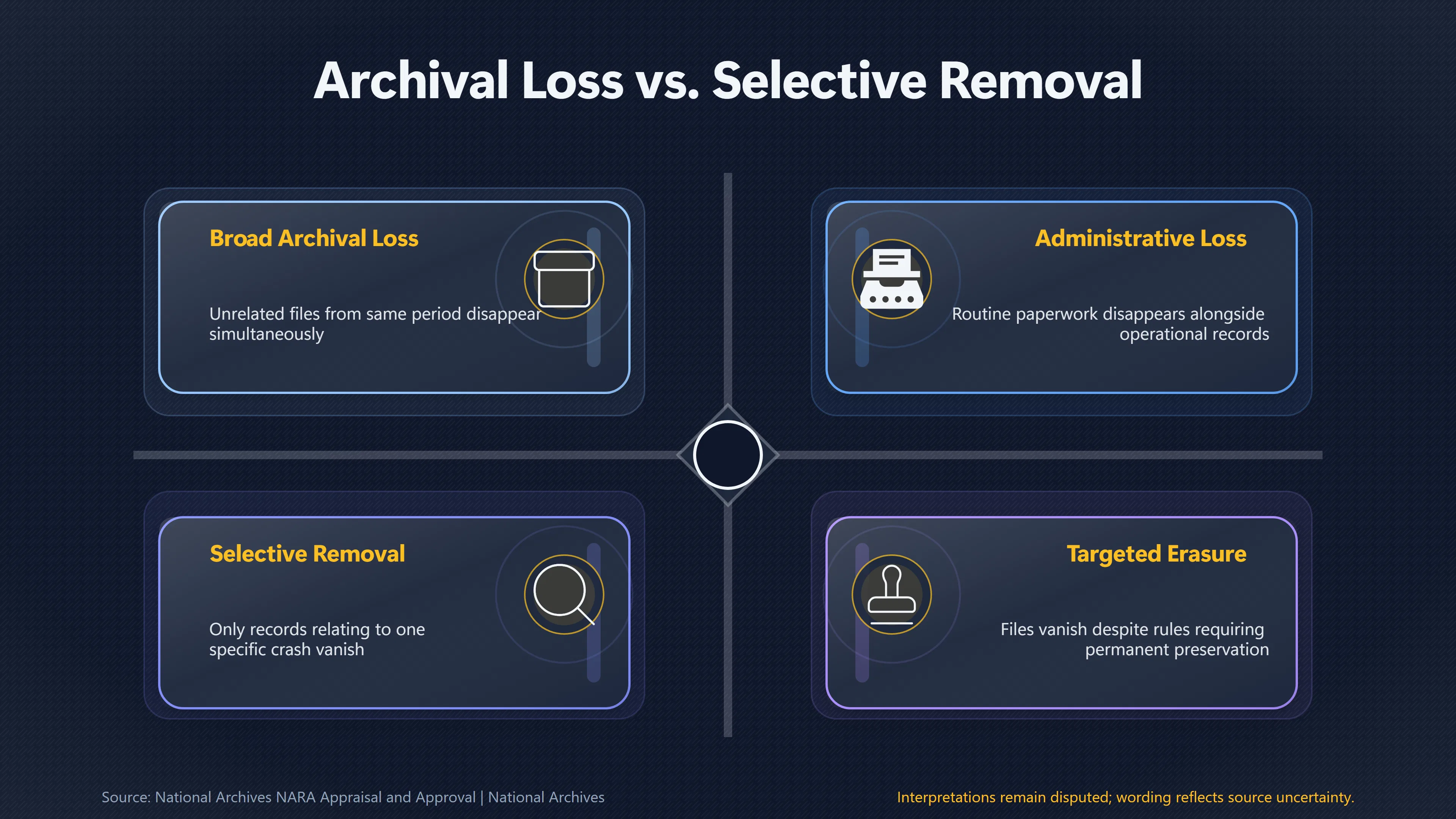
If missing UFO-related records resulted from broad archival loss, investigators would expect to find several characteristics:
- Numerous unrelated files from the same office and time period missing.
- Routine administrative records disappearing alongside operational records.
- Evidence that destruction followed an approved retention schedule or reflected known record-management practices.
- Comparable losses affecting subjects with no connection to UFO reports.
Such a pattern weakens the argument that UFO files received exceptional treatment. Instead, it suggests that the archive reflects ordinary administrative attrition rather than deliberate selection.
Historical archives frequently exhibit this kind of uneven survival because of office relocations, organisational restructuring, deteriorating storage conditions or changing appraisal policies. Modern archival guidance specifically acknowledges that appraisal is intended to identify which records should be preserved permanently and which may legally be destroyed.[National Archives]archives.govNational Archives NARA Appraisal and Approval | National ArchivesNational Archives NARA Appraisal and Approval | National Archives
What Would Suggest Incident-Specific Removal?
By contrast, a genuinely selective pattern would be difficult to explain through routine records management alone.
Investigators would look for evidence such as:
- Ordinary correspondence, flight logs and administrative files surviving, while only records relating to one reported crash are absent.
- Indexes, registers or references proving that a missing file once existed.
- Missing documents occurring despite applicable retention rules requiring permanent preservation.
- Parallel copies disappearing simultaneously from multiple offices.
- Removal occurring shortly before public inquiries, litigation or Freedom of Information requests.
Even this evidence would not establish what the missing records contained. It would merely strengthen the inference that someone considered those records exceptional.
This distinction is often overlooked in public discussion. A selective absence may justify further investigation into records management decisions, but it still does not demonstrate that the underlying subject involved extraterrestrial technology rather than classified terrestrial programmes, intelligence activities or another sensitive matter.
Roswell as a Case Study
Roswell illustrates both the usefulness and the limits of this approach.
The 1995 investigation by the U.S. General Accounting Office (now the Government Accountability Office) confirmed that some Army Air Forces administrative records from Roswell Army Air Field had been destroyed. Importantly, investigators were unable to determine precisely when certain records had been destroyed or under what disposal authority. This uncertainty has fuelled continuing debate. At the same time, the investigation did not conclude that incident-specific files had been selectively removed to conceal a recovered spacecraft. Instead, it documented incomplete archival histories and an inability to reconstruct every administrative action decades later.[National Archives]archives.govNational ArchivesFrequently Asked Questions (FAQs) About Records Scheduling & Appraisal | National ArchivesSeptember 23, 2020…
This distinction matters because two competing explanations remain consistent with the surviving evidence:
- routine destruction combined with incomplete documentation of disposal; or
- deliberate removal of specific material.
The archival record alone does not distinguish conclusively between these possibilities.
Equally significant is what survives. Numerous military, FBI and newspaper records concerning the July 1947 incident remain available, even though many administrative files no longer exist. If a comprehensive campaign had sought to eliminate every trace of the event, investigators would expect far broader disappearance across multiple independent repositories. Instead, the surviving record is fragmented rather than uniformly erased.

Why Comparison Records Matter More Than Missing Files
The strongest way to evaluate claims of selective deletion is through comparison.
Rather than asking whether one file is missing, historians examine whether similar records survived under comparable circumstances. Useful comparison questions include:
Comparison questionWhy it mattersDid other incidents from the same period retain equivalent paperwork?Tests whether one case received unusual treatment.Did unrelated operational files survive?Helps distinguish targeted removal from general loss.Are disposal logs or transfer records available?Shows whether destruction followed documented procedures.Do duplicate collections exist elsewhere?Independent copies can reveal whether loss was isolated or systematic.Did multiple agencies lose the same material?Coincidental loss across repositories is less likely than loss within a single office.
Without these comparisons, a missing file has limited evidential value. Archives naturally contain gaps, and isolated absences are common across many historical subjects unrelated to UFOs.
Lessons from Broader Archival Practice
Archival institutions themselves illustrate why caution is necessary when interpreting missing records.
For example, the UK’s National Archives notes that many Ministry of Defence UFO files created before 1967 were destroyed under the department’s then-current five-year disposal policy. That represents a documented, category-wide records policy rather than evidence that particular sightings were singled out for suppression. Later changes in policy led to many surviving files being preserved and ultimately released because of public interest.[National Archives]nationalarchives.gov.ukNational Archives UFOsNational ArchivesUFOs - The National Archives…
This example demonstrates an important analytical principle:
- Documented policy affecting an entire records series generally indicates routine archival practice.
- Unexplained disappearance affecting only one sensitive incident deserves closer scrutiny.
The first reflects normal records administration; the second raises questions that require additional evidence before any conclusions about motive can be drawn.

Why Selective Deletion Alone Cannot Prove a UFO Crash
Even if investigators could establish that records relating to a particular incident were deliberately removed, that finding would answer only one question: that records were treated differently.
It would not establish:
- that an extraterrestrial craft had been recovered;
- that witnesses accurately described the event;
- that removed files contained evidence supporting extraordinary claims; or
- that the motive for removal related to UFOs rather than military secrecy, intelligence operations, nuclear activities or administrative sensitivity.
For that reason, professional historical analysis treats selective deletion as one component of an evidential chain rather than decisive proof. The strongest cases require corroboration from surviving documents, independent witnesses, contemporaneous records in parallel archives and a demonstrable pattern showing that incident-specific files disappeared while comparable records remained intact. Without that broader context, missing records reveal an incomplete archive—but not necessarily the reason it became incomplete.
Amazon book picks
Further Reading
Books and field guides related to Was the UFO Record Gap Targeted or Routine?. Use these as the next step if you want deeper reading beyond the article.
UFOs and Government: A Historical Inquiry
Governments around the world have had to deal with the UFO phenomenon for a good part of a century. How and why they did so is the subjec...
Archives: Principles and Practices
This new and extensively revised second edition offers an international perspective on archives management, providing authoritative guida...
Going to the Sources: A Guide to Historical Research and Writing
It’s been almost 30 years since the first edition of Going to the Sources: A Guide to Historical Research and Writing was first published...
Managing Records: A Handbook of Principles and Practice
Many organizations do not yet have a formal programme of records management, but increasingly they are recognizing the benefits of well m...
eBay marketplace picks
Marketplace Samples
Live-tested eBay searches with available results related to this page.
Selected fromUFO poster oneBay.co.uk.



Current eBay listing
I Want To Believe UFO Poster Giclée Fine Art Heavyweight Print

Current eBay listing
VINTAGE UFO FLYING SAUCERS COMIC ADVERTISING A2 POSTER PRINT
Endnotes
1.
Source: archives.gov
Link:https://www.archives.gov/records-mgmt/faqs/records-mgmt/faqs/scheduling-appraisal
Source snippet
National ArchivesFrequently Asked Questions (FAQs) About Records Scheduling & Appraisal | National ArchivesSeptember 23, 2020...
Published: September 23, 2020
2.
Source: archives.gov
Title: National Archives NARA Appraisal and Approval | National Archives
Link:https://www.archives.gov/records-mgmt/scheduling/nara-review
3.
Source: archives.gov
Title: fire 1973
Link:https://www.archives.gov/personnel-records-center/fire-1973
Source snippet
The 1973 Fire, National Personnel Records Center | National ArchivesMay 28, 2025 — THE 1973 FIRE, NATIONAL PERSONNEL RECORDS CENTER The N...
Published: May 28, 2025
4.
Source: archives.gov
Title: Project [BLUE BOOK]({{ ‘blue-book/’ | relative_url }})
Link:https://www.archives.gov/research/military/air-force/ufos
5.
Source: archives.gov
Title: Do Records Show Proof of UFOs? | National Archives
Link:https://www.archives.gov/news/articles/do-records-show-proof-of-ufos
6.
Source: unwritten-record.blogs.archives.gov
Title: the roswell reports what crashed in the desert
Link:https://unwritten-record.blogs.archives.gov/2014/07/07/the-roswell-reports-what-crashed-in-the-desert/
7.
Source: archives.gov
Link:https://www.archives.gov/press/press-releases/2006/nr06-96
8.
Source: archives.gov
Title: ISO O Audit & Audit Reports | National Archives
Link:https://www.archives.gov/isoo/reports/2006-audit-report.html
9.
Source: archives.gov
Link:https://www.archives.gov/records-mgmt/policy/protecting-federal-records.html
10.
Source: nationalarchives.gov.uk
Title: National Archives Step 1: Appraising your records
Link:https://www.nationalarchives.gov.uk/information-management/manage-information/selection-and-transfer/appraising-records/
Source snippet
National ArchivesStep 1: Appraising your records - The National Archives...
11.
Source: nationalarchives.gov.uk
Title: National Archives Appraisal and selection
Link:https://www.nationalarchives.gov.uk/information-management/manage-information/planning/guiding-principles/appraisal-and-selection/
Source snippet
National ArchivesAppraisal and selection - The National Archives...
12.
Source: nationalarchives.gov.uk
Title: National Archives UFOs
Link:https://www.nationalarchives.gov.uk/help-with-your-research/research-guides/ufos/
Source snippet
National ArchivesUFOs - The National Archives...
13.
Source: nationalarchives.gov.uk
Title: Records collection policy
Link:https://www.nationalarchives.gov.uk/about-us/how-we-work/plans-policies-performance-and-projects/our-policies/records-collection-policy/
Additional References
14.
Source: foia.state.gov
Title: Records Disposition2.aspx
Link:https://foia.state.gov/RecordsManagement/RecordsDisposition2.aspx
Source snippet
Disposition SchedulesMay 23, 2025 — FOIA Home > Records Management > Records Disposition Schedules RECORDS DISPOSITION SCHEDULES RECORDS...
Published: May 23, 2025
15.
Source: files.gao.gov
Link:https://files.gao.gov/reports/GAO-26-107861/index.html
Source snippet
gao.govGAO-26-107861, INDUSTRIAL SECURITY: Improved Risk Management and Stakeholder Engagement Needed to Help DOD Address Mission GapsApr...
16.
Source: justice.gov
Link:https://www.justice.gov/oip/oip-guidance/segregating-and-marking-documents-release-accordance-open-government-act
17.
Source: ecfr.io
Title: Section 1220.12
Link:https://ecfr.io/Title-36/Section-1220.12
Source snippet
36 CFR 1220.12 Citation 36 CFR 1220.12 Corpus Daily eCFR Displayed edition 2026-06-26 Last updated 2026-06-26 § 1220.12 WHAT ARE N...
Published: June 26, 2026
18.
Source: gao.gov
Title: GA O-03-936T, Electronic Records: Management and Preservation Pose Challenges
Link:https://www.gao.gov/assets/a110137.html
19.
Source: youtube.com
Title: USA: UFO ANTI-SECRECY GROUP DEMONSTRATION
Link:https://www.youtube.com/watch?v=iuaLed7Jnu4
Source snippet
Official Reports on the Roswell UFO Incident | USAF Documentary | 1997...
20.
Source: legistorm.com
Link:https://www.legistorm.com/reports/view/gao/19731/Major_Effort_Is_Needed_to_Improve_NOAA_s_Data_Management_and_Archiving.html
21.
Source: youtube.com
Link:https://www.youtube.com/watch?v=dzv6nRpMX24
Source snippet
UFO Reverse Engineering, Crash Retrievals, and the Pentagon's New Files | UAP Gerb...
22.
Source: youtube.com
Link:https://www.youtube.com/watch?v=ecEY2xNFzPw
Source snippet
Roswell: Three Stories...
23.
Source: ufotransparency.com
Title: 1995 07 28 gao roswell report nsiad 95 187 gao nsiad 95 187 roswell 1995
Link:https://ufotransparency.com/files/1995-07-28-gao-roswell-report-nsiad-95-187-gao-nsiad-95-187-roswell-1995