Within Proof Standard
Were the Records Created During the Event?
Dispatch logs, photographs, manifests and laboratory requests can establish timing and custody when their originals and archival histories are authentic.
On this page
- Which contemporary records carry the most weight
- How originals and institutional copies are authenticated
- Checking names, times, vehicles and locations for consistency
Page outline Jump by section
Introduction
When assessing claims of a UFO crash, incident records are valuable not because they prove what an object was, but because they can establish when evidence first appeared, who handled it, and whether its documented history remained consistent. Dispatch logs, military message traffic, police reports, photographs, transport manifests, laboratory requests and archival copies all help reconstruct the chronology of an event. Records created during an incident generally carry greater evidential weight than recollections written decades later because they are less vulnerable to memory distortion and retrospective interpretation. At the same time, authentic records alone cannot establish that recovered material was extraterrestrial. They demonstrate the timing, custody and administrative handling of an incident, while the identity of any recovered object depends on separate physical and scientific evidence.[National Archives]archives.govNational Archives Project BLUE BOOKNational ArchivesProject BLUE BOOK - Unidentified Flying Objects | National ArchivesJune 25, 2024…
Which contemporary records carry the most weight?
The strongest documentary evidence is usually created as part of ordinary operational procedures rather than for public consumption. Such records often have fixed formats, known authorship and predictable filing systems that make later verification possible.
Records that typically provide the most reliable timeline include:
- Dispatch and communications logs, recording when calls or reports were received, transmitted and acknowledged.
- Duty rosters and watch logs, identifying personnel present during key events.
- Photographs with original negatives or authenticated metadata, showing conditions before objects were moved.
- Evidence inventories and transport manifests, documenting when materials changed hands.
- Laboratory submission forms, recording the date samples entered scientific examination.
- Maintenance or vehicle movement records, confirming whether aircraft, trucks or specialist teams were present at the claimed time.
- Official correspondence, such as memoranda or telegrams prepared during the response rather than years afterwards.
These documents become particularly persuasive when they were generated independently by different organisations but describe the same sequence of events. A police dispatcher’s timestamp, a military transport record and a laboratory receipt that all agree within expected operational delays create a far stronger chronology than a single isolated document. This principle applies regardless of whether the incident ultimately proves mundane, remains unidentified or is later disputed.
Why records created during the event matter more than later recollections
Human memory changes over time. Historians therefore generally assign greater evidential weight to documents produced while events were unfolding than to memoirs or interviews recorded decades afterwards.
Contemporary records offer several advantages:
- they usually contain timestamps created before later controversy developed;
- they reflect routine administrative requirements rather than retrospective narratives;
- they preserve operational details that witnesses often forget, including vehicle numbers, weather conditions and exact timings;
- they allow independent comparison with other archival sources.
Later testimony remains valuable, especially when explaining why actions were taken or identifying people involved. However, if memories conflict with surviving incident records, historians normally begin by examining whether the documentary timeline can explain the discrepancy before treating recollections as corrections.
This approach does not assume official records are always complete or accurate. Clerical mistakes occur, documents can be lost and records may reflect limited knowledge available at the time. Their importance lies in showing what was documented contemporaneously rather than proving every recorded conclusion was correct.
How originals and institutional copies are authenticated
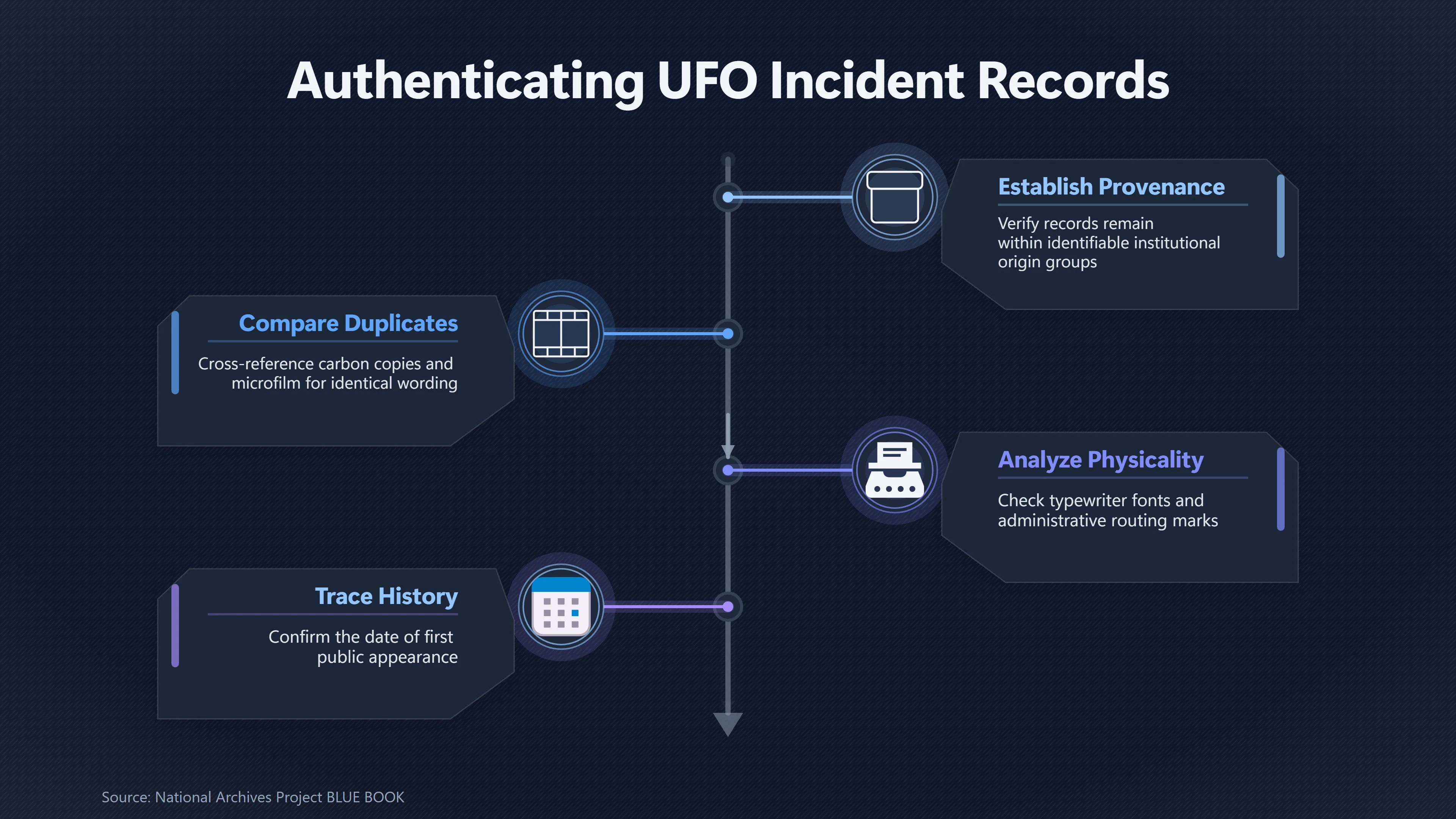
The credibility of an incident record depends not only on its contents but also on demonstrating that it is genuine and has not been altered.
Archivists and researchers typically authenticate records through several complementary methods.
Provenance within archival collections
Authentic documents normally remain within identifiable record groups that preserve their institutional origin. National archives maintain descriptions showing which agency created the records, how they were transferred and how they fit into broader administrative collections. This archival context makes fabricated or misplaced documents easier to detect.[National Archives]archives.govNational ArchivesRecords Related to Unidentified Flying Objects (UFOs) and Unidentified Anomalous Phenomena (UAPs) at the National Archiv…
Comparison between originals and duplicate copies
Many operational documents existed in multiple copies. Carbon copies, microfilm, regional archives and receiving-office files can often be compared to confirm identical wording, dates and signatures. Differences may indicate later revisions or copying errors that deserve further investigation.
Physical characteristics
Original paper, filing stamps, typewriter fonts, handwritten annotations, page numbering and administrative routing marks often correspond with known government practices of the period. Although none of these features proves authenticity alone, together they establish whether a document fits the administrative environment in which it supposedly originated.
Document history
Researchers also examine when a document first appeared publicly. A record continuously preserved in an archive generally carries more weight than one emerging decades later without a documented chain of custody.
Checking names, times, vehicles and locations for consistency
The most convincing documentary chronology comes from internal consistency across independent records rather than from dramatic language within a single report.
Investigators compare details such as:
- arrival and departure times;
- names, ranks and duty assignments;
- vehicle registration numbers;
- aircraft serial numbers;
- shipment references;
- building locations;
- laboratory accession numbers;
- weather conditions;
- distances and travel times.
If multiple records independently support these details, confidence increases that the reconstructed timeline reflects genuine administrative activity. Conversely, unexplained contradictions—such as personnel appearing simultaneously in different places or transport records inconsistent with travel times—may indicate transcription errors, mistaken recollections or incomplete archives rather than deliberate concealment.
What missing records can—and cannot—prove
Claims surrounding alleged UFO crashes often focus on documents said to have been destroyed or withheld. Missing records deserve investigation, but absence alone is not evidence that extraordinary material once existed.
Archives routinely lose material through administrative disposal schedules, accidental destruction, filing errors and incomplete transfers between agencies. The United Kingdom’s Ministry of Defence, for example, destroyed many UFO files under routine retention policies before later changing its archival practices.[National Archives]nationalarchives.gov.ukNational Archives UFOsNational ArchivesUFOs - The National Archives…
Likewise, investigations into historical American UFO records have documented extensive archival searches, including reviews connected with the Roswell case. These searches identified surviving collections, located some previously overlooked records and acknowledged missing material, but did not establish documentary evidence for recovered extraterrestrial technology.[National Archives]archives.govNational Archives Project BLUE BOOKNational ArchivesProject BLUE BOOK - Unidentified Flying Objects | National ArchivesJune 25, 2024…
A missing dispatch log therefore raises questions about the completeness of the historical record, not about what the missing document necessarily contained.
Roswell illustrates the importance—and limits—of incident records
The Roswell incident demonstrates why documentary chronology matters. Researchers have examined military messages, press releases, weather records, personnel files and later interviews to reconstruct events surrounding July 1947.
Several important points emerge from this documentary record:
- different agencies generated records at different stages of the response;
- some records survive only through archival copies or later transfers;
- official explanations evolved as additional information became available;
- decades of archival searches have not produced a continuous chain of authenticated records documenting the recovery of extraterrestrial craft or bodies.
The debate therefore illustrates both the value and the limitations of incident documentation. Records can establish that reports were made, debris was recovered and official responses occurred. They cannot, by themselves, determine the nature of the recovered material without corresponding physical evidence and verified provenance.[National Archives]archives.govNational Archives Project BLUE BOOKNational ArchivesProject BLUE BOOK - Unidentified Flying Objects | National ArchivesJune 25, 2024…
Documentary timelines strengthen evidence, not extraordinary conclusions
Incident records are most useful when they answer practical historical questions: when was an object reported, who responded, when was material collected, when did laboratory testing begin and who maintained custody throughout the process.
A persuasive documentary case therefore depends on several features working together:
- records created contemporaneously rather than retrospectively;
- authenticated originals or institutional copies;
- agreement across independent administrative systems;
- traceable archival provenance;
- consistency between documentary evidence and the physical chain of custody.
If these conditions are met, incident records can provide a reliable chronology showing when alleged UFO evidence first entered the historical record. They do not, however, establish the origin of that evidence. Determining whether recovered material represents ordinary debris, classified technology or something genuinely unprecedented requires independent physical examination that matches the documentary timeline rather than contradicting it.
Amazon book picks
Further Reading
Books and field guides related to Were the Records Created During the Event?. Use these as the next step if you want deeper reading beyond the article.
Evidence Explained
History is not just a collection of documents-- and all records are not created equal. To analyze and decide what to believe, we also nee...
Digital Evidence and Computer Crime
Digital Evidence and Computer Crime, Third Edition, provides the knowledge necessary to uncover and use digital evidence effectively in a...
Forensic Document Examination: Principles and Practice
This book introduces the reader to the basic principles of handwriting and the factors that affect their development. The book discusses...
The Historian's Toolbox
Written in an engaging and entertaining style, this widely-used how-to guide introduces readers to the theory, craft, and methods of hist...
eBay marketplace picks
Marketplace Samples
Live-tested eBay searches with available results related to this page.
Selected fromUFO patch oneBay.co.uk.


Endnotes
1.
Source: archives.gov
Title: National Archives Project [BLUE BOOK]({{ ‘blue-book/’ | relative_url }})
Link:https://www.archives.gov/research/military/air-force/ufos
Source snippet
National ArchivesProject BLUE BOOK - Unidentified Flying Objects | National ArchivesJune 25, 2024...
Published: June 25, 2024
2.
Source: archives.gov
Link:https://www.archives.gov/research/topics/uaps/textual-and-microfilm
Source snippet
National ArchivesRecords Related to Unidentified Flying Objects (UFOs) and Unidentified Anomalous Phenomena (UAPs) at the National Archiv...
3.
Source: archives.gov
Link:https://www.archives.gov/research/topics/uaps/faqs
Source snippet
Unidentified Anomalous Phenomena Records Collection: Frequently Asked Questions | National ArchivesApril 24, 2025 — UNIDENTIFIED ANOMALOU...
Published: April 24, 2025
4.
Source: archives.gov
Title: National Archives Do Records Show Proof of UFOs? | National Archives
Link:https://www.archives.gov/news/articles/do-records-show-proof-of-ufos
Source snippet
National ArchivesFebruary 9, 2018 — DO RECORDS SHOW PROOF OF UFOS? En Español Image: UFO graphic banner By Kerri Lawrence | National Ar...
Published: February 9, 2018
5.
Source: archives.gov
Link:https://www.archives.gov/research/topics/uaps/rg-collections
Source snippet
ecord Group or Collection | National ArchivesDecember 12, 2025 — RECORDS RELATED TO UNIDENTIFIED FLYING OBJECTS (UFOS) AND UNIDENTIFIED A...
Published: December 12, 2025
6.
Source: archives.gov
Link:https://www.archives.gov/records-mgmt/uap-guidance
Source snippet
May 8, 2024 — GUIDANCE TO FEDERAL AGENCIES ON UNIDENTIFIED ANOMALOUS PHENOMENA RECORDS COLLECTION The 2024 National Defense Authorization...
Published: May 8, 2024
7.
Source: nationalarchives.gov.uk
Title: National Archives UFOs
Link:https://www.nationalarchives.gov.uk/help-with-your-research/research-guides/ufos/
Source snippet
National ArchivesUFOs - The National Archives...
Additional References
8.
Source: faa.gov
Title: What You Need to Know to Submit a FOIA Request | Federal Aviation Administration
Link:https://www.faa.gov/foia/foia_request
Source snippet
June 9, 2026 — WHAT YOU NEED TO KNOW TO SUBMIT A FOIA REQUEST YOU CAN REQUEST RECORDS FROM ONE OF THE FOLLOWING FAA FOIA SERVICE CENTERS...
Published: June 9, 2026
9.
Source: faa.gov
Link:https://www.faa.gov/about/office_org/headquarters_offices/avs/offices/aam/aam600/aam611/case_data
Source snippet
FOIA and Case Data Packet Information | Federal Aviation AdministrationNovember 19, 2024 — FOIA AND CASE DATA PACKET INFORMATION Informat...
Published: November 19, 2024
10.
Source: uap-files.org
Title: Declassified UFO/UAP Files — The US Government Disclosure Archive
Link:https://uap-files.org/
Source snippet
July 10, 2026 — Preserved public archive · 188 PDFs · 103 videos · 675 extracted photos THE PUBLIC ARCHIVE OF US GOVERNMENT UFO/UAP DOCUM...
Published: July 10, 2026
11.
Source: ufosearch.org
Title: The full Department of War PURSUE archive — d
Link:https://ufosearch.org/
Source snippet
UFO Search — PURSUE UAP ArchiveMay 8, 2026 — P PRESIDENTIAL UNSEALING & REPORTING SYSTEM FOR UAP ENCOUNTERS▍ RELEASE 01 · CLEARED 2026-05...
Published: May 8, 2026
12.
Source: youtube.com
Title: Fourth batch of Pentagon UFO files released: See all 19 videos
Link:https://www.youtube.com/watch?v=Bg-aBR2f0rk
Source snippet
This Pentagon releases UFO report video directly examines how official government filings, military archives, and contemporary incident r...
13.
Source: aaro.mil
Link:https://www.aaro.mil/EFOIA-Reading-Room/
Source snippet
FOIA was established to ensure an informed citizenry and to ensure...
14.
Source: youtube.com
Title: New Pentagon UFO files: 6 videos worth watching
Link:https://www.youtube.com/watch?v=E2mbrMlVN5A
Source snippet
Fourth batch of Pentagon UFO files released: See all 19 videos...
15.
Source: youtube.com
Title: Explosive Proof the Government Hid UFOs for 80 Years
Link:https://www.youtube.com/watch?v=X7gh-4gM-AE
Source snippet
New Pentagon UFO files: 6 videos worth watching...
16.
Source: youtube.com
Link:https://www.youtube.com/watch?v=GcOCIabFnLE
Source snippet
Explosive Proof the Government Hid UFOs for 80 Years...
17.
Source: youtube.com
Title: Pentagon releases UFO report
Link:https://www.youtube.com/watch?v=i04a0WZ7xfo
Source snippet
Project Blue Book UFO Interview USAF (1966)...