Within Chain of Custody
Why Good Lab Records Still Cannot Prove Origin
A laboratory can document what it received without establishing where the sample was originally recovered.
On this page
- What the analytical chain can establish
- What the historical chain must establish
- How the two chains are often confused
Page outline Jump by section
Introduction
In discussions of alleged UFO crash debris, two different evidential chains are often treated as though they were the same. They are not. A laboratory may maintain an impeccable record showing exactly when a specimen arrived, who handled it, how it was prepared, and which analytical instruments were used. That documentation demonstrates the integrity of the laboratory’s work. It does not demonstrate where the specimen originated before it reached the laboratory.
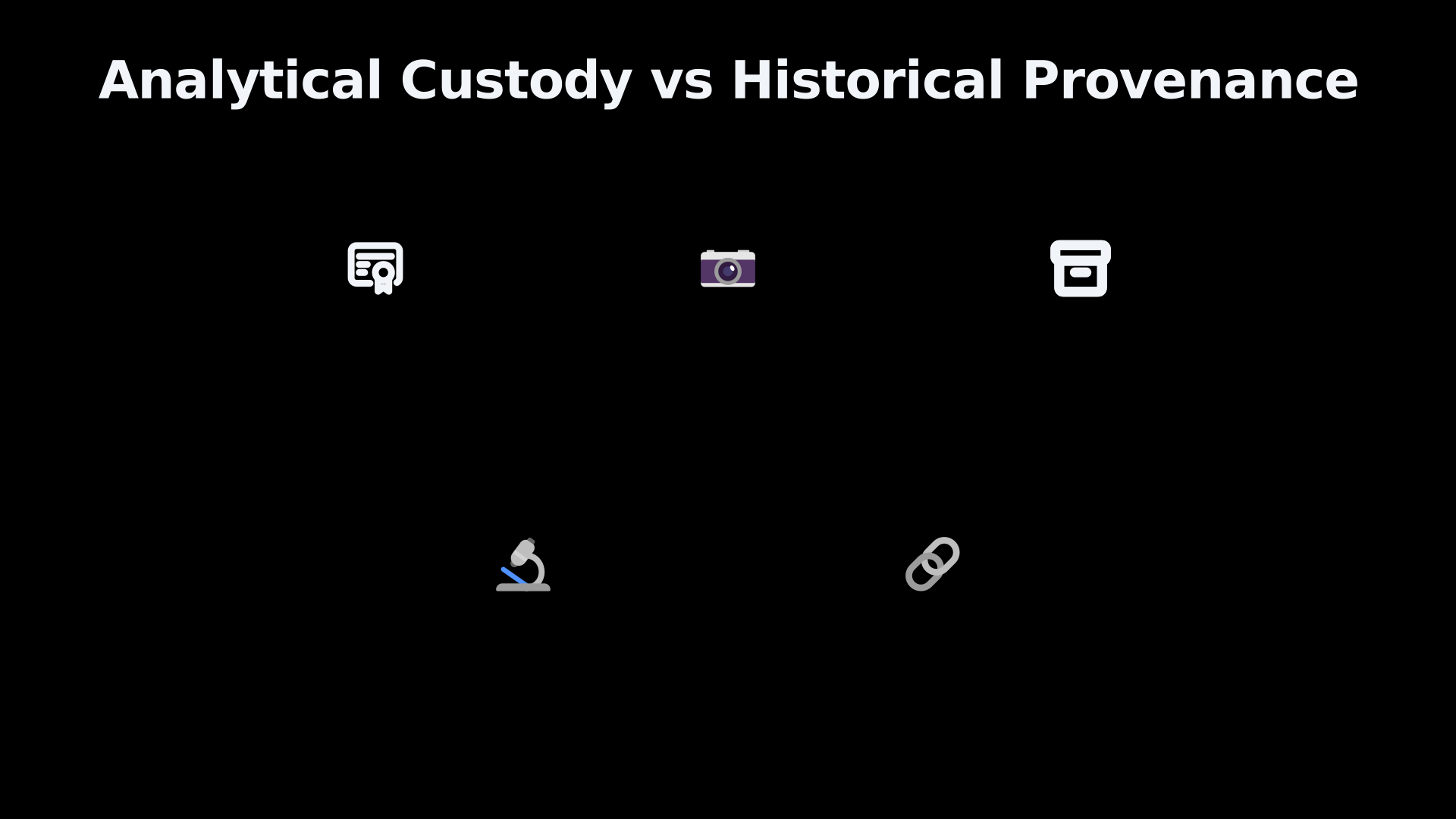
This distinction is central to evaluating extraordinary claims. Analytical custody establishes that the reported measurements genuinely belong to the sample the laboratory examined. Historical provenance must establish that the same sample was actually recovered from the claimed crash site, at the claimed time, without undocumented substitution or contamination. Confusing these two chains can make sound laboratory science appear to support a historical claim that the laboratory itself was never in a position to verify. Forensic standards consistently distinguish custody of evidence from questions of origin or provenance.[nist.gov]csrc.nist.govComputer Security Resource Centerchain of custodyNIST Computer Security Resource Centerchain of custody - Glossary | CSRC…
What the analytical chain can establish
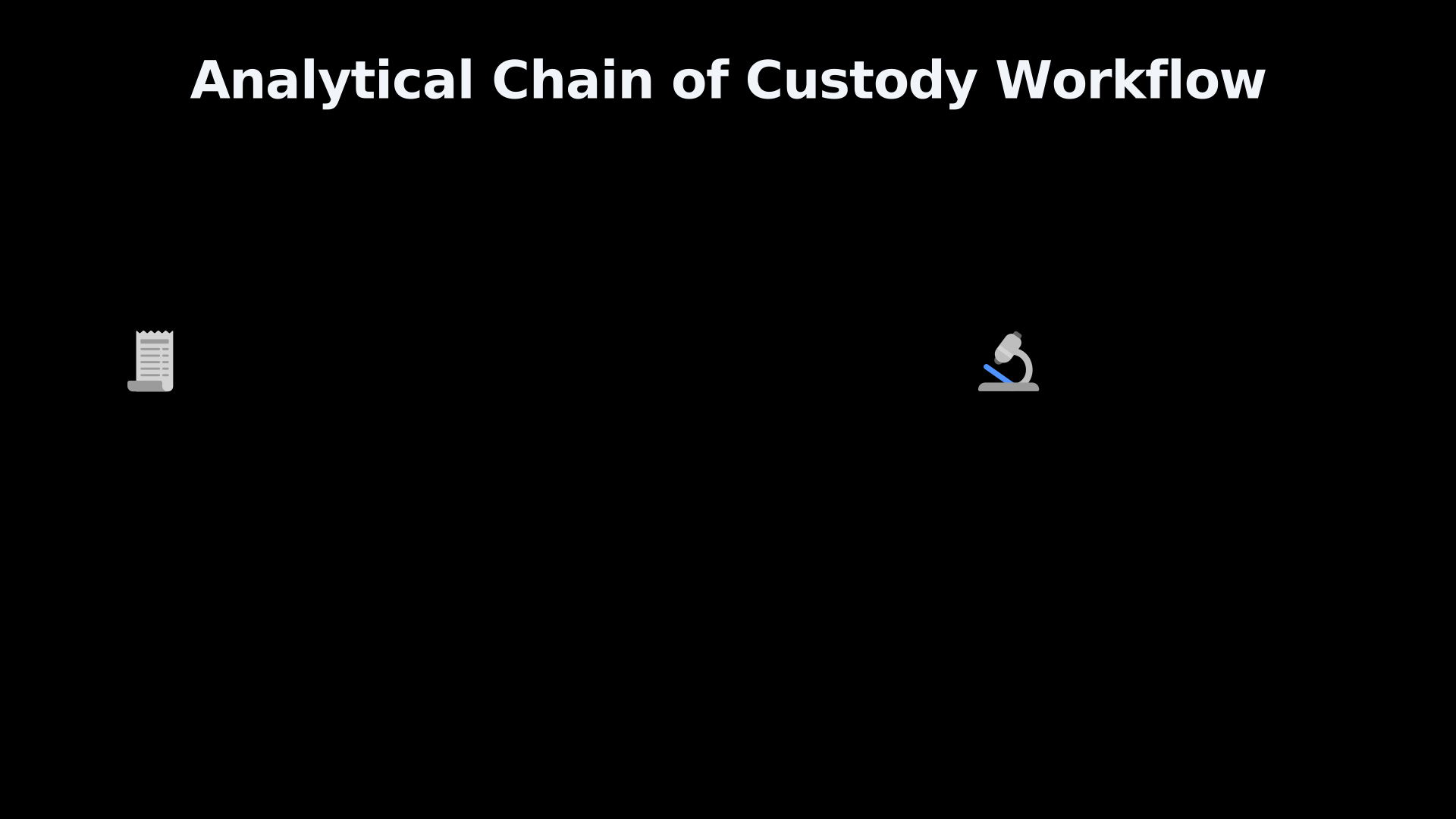
Once a specimen enters a competent laboratory, a separate evidential history begins. Laboratories operating under recognised forensic or testing quality systems document each transfer, preparation step and analytical procedure to ensure that reported results can be traced back to the exact specimen analysed.
A robust analytical chain typically establishes:
- when the sample was received;
- how it was labelled and uniquely identified;
- who handled it during storage and testing;
- whether it remained sealed or secured;
- what subsamples were removed for destructive analysis;
- which instruments, calibration procedures and quality controls were used;
- how analytical data were reviewed before reporting.
These records allow later investigators to verify that the published measurements correspond to the specimen actually examined and that the laboratory followed documented procedures. Modern forensic guidance requires continuous documentation of evidence handling within the analytical process precisely to prevent confusion, contamination or accidental substitution after receipt.[gov.uk]GOV.UKForensic science activities: statutory code of practiceversion 2 (accessible) - GOV.UKJune 5, 2025…
Importantly, none of these records normally include independent verification of the specimen’s alleged discovery location. Laboratories generally rely on information supplied by the submitting party unless they have themselves participated in the field recovery.
What the historical chain must establish
Historical provenance answers an entirely different question: where did the material come from before it entered the laboratory?
For alleged UFO crash debris, historical provenance requires evidence that connects a physical fragment to a specific recovery event through contemporaneous documentation rather than later recollection.
A persuasive historical chain would ideally include:
- documented recovery at a known location;
- photographs or mapping before collection;
- dated field notes identifying the collector;
- uninterrupted possession records from recovery to submission;
- explanations for every transfer of ownership;
- preservation of associated contextual evidence such as surrounding material or comparison samples.
Each missing link increases uncertainty. A laboratory cannot reconstruct undocumented decades of ownership simply by examining the material itself. Even an unusual alloy or manufacturing feature cannot identify the place where that object was found without supporting historical documentation.
This principle applies broadly in forensic science. Provenance concerns origin, whereas chain of custody concerns documented handling after collection. Although related, they answer different evidential questions.[nist.gov]nist.govProvenance | NISTProvenance | NIST…
How the two chains are often confused
The confusion usually arises because laboratory reports are highly detailed while recovery histories are comparatively weak.
A reader may encounter pages of microscopy, spectroscopy or isotope measurements and reasonably assume that the scientific sophistication validates the accompanying origin story. In reality, the report generally validates only the analytical work performed on the submitted specimen.
The distinction can be illustrated simply.
QuestionAnalytical custody answersHistorical provenance answersWas this the sample the laboratory tested?Yes, if custody inside the laboratory is documented.Not necessarily.Were accepted analytical procedures followed?Yes, if quality records support them.Not applicable.Did the sample originate at the alleged UFO crash site?No. Laboratory custody alone cannot answer this.Only if independent recovery documentation supports the claim.Can laboratory measurements authenticate the recovery story?No. They describe the specimen, not its history.Only together with an independently documented provenance chain.
The distinction is particularly important because scientific papers and laboratory reports usually define their scope carefully. Analysts describe the composition, structure or properties of the submitted specimen, while avoiding claims about historical origin unless that origin has been independently established.
Why later testing cannot repair missing provenance
One common misconception is that increasingly sophisticated testing can compensate for missing historical documentation.
It cannot.
Advanced analytical techniques—whether scanning electron microscopy, isotope analysis, X-ray diffraction or mass spectrometry—may reveal manufacturing methods, corrosion history or elemental composition. They may even demonstrate that an object is unusual compared with known industrial materials.
None of those observations identifies where the object was recovered.
If a fragment spent years in private collections before reaching a laboratory, every undocumented transfer creates opportunities for accidental mixing, mistaken identity or simple uncertainty. Excellent laboratory practice can preserve the integrity of the specimen from the moment of receipt onward, but it cannot recreate missing records from the years or decades before submission.
This limitation is well recognised throughout forensic evidence management, where maintaining continuity from the point of collection is considered essential because later handling records cannot compensate for undocumented earlier history.[nist.gov]nist.govEvidence Management | NISTEvidence Management | NIST…
Examples from alleged UFO debris
Several well-known alleged UFO debris samples have undergone increasingly sophisticated laboratory examination over the years while continuing to face questions about provenance.
In many publicly discussed cases, researchers have published detailed analytical observations regarding metallurgy or layered structures, yet the ownership history leading back to the alleged recovery depends largely upon testimony, private transfers or undocumented custodianship rather than contemporaneous recovery records. Even supporters of renewed laboratory analysis frequently distinguish between confidence in the analytical work and uncertainty regarding the specimen’s documented origin.[Reddit]reddit.comHands on analysis of UFO debrisHands on analysis of UFO debrisJuly 3, 2024…
This does not mean the laboratory analyses are incorrect. It means the analyses and the historical claims address different questions.
A technically sound laboratory report may therefore justify conclusions such as:
- the specimen contains particular alloys;
- certain manufacturing features are present;
- specific contaminants were detected;
- no analytical errors were identified.
It cannot, by itself, justify the additional conclusion that the specimen originated from an alleged extraterrestrial crash.

The practical lesson
The most reliable way to evaluate alleged crash debris is to treat analytical custody and historical provenance as complementary but independent forms of evidence.
A strong analytical chain increases confidence that reported scientific results accurately describe the tested specimen. A strong historical chain increases confidence that the tested specimen genuinely came from the claimed recovery site. Only when both are well documented can analytical findings be meaningfully connected to historical claims.
Where either chain is incomplete, the uncertainty should be attributed to the missing link rather than transferred to the other. Good laboratory records can establish the integrity of scientific testing. They cannot, on their own, prove the origin story attached to the material.
Amazon book picks
Further Reading
Books and field guides related to Why Good Lab Records Still Cannot Prove Origin. Use these as the next step if you want deeper reading beyond the article.
Forensic Science: An Introduction to Scientific and Investiga...
Covering a range of fundamental topics essential to modern forensic investigation, the fourth edition of the landmark text Forensic Scien...
Criminalistics: An Introduction to Forensic Science
For introductory courses in Forensic Science and Crime Scene Investigation. This best-selling text, written for the non-scientist, is app...
Practical Crime Scene Processing and Investigation
All too often, the weakest link in the chain of criminal justice is the crime scene investigation. Improper collection of evidence blocks...
eBay marketplace picks
Marketplace Samples
Live-tested eBay searches with available results related to this page.
Selected fromUFO collectible oneBay.co.uk.


Endnotes
1.
Source: csrc.nist.gov
Title: Computer Security Resource Centerchain of custody
Link:https://csrc.nist.gov/glossary/term/chain_of_custody
Source snippet
NIST Computer Security Resource Centerchain of custody - Glossary | CSRC...
2.
Source: nist.gov
Title: Chain Of Custody | NIST
Link:https://www.nist.gov/glossary-term/20076
Source snippet
Chain Of Custody | NIST...
3.
Source: nist.gov
Title: Provenance | NIST
Link:https://www.nist.gov/glossary-term/40006
Source snippet
Provenance | NIST...
4.
Source: GOV.UK
Title: Forensic science activities: statutory code of practice
Link:https://www.gov.uk/government/publications/forensic-science-activities-statutory-code-of-practice-version-2/forensic-science-activities-statutory-code-of-practice-version-2-accessible
Source snippet
version 2 (accessible) - GOV.UKJune 5, 2025...
Published: June 5, 2025
5.
Source: nist.gov
Title: Evidence Management | NIST
Link:https://www.nist.gov/forensic-science/interdisciplinary-topics/evidence-management
Source snippet
Evidence Management | NIST...
6.
Source: hse.gov.uk
Title: HSECollecting physical evidence
Link:https://www.hse.gov.uk/enforce/enforcementguidesc/collectingphysical/preparing.htm
Source snippet
Preparing evidence for use in court...
7.
Source: reddit.com
Title: Hands on analysis of UFO debris
Link:https://www.reddit.com/r/UFOs/comments/1dukp3j
Source snippet
Hands on analysis of UFO debrisJuly 3, 2024...
Published: July 3, 2024
8.
Source: nist.gov
Title: demystifying accreditation framework accreditation forensic units
Link:https://www.nist.gov/publications/demystifying-accreditation-framework-accreditation-forensic-units
9.
Source: GOV.UK
Title: www.gov.uk[Withdrawn] Forensic Science Regulator: Code of Practice (accessible)
Link:https://www.gov.uk/government/publications/statutory-code-of-practice-for-forensic-science-activities/forensic-science-regulator-code-of-practice-accessible
10.
Source: strbase-archive.nist.gov
Link:https://strbase-archive.nist.gov/dabqas.htm
11.
Source: csrc.nist.rip
Title: ripchain of custody
Link:https://csrc.nist.rip/glossary/term/chain_of_custody
12.
Source: nij.ojp.gov
Link:https://nij.ojp.gov/nij-hosted-online-training-courses/law-101-legal-guide-forensic-expert/sources-scientific-evidence/testing-or-evaluating-evidence-and-writing-reports/chain-custody-typical-checklist
Source snippet
National Institute of JusticeArchived | Law 101: Legal Guide for the Forensic Expert | A Chain of Custody: The Typical Checklist | Nation...
13.
Source: books.rsc.org
Title: Forensic Science
Link:https://books.rsc.org/books/edited-volume/2229/chapter/8122179/Forensic-Science
Additional References
14.
Source: aliencouncil.com
Title: MI T Lincoln Laboratory Acknowledges Custody of… · The Council
Link:https://aliencouncil.com/cases/00503-mit-lincoln-lab-1952-flying-saucer-talk-burlison/
Source snippet
MIT Lincoln Laboratory Acknowledges Custody of… · The CouncilJuly 18, 2026 — CASE #00503 · CASE OF RECORD MIT LINCOLN LABORATORY ACKNOWLE...
Published: July 18, 2026
15.
Source: legalclarity.org
Title: UF O Material: Government Programs, Lab Results, and [Roswell]({{ ‘roswell/’ | relative_url }})
Link:https://legalclarity.org/ufo-material-government-programs-lab-results-and-roswell/
Source snippet
UFO Material: Government Programs, Lab Results, and Roswell - LegalClarityJuly 5, 2026 — UFO MATERIAL: GOVERNMENT PROGRAMS, LAB RESULTS...
Published: July 5, 2026
16.
Source: youtube.com
Title: Art’s Parts 1: UFO Crash Recovery Material Analysis
Link:https://www.youtube.com/watch?v=f1LylzKZC-U
Source snippet
ANALYSING UFO EXPERIENCERS' BRAINS & ANOMALOUS MATERIALS - Garry Nolan PHD #62...
17.
Source: youtube.com
Title: UFO Crash Debris! (Art’s Parts)
Link:https://www.youtube.com/watch?v=v4HWxOel7zw
Source snippet
Garry Nolan: UFOs and Aliens | Lex Fridman Podcast #262...
18.
Source: youtube.com
Title: Analysis of the “[Ubatuba]({{ ‘ubatuba/’ | relative_url }})” material by Robert Powell
Link:https://www.youtube.com/watch?v=NamnxaADugo
Source snippet
UFO Crash Debris! (Art's Parts) - Jimmy Akin's Mysterious World...
19.
Source: youtube.com
Title: Garry Nolan: UFOs and Aliens | Lex Fridman Podcast #262
Link:https://www.youtube.com/watch?v=uTCc2-1tbBQ
Source snippet
Art's Parts 1: UFO Crash Recovery Material Analysis...
20.
Source: ufxufo.org
Link:https://www.ufxufo.org/dow/dow.htm
21.
Source: sciencedirect.com
Link:https://www.sciencedirect.com/science/chapter/edited-volume/abs/pii/B9780443301285000266
22.
Source: certis-biolabs.co.uk
Link:https://www.certis-biolabs.co.uk/latest-news/chain-of-custody-explained-why-it-matters-in-forensic-drug-and-alcohol-testing/
23.
Source: disclosdex.com
Title: 2026 pursue release 02 005 dow uap d017 uap reported at sandia base 1948 1950
Link:https://disclosdex.com/documents/2026-pursue-release-02-005-dow-uap-d017-uap-reported-at-sandia-base