Within Kecksburg
Fireball Endpoint
One of the most persistent misunderstandings in the Kecksburg case is the assumption that a bright fireball seen descending towards the horizon must have landed nearby. In reality, human observers are remarkably poor at judging the distance and endpoint of luminous objects in the sky.
Page outline Jump by section
Introduction
In the context of Kecksburg, this does not prove that no separate object descended into the woods. It does, however, explain why sincere witnesses could honestly conclude that the widely observed regional fireball had landed locally even if its actual luminous flight ended far away.
The False Horizon Effect
The strongest visual illusion arises when a fireball approaches the horizon. Human vision has very few reliable cues for estimating the distance of an object suspended in open sky. Without nearby reference points, the brain often interprets the object as being much closer than it really is.
As a bright meteor descends, it may simply fade below the observer’s line of sight or cease glowing while still high in the atmosphere. Because the final visible point appears to line up with nearby terrain, observers frequently perceive it as dropping behind local hills or forests. The landscape becomes a false horizon that gives the impression of an impact immediately beyond it.
This effect is particularly convincing because fireballs are exceptionally bright. Their apparent size and brilliance bear little relationship to their actual distance. A meteor tens of kilometres above the Earth can appear comparable in brightness to an aircraft or flare that is genuinely nearby, encouraging the observer to underestimate its range.[American Meteor Society]amsmeteors.orgAmerican Meteor Society Meteor FAQsAmerican Meteor SocietyMeteor FAQs - American Meteor Society…
Why a Single Viewpoint Cannot Judge Distance
Unlike ordinary ground objects, a meteor provides almost no stereoscopic depth information. Human binocular vision is effective over short distances but contributes virtually nothing for objects many kilometres away.
Several factors combine to produce systematic errors:
- No depth reference. The sky offers few fixed objects against which distance can be judged.
- Brightness is misleading. Larger, faster fireballs remain visible over enormous distances, making distant events seem local.
- Angular motion is deceptive. A meteor moving almost directly towards or away from an observer changes position slowly against the background sky, while one crossing the observer’s field of view appears dramatically closer.
- Unexpected perspective. Most people have little experience estimating the altitude of objects 80–120 km above the Earth, where visible meteors typically begin and continue their luminous flight.[American Meteor Society]amsmeteors.orgAmerican Meteor Society Meteor FAQsAmerican Meteor SocietyMeteor FAQs - American Meteor Society…
These limitations affect experienced observers as well as casual witnesses. The issue is not honesty or attentiveness but the geometry of viewing distant objects in three-dimensional space from a single location.

Why Fireballs Often Seem to Land Nearby
Reports of “it landed just over the hill” are common after major fireballs and do not necessarily indicate an actual impact site.
A meteor visible near the horizon may be several hundred kilometres from the observer. The geometry becomes increasingly deceptive at low viewing angles because the observer is looking almost tangentially through the atmosphere. Calculations used by the American Meteor Society show that meteors near the horizon can be hundreds of kilometres away while still appearing low in the sky.[American Meteor Society]amsmeteors.orgAmerican Meteor SocietyThe Meteor Meniscus: Meteor Distance verses Meteor Zenith Angle - American Meteor Society…
The illusion is strengthened when witnesses hear delayed sonic booms or rumbling several minutes later. People naturally associate the sound with the apparent disappearance point, even though sound travels much more slowly than light and may originate from a completely different part of the meteor’s atmospheric path.
As a result, independent witnesses spread across a wide region may each become convinced that the fireball landed close to their own location.
How Multiple Observations Correct the Error
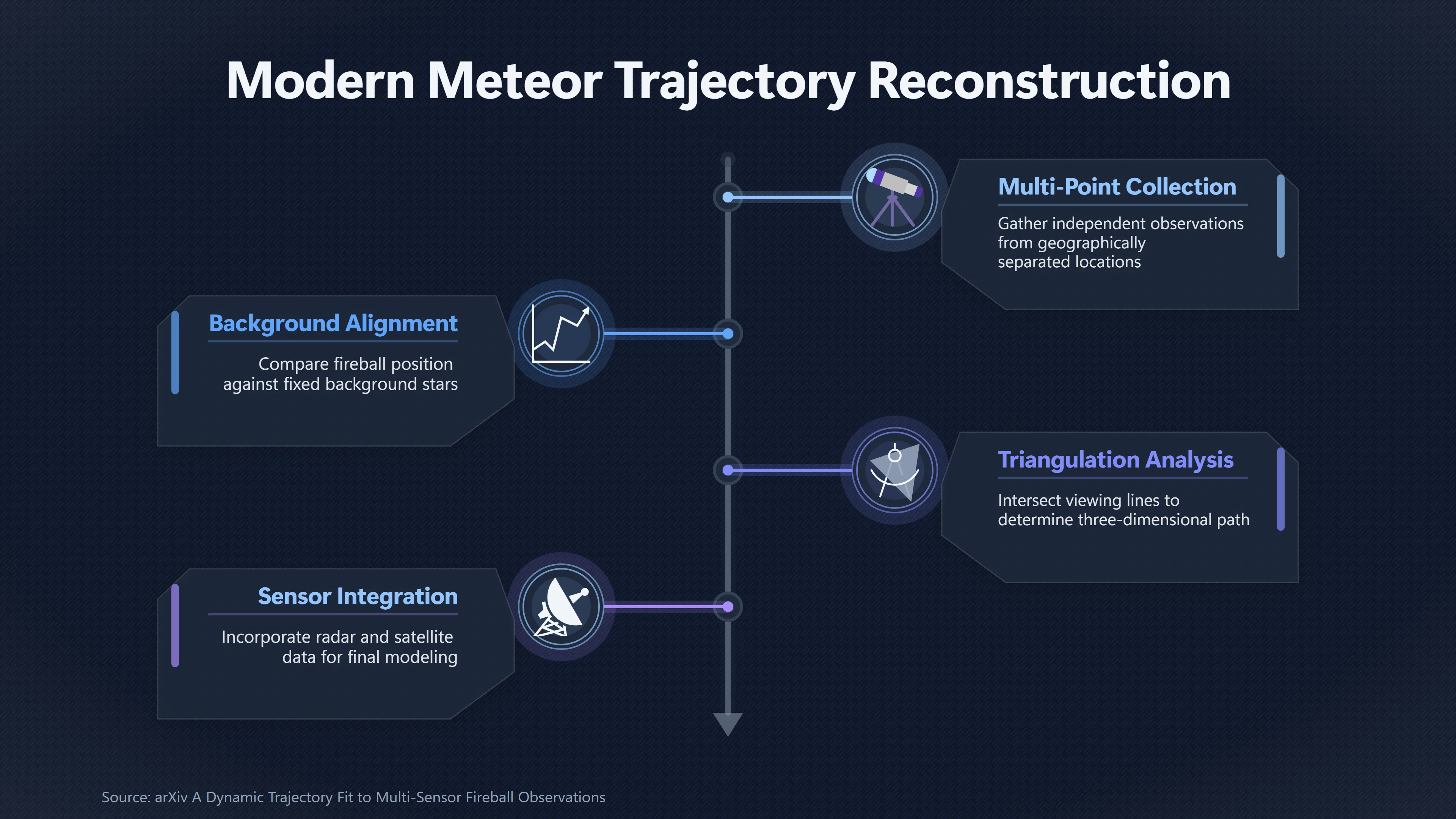
Modern meteor investigations overcome these perceptual limitations by combining many independent observations rather than relying on any single eyewitness.
Researchers compare observations from geographically separated locations and determine where each observer saw the fireball against the background stars or horizon. The intersection of these viewing lines allows the three-dimensional trajectory to be reconstructed through triangulation. Modern fireball networks also incorporate precisely timed photographs, video, radar, satellite observations and dynamic flight modelling to estimate where surviving meteorites, if any, may have fallen.[arXiv]arxiv.orgarXiv A Dynamic Trajectory Fit to Multi-Sensor Fireball ObservationsarXiv A Dynamic Trajectory Fit to Multi-Sensor Fireball Observations
This approach frequently produces trajectories that differ substantially from what individual witnesses believed they had seen. In some documented events, observers who were convinced a meteor passed directly overhead were shown by instrumental measurements to have viewed the same object many tens or even hundreds of kilometres away.
What This Means for the Kecksburg Fireball
The Kecksburg incident illustrates why eyewitness testimony about a fireball’s apparent endpoint must be interpreted cautiously rather than dismissed or accepted at face value.
Residents near Kecksburg genuinely reported seeing the object descend towards nearby woodland, and many later concluded that it had landed there. However, the regional fireball was observed across a vast area of North America, making it exactly the kind of event for which perspective effects become significant.
Astronomical analyses have therefore treated the visual impressions separately from attempts to reconstruct the object’s actual atmospheric path. The existence of sincere local reports does not, by itself, establish that the regional fireball physically reached the woods near Kecksburg. Instead, it demonstrates a well-understood limitation of human perception: a distant fireball can convincingly appear to vanish just beyond the nearest ridge when its true endpoint lies far away.[arxiv.org]arxiv.orgarXiv A Dynamic Trajectory Fit to Multi-Sensor Fireball ObservationsarXiv A Dynamic Trajectory Fit to Multi-Sensor Fireball Observations
Amazon book picks
Further Reading
Books and field guides related to Fireball Endpoint. Use these as the next step if you want deeper reading beyond the article.
Meteors and How to Observe Them
In this era of high-tech instruments, meteor observing is the one facet of astr- omy that needs nothing more than your naked eye. Meteors...
The Demon-Haunted World: Science as a Candle in the Dark
NEW YORK TIMES BESTSELLER • From the renowned astronomer and author of Cosmos comes a “powerful [and] stirring defense of informed ration...
Meteor Showers and their Parent Comets
Meteor Showers and their Parent Comets is a unique handbook for astronomers interested in observing meteor storms and outbursts. Spectacu...
Bad Astronomy: Misconceptions and Misuses Revealed, from Astr...
A clever, thought-provoking guide that attacks common astronomical misconceptions What is Bad Astronomy? Anything that accidentally or in...
eBay marketplace picks
Marketplace Samples
Live-tested eBay searches with available results related to this page.
Selected fromUFO poster oneBay.co.uk.
Current eBay listing
I Want To Believe UFO Poster Giclée Fine Art Heavyweight Print



Current eBay listing
VINTAGE UFO FLYING SAUCERS COMIC ADVERTISING A2 POSTER PRINT
Endnotes
1.
Source: arxiv.org
Title: arXiv A Dynamic Trajectory Fit to Multi-Sensor Fireball Observations
Link:https://arxiv.org/abs/1911.00816
2.
Source: arxiv.org
Title: ar Xiv3D Meteoroid Trajectories
Link:https://arxiv.org/abs/1802.02697
3.
Source: amsmeteors.org
Title: American Meteor Society Meteor FAQs
Link:https://www.amsmeteors.org/meteor-showers/meteor-faq/
Source snippet
American Meteor SocietyMeteor FAQs - American Meteor Society...
4.
Source: amsmeteors.org
Link:https://www.amsmeteors.org/resources/ams-programs/radio-observing/the-meteor-meniscus-meteor-distance-verses-meteor-zenith-angle/
Source snippet
American Meteor SocietyThe Meteor Meniscus: Meteor Distance verses Meteor Zenith Angle - American Meteor Society...
5.
Source: amsmeteors.org
Title: ams q1 2026 fireball analysis
Link:https://amsmeteors.org/ams-q1-2026-fireball-analysis.html
Source snippet
American Meteor SocietyMarch 25, 2026 — SUPPORTING DATA In the interest of transparency and reproducibility, the radiant dataset used i...
Published: March 25, 2026
6.
Source: amsmeteors.org
Title: Radio Observing
Link:https://amsmeteors.org/ams-programs/radio-observing/
7.
Source: amsmeteors.org
Title: Visual Observing
Link:https://amsmeteors.org/ams-programs/visual-observing/
8.
Source: amsmeteors.org
Title: Fireball FAQs
Link:https://www.amsmeteors.org/fireballs/faqf/
9.
Source: amsmeteors.org
Title: Fireball or Contrail?
Link:https://www.amsmeteors.org/fireballs/fireball-or-contrail/
10.
Source: amsmeteors.org
Link:https://www.amsmeteors.org/fireballs/
12.
Source: amsmeteors.org
Link:https://amsmeteors.org/majden/
13.
Source: imo.net
Link:https://www.imo.net/observations/fireballs/fireballs/
14.
Source: ssd-api.jpl.nasa.gov
Link:https://ssd-api.jpl.nasa.gov/doc/fireball.html
15.
Source: science.gov
Link:https://www.science.gov/topicpages/f/fireballs
Additional References
16.
Source: sciencedirect.com
Link:https://www.sciencedirect.com/science/article/pii/S0019103526003258
Source snippet
December 1, 2026 — ICARUS Volume 460, December 2026, 117259 Research Paper A cornucopia of null results: A statistical analy...
Published: December 1, 2026
17.
Source: eppcgs.org
Link:https://eppcgs.org/article/doi/10.26464/epp2026026
Source snippet
J., Zhao, H. B., Mahomed, N., and Li, Y. (2026). Multi-station fireball observations combining all-sky spectroscopy and optical traject...
18.
Source: eppcgs.org
Link:https://www.eppcgs.org/article/doi/10.26464/epp2026026?viewType=citedby-info
Source snippet
J., Zhao, H. B., Mahomed, N., and Li, Y. (2026). Multi-station fireball observations combining all-sky spectroscopy and optical traject...
19.
Source: phys.org
Title: Meteors are ‘extremely common.’ What makes the one over New England ‘rare’?
Link:https://phys.org/news/2026-06-meteors-extremely-common-england-rare.html
Source snippet
June 4, 2026 — WHAT MADE THE NEW ENGLAND INCIDENT 'RARE?' "Most of the material that Earth intersects [with] is just interplanetary dust...
Published: June 4, 2026
20.
Source: youtube.com
Title: The Kecksburg UFO Mystery: Secrets, Witnesses and Vanished Evidence
Link:https://www.youtube.com/watch?v=vkZszbMzl3Q
Source snippet
The Mysterious Fireball That Terrified 8 States — Then Vanished...
21.
Source: youtube.com
Title: The Mysterious Fireball That Terrified 8 States — Then Vanished
Link:https://www.youtube.com/watch?v=8cdF_z71TRw
Source snippet
Kecksburg UFO Shocks the World Actual Interview Footage...
22.
Source: youtube.com
Link:https://www.youtube.com/watch?v=OwHLildbuiI
Source snippet
Cosmic discovery in our backyard: Meteorite fragments found in Medina County...
23.
Source: youtube.com
Title: Kecksburg UFO Shocks the World Actual Interview Footage
Link:https://www.youtube.com/watch?v=BYEh3JLrQbg
Source snippet
RealtimeEarth 2020 New Mexico Meteor Track...
24.
Source: sciencedirect.com
Link:https://www.sciencedirect.com/science/article/abs/pii/S0032063316302288
25.
Source: frontiersin.org
Link:https://www.frontiersin.org/journals/astronomy-and-space-sciences/articles/10.3389/fspas.2022.1027750/full