Within Material Testing
Why the Ohio UFO Metal Looked Like a Casting
Chemical and microscopic evidence showed that the Ohio specimen closely matched a common aluminium-silicon casting alloy.
On this page
- The claimed link to the Ohio event
- Composition and cooling features in the sample
- How casting pores and silicon plates changed the verdict
Page outline Jump by section
Introduction
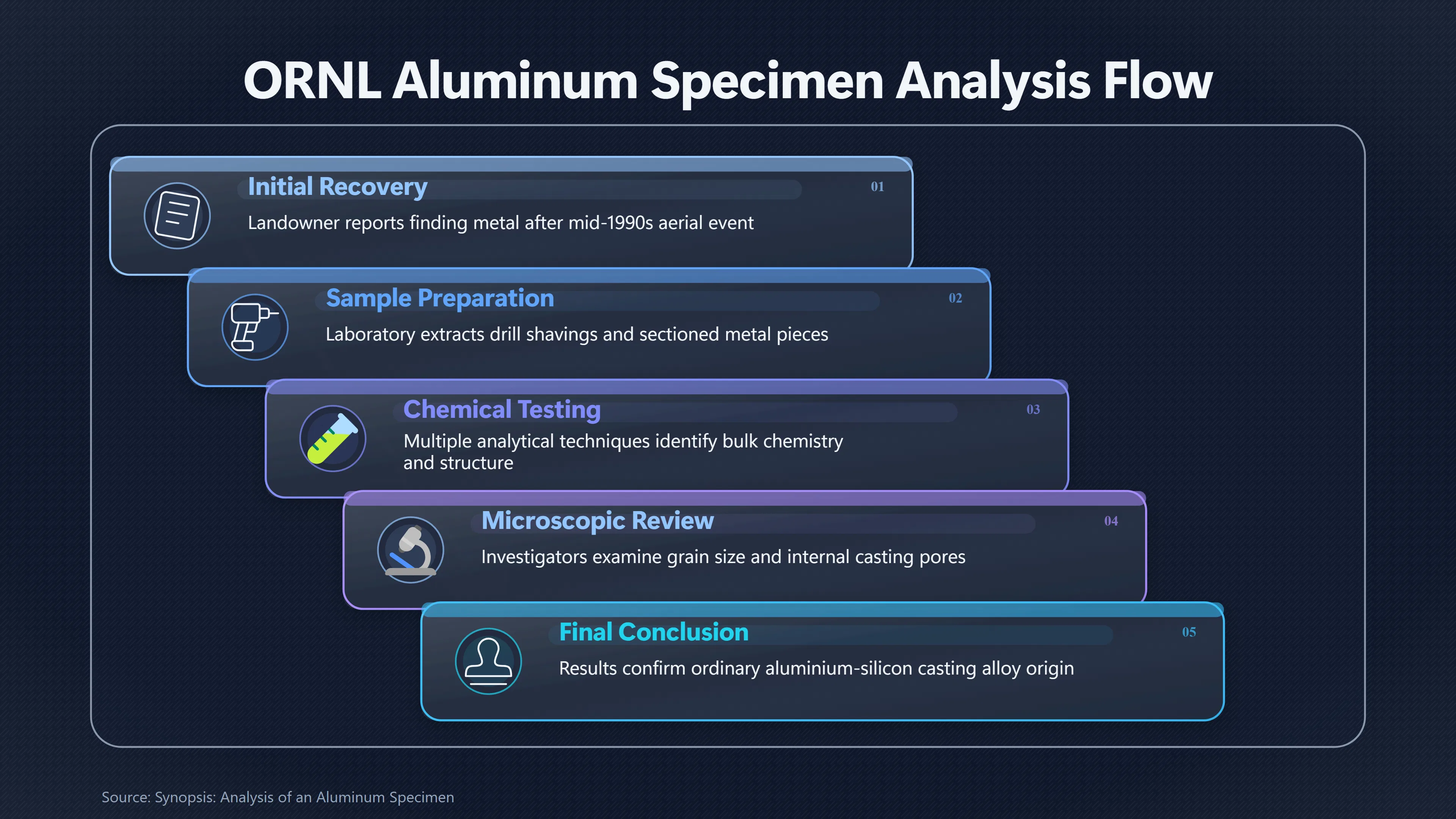
A metal fragment reportedly recovered from private property near Flint Ridge State Park, Ohio, after a claimed unidentified aerial event in the mid-1990s was examined to determine whether it represented an unusual or even non-terrestrial material. The laboratory findings did not support that interpretation. Instead, Oak Ridge National Laboratory (ORNL), working for the U.S. All-domain Anomaly Resolution Office (AARO), concluded that the specimen was an ordinary aluminium–silicon casting alloy whose chemistry and microscopic structure closely matched conventional industrial castings. The decisive evidence came not from a single chemical measurement but from the combination of alloy composition, cooling features, casting porosity and silicon microstructure, all of which pointed towards familiar manufacturing processes rather than an exotic origin.[AARO]aaro.milSynopsis: Analysis of an Aluminum SpecimenSynopsis: Analysis of an Aluminum SpecimenJanuary 14, 2026…

The claimed link to the Ohio event
According to AARO’s published account, the specimen was reportedly found on private property near Flint Ridge State Park, Ohio, after the landowner observed a large unidentified airborne object during the mid-1990s. That reported association provided the reason for testing, but it was not independently verified through a documented chain of custody. ORNL therefore evaluated the material itself rather than the claimed recovery story.[AARO]aaro.milSupplement to Oak Ridge National Laboratory’s Analysis of an Aluminum SpecimenAARO Supplement to Oak Ridge National Laboratory’s Analysis of an Aluminum Specimen…
This distinction is important in laboratory investigations of alleged UFO materials. Scientific analysis can establish what a specimen is made of and how it was probably manufactured, but it cannot confirm that the object genuinely originated from the reported event without reliable provenance.
Composition pointed to a familiar aluminium casting alloy
ORNL subjected drill shavings and a sectioned piece of the specimen to multiple analytical techniques designed to identify both its bulk chemistry and its internal structure. The laboratory concluded that the material was a conventional near-eutectic aluminium–silicon alloy rather than a previously unknown metal or advanced engineered composite.[AARO]aaro.milSynopsis: Analysis of an Aluminum SpecimenSynopsis: Analysis of an Aluminum SpecimenJanuary 14, 2026…
AARO’s supplementary assessment noted that the chemistry most closely resembled recognised Aluminium Association casting alloys, particularly alloys comparable to 369.1 and A413.1. These aluminium–silicon alloys have been widely used for decades because they cast readily into complex shapes and provide a practical balance of hardness, wear resistance and manufacturability. They are common in automotive and industrial components rather than aerospace mysteries.[AARO]aaro.milSupplement to Oak Ridge National Laboratory’s Analysis of an Aluminum SpecimenAARO Supplement to Oak Ridge National Laboratory’s Analysis of an Aluminum Specimen…
Equally significant was what the specimen did not contain. Investigators found no evidence of unusual elemental combinations, exotic isotope signatures or radioactive emissions that would distinguish it from ordinary terrestrial industrial materials.[AARO]aaro.milSynopsis: Analysis of an Aluminum SpecimenSynopsis: Analysis of an Aluminum SpecimenJanuary 14, 2026…
Cooling features revealed an ordinary casting history
The strongest clues came from the specimen’s microscopic structure, which records how molten metal solidified.
ORNL identified several characteristic features:
- large aluminium grains;
- interconnected internal pores reaching roughly one millimetre in diameter;
- needle-like or plate-like silicon precipitates;
- a microstructure consistent with slow solidification in a cast component.
Taken together, these features are well known in aluminium foundry practice. Rather than indicating advanced manufacturing, they typically arise when molten aluminium–silicon alloys cool under conventional casting conditions.[AARO]aaro.milSupplement to Oak Ridge National Laboratory’s Analysis of an Aluminum SpecimenAARO Supplement to Oak Ridge National Laboratory’s Analysis of an Aluminum Specimen…
The morphology of the silicon phase was especially informative. In many modern high-performance castings, foundries deliberately modify the silicon structure using small additions of elements such as strontium or sodium. These additions transform coarse silicon plates into finer fibrous structures that improve toughness and fatigue resistance.
The Ohio specimen lacked these modification signatures. Instead, its coarse silicon morphology matched an unmodified casting, consistent with routine industrial production or remelting rather than a highly engineered structural component.[AARO]aaro.milSupplement to Oak Ridge National Laboratory’s Analysis of an Aluminum SpecimenAARO Supplement to Oak Ridge National Laboratory’s Analysis of an Aluminum Specimen…
How casting pores and silicon plates changed the verdict
The internal pores proved particularly important because they are difficult to reconcile with claims of an advanced manufactured object.
Casting porosity develops when gases become trapped in molten metal or when the alloy shrinks during solidification without sufficient feeding from surrounding liquid metal. The interconnected voids observed throughout the specimen are recognised casting defects that reduce mechanical strength and are routinely discussed in metallurgical literature.[AARO]aaro.milSupplement to Oak Ridge National Laboratory’s Analysis of an Aluminum SpecimenAARO Supplement to Oak Ridge National Laboratory’s Analysis of an Aluminum Specimen…
Similarly, the coarse silicon plates indicated relatively slow cooling rather than sophisticated processing. Modern premium aluminium castings generally seek to minimise these features because they act as crack initiation sites under stress.
For investigators, these microscopic observations were more persuasive than any anecdotal appearance of the fragment. An allegedly exotic material would be expected to display manufacturing features beyond established metallurgy, whereas the Ohio sample instead exhibited imperfections familiar to foundries and failure analysts.[AARO]aaro.milSupplement to Oak Ridge National Laboratory’s Analysis of an Aluminum SpecimenAARO Supplement to Oak Ridge National Laboratory’s Analysis of an Aluminum Specimen…
Why investigators favoured conventional explanations
Although AARO stated that the exact origin of the fragment could not be determined, the laboratory evidence supported several ordinary possibilities that fit both the chemistry and the microstructure.
These included:
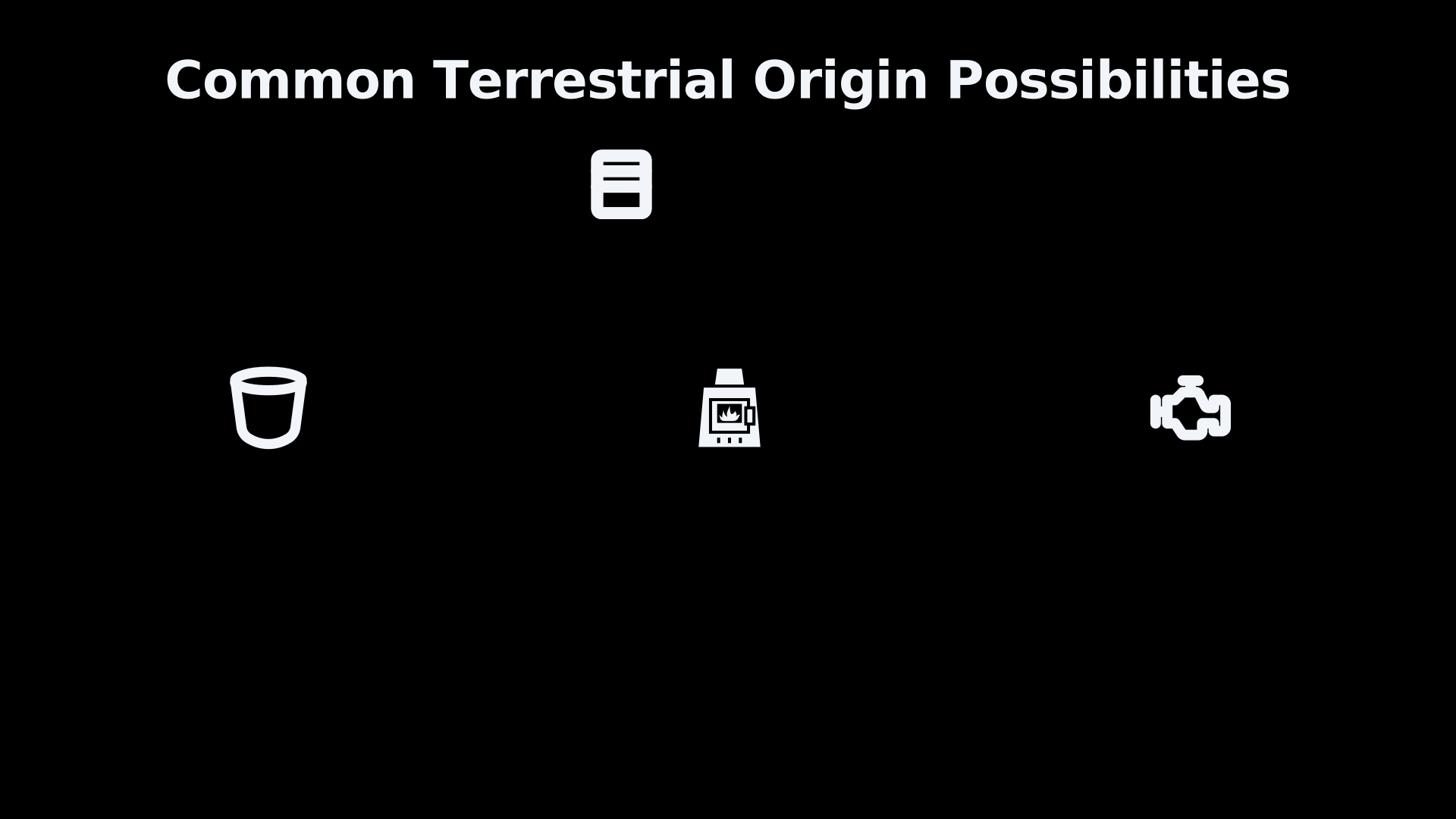
- a discarded commercial aluminium casting;
- an industrial casting by-product;
- recycled aluminium that had been remelted and cast;
- metal that had experienced slow cooling after catastrophic heating, such as an automotive or industrial fire.
The specimen’s irregular form also lacked any recognisable functional geometry that would suggest it had once been part of a specialised engineered device. Combined with the alloy chemistry and casting defects, these observations led investigators to conclude that the fragment was consistent with commonplace terrestrial manufacturing rather than evidence of unfamiliar technology.[AARO]aaro.milSupplement to Oak Ridge National Laboratory’s Analysis of an Aluminum SpecimenAARO Supplement to Oak Ridge National Laboratory’s Analysis of an Aluminum Specimen…
What the Ohio alloy demonstrates about alleged UFO materials
The Ohio aluminium specimen illustrates why modern materials science relies on multiple independent lines of evidence rather than unusual appearance or anecdotal recovery stories alone.
Its composition initially allowed comparison with known alloy families, but the decisive evidence came from microscopic casting clues: coarse silicon plates, extensive porosity, large grains and the absence of alloy modifications associated with high-performance castings. Together, these characteristics formed a coherent metallurgical history pointing towards an ordinary aluminium–silicon casting alloy produced by conventional industrial processes.
Within the broader study of alleged UFO materials, the Ohio case demonstrates how manufacturing signatures preserved inside a metal can be more informative than the circumstances in which the specimen is claimed to have been found.[AARO]aaro.milSupplement to Oak Ridge National Laboratory’s Analysis of an Aluminum SpecimenAARO Supplement to Oak Ridge National Laboratory’s Analysis of an Aluminum Specimen…
Amazon book picks
Further Reading
Books and field guides related to Why the Ohio UFO Metal Looked Like a Casting. Use these as the next step if you want deeper reading beyond the article.
Complete Casting Handbook
Complete Casting Handbook is the result of a long-awaited update, consolidation and expansion of expert John Campbell's market-leading ca...
Aluminum: Properties and Physical Metallurgy
A collective effort of 53 recognized experts on aluminum and aluminum alloys. This book is a joint venture by world-renowned authorities...
Physical Metallurgy Principles
This comprehensive, student friendly text is intended for use in an introductory course in physical metallurgy and is designed for all en...
Casting
In a career spanning almost six decades, Prof. John T. Berry has made significant contributions towards building our understanding of sol...
eBay marketplace picks
Marketplace Samples
Live-tested eBay searches with available results related to this page.
Selected fromUFO collectible oneBay.co.uk.




Endnotes
1.
Source: aaro.mil
Title: Synopsis: Analysis of an Aluminum Specimen
Link:https://www.aaro.mil/Portals/136/PDFs/Information%20Papers/ORNL_ANALYSIS_OF_AN_ALUMINUM_SPECIMEN.pdf
Source snippet
Synopsis: Analysis of an Aluminum SpecimenJanuary 14, 2026...
Published: January 14, 2026
2.
Source: aaro.mil
Title: Supplement to Oak Ridge National Laboratory’s Analysis of an Aluminum Specimen
Link:https://www.aaro.mil/Portals/136/PDFs/Information%20Papers/AARO_Aluminum_Materials_Analysis_Supplement_Jan2026.pdf
Source snippet
AARO Supplement to Oak Ridge National Laboratory’s Analysis of an Aluminum Specimen...
3.
Source: ornl.gov
Link:https://www.ornl.gov/news/ornl-optimizes-process-produce-more-consistent-aluminum-casting
4.
Source: aaro.mil
Title: AAR O UAP Records
Link:https://www.aaro.mil/UAP-Records/fbclid/IwZXh0bgNhZW0CMTEAAR0F9nbI4TTQyu8d96BuOtBb1uVQuvapZEvLug7mWxQC4ZqlNDrM5_ejMt4_aem_q0czZMebJdVWJ-6XDLdWAA/
Source snippet
AARO UAP RecordsFebruary 13, 2026 — All-domain Anomaly Resolution Office UAP RECORDS/INFORMATION PAPERS NEW CONTENT Content Type Date Add...
Published: February 13, 2026
5.
Source: ornl.gov
Title: Image from Envato. This technology is a newl
Link:https://www.ornl.gov/technology/202506131
Source snippet
New High Sustainable Non-Heat Treatment (NTH) Cast Aluminum-Silicon Based Alloy | ORNLFebruary 2, 2026 — NEW HIGH SUSTAINABLE NON-HEAT TR...
Published: February 2, 2026
6.
Source: neutrons.ornl.gov
Title: centuries old foundry process finds new high tech use
Link:https://neutrons.ornl.gov/content/centuries-old-foundry-process-finds-new-high-tech-use
7.
Source: ornl.gov
Link:https://www.ornl.gov/publication/brief-summary-unreflected-and-unmoderated-cylindrical-critical-experiments-oralloy-0
8.
Source: impact.ornl.gov
Title: aluminum target dissolution in support of the pu 238 program 3
Link:https://impact.ornl.gov/en/publications/aluminum-target-dissolution-in-support-of-the-pu-238-program-3/
9.
Source: impact.ornl.gov
Title: additive manufacturing evaporative casting
Link:https://impact.ornl.gov/en/publications/additive-manufacturing-evaporative-casting/
10.
Source: aaro.mil
Link:https://www.aaro.mil/UAP-Records/-1/
11.
Source: aaro.mil
Link:https://www.aaro.mil/Next-AARO-Home-redesign/Inactive-Parent/Next-AARO-UAP-DT-Records/
12.
Source: aaro.mil
Link:https://www.aaro.mil/Next-AARO-Home-redesign/Inactive-Parent/AARO-Records-Tabs/
Additional References
13.
Source: hjkc.de
Title: Raumfahrt+Astronomie-Blog von CENAP
Link:https://www.hjkc.de/_blog/27064-ufo-forschung-the-pentagon-s-ufo-report-update-152-aaro-synopsis-analysis-of-an-aluminum-specimen/
Source snippet
März 2026 - 19:00 UFO-Forschung - The Pentagon’s UFO Report -Update-152 - AARO: SYNOPSIS: Analysis of an Aluminum Specimen 27.03.2026 Ima...
14.
Source: legalclarity.org
Title: UF O Material: Government Programs, Lab Results, and [Roswell]({{ ‘roswell/’ | relative_url }})
Link:https://legalclarity.org/ufo-material-government-programs-lab-results-and-roswell/
Source snippet
Its website states plainly that it has found no evidence of extraterrestrial technology, wh...
15.
Source: legalclarity.org
Title: UAP Program: How the U.S
Link:https://legalclarity.org/uap-program-how-the-u-s-government-investigates-ufos/
Source snippet
Government Investigates UFOs - LegalClarityJuly 4, 2026 — WHAT AARO HAS FOUND AARO’s annual reports to Congress paint a consistent pictur...
Published: July 4, 2026
16.
Source: fotocat.blogspot.com
Link:https://fotocat.blogspot.com/2026_03_15_archive.html
Source snippet
([https://mickwest.substack.com/p/disclosure-again-why-im-not-holding?r=tcx45&triedRedirect=true](https://mickwest.substack.com/p/disclosure-again-why-im-not-holding?r=tcx45&triedRedirect=true)) Los últ...
17.
Source: youtube.com
Link:https://www.youtube.com/watch?v=enNqnnot4Mo
Source snippet
Casting Defects, causes and Remedies (Part-2)...
18.
Source: youtube.com
Title: Aluminium based Alloys & Metal Matrix Composites
Link:https://www.youtube.com/watch?v=JWddKLW8qAw
Source snippet
THERMODYNAMICS EXPLAINED: Metal Casting, Solidification, Dendrites & Mushy Zone Science...
19.
Source: youtube.com
Link:https://www.youtube.com/watch?v=J6xtxZwrGLY
Source snippet
Art's Parts 1: UFO Crash Recovery Material Analysis...
20.
Source: osti.gov
Link:https://www.osti.gov/biblio/425301
21.
Source: osti.gov
Link:https://www.osti.gov/biblio/4742050
22.
Source: iheartaliens.com
Link:https://www.iheartaliens.com/news/aaro-ornl-ohio-aluminum-specimen