Within Fireballs
How Investigators Find a Fireball's True Path
Multiple witness reports, calibrated cameras and sensor data can replace a convincing crash impression with a measured trajectory.
On this page
- Why one witness provides only a direction
- How reports from different locations are combined
- What cameras and sensors add to eyewitness accounts
Page outline Jump by section
Introduction
When a spectacular fireball appears to plunge into nearby woodland or behind a hillside, witnesses often conclude that something has crashed close by. In reality, a single observation provides only the direction in which the object was seen, not its true distance or flight path. Investigators reconstruct the trajectory by combining many independent observations, calibrated camera footage and, where available, specialised sensor data. The result is often surprising: an event that seemed to end just beyond a local horizon may actually have occurred tens or hundreds of kilometres away.
This reconstruction process is one of the main reasons that many apparent “UFO crash” reports are ultimately explained as distant meteors. Rather than relying on one convincing eyewitness account, investigators build a three-dimensional model of the fireball’s passage through the atmosphere from multiple, independently verifiable datasets.[imo.net]imo.netInternational Meteor Organization Fireball Program | IMOInternational Meteor Organization Fireball Program | IMO
Why One Witness Provides Only a Direction
A single observer can accurately describe where a fireball appeared in the sky relative to landmarks, but cannot determine how far away it was. The same line of sight could intersect the atmosphere at many different distances.
This limitation arises because a fireball has no obvious size reference. Unlike an aircraft or mountain, it offers no visual cues from which the brain can estimate range. Even dramatic features such as fragmentation or a bright terminal flash reveal little about location on their own.
Investigators therefore treat an individual report as a directional measurement rather than a crash location. Modern fireball reporting systems ask witnesses for information such as:
- the object’s position relative to the horizon;
- compass direction;
- elevation angle;
- apparent motion;
- start and end points in the sky; and
- timing.
Collecting many such reports allows astronomers to compare independent viewing directions instead of accepting any one observer’s estimate of where the object landed. The International Meteor Organization and the American Meteor Society specifically design their reporting systems so that multiple eyewitness accounts can be merged into a preliminary trajectory estimate.[International Meteor Organization]imo.netInternational Meteor Organization Fireball Program | IMOInternational Meteor Organization Fireball Program | IMO
How Reports from Different Locations Are Combined
The essential technique is geometric triangulation. Every observer contributes a line of sight extending from their known location towards the fireball. Where these independently measured sightlines intersect most consistently, investigators can estimate the meteor’s actual path through the atmosphere.
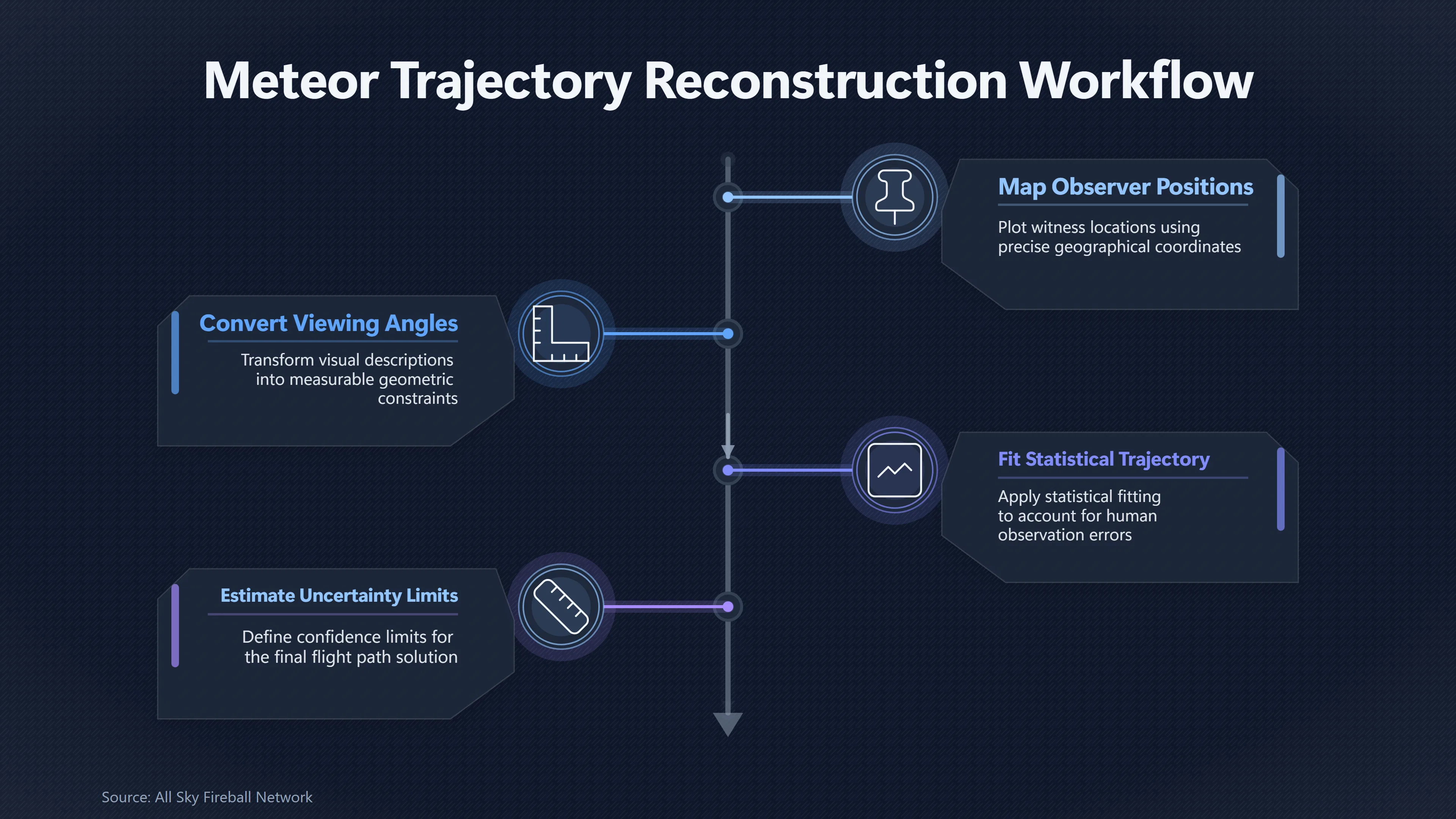
In practice, reconstruction involves several stages:
- Mapping observer positions. Each witness location is plotted accurately using geographical coordinates.
- Converting observations into viewing angles. Descriptions such as “20 degrees above the western horizon” become measurable geometric constraints.
- Finding the best-fitting trajectory. Because eyewitness observations contain errors, investigators use statistical fitting rather than expecting every viewing line to intersect perfectly.
- Estimating uncertainties. The final solution includes confidence limits showing how precisely the trajectory is known.
As additional reports arrive, the solution often improves. A trajectory initially based on a handful of observations may shift noticeably once dozens of reports from a wider area become available. This explains why early media estimates of an apparent crash location sometimes change substantially during the following day.[International Meteor Organization]imo.netInternational Meteor Organization Fireball Program | IMOInternational Meteor Organization Fireball Program | IMO
What Calibrated Cameras Add
Video evidence is far more valuable than ordinary eyewitness accounts because the camera position is fixed and its optical properties can be measured.
Investigators calibrate cameras by identifying stars recorded in the same field of view, allowing each pixel to be converted into a precise direction in the sky. Security cameras, dashboard cameras and dedicated all-sky meteor stations can all contribute if their locations and viewing geometry are known.
When several calibrated cameras capture the same event, researchers can reconstruct:
- the precise atmospheric entry direction;
- altitude throughout the luminous flight;
- speed and deceleration;
- fragmentation points; and
- the final visible position before the object enters its non-luminous “dark flight”.
Dedicated networks such as NASA’s All Sky Fireball Network continuously record bright meteors specifically for this purpose. Their calibrated observations provide much greater positional accuracy than eyewitness reports alone and can sometimes support calculations of the meteoroid’s original orbit around the Sun.[NASA]nasa.govAll Sky Fireball NetworkAll Sky Fireball Network - NASA…
How Additional Sensors Refine the Solution
Optical observations are not the only evidence available. Large fireballs often generate physical signals that can be measured independently.
Infrasound sensors detect very low-frequency sound waves produced by the meteor’s shock wave, sometimes hundreds of kilometres away.
Seismic instruments may record vibrations produced when those pressure waves couple into the ground.
Weather radar can occasionally detect slowly falling meteorite debris after the bright flight has ended, even though it cannot usually observe the luminous meteor itself.
Space-based and government sensors sometimes provide independent measurements of energy release, altitude and location for particularly bright fireballs, with publicly released data available through NASA’s Center for Near Earth Object Studies (CNEOS).[nasa.gov]cneos.jpl.nasa.govOpen source on nasa.gov.
Modern investigations increasingly combine these independent datasets. A recent reconstruction of the April 2025 Alaska fireball illustrates the approach: researchers integrated seismic stations, infrasound sensors, weather radar and calibrated video observations to determine the trajectory, identify fragmentation points and narrow the likely meteorite fall area. Independent datasets agreed closely, providing a far more reliable solution than any single observation could achieve.[Sandia National Laboratories]sandia.govSandia National LaboratoriesHow scientists support planetary defense by reconstructing a fireball’s path using sound waves – LabNews…

From Flight Path to Meteorite Search Area
Reconstructing the luminous trajectory is only part of the investigation. If fragments survive atmospheric entry, they continue falling invisibly after they stop glowing.
This stage, known as dark flight, is influenced by gravity, atmospheric winds, fragment mass and shape. Meteorite recovery teams combine the reconstructed trajectory with weather data describing winds at different altitudes to predict a strewn field—the elongated area where fragments are expected to land.
Accurate trajectory reconstruction dramatically reduces the search area. Well-documented meteorite recoveries, including the Grimsby meteorite in Canada and recoveries by Australia’s Desert Fireball Network, have demonstrated that combining calibrated observations with atmospheric modelling can guide search teams to within tens of metres of recovered meteorites.[unl.edu]digitalcommons.unl.eduOpen source on unl.edu.
Why Reconstruction Often Disproves an Apparent Crash
The finished trajectory frequently contradicts the initial impression formed by eyewitnesses. What looked like an object disappearing behind a nearby hill may instead prove to have remained tens of kilometres above the ground while passing over another region entirely.
This explains why numerous reports of apparent local crashes produce no wreckage at the location witnesses expected. The observers were usually reporting a genuine and often spectacular event, but perspective created an incorrect impression of where it occurred. By replacing a single line of sight with multiple calibrated observations and independent sensor measurements, investigators can distinguish an apparent nearby impact from a measured atmospheric flight path with far greater confidence.[imo.net]imo.netInternational Meteor Organization Fireball Program | IMOInternational Meteor Organization Fireball Program | IMO
Amazon book picks
Further Reading
Books and field guides related to How Investigators Find a Fireball's True Path. Use these as the next step if you want deeper reading beyond the article.
Meteorites: The Story of Our Solar System
Meteorite tells the fascinating story of the stones from outer space scattered across our planet. From the impact that finished off the d...
The Cambridge Encyclopedia of Meteorites
Beautifully illustrated with over 140 full colour images, The Cambridge Encyclopedia of Meteorites provides a thorough guide to these fas...
Meteorites: A Journey Through Space and Time
Contains several previously unpublished accounts of meteorite recoveries in Australia and provides deatails on many Australian contributi...
Astronomy: A Self-Teaching Guide
Discover the wonders of the night sky with this bestselling Astronomy Guide For a generation, Astronomy: A Self-Teaching Guide has introd...
eBay marketplace picks
Marketplace Samples
Live-tested eBay searches with available results related to this page.
Selected fromastronomy poster oneBay.co.uk.


Endnotes
1.
Source: nasa.gov
Title: All Sky Fireball Network
Link:https://www.nasa.gov/meteoroid-environment-office/all-sky-fireball-network/
Source snippet
All Sky Fireball Network - NASA...
2.
Source: cneos.jpl.nasa.gov
Link:https://cneos.jpl.nasa.gov/fireballs/
3.
Source: digitalcommons.unl.edu
Link:https://digitalcommons.unl.edu/usafresearch/104/
4.
Source: sandia.gov
Link:https://www.sandia.gov/labnews/2026/06/18/how-scientists-support-planetary-defense-by-reconstructing-a-fireballs-path-using-sound-waves/
Source snippet
Sandia National LaboratoriesHow scientists support planetary defense by reconstructing a fireball’s path using sound waves – LabNews...
5.
Source: cneos.jpl.nasa.gov
Link:https://cneos.jpl.nasa.gov/fireballs/lc/
6.
Source: arxiv.org
Link:https://arxiv.org/abs/2603.22630
Source snippet
Multi-Sensor Trajectory Reconstruction of the 24 April 2025 Alaska Fireball and Implications for Planetary Defense...
Published: April 2025
7.
Source: arxiv.org
Link:https://arxiv.org/abs/2203.01466
8.
Source: arxiv.org
Title: ar Xiv3D Meteoroid Trajectories
Link:https://arxiv.org/abs/1802.02697
9.
Source: newsreleases.sandia.gov
Link:https://newsreleases.sandia.gov/how-scientists-support-planetary-defense-by-reconstructing-a-fireballs-path-using-sound-waves/
Source snippet
scientists support planetary defense by reconstructing a fireball’s path using sound waves – News ReleasesJune 30, 2026 — HOW SCIENTISTS...
Published: June 30, 2026
10.
Source: fireballs.ndc.nasa.gov
Link:https://fireballs.ndc.nasa.gov/skyfalls/events/20260323-031821
11.
Source: science.nasa.gov
Link:https://science.nasa.gov/solar-system/meteors-meteorites/exploration/
12.
Source: nasa.gov
Title: Brian Day Talks About Tracking Fireballs
Link:https://www.nasa.gov/podcasts/nasa-in-silicon-valley/brian-day-talks-about-tracking-fireballs/
13.
Source: ntrs.nasa.gov
Link:https://ntrs.nasa.gov/citations/20160008889
14.
Source: ntrs.nasa.gov
Link:https://ntrs.nasa.gov/search.jsp?R=20130013869
15.
Source: fireballs.ndc.nasa.gov
Link:https://fireballs.ndc.nasa.gov/Site/Welcome.html
16.
Source: imo.net
Title: International Meteor Organization Fireball Program | IMO
Link:https://www.imo.net/observations/fireballs/fireball-report-program/
17.
Source: imo.net
Title: can a meteorite fall trigger a wildfire
Link:https://www.imo.net/can-a-meteorite-fall-trigger-a-wildfire/
18.
Source: imo.net
Title: 2024 bx1 fireball trajectory and strewn field calculations
Link:https://www.imo.net/2024-bx1-fireball-trajectory-and-strewn-field-calculations/
19.
Source: imo.net
Link:https://www.imo.net/observations/fireballs/observations/
Additional References
20.
Source: phys.org
Title: Sound waves reconstruct Alaska fireball path after cameras miss key details
Link:https://phys.org/news/2026-06-reconstruct-alaska-fireball-path-cameras.html
Source snippet
June 30, 2026 — June 30, 2026 SOUND WAVES RECONSTRUCT ALASKA FIREBALL PATH AFTER CAMERAS MISS KEY DETAILS by Kristen Meub, Sandia Nationa...
Published: June 30, 2026
21.
Source: youtube.com
Title: Micrometeorites trajectories in the atmosphere from fireball fragmentations
Link:https://www.youtube.com/watch?v=ks9lSKiaBUw
Source snippet
They Built a Network to Catch Meteorites — And Trace Their Origins...
22.
Source: youtube.com
Title: They Built a Network to Catch Meteorites — And Trace Their Origins
Link:https://www.youtube.com/watch?v=_hpS1W3CiOs
Source snippet
Atmospheric trajectory and orbit of Jerez de la Frontera bolide...
23.
Source: youtube.com
Title: Atmospheric Science: The Journey of a Meteor Fireball
Link:https://www.youtube.com/watch?v=Id1V6Vs7pYw
Source snippet
Micrometeorites trajectories in the atmosphere from fireball fragmentations...
24.
Source: usgs.gov
Link:https://www.usgs.gov/publications/3-d-high-speed-imaging-volcanic-bomb-trajectory-basaltic-explosive-eruptions
25.
Source: researchgate.net
Link:https://www.researchgate.net/publication/403209906_Multi-Sensor_Trajectory_Reconstruction_of_the_24_April_2025_Alaska_Fireball_and_Implications_for_Planetary_Defense
Published: April 2025
26.
Source: frontiersin.org
Link:https://www.frontiersin.org/journals/astronomy-and-space-sciences/articles/10.3389/fspas.2022.1027750/full
27.
Source: youtube.com
Title: Triangulated Meteorite Trajectories
Link:https://www.youtube.com/watch?v=IpGx_mnalVk
Source snippet
Atmospheric Science: The Journey of a Meteor Fireball...
28.
Source: youtube.com
Title: Atmospheric trajectory and orbit of Jerez de la Frontera bolide
Link:https://www.youtube.com/watch?v=8kyAMdvG1lk
29.
Source: conferences.ctbto.org
Link:https://conferences.ctbto.org/event/23/contributions/5082/