Within Crash Photos
Can the Photos Trace Debris Through the Scene?
A credible crash photo set should let viewers follow the same debris from the landscape into detailed close-ups without losing its position.
On this page
- What overall, mid range and close up views each establish
- How overlapping landmarks link separate photographs
- Warning signs that a sequence was staged or selectively framed
Page outline Jump by section
Introduction
When evaluating photographs claimed to document a UFO crash, one of the strongest indicators of scene reliability is a continuous sequence that allows the viewer to follow the same object or debris from the surrounding landscape to its smallest visible details. A convincing photographic record is not simply a collection of dramatic close-ups. Instead, it should demonstrate an unbroken visual chain: overall views establish where the alleged crash occurred, mid-range photographs show where each item sits within that landscape, and close-ups document the object’s physical characteristics while preserving its original position. This approach does not establish that any material is extraterrestrial, but it does make basic claims about the scene testable and helps distinguish systematic documentation from selective presentation.[nist.gov]nist.govStandard Guide for CrimeStandard Guide for CrimeMarch 27, 2026…
Can the Photos Trace Debris Through the Scene?
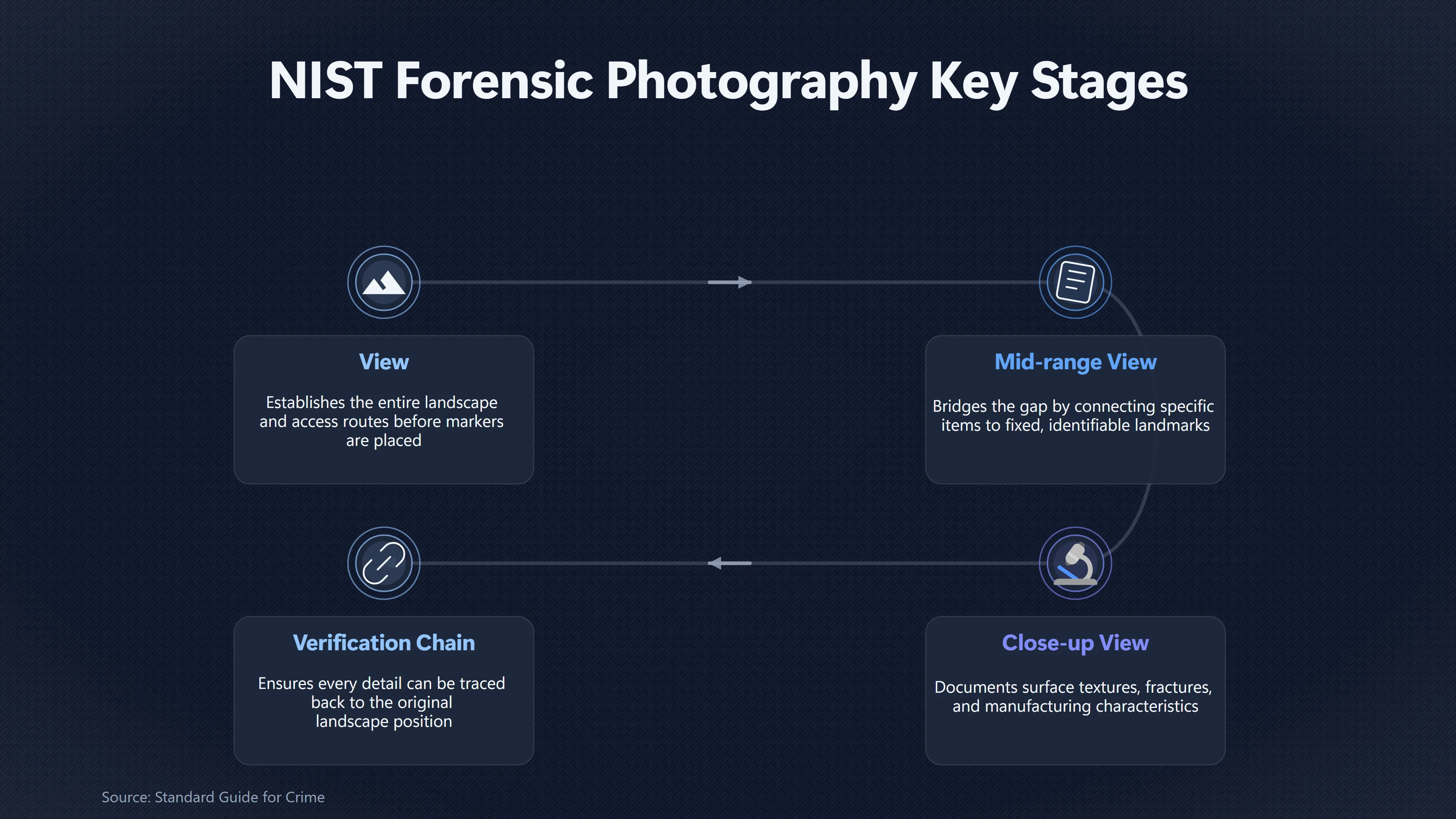
The key question is whether every close-up can be traced back to a wider view without ambiguity. Forensic photography standards use a progressive sequence—overall, mid-range and close-up—because each image answers a different question while supporting the next.
An overall photograph establishes the setting. It should show the broader landscape, access routes, terrain, vegetation, buildings, roads or other permanent features that identify the location. Importantly, these photographs are taken before evidence markers, measuring scales or recovered objects alter the scene.[NIST]nist.govStandard Guide for CrimeStandard Guide for CrimeMarch 27, 2026…
Mid-range photographs then bridge the gap between the landscape and individual objects. Rather than simply zooming closer, they deliberately include both the item of interest and a fixed landmark visible in the overall images. This creates an identifiable spatial relationship that later viewers can verify independently. According to forensic guidance, the purpose of these photographs is specifically to establish where evidence is located within the documented scene.[nist.gov]nist.govStandard Guide for CrimeStandard Guide for CrimeMarch 27, 2026…
Only after those relationships are documented do close-up photographs become meaningful. These images record surface detail, markings, fractures, textures or manufacturing characteristics while remaining linked to the earlier photographs. Without that link, a close-up merely shows an object, not where it was found.[NIST]nist.govStandard Guide for CrimeStandard Guide for CrimeMarch 27, 2026…
What Overall, Mid-Range and Close-Up Views Each Establish
A complete photographic sequence lets each level answer a distinct evidential question.
Photograph typePrimary purposeReader can verifyOverall viewEstablishes the entire locationWhere the alleged debris field exists within the landscapeMid-range viewConnects individual objects to fixed landmarksWhether each object genuinely occupied the recorded positionClose-up viewDocuments physical detailsSurface features, construction, damage and identifying characteristics
The sequence becomes stronger when multiple intermediate photographs are included instead of a single jump from landscape to close-up. For example, an investigator might photograph a hillside, then a particular cluster of rocks, then a specific metallic fragment beside those rocks before recording the fragment in detail. Each image overlaps with the previous one, preventing the viewer from losing orientation.[ojp.gov]nij.ojp.govNational Institute of Justice CRIME SCENE PROCEDURES IINational Institute of Justice CRIME SCENE PROCEDURES II
How Overlapping Landmarks Link Separate Photographs
Scene continuity depends on overlap rather than trust.
Each photograph should share recognisable features with adjacent photographs so the sequence forms a continuous visual path. Useful reference points include:
- Distinctive trees or rock formations.
- Fence posts, utility poles or road signs.
- Stream beds, ridgelines or cliff edges.
- Buildings, gates or permanent structures.
- Large immovable boulders or terrain breaks.
Because these features appear repeatedly across several images, viewers can confirm that the photographer moved progressively through one location rather than presenting unrelated photographs as though they belonged together. Forensic guidance specifically recommends using known landmarks or fixed objects in mid-range photographs to establish evidence locations.[NIST]nist.govStandard Guide for CrimeStandard Guide for CrimeMarch 27, 2026…
The overlap should also work in both directions. Starting with a close-up, an independent reviewer ought to be able to identify the surrounding landmark in the mid-range image, then locate that landmark within the wider landscape. If this chain cannot be reconstructed, confidence in the sequence decreases.

Why Continuous Sequences Are Harder to Manipulate
Individual photographs can be misleading for many innocent reasons, including unusual camera angles, selective framing or missing context. Continuous sequences reduce these problems because they preserve spatial relationships across multiple images.
Several common forms of misinterpretation become easier to detect:
- Selective framing. A close-up may imply isolation or impact damage that disappears once wider views reveal surrounding context.
- Perspective distortion. A fragment positioned close to the camera can appear much larger than nearby objects unless intermediate views clarify scale.
- Object relocation. If debris was moved before close-up photography, the absence of earlier establishing photographs makes relocation difficult to detect.
- False adjacency. Separate objects photographed from similar angles may appear to belong together despite being metres apart.
A properly documented sequence therefore limits the photographer’s ability—intentionally or unintentionally—to create misleading visual impressions through framing alone.[nist.gov]nist.govStandard Guide for CrimeStandard Guide for CrimeMarch 27, 2026…
Warning Signs That a Sequence Was Staged or Selectively Framed
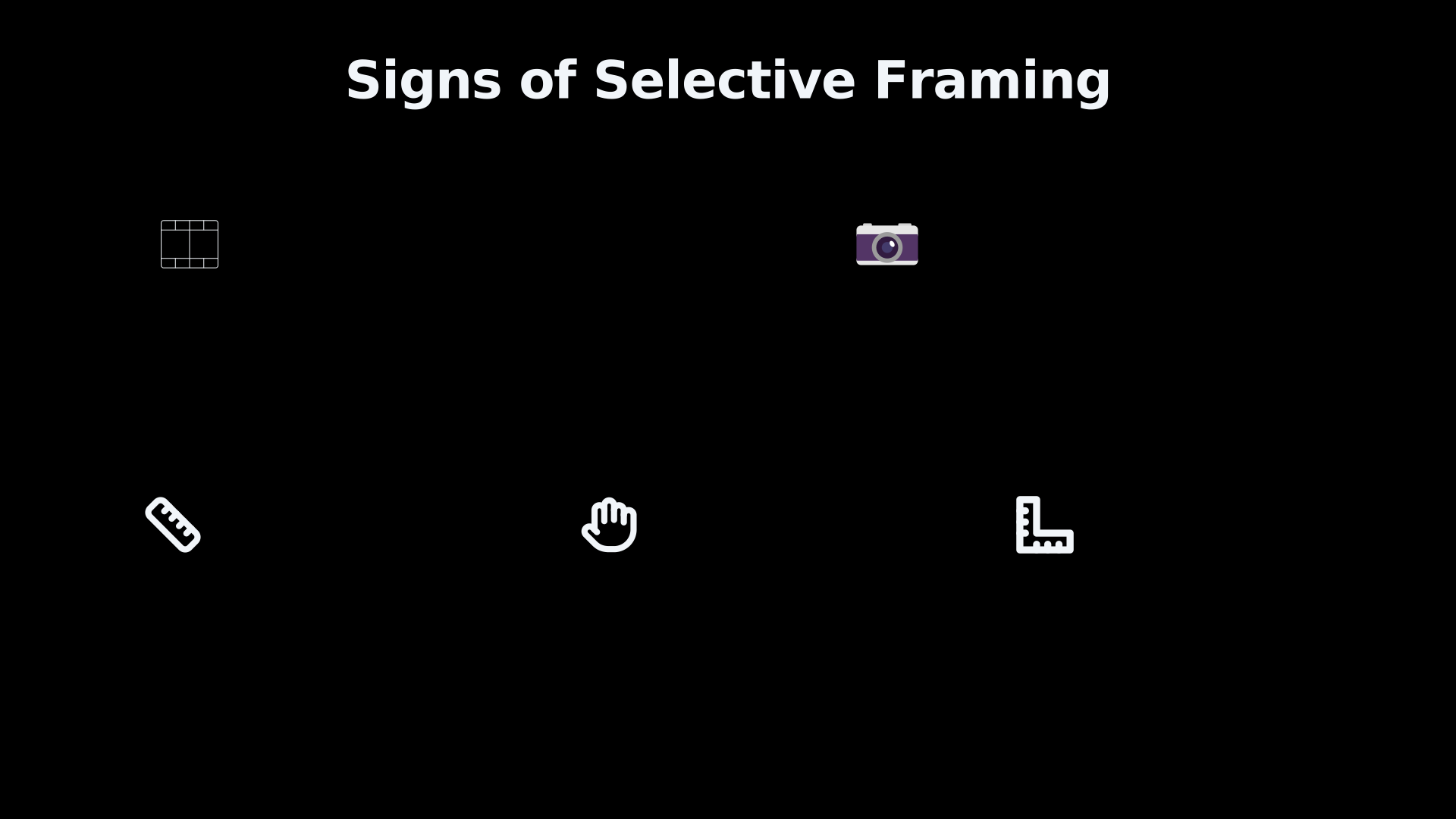
Photographs claiming to document a UFO crash deserve closer scrutiny when they exhibit one or more of the following characteristics:
- Numerous detailed close-ups but no identifiable overall scene.
- Abrupt jumps between image scales with no intermediate photographs.
- Landmarks that disappear instead of recurring across the sequence.
- Objects photographed only after being handled, cleaned or repositioned.
- Different lighting, weather or shadows that suggest images were taken at different times despite being presented as one continuous record.
- Background features that change inconsistently between supposedly adjacent photographs.
- Close-ups that cannot be matched to any visible position in wider views.
- Only one camera angle despite an open landscape where multiple viewpoints would have been practical.
None of these observations independently proves fabrication. Missing photographs may simply reflect poor documentation, limited equipment or an incomplete surviving archive. However, several warning signs together reduce confidence that the photographs faithfully record an undisturbed scene.[ojp.gov]nij.ojp.govNational Institute of Justice CRIME SCENE PROCEDURES IINational Institute of Justice CRIME SCENE PROCEDURES II
Applying the Principle to Alleged UFO Crash Evidence
Many historical UFO crash claims circulate through isolated images whose original sequence is incomplete or unknown. Individual photographs may depict unusual-looking fragments, disturbed ground or recovery activities, yet without a documented progression from landscape to object they provide little independent evidence that the photographed material originated where claimed.
A stronger evidential record would allow independent reviewers to reconstruct the photographer’s movement through the scene frame by frame. They could identify the same debris field in successive photographs, verify that individual fragments remained in place before recovery, and confirm that each close-up corresponds to a clearly identifiable location visible in earlier images.
This standard does not determine whether recovered material is conventional, experimental or extraordinary. Instead, it addresses a more fundamental question: whether the photographs genuinely document a single, continuous scene rather than a collection of disconnected images. In evaluating alleged UFO crash sites, that distinction is often more important than the appearance of any individual photograph itself.
Amazon book picks
Further Reading
Books and field guides related to Can the Photos Trace Debris Through the Scene?. Use these as the next step if you want deeper reading beyond the article.
Crime Scene Photography
Crime Scene Photography is a book wrought from years of experience, with material carefully selected for ease of use and effectiveness in...
Forensic Photography: A Practitioner's Guide
Forensic photography plays a vitally important part in the investigation of crime and the subsequent administration of justice. Written b...
Understanding Exposure
Rating: 4.5/5 from 19 Google Books ratings
Provides detailed lessons on the elements of exposure and how each relates to depth of field, freezing and blurring action, and shooting...
Forensic Science: An Introduction to Scientific and Investiga...
Covering a range of fundamental topics essential to modern forensic investigation, the fourth edition of the landmark text Forensic Scien...
eBay marketplace picks
Marketplace Samples
Live-tested eBay searches with available results related to this page.
Selected fromalien spacecraft model oneBay.co.uk.
Endnotes
1.
Source: nist.gov
Title: Standard Guide for Crime
Link:https://www.nist.gov/document/standard-guide-crime-scene-photography
Source snippet
Standard Guide for CrimeMarch 27, 2026...
Published: March 27, 2026
2.
Source: nist.gov
Title: forensics science crime scene
Link:https://www.nist.gov/forensic-science/nist-forensics-science-crime-scene
Source snippet
NIST Forensics Science — Crime Scene | NISTMay 27, 2026 — NIST FORENSICS SCIENCE — CRIME SCENE Crime scene investigation includes everyth...
Published: May 27, 2026
3.
Source: nist.gov
Title: divide and conquer new algorithm examines crime scene bullets segment
Link:https://www.nist.gov/news-events/news/2020/03/divide-and-conquer-new-algorithm-examines-crime-scene-bullets-segment
4.
Source: nij.ojp.gov
Title: National Institute of Justice CRIME SCENE PROCEDURES II
Link:https://nij.ojp.gov/sites/g/files/xyckuh171/files/media/document/Crime_Scene_Procedures_II.pdf
5.
Source: ojp.gov
Link:https://www.ojp.gov/ncjrs/virtual-library/abstracts/photographing-crime-scene
6.
Source: ojp.gov
Link:https://www.ojp.gov/library/publications/guidance-document-considerations-photographic-documentation-sexual-assault
7.
Source: inspectioncopy.elsevier.com
Link:https://www.inspectioncopy.elsevier.com/book/details/9780128027646
8.
Source: ojp.gov
Link:https://www.ojp.gov/ncjrs/virtual-library/abstracts/fundamental-principles-and-theory-crime-scene-photography
Additional References
9.
Source: legalclarity.org
Title: How Does a Photographer Take Photos at a Crime Scene?
Link:https://legalclarity.org/what-is-the-method-for-taking-crime-scene-photographs/
Source snippet
April 4, 2026 — HOW DOES A PHOTOGRAPHER TAKE PHOTOS AT A CRIME SCENE? Crime scene photographers follow a careful process to d...
Published: April 4, 2026
10.
Source: pinnacleforensics.co
Title: What a Crime Scene Photography Course Should Cover
Link:https://pinnacleforensics.co/what-a-crime-scene-photography-course-should-cover/
Source snippet
April 30, 2026 — Image: Close-up of a camera shutter speed dial used to illustrate exposure control in crime scene photography training W...
Published: April 30, 2026
11.
Source: youtube.com
Title: Forensics Lesson: Photographing the Crime Scene (older version)
Link:https://www.youtube.com/watch?v=Tj8gyuwCwKU
Source snippet
Crime scene photography overall mid-range close-up How to Photograph a Crime Scene - Forensic Education Forensic Education...
12.
Source: legalclarity.org
Title: What Is Forensic Photography?
Link:https://legalclarity.org/what-is-forensic-photography-and-its-role-in-a-case/
Source snippet
Techniques and Evidence - LegalClarityApril 1, 2026 — WHAT IS FORENSIC PHOTOGRAPHY? TECHNIQUES AND EVIDENCE Forensic photography goes bey...
Published: April 1, 2026
13.
Source: youtube.com
Title: What Are Overall, Midrange, And Close-up Crime Scene Photos?
Link:https://www.youtube.com/watch?v=gSKpnU0XSVo
Source snippet
Forensics Lesson: Photographing the Crime Scene (older version)...
14.
Source: police1.com
Title: How to take a midrange photo for crime scene investigations
Link:https://www.police1.com//investigations/articles/a-better-understanding-of-midrange-photographs-in-a-crime-scene-sxveGuGs1YbLkC1n/
Source snippet
How to take a midrange photo for crime scene investigations...
15.
Source: youtube.com
Title: MID-RANGE VIEW AND CLOSE-UP VIEW OF EVIDENCES IN A CRIME SCENE
Link:https://www.youtube.com/watch?v=XJQwS_uX7Oo
Source snippet
Forensic Files - Crime Scene Photography...
16.
Source: youtube.com
Title: How to Photograph a Crime Scene
Link:https://www.youtube.com/watch?v=tOWOnYb71_0
Source snippet
MID-RANGE VIEW AND CLOSE-UP VIEW OF EVIDENCES IN A CRIME SCENE - Lab Activity #19...
17.
Source: docslib.org
Title: Standard Guide for Crime Scene Photography
Link:https://docslib.org/doc/8876863/standard-guide-for-crime-scene-photography
Source snippet
Standard Guide for Crime Scene Photography - DocsLib...
18.
Source: youtube.com
Title: Forensic Files
Link:https://www.youtube.com/watch?v=ihj4y_EeLRs
Source snippet
What Are Overall, Midrange, And Close-up Crime Scene Photos? - True Crime Lovers...