Within Missing Wreckage
Can Science Identify Debris With No Provenance?
A laboratory can identify a fragment's composition, but it cannot prove where the object was found when its recovery history is undocumented.
On this page
- What laboratory testing can establish
- Why an object's origin requires documented custody
- How contamination and informal transfers weaken conclusions
Page outline Jump by section
Introduction
Laboratory analysis can answer an important question about a piece of alleged UFO debris: what is it made of? It cannot, by itself, answer the equally important question: where did it come from? That distinction is central to understanding why no privately held fragment has become publicly verifiable evidence of a UFO crash.
Modern analytical techniques can identify elemental composition, crystal structure, isotopic ratios, manufacturing processes and signs of heat or mechanical stress with remarkable precision. However, none of those measurements can reconstruct an undocumented recovery history. If an object lacks a documented chain of custody—from discovery through storage, transfer and testing—even exceptional laboratory results cannot establish that it originated from the claimed crash site rather than another source. This limitation is well recognised in forensic science and explains why disputed UFO materials remain scientifically interesting while falling short of proving their alleged origin.[nih.gov]pubmed.ncbi.nlm.nih.govPub Med Chain of CustodyChain of Custody - PubMedFebruary 13, 2023…
What laboratory testing can establish
Modern materials laboratories have an extensive toolkit for characterising unknown objects. Depending on the specimen, researchers may use scanning electron microscopy, X-ray diffraction, electron microprobe analysis, mass spectrometry or isotope-ratio measurements to determine physical and chemical properties.
Such testing can reliably establish information including:
- The elements present in the sample.
- The alloy or mineral composition.
- Crystal structure and microscopic features.
- Manufacturing techniques, such as casting, rolling, machining or thin-film deposition.
- Evidence of corrosion, heating, impact or environmental exposure.
- Whether the material matches known industrial products or naturally occurring substances.
These methods are valuable because they replace speculation with measurable data. In many investigations, laboratory work has shown that supposedly mysterious fragments were consistent with conventional aerospace materials, industrial alloys or naturally occurring minerals rather than unknown substances. NASA’s 2023 independent UAP study likewise emphasised that resolving unusual claims requires high-quality physical evidence supported by reliable contextual data rather than isolated laboratory measurements.[NASA Science]science.nasa.govScience UAPNASA ScienceUAP - NASA Science…
Importantly, identifying an unusual material is not the same as identifying its source. An alloy may be uncommon, proprietary or difficult to manufacture while still being entirely terrestrial.
Why an object’s origin requires documented custody
The missing link in many alleged UFO debris cases is provenance—the documented history showing where an object originated and how it reached the laboratory.
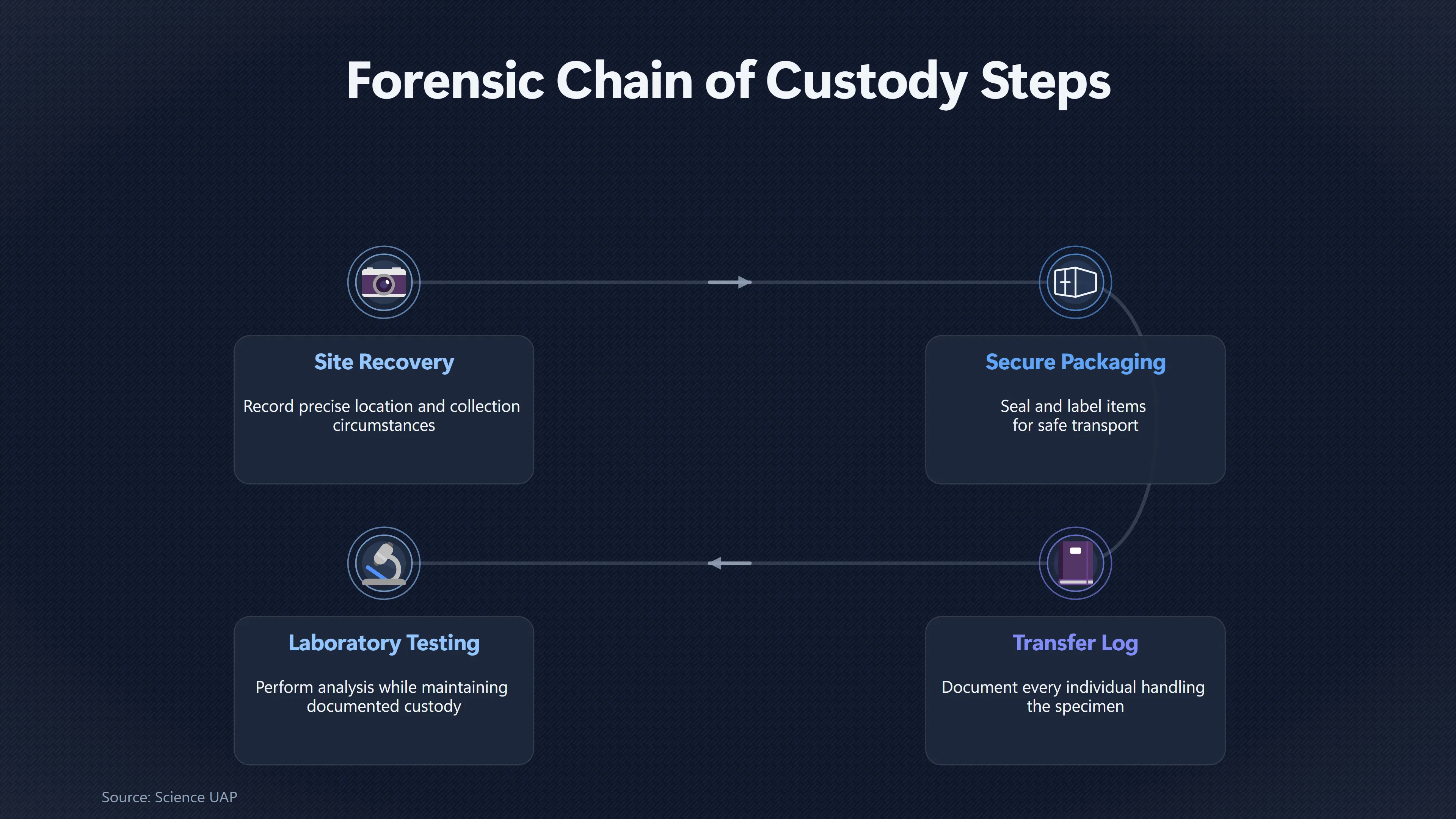
In forensic science, this history is preserved through a chain of custody, which records:
- The precise recovery location.
- The date and circumstances of collection.
- Who handled the item at every stage.
- How it was packaged and stored.
- Every transfer between individuals or institutions.
- Any testing that altered or consumed part of the sample.
These records exist because laboratory instruments examine the object presented to them; they do not verify that the object truly came from the claimed location. If an undocumented fragment is handed to a laboratory decades after an alleged crash, the laboratory can authenticate its measurements but cannot authenticate the recovery story attached to it. Forensic standards therefore treat provenance as evidence that must be documented separately from the analytical results.[nih.gov]pubmed.ncbi.nlm.nih.govPub Med Chain of CustodyChain of Custody - PubMedFebruary 13, 2023…
This distinction is familiar outside UFO research. Courts routinely require both reliable scientific testing and documented custody before physical evidence is considered trustworthy. A technically accurate laboratory report cannot compensate for uncertainty about whether the tested object is the same object allegedly recovered at the scene.[ojp.gov]nij.ojp.govOpen source on ojp.gov.
Why contamination and informal transfers weaken conclusions
Many alleged UFO fragments reach researchers through private collectors, retired military personnel, anonymous intermediaries or inheritance rather than documented scientific recovery.
Each undocumented transfer creates additional uncertainty. Questions naturally arise such as:
- Was the specimen mixed with other material?
- Was it cleaned, cut or modified before testing?
- Could contamination have altered surface chemistry?
- Is the object actually the one described by earlier witnesses?
- Has the story attached to the specimen changed over time?
None of these possibilities necessarily means the object is inauthentic. The problem is that they cannot be ruled out without contemporaneous documentation.
Contamination is particularly significant because many analytical techniques examine surface layers only a few micrometres thick. Handling, polishing, oxidation, adhesives, storage conditions or previous laboratory preparation may alter those surfaces. Researchers can often identify some contamination, but they cannot reconstruct every undocumented event in an object’s history decades after the fact.[PubMed]pubmed.ncbi.nlm.nih.govPub Med Chain of CustodyChain of Custody - PubMedFebruary 13, 2023…
Alleged UFO materials illustrate the provenance problem
Several well-known UFO researchers have commissioned sophisticated analyses of privately held fragments, including studies associated with Jacques Vallée and collaborators. These investigations have employed advanced analytical methods, sometimes reporting unusual microstructures or isotopic characteristics worthy of further study.
However, even the researchers involved have generally acknowledged an important limitation: unusual analytical findings do not, by themselves, demonstrate an extraterrestrial origin. Alternative explanations—including specialised terrestrial manufacturing, contamination, misidentification or incomplete historical documentation—must still be considered. The scientific question therefore extends beyond the laboratory measurements to the reliability of the specimen’s documented history.[Reddit]reddit.comJacques Vallée and Garry Nolan have released their paper on the Trinity crash materials.December 11, 2021…
This explains why debates over individual fragments often focus as much on recovery narratives as on metallurgical results. Critics question whether the objects genuinely originated where claimed, while proponents argue that the laboratory findings deserve greater attention. Regardless of those differing interpretations, the absence of independently documented provenance limits the strength of any conclusion about origin.
Why exceptional chemistry is not proof of an exceptional source
It is tempting to assume that an unusual composition points to an extraordinary origin. In practice, materials science is more cautious.
Several possibilities can produce unexpected laboratory results without requiring an extraterrestrial explanation:
- Proprietary military or aerospace alloys.
- Experimental industrial manufacturing.
- Rare but terrestrial isotope distributions.
- Weathering or chemical alteration after burial.
- Contamination introduced during recovery or handling.
- Analytical uncertainty or sampling effects.
Scientific conclusions become strongest when multiple independent lines of evidence converge. For an alleged UFO fragment, those lines would ideally include secure recovery documentation, multiple independent laboratories obtaining consistent results, exclusion of known terrestrial sources, and a documented chain of custody from discovery onward. A single unusual measurement, however intriguing, does not establish all of those points.
Why provenance remains the decisive evidence gap
The central obstacle is not a lack of laboratory capability but a lack of documented history.
Modern laboratories are exceptionally good at determining what an object is. They are not designed to determine where an undocumented object was decades earlier. Provenance must be established through records, witnesses, photographs, collection documentation and continuous custody—not inferred from chemistry alone.
For this reason, privately held UFO fragments may remain legitimate subjects for materials research while still being insufficient to verify a specific crash claim. Without secure provenance, laboratory analysis can characterise the specimen in detail but cannot restore the missing historical link needed to connect it convincingly to an alleged UFO incident.[nih.gov]pubmed.ncbi.nlm.nih.govPub Med Chain of CustodyChain of Custody - PubMedFebruary 13, 2023…
Amazon book picks
Further Reading
Books and field guides related to Can Science Identify Debris With No Provenance?. Use these as the next step if you want deeper reading beyond the article.
Criminalistics: An Introduction to Forensic Science
For introductory courses in Forensic Science and Crime Scene Investigation. This best-selling text, written for the non-scientist, is app...
Stuff Matters: Exploring the Marvelous Materials That Shape O...
An eye-opening adventure deep inside the everyday materials that surround us, from concrete and steel to denim and chocolate, packed with...
Callister's Materials Science and Engineering, Global Edition
Callister's Materials Science and Engineering: An Introduction, 10th Edition promotes student understanding of the three primary types of...
Forensic Science: An Introduction to Scientific and Investiga...
Covering a range of fundamental topics essential to modern forensic investigation, the fourth edition of the landmark text Forensic Scien...
eBay marketplace picks
Marketplace Samples
Live-tested eBay searches with available results related to this page.
Selected fromspecimen storage case oneBay.co.uk.

Related eBay result
Vintage Storage Box Vintage Specimen Box Display Case Wooden
Related eBay result
Insect Collecting Box Boxes Butterfly Display Case Specimen

Related eBay result
Wooden Slide Storage Box Case For Microscope Slides Specimens
Endnotes
1.
Source: science.nasa.gov
Title: Science UAP
Link:https://science.nasa.gov/uap/
Source snippet
NASA ScienceUAP - NASA Science...
2.
Source: store.astm.org
Title: e1492 11r17
Link:https://store.astm.org/e1492-11r17.html
Source snippet
ASTM StoreE1492 Standard Practice for Receiving, Documenting, Storing, and Retrieving Evidence in a Forensic Science Laboratory...
3.
Source: assets.publishing.service.gov.uk
Title: Legal Issues in Forensic Pathology and Tissue Retention Issue 3
Link:https://assets.publishing.service.gov.uk/government/uploads/system/uploads/attachment_data/file/910282/Legal_Issues_in_Forensic_Pathology_and_Tissue_Retention_Issue_3.pdf
Source snippet
document was archived on 31 August 2020...
Published: August 2020
4.
Source: nolo.com
Title: Establishing and Challenging Chain of Custody for Evidence
Link:https://www.nolo.com/legal-encyclopedia/what-chain-custody.html
Source snippet
Establishing and Challenging Chain of Custody for Evidence...
5.
Source: reddit.com
Link:https://www.reddit.com/r/UFOs/comments/rdpd57/jacques_vall%C3%A9e_and_garry_nolan_have_released/
Source snippet
Jacques Vallée and Garry Nolan have released their paper on the Trinity crash materials.December 11, 2021...
Published: December 11, 2021
6.
Source: reddit.com
Link:https://www.reddit.com/r/UFObelievers/comments/nowxd8
Source snippet
Question about recent Jaques Vallée paper, "What do we know about the material composition of UFOs?"...
7.
Source: GOV.UK
Title: www.gov.uk Forensic science activities: statutory code of practice
Link:https://www.gov.uk/government/publications/forensic-science-activities-statutory-code-of-practice-version-2/forensic-science-activities-statutory-code-of-practice-version-2-accessible
8.
Source: nasa.gov
Link:https://www.nasa.gov/history/Apollo204/cust.html
9.
Source: pubmed.ncbi.nlm.nih.gov
Title: Pub Med Chain of Custody
Link:https://pubmed.ncbi.nlm.nih.gov/31869141/
Source snippet
Chain of Custody - PubMedFebruary 13, 2023...
Published: February 13, 2023
10.
Source: nij.ojp.gov
Link:https://nij.ojp.gov/es/node/196491
11.
Source: nij.ojp.gov
Link:https://nij.ojp.gov/nij-hosted-online-training-courses/law-101-legal-guide-forensic-expert/sources-scientific-evidence/testing-or-evaluating-evidence-and-writing-reports/chain-custody-typical-checklist
Source snippet
National Institute of JusticeArchived | Law 101: Legal Guide for the Forensic Expert | A Chain of Custody: The Typical Checklist | Nation...
12.
Source: pmc.ncbi.nlm.nih.gov
Link:https://pmc.ncbi.nlm.nih.gov/articles/PMC10000967/
13.
Source: ojp.gov
Link:https://www.ojp.gov/ncjrs/virtual-library/abstracts/forensic-science-chain-custody
Additional References
14.
Source: youtube.com
Title: The Future of UAP Evidence: What Would Finally Prove a UFO Case?
Link:https://www.youtube.com/watch?v=BxBVwapvuMw
Source snippet
UFO crash debris chain of custody forensic material analysis The Future of UAP Evidence: What Would Finally Prove a UFO Case?...
15.
Source: legalclarity.org
Title: UF O Material: Government Programs, Lab Results, and [Roswell]({{ ‘roswell/’ | relative_url }})
Link:https://legalclarity.org/ufo-material-government-programs-lab-results-and-roswell/
Source snippet
Perhaps the oldest fragment in the UFO-materials canon is a piece of magnesium collected in Brazil in 1...
16.
Source: youtube.com
Title: New UAP Materials Tests: What the Results Reveal | Dr. Garry Nolan
Link:https://www.youtube.com/watch?v=Mifx4nzPY68
Source snippet
How To Scientifically Test & Analyze Potential UAP/UFO Material...
17.
Source: youtube.com
Title: Through Conversations Podcast
Link:https://www.youtube.com/watch?v=BBHrrdrmYIQ&t=1245s
Source snippet
Garry Nolan testing UFO materials isotopes GRANT CAMERON UFO Hardware, Dream Signs, Gary Nolan, Metamaterials...
18.
Source: archives.gov
Link:https://www.archives.gov/research/topics/uaps/rg-collections
19.
Source: youtube.com
Title: How To Scientifically Test & Analyze Potential UAP/UFO Material
Link:https://www.youtube.com/watch?v=SbAtCzZIIsk
Source snippet
Analysis of the "[Ubatuba]({{ 'ubatuba/' | relative_url }})" material by Robert Powell...
20.
Source: youtube.com
Title: Analysis of the “Ubatuba” material by Robert Powell
Link:https://www.youtube.com/watch?v=NamnxaADugo
Source snippet
The Future of UAP Evidence: What Would Finally Prove a UFO Case?...
21.
Source: decur.org
Link:https://decur.org/research/papers/vallee-nolan-jiang-lemke-2022
22.
Source: mdpi.com
Link:https://www.mdpi.com/2227-9032/11/5/634
23.
Source: disclosurearchives.com
Link:https://disclosurearchives.com/research