Within Fireballs
When a Meteor Looks Like Burning Wreckage
Flares, glowing fragments and persistent trails can make a natural fireball look like an aircraft or UFO breaking apart.
On this page
- What causes flares and fragmentation
- Why glowing pieces appear mechanical
- How persistent trails mimic smoke
Page outline Jump by section
Introduction
One reason spectacular fireballs are repeatedly reported as aircraft crashes or UFO crashes is that many bright meteors do not remain intact. As they plunge through the atmosphere at tens of kilometres per second, increasing aerodynamic pressure and intense heating can cause them to fragment into multiple glowing pieces. To an observer on the ground, these bright fragments may appear to separate, slow, flare and leave lingering trails, closely resembling a large aircraft breaking up in flight.[NASA Science]science.nasa.govScience Meteors and Meteorites: FactsNASA ScienceMeteors and Meteorites: Facts - NASA ScienceFebruary 14, 2025…

This resemblance is compelling because the human visual system interprets familiar patterns. Multiple lights spreading apart evoke engines or burning wreckage, while glowing trails resemble smoke. Yet the underlying physics is entirely different. Understanding how meteoroids fragment helps explain why sincere witnesses can mistake a natural fireball for an aviation disaster without requiring any unusual object or unexplained crash.
What causes flares and fragmentation?
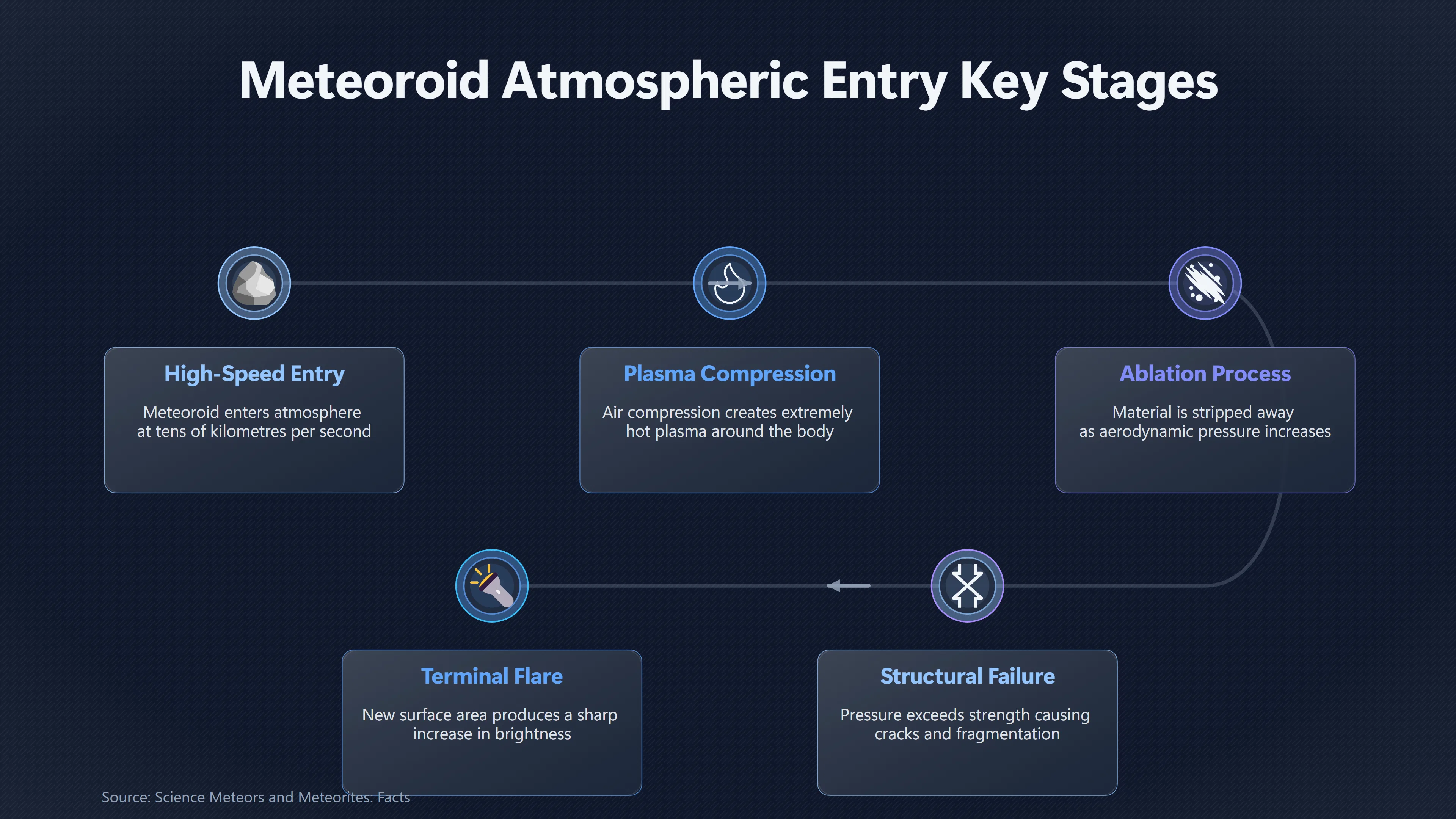
A meteoroid enters Earth’s atmosphere at enormous speed. Rather than burning because of simple friction, it is compressed by the air ahead of it, creating extremely hot plasma around the object. Material is stripped away in a process known as ablation while aerodynamic pressure increases rapidly as the atmosphere becomes denser. When this dynamic pressure exceeds the structural strength of the meteoroid, cracks propagate and the body can split into several pieces.[sciencedirect.com]sciencedirect.comScienceDirect Meteoroid structure and fragmentationMeteoroid structure and fragmentation - ScienceDirect…
Each newly exposed fragment suddenly presents fresh surface area to the airflow. That often produces a sharp increase in brightness known as a terminal flare. To a witness, this appears remarkably similar to an explosion aboard an aircraft or spacecraft.
Fragmentation is not unusual. Research on meteor observations indicates that many bright fireballs experience either continuous shedding of material or one or more distinct fragmentation events during their visible flight, depending on their internal structure and composition. Weak, fractured or porous meteoroids are especially prone to breaking apart.[ScienceDirect]sciencedirect.comScienceDirect Meteoroid structure and fragmentationMeteoroid structure and fragmentation - ScienceDirect…
The well-documented Chelyabinsk event in 2013 demonstrated this dramatically. The incoming asteroid underwent intense fragmentation high in the atmosphere, producing brilliant flashes and numerous glowing fragments while only a tiny fraction of its original mass ultimately reached the ground.[Wiley Online Library]onlinelibrary.wiley.comOnline Library Air penetration enhances fragmentation of entering meteoroidsWiley Online LibraryAir penetration enhances fragmentation of entering meteoroids - Tabetah - 2018 - Meteoritics & Planetary Science - Wi…
Why glowing pieces appear mechanical
The visual appearance of meteor fragmentation overlaps surprisingly well with familiar aircraft emergencies.
Several characteristics contribute to this illusion:
- Multiple bright lights: Instead of a single point, observers see several luminous objects travelling together after fragmentation, resembling separate pieces of wreckage.
- Changing brightness: Individual fragments brighten and fade independently, creating the impression of fires intensifying or engines failing.
- Apparent slowing: As fragments separate and dim, they seem to decelerate, even though they remain at hypersonic speeds. Human perception is influenced by changing brightness and perspective rather than true velocity.
- Curved or diverging paths: Small differences in fragment motion can make debris appear to spread apart like pieces of an exploding aircraft rather than remaining on a perfectly straight trajectory.[ScienceDirect]sciencedirect.comScienceDirect Meteoroid structure and fragmentationMeteoroid structure and fragmentation - ScienceDirect…
Because most people have seen news footage of aircraft break-ups but have never witnessed a fragmenting meteor, the brain naturally favours the familiar interpretation. This is particularly true at night, when there are few visual references for judging altitude or distance.
Witness testimony often includes descriptions such as “parts falling off”, “burning debris”, “engines on fire” or “multiple objects”. Those descriptions accurately capture what was seen but not necessarily what caused it.
How persistent trails mimic smoke
After the brightest part of the meteor disappears, the illusion often becomes even stronger.
Bright fireballs can leave two different kinds of visible trails:
- Persistent trains, consisting of glowing ionised gases high in the atmosphere.
- Smoke trails, formed from fine particles stripped from the meteoroid during ablation, particularly in brighter daylight fireballs.[American Meteor Society]amsmeteors.orgAmerican Meteor Society Fireball FAQsAmerican Meteor SocietyFireball FAQs - American Meteor Society…
Unlike the meteor itself, which may be visible for only one or two seconds, these trails can remain visible for several minutes. High-altitude winds gradually twist, stretch and distort them into irregular shapes.
To an observer unfamiliar with meteor physics, this evolving trail closely resembles drifting smoke from an aircraft crash. In some cases the trail bends into corkscrew or looping patterns, suggesting a damaged vehicle descending out of control even though the meteor has already vanished. NASA documented such behaviour following a western United States fireball in December 2018, where the persistent train remained visible for minutes while upper-atmospheric winds distorted its shape.[NASA]nasa.govFireball Leaves Persistent Train over Western SkiesFireball Leaves Persistent Train over Western Skies - NASADecember 20, 2018…
This delayed evolution also explains why witnesses sometimes continue searching the apparent crash location long after the meteor itself has disappeared. The lingering trail appears connected to an object descending towards the ground when it is actually a high-altitude atmospheric phenomenon.
Why the apparent wreckage rarely matches reality
The features that make fragmenting meteors resemble failing aircraft are largely visual rather than physical.
Aircraft debris typically slows rapidly because of aerodynamic drag and falls from comparatively low altitude. Meteor fragments, by contrast, remain tens of kilometres above Earth during most of their luminous flight. Even fragments that eventually survive to become meteorites usually stop glowing long before they reach the ground and continue falling invisibly during what is known as dark flight.[NASA Science]science.nasa.govScience Meteors and Meteorites: FactsNASA ScienceMeteors and Meteorites: Facts - NASA ScienceFebruary 14, 2025…
As a result, observers often search beneath the last visible flare or persistent trail, believing they have identified an impact point. In reality, any surviving meteorites may land many kilometres away, while many fragmenting fireballs leave no recoverable material at all.
This mismatch between apparent and actual landing sites explains why emergency services responding to reports of a fiery object breaking apart frequently find no aircraft wreckage despite numerous credible eyewitness accounts.
Distinguishing a fragmenting meteor from an aircraft accident
Several observational clues favour a natural fireball over a genuine aviation emergency:
- The entire luminous event usually lasts only a few seconds.
- Fragmentation occurs while the object continues at extremely high apparent speed.
- Bright flares are followed by a glowing or drifting atmospheric trail.
- The object crosses a large portion of the sky rather than descending steadily towards one location.
- Numerous reports emerge simultaneously across a very wide geographical area because the event occurs at high altitude.[amsmeteors.org]amsmeteors.orgAmerican Meteor Society Fireball FAQsAmerican Meteor SocietyFireball FAQs - American Meteor Society…
These characteristics do not always allow an eyewitness to identify the phenomenon in real time. They do, however, explain why many reports initially interpreted as burning aircraft, crashing spacecraft or UFO wreckage are later shown through camera recordings, radar data and multiple witness reports to have been ordinary fragmenting meteors.
Amazon book picks
Further Reading
Books and field guides related to When a Meteor Looks Like Burning Wreckage. Use these as the next step if you want deeper reading beyond the article.
Meteorites: The Story of Our Solar System
Meteorite tells the fascinating story of the stones from outer space scattered across our planet. From the impact that finished off the d...
The Cambridge Encyclopedia of Meteorites
Beautifully illustrated with over 140 full colour images, The Cambridge Encyclopedia of Meteorites provides a thorough guide to these fas...
Meteorites: A Journey Through Space and Time
Contains several previously unpublished accounts of meteorite recoveries in Australia and provides deatails on many Australian contributi...
Rocks from Space: Meteorites and Meteorite Hunters
Appendices A-C: Meteorite verification laboratories, Commercial meteorite dealers, Selected list of suspected impact craters worldwide.
eBay marketplace picks
Marketplace Samples
Live-tested eBay searches with available results related to this page.
Selected fromUFO disclosure poster oneBay.co.uk.



Endnotes
1.
Source: science.nasa.gov
Title: Science Meteors and Meteorites: Facts
Link:https://science.nasa.gov/solar-system/meteors-meteorites/facts/
Source snippet
NASA ScienceMeteors and Meteorites: Facts - NASA ScienceFebruary 14, 2025...
Published: February 14, 2025
2.
Source: sciencedirect.com
Title: ScienceDirect Meteoroid structure and fragmentation
Link:https://www.sciencedirect.com/science/article/abs/pii/S003206331630349X
Source snippet
Meteoroid structure and fragmentation - ScienceDirect...
3.
Source: onlinelibrary.wiley.com
Title: Online Library Air penetration enhances fragmentation of entering meteoroids
Link:https://onlinelibrary.wiley.com/doi/full/10.1111/maps.13034
Source snippet
Wiley Online LibraryAir penetration enhances fragmentation of entering meteoroids - Tabetah - 2018 - Meteoritics & Planetary Science - Wi...
4.
Source: onlinelibrary.wiley.com
Title: Online Library Air penetration enhances fragmentation of entering meteoroids
Link:https://onlinelibrary.wiley.com/doi/10.1111/maps.13034
Source snippet
Wiley Online LibraryAir penetration enhances fragmentation of entering meteoroids - Tabetah - 2018 - Meteoritics & Planetary Science - Wi...
5.
Source: nas.nasa.gov
Link:https://www.nas.nasa.gov/pubs/ams/2021/09-23-21.html
Source snippet
A Advanced SupercomputingAerodynamic Separation of Fragmented Bodies in High-Speed Flow...
6.
Source: nasa.gov
Title: Fireball Leaves Persistent Train over Western Skies
Link:https://www.nasa.gov/blogs/watch-the-skies/2018/12/20/fireball-leaves-persistent-train-over-western-skies/
Source snippet
Fireball Leaves Persistent Train over Western Skies - NASADecember 20, 2018...
Published: December 20, 2018
7.
Source: fireballs.ndc.nasa.gov
Link:https://fireballs.ndc.nasa.gov/skyfalls/events/20181220-013502
Source snippet
Event 20181220-013502...
8.
Source: science.nasa.gov
Title: fragmenting comet c 2025 k1
Link:https://science.nasa.gov/asset/hubble/fragmenting-comet-c-2025-k1/
Source snippet
Comet C/2025 K1 - NASA ScienceMarch 18, 2026 — 1 min read FRAGMENTING COMET C/2025 K1 To view this video please enable JavaScript, and co...
Published: March 18, 2026
9.
Source: agupubs.onlinelibrary.wiley.com
Link:https://agupubs.onlinelibrary.wiley.com/doi/full/10.1029/2024JA032643
10.
Source: agupubs.onlinelibrary.wiley.com
Link:https://agupubs.onlinelibrary.wiley.com/doi/abs/10.1029/2024JA032643
11.
Source: nasa.gov
Title: Meteoroid Environment Office
Link:https://www.nasa.gov/meteoroid-environment-office/
12.
Source: sciencedirect.com
Link:https://www.sciencedirect.com/science/article/abs/pii/S0019103520304437
13.
Source: sciencedirect.com
Title: Physics of meteor generated shock waves in the Earth’s atmosphere – A review
Link:https://www.sciencedirect.com/science/article/pii/S027311771830406X
14.
Source: ntrs.nasa.gov
Link:https://ntrs.nasa.gov/archive/nasa/casi.ntrs.nasa.gov/20170009804.pdf
15.
Source: ntrs.nasa.gov
Link:https://ntrs.nasa.gov/citations/20150018059
16.
Source: ntrs.nasa.gov
Link:https://ntrs.nasa.gov/citations/20150018060
17.
Source: ntrs.nasa.gov
Link:https://ntrs.nasa.gov/citations/20150011433
18.
Source: ntrs.nasa.gov
Link:https://ntrs.nasa.gov/archive/nasa/casi.ntrs.nasa.gov/20110016619.pdf
19.
Source: agupubs.onlinelibrary.wiley.com
Link:https://agupubs.onlinelibrary.wiley.com/doi/full/10.1029/2003GL018312
20.
Source: cneos.jpl.nasa.gov
Link:https://cneos.jpl.nasa.gov/fireballs/intro.html
21.
Source: sciencedirect.com
Title: Meteor Trails
Link:https://www.sciencedirect.com/topics/earth-and-planetary-sciences/meteor-trails
22.
Source: amsmeteors.org
Title: American Meteor Society Fireball FAQs
Link:https://www.amsmeteors.org/fireballs/faqf/
Source snippet
American Meteor SocietyFireball FAQs - American Meteor Society...
23.
Source: amsmeteors.org
Title: American Meteor Society Fireball or Contrail?
Link:https://www.amsmeteors.org/fireballs/fireball-or-contrail/
Source snippet
American Meteor SocietyFireball or Contrail? - American Meteor Society...
24.
Source: fireball.amsmeteors.org
Link:https://fireball.amsmeteors.org/members/imo_view/report/360141
25.
Source: amsmeteors.org
Title: Fireball over Colorado
Link:https://www.amsmeteors.org/2019/02/fireball-over-colorado/
27.
Source: amsmeteors.org
Title: fireball caught on camera on october 16th 2014
Link:https://amsmeteors.org/2014/10/fireball-caught-on-camera-on-october-16th-2014/
Additional References
28.
Source: cambridge.org
Link:https://www.cambridge.org/core/journals/international-astronomical-union-colloquium/article/physics-of-meteors/599B53D25D7EE56EA6F0407C96645626
Source snippet
Cambridge University PressThe Physics of Meteors | International Astronomical Union Colloquium | Cambridge Core...
29.
Source: youtube.com
Link:https://www.youtube.com/watch?v=3QBz6hNxalo
Source snippet
This video from Crash Course Astronomy on Meteors explains the physical processes of atmospheric entry, ablation, and extreme ram pressur...
30.
Source: youtube.com
Title: Watch: Asteroid explodes above England after entering Earth’s atmosphere
Link:https://www.youtube.com/watch?v=tk2g9pRwOBU
Source snippet
Most Mind-Blowing Video of 2013: Chelyabinsk Meteor - Science on the Web #37...
31.
Source: youtube.com
Title: Watch: Meteor Causes Thunderous Boom Over Ohio and Pennsylvania
Link:https://www.youtube.com/watch?v=DArrBIFdzhI
Source snippet
Watch: Asteroid explodes above England after entering Earth's atmosphere...
32.
Source: youtube.com
Title: Fireball flies across the sky and causes sonic boom
Link:https://www.youtube.com/watch?v=PWdya32j0d8
Source snippet
Watch: Meteor Causes Thunderous Boom Over Ohio and Pennsylvania...
33.
Source: imo.net
Link:https://www.imo.net/observations/fireballs/observations/
34.
Source: paperzz.com
Link:https://paperzz.com/doc/9224309/physical-properties-of-meteoroids
35.
Source: cambridge.org
Link:https://www.cambridge.org/core/journals/symposium-international-astronomical-union/article/meteoroid-properties-from-photographic-records-of-meteors-and-fireballs/24E02B6ADCA600F034A60496F05AD876
36.
Source: researchgate.net
Link:https://www.researchgate.net/publication/325248425Physics_of_Meteor_Generated_Shock_Waves_in_the_Earth%27s_Atmosphere-_A_Review
37.
Source: youtube.com
Title: Meteors: Crash Course Astronomy #23
Link:https://www.youtube.com/watch?v=TuDfZ2Md5x8
Source snippet
Fireball flies across the sky and causes sonic boom...