Within UFO Crashes
How to Document a Reported UFO Crash
Early scene control, precise mapping and independent sampling can preserve evidence before weather, crowds and rumour alter the record.
On this page
- Securing and mapping the location
- Photographing and collecting material
- Recording witnesses and preserving data
Page outline Jump by section
Introduction
A fresh report of a possible UFO crash should be treated first as an unknown accident and potential hazardous-materials scene, not as proof that an extraordinary craft has fallen. The investigator’s immediate job is to preserve what exists before rescue activity, rain, fire, vehicles, crowds and rumour change it. That means establishing safe control of the location, recording the scene from the outside in, fixing every relevant item to a measured map, preserving original digital files and collecting properly labelled samples with an unbroken chain of custody.
The most valuable record is not the most dramatic photograph or unusual fragment. It is a reconstruction package showing exactly where, when and under what conditions each observation was made, who handled each item and whether independent tests can reproduce the findings. NASA has identified missing metadata, poor sensor calibration, inadequate baseline information and a lack of multiple measurements as recurring obstacles in unidentified anomalous phenomena research. A reported crash scene offers a rare opportunity to avoid those failures from the outset.[NASA Science]science.nasa.govScience Independent Study Team ReportNASA ScienceIndependent Study Team ReportSeptember 13, 2023 — At present, analysis of UAP data is hampered by poor sensor calibration, th…
Secure the location before interpreting it
Life safety takes precedence over evidence. Police, fire and rescue services, bomb-disposal personnel and hazardous-materials specialists should control the response whenever there is wreckage, fire, injury, unexploded ordnance, damaged batteries, pressurised vessels, exposed wiring, leaking liquids or suspected radioactive or biological material. Aircraft accident sites can contain corrosive fluids, composite fibres, fuels, batteries and pressurised components even when the vehicle itself is conventional. An unfamiliar object should never be assumed harmless merely because no warning label is visible.[NTSB]ntsb.govResponding to a Transportation AccidentResponding to a Transportation AccidentSeptember 29, 2023 — Protect and preserve ground scars and marks made by the aircraft, vehicle…
Once urgent rescue and hazard-control work permits, the incident commander should establish an inner scene boundary around the apparent impact and debris field, with a wider outer boundary for vehicles, media and bystanders. Access should be limited to named personnel, using one controlled entry and exit point where practical. A contemporaneous scene log should record each person’s name, role, entry and departure times, reason for access and any equipment carried into the area. Standard forensic guidance stresses documenting everyone entering and leaving because responders can unintentionally move, contaminate or introduce material.[NIST]nist.govCrime Scene InvestigationEstablish a secure area for temporary evidence storage in accordance with rules of evidence/chain of custody…
Nothing should be picked up, turned over, cleaned or arranged for a clearer photograph before its original position has been recorded. Transportation investigators similarly instruct responders to prevent unnecessary disturbance and preserve ground scars, marks and debris until they have been documented. Movement required to rescue someone, suppress a fire or neutralise an immediate hazard should be recorded as precisely as possible: who moved the item, from where, at what time, by what method and where it was placed.[ntsb.gov]ntsb.govResponding to a Transportation AccidentResponding to a Transportation AccidentSeptember 29, 2023 — Protect and preserve ground scars and marks made by the aircraft, vehicle…
Early scene notes should separate observation from interpretation. “A curved silver-coloured panel measuring approximately 80 centimetres” is an observation. “Part of an extraterrestrial hull” is an interpretation unsupported by the initial view. This distinction should be maintained in labels, maps, radio messages and public statements so that an early assumption does not become embedded as a fact throughout the investigation.
Map the debris field before recovery begins
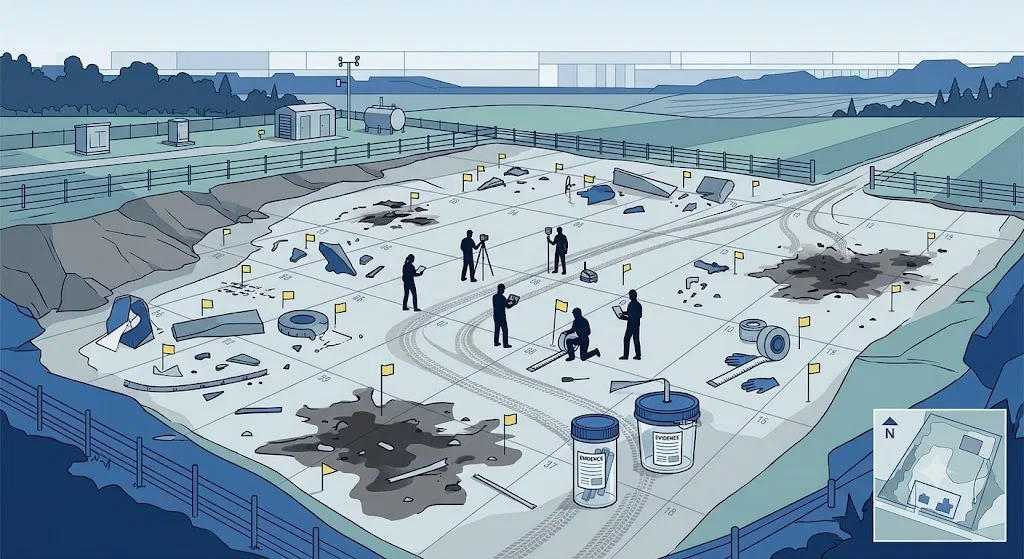
The first mapping pass should define the entire affected area, not merely the largest object. Small fragments, scorched vegetation, furrows, broken branches, splash marks, footprints and vehicle tracks may reveal direction of travel, fragmentation, secondary impacts or later disturbance. NTSB practice includes documenting overall wreckage distribution, impact marks and evidence connected with the object’s path; sketches supplement photographs because photographs alone often fail to show exact spatial relationships.[NTSB]ntsb.govi AVIATION INVESTIGATION MANUALi AVIATION INVESTIGATION MANUAL
Investigators should establish a fixed reference system that another team could reoccupy later. The minimum useful record includes:
- Accurate coordinates and time. Record the location of the scene reference point, the coordinate system and datum used, measurement time and estimated positional accuracy. Times should include the time zone or be recorded in Coordinated Universal Time to prevent later ambiguity.
- A north-oriented site plan. Show roads, buildings, fences, waterways, slopes, utilities, tree lines and other durable landmarks.
- A numbered evidence grid. Assign each object or sample location a unique identifier before collection. Plot its coordinates, elevation where relevant, orientation, dimensions and relationship to nearby marks.
- Debris-field limits. Walk or survey beyond the visible centre until the absence of related debris is reasonably established. Mark areas that could not be searched.
- Environmental conditions. Record temperature, wind, precipitation, cloud, visibility, soil moisture, recent weather and approaching changes. These conditions affect corrosion, odour, dispersal, thermal readings and the survival of impressions.
- Disturbance history. Mark responder routes, tyre tracks, firefighting areas, public access points and any locations already searched or cleared.
Mapping methods may range from tapes, compasses and hand sketches to survey-grade Global Navigation Satellite System equipment, total stations, photogrammetry or authorised drone imagery. Whatever the technology, the report must identify the instrument, operator, settings, calibration status, coordinate reference system and known error. A sophisticated three-dimensional model is of limited evidential value when its scale, accuracy or processing history cannot be checked.
The map should distinguish original observations from later reconstruction. A fragment found where it landed receives one notation; an item handed to investigators by a resident receives another, together with the resident’s account of where and when it was found. Combining the two categories on a single unqualified “debris map” would falsely imply equal positional certainty.
Photograph the scene as a sequence, not a spectacle
Photography should tell a chronological and spatial story. Begin with wide views from outside the controlled area, then take overlapping mid-range images connecting individual items to fixed landmarks, followed by close views both without and with a scale. Photograph all sides of an item in place when this can be done safely. Include ground impressions, fracture surfaces, deposits, labels, fasteners and signs of heat, weathering or previous handling. Forensic guidance treats photographs, video, notes and sketches as complementary records rather than substitutes for one another.[National Institute of Justice]nij.ojp.govdocumentation chain custodydocumentation chain custody
Each image should be linked to the scene map and photo log. The log should record the file number, photographer, camera and lens, date and time, viewpoint, direction, subject, lighting method and any scale used. A colour reference card and measurement scale should appear in selected evidential images, but should not cover or touch the object. Images taken through night modes, computational zoom or automatic enhancement should be identified because software processing can alter fine detail.
Original files must be preserved exactly as captured. Investigators should copy them into controlled storage, calculate a cryptographic hash—a digital fingerprint used to detect change—and perform analysis only on verified working copies. NIST guidance recommends hashing digital evidence, storing the hash separately and documenting every processing step sufficiently for another trained examiner to understand and reproduce it. Metadata such as camera model, timestamps and processing history should be retained rather than stripped during messaging or social-media upload.[NIST]nist.govosac 2024 n 0011 standard guide forensic digital image management version 10osac 2024 n 0011 standard guide forensic digital image management version 10
Images supplied by witnesses require their own provenance record. Obtain the original file directly from the recording device where lawful and possible, rather than downloading a compressed copy from a social platform. Record who supplied it, how it was transferred and whether the device clock was known to be accurate. Preserve longer recordings, frames before and after the apparent event and associated audio; a cropped clip may remove aircraft lights, voices, reflections or movement that later proves essential.
Collect material without destroying its context
Physical recovery should follow a written sampling plan prepared with the relevant laboratory specialists. The plan should define what questions each sample is intended to answer—composition, manufacturing process, heat exposure, environmental contamination or comparison with local soil—and specify containers, tools, preservation conditions and sample quantities before items are disturbed.
Every collected item should receive a unique identifier tied to its in-place photographs and mapped location. The evidence label and custody record should include a description, collector, collection date and time, exact location and subsequent transfers. Chain of custody matters because it provides a chronological account of possession and protects against substitution, mixing, contamination, loss or undocumented alteration.[National Institute of Justice]nij.ojp.govglossary crime scene investigation guides law enforcementglossary crime scene investigation guides law enforcement
Materials with different characteristics should generally be packaged separately. Wet items should not be sealed in a way that encourages mould or chemical change unless a specialist protocol requires it. Sharp, magnetic, friable, volatile or potentially energetic material may require specialised containment. Any object suspected of containing explosives, fuel, toxic chemicals, biological contamination or radioactivity must be left for qualified emergency personnel rather than handled by an informal investigation team.
Use controls, blanks and duplicates
A laboratory result is difficult to interpret without knowing what contamination was already present in the environment or introduced during collection. Investigators should therefore collect comparison soil, vegetation, water or surface deposits from appropriate unaffected locations, following advice from geologists, chemists or environmental scientists. The location and reason for each control sample must be mapped.
Field blanks can reveal contamination from containers, air, preservatives or handling, while equipment blanks test whether reusable tools were adequately decontaminated. Duplicate or split samples help assess consistency and permit genuinely independent analysis. US Geological Survey and Environmental Protection Agency guidance uses blanks and duplicate samples specifically to identify contamination and evaluate sampling quality; EPA procedures also require custody documentation during transport to the laboratory.[usgs.gov]pubs.usgs.govOpen source on usgs.gov.
Where sufficient material exists, a defensible programme should reserve sealed portions for later examination and send blinded splits to independent accredited laboratories. “Blinded” means the laboratory receives the sample identifiers and analytical instructions without being told which fragment is claimed to be anomalous, reducing the risk that expectation influences interpretation. Laboratories should report raw measurements, detection limits, uncertainties, calibration records, reference methods and negative results—not merely a summary declaring the sample “unknown”.
Investigators should avoid destructive tests until non-destructive documentation is complete. Weighing, dimensional measurement, microscopy, radiography and surface imaging may preserve information that cutting, polishing, dissolving or heating would erase. Any removed test portion should be photographed, weighed and linked to the parent item, with the cut position shown on a diagram.

Record witnesses before stories converge
Witness evidence is most useful when collected promptly, separately and without leading questions. People who have talked together, watched news coverage or read online theories may unintentionally incorporate one another’s details. College of Policing guidance recommends separating witnesses for initial accounts, while its evidence review notes that misinformation from co-witnesses, interviewers or media can enter later recollection.[College of Policing]college.police.ukwitness separationwitness separation
Begin by allowing each witness to describe what happened in their own words. Ask open questions such as “Tell me everything you remember from the beginning” before seeking clarification. Do not introduce terms such as “spacecraft”, “occupants”, “radiation” or “military recovery” unless the witness has independently used them. Interview guidance favours an interviewee-led account, minimal interruption and active listening because these practices can increase detail while reducing confirmation bias.[College Asset Store]assets.college.police.ukCollege Asset Store Obtaining initial accounts from victims and witnessesCollege Asset Store Obtaining initial accounts from victims and witnesses
For each witness, record:[epa.gov]epa.govSource details in endnotes.
- where they were standing or travelling, with the position plotted on the map;
- what first attracted their attention;
- viewing direction, elevation and any intervening terrain or structures;
- start and end times, including how the time was established;
- lighting, weather, visibility and whether corrective lenses were worn;
- apparent colour, brightness, shape, sound, movement and duration;
- whether they saw an impact, or merely lost sight of something near the horizon;
- photographs, video, messages, calls or contemporaneous notes;
- whom they spoke to afterwards and what media they encountered;
- relevant familiarity with aircraft, astronomy, machinery or the local landscape.
Investigators should record confidence and uncertainty in the witness’s own terms. A person may be certain that a light disappeared behind a hill but uncertain whether it reached the ground. Those are different propositions. A scaled sketch made by the witness can be helpful, but investigators should preserve the original drawing rather than replacing it with a polished illustration that may imply greater precision.
Claims heard from another person must be labelled as hearsay, not merged into the witness’s direct observations. The final chronology should preserve disagreements rather than averaging them away. Independent witnesses who report different colours, times or directions may be describing separate events, viewing effects or memory errors; the discrepancy itself is evidence requiring examination.
Preserve the wider data trail
A physical scene should be connected to contemporaneous records before routine retention systems overwrite them. Investigators should promptly seek lawful preservation of emergency calls, dispatch logs, body-worn video, radio traffic, traffic cameras, security systems, weather-station data, lightning records and relevant aviation or maritime information. Nearby phones, vehicle cameras and doorbell systems may contain useful material even when their owners did not notice the event at the time.
Sensor records are valuable only when their operating context survives. A radar return or infrared image should be accompanied by the original data, timestamps, platform position and motion, sensor mode, field of view, range assumptions, calibration information and processing history. NASA has warned that UAP analysis is obstructed by missing sensor metadata, calibration and baseline data, while AARO guidance similarly stresses precise time, date, location and contextual metadata.[NASA Science]science.nasa.govScience Independent Study Team ReportNASA ScienceIndependent Study Team ReportSeptember 13, 2023 — At present, analysis of UAP data is hampered by poor sensor calibration, th…
The investigation should also build a comparison timeline of ordinary activity. Check known aircraft routes, balloon launches, satellite re-entries, meteor reports, military exercises, fireworks, blasting, power failures and emergency responses in the relevant time window. This does not presume a conventional explanation. It prevents investigators from declaring an object anomalous merely because comparison information was never obtained.
All records should be placed under version control. Corrections must leave the original entry legible or retrievable, identify the person making the amendment and state when and why it was made. Publicly released copies may require redaction for privacy, security or an active legal inquiry, but the unaltered evidential originals should remain preserved.
Build a report that others can challenge
The initial crash report should not attempt to settle the object’s origin. Its purpose is to freeze the evidential position and state what work remains. A useful report distinguishes four levels:
- Directly observed: recorded by the investigator at the controlled scene.
- Instrument-derived: produced by a named device with documented settings and limitations.
- Witness-reported: attributed to a particular person and interview.
- Inferred: a proposed reconstruction or explanation that remains open to testing.
The report should include a timed action log; personnel and access records; safety assessments; maps and search limits; complete photo and video indexes; item and sample registers; custody documentation; witness accounts; environmental and sensor data; laboratory submissions; and a list of alterations caused by rescue, weather or recovery work. It should also record negative findings, such as no detectable radiation above local background, no debris found beyond a stated boundary or no corroborating radar data located. Negative evidence narrows later claims and prevents an unsuccessful search from disappearing from the narrative.
Preliminary conclusions should use restrained language. “Unidentified pending metallurgical examination” is defensible. “Material not immediately recognised by the recovery team” is not equivalent to “material unknown to science”. An unexplained result may reflect a poor sample, contamination, an unsuitable test, missing reference data or incomplete expertise.
Before publication, investigators should commission separate reviews of scene reconstruction, laboratory methods and digital evidence. Reviewers should receive the underlying measurements and records, not only the preferred interpretation. Any material conclusion should state what observation supports it, what alternatives were considered, what uncertainty remains and what new evidence could change the assessment.
A fresh reported UFO crash is unusually vulnerable to premature certainty. Within hours, an ambiguous accident scene can become a public legend shaped by removed fragments, reposted images and mutually reinforced testimony. The practical defence is disciplined documentation: protect people, control access, map before moving, preserve originals, sample with controls, interview independently and publish conclusions no stronger than the record allows.
Amazon book picks
Further Reading
Books and field guides related to How to Document a Reported UFO Crash. Use these as the next step if you want deeper reading beyond the article.
Techniques of Crime Scene Investigation
"Techniques of Crime Scene Investigation is a staple for any forensic science library and is routinely referenced by professional organiz...
Practical Crime Scene Processing and Investigation
All too often, the weakest link in the chain of criminal justice is the crime scene investigation. Improper collection of evidence blocks...
Aircraft Accident Investigation
Beskrivelse af situationer omkring flyvehavarier samt gennemgang af forhold i f.m. undersøgelser og udfærdigelse af rapporter.
Crime Scene Photography
Crime Scene Photography is a book wrought from years of experience, with material carefully selected for ease of use and effectiveness in...
eBay marketplace picks
Marketplace Samples
Live-tested eBay searches with available results related to this page.
Selected fromUFO disclosure print oneBay.co.uk.



Endnotes
1.
Source: science.nasa.gov
Title: Science Independent Study Team Report
Link:https://science.nasa.gov/wp-content/uploads/2023/09/uap-independent-study-team-final-report.pdf
Source snippet
NASA ScienceIndependent Study Team ReportSeptember 13, 2023 — At present, analysis of UAP data is hampered by poor sensor calibration, th...
Published: September 13, 2023
2.
Source: aaro.mil
Title: 2025 UAP Workshop Paper
Link:https://www.aaro.mil/Portals/136/PDFs/Information%20Papers/2025_UAP_Workshop_Paper.pdf
Source snippet
Every report should ideally contain time, date, and location, preferably with geospatial precision.Read more...
3.
Source: ntsb.gov
Title: Responding to a Transportation Accident
Link:https://www.ntsb.gov/Documents/2023%20Transportation%20Accident%20Response%20Guide.pdf
Source snippet
Responding to a Transportation AccidentSeptember 29, 2023 — Protect and preserve ground scars and marks made by the aircraft, vehicle...
Published: September 29, 2023
4.
Source: nist.gov
Link:https://www.nist.gov/system/files/documents/forensics/Crime-Scene-Investigation.pdf
Source snippet
Crime Scene InvestigationEstablish a secure area for temporary evidence storage in accordance with rules of evidence/chain of custody...
5.
Source: ntsb.gov
Link:https://www.ntsb.gov/Pages/aviationreport.aspx
6.
Source: ntsb.gov
Title: i AVIATION INVESTIGATION MANUAL
Link:https://www.ntsb.gov/about/Documents/MajorInvestigationsManualApp.pdf
7.
Source: nist.gov
Title: osac 2024 n 0011 standard guide forensic digital image management version 10
Link:https://www.nist.gov/document/osac-2024-n-0011-standard-guide-forensic-digital-image-management-version-10
8.
Source: nist.gov
Title: osac 2021 s 0036standard guide image authenticationdraft osac proposed
Link:https://www.nist.gov/document/osac-2021-s-0036standard-guide-image-authenticationdraft-osac-proposed
9.
Source: nvlpubs.nist.gov
Link:https://nvlpubs.nist.gov/nistpubs/ir/2022/NIST.IR.8387.pdf
10.
Source: pubs.usgs.gov
Link:https://pubs.usgs.gov/twri/twri9a4/twri9a4_chapter4.pdf
11.
Source: epa.gov
Link:https://www.epa.gov/sites/default/files/2015-03/documents/samplers_guide.pdf
12.
Source: epa.gov
Title: sample submission procedures rev13
Link:https://www.epa.gov/sites/default/files/2015-07/documents/sample-submission-procedures-rev13.pdf
13.
Source: college.police.uk
Title: witness separation
Link:https://www.college.police.uk/guidance/obtaining-initial-accounts/witness-separation
14.
Source: assets.college.police.uk
Link:https://assets.college.police.uk/s3fs-public/2020-11/Initial_Accounts_REA.pdf?v=1606213205
15.
Source: assets.college.police.uk
Title: College Asset Store Obtaining initial accounts from victims and witnesses
Link:https://assets.college.police.uk/s3fs-public/2020-11/Initial_Accounts_Guidelines.pdf
16.
Source: aaro.mil
Link:https://www.aaro.mil/
17.
Source: aaro.mil
Title: Official UAP Imagery
Link:https://www.aaro.mil/UAP-Cases/Official-UAP-Imagery/
18.
Source: aaro.mil
Title: AARO FY2025 Consolidated Annual Report on UAP
Link:https://www.aaro.mil/Portals/136/PDFs/FY25%20UAP%20Annual%20Report/AARO_FY2025_Consolidated_Annual_Report_on_UAP.pdf
19.
Source: aaro.mil
Link:https://www.aaro.mil/Portals/136/PDFs/AARO_UAP_Program_Report_User_Guide-20231211.pdf?ver=dJtqTlbDr3HqkIVDW8MP4Q%3D%3D
20.
Source: aaro.mil
Title: Next UAP Report Documents
Link:https://www.aaro.mil/Next-AARO-Home-redesign/Next-Parent/Next-UAP-Report-Documents/
21.
Source: aaro.mil
Link:https://www.aaro.mil/FAQ/
22.
Source: aaro.mil
Link:https://www.aaro.mil/Submit-A-Report/
23.
Source: aaro.mil
Title: Go Fast Case Resolution Card Methodology Final
Link:https://www.aaro.mil/Portals/136/PDFs/case_resolution_reports/AARO_GoFast_Case_Resolution_Card_Methodology_Final.pdf
24.
Source: aaro.mil
Title: DD 3212
Link:https://www.aaro.mil/Portals/136/PDFs/UAP_Program_Report/DD_3212.pdf
25.
Source: data.ntsb.gov
Title: doc BLOB
Link:https://data.ntsb.gov/Docket/Document/docBLOB?FileExtension=pdf&FileName=Clarendon+Hills%2C+IL+Rail+Crashworthiness+Factual2-Rel.pdf&ID=16058294
26.
Source: ntsb.gov
Title: FY2024 Performance and Accountability Report
Link:https://www.ntsb.gov/about/reports/Documents/FY2024%20Performance%20and%20Accountability%20Report.pdf
27.
Source: ntsb.gov
Title: AIR 24 07
Link:https://www.ntsb.gov/investigations/AccidentReports/Reports/AIR-24-07.pdf
28.
Source: ntsb.gov
Title: AIR 24 03
Link:https://www.ntsb.gov/investigations/AccidentReports/Reports/AIR-24-03.pdf
29.
Source: ntsb.gov
Link:https://www.ntsb.gov/investigations/AccidentReports/Reports/HAR0803.pdf
30.
Source: ntsb.gov
Link:https://www.ntsb.gov/investigations/AccidentReports/Reports/SIR1802.pdf
31.
Source: ntsb.gov
Link:https://www.ntsb.gov/investigations/AccidentReports/Reports/MIR2540.pdf
32.
Source: ntsb.gov
Title: RIR2405 CORRECTED
Link:https://www.ntsb.gov/investigations/AccidentReports/Reports/RIR2405%20CORRECTED.pdf
33.
Source: ntsb.gov
Link:https://www.ntsb.gov/about/Documents/SPC0901.pdf
34.
Source: ntsb.gov
Link:https://www.ntsb.gov/tda/TDADocuments/SPC2001.pdf
35.
Source: ntsb.gov
Link:https://www.ntsb.gov/investigations/Pages/RecommendationsArchive.aspx
36.
Source: ntsb.gov
Link:https://www.ntsb.gov/about/Documents/MajorInvestigationsManual.pdf
37.
Source: ntsb.gov
Link:https://www.ntsb.gov/safety/safety-studies/Documents/SR0601.pdf
38.
Source: data.ntsb.gov
Title: doc BLOB
Link:https://data.ntsb.gov/Docket/Document/docBLOB?FileExtension=pdf&FileName=Airport+Emergency+Plan+Extracts_2024+Rev_Redacted-Rel.pdf&ID=18976954
39.
Source: ntsb.gov
Link:https://www.ntsb.gov/safety/safety-studies/Documents/SS0001.pdf
40.
Source: ntsb.gov
Link:https://www.ntsb.gov/investigations/AccidentReports/Reports/ASR1604.pdf
41.
Source: epa.gov
Link:https://www.epa.gov/sites/default/files/2017-07/documents/field_sampling_quality_control011_af.r5.pdf
42.
Source: nepis.epa.gov
Title: Zy PURL.cgi
Link:https://nepis.epa.gov/Exe/ZyPURL.cgi?Dockey=P1009PCY.TXT
43.
Source: epa.gov
Link:https://www.epa.gov/sites/default/files/2018-10/sampling_and_analysis_plan_sap_guidance_and_template-2018-08.docx
44.
Source: nepis.epa.gov
Title: Zy PURL.cgi
Link:https://nepis.epa.gov/Exe/ZyPURL.cgi?Dockey=9101YBA2.TXT
45.
Source: archive.epa.gov
Title: qa terms
Link:https://archive.epa.gov/emap/archive-emap/web/html/qa_terms.html
46.
Source: 19january2021snapshot.epa.gov
Link:https://19january2021snapshot.epa.gov/esam/glossary_.html
47.
Source: nepis.epa.gov
Title: Zy PURL.cgi
Link:https://nepis.epa.gov/Exe/ZyPURL.cgi?Dockey=P10151FY.txt
48.
Source: epa.gov
Title: sample submission procedures rev15
Link:https://www.epa.gov/sites/default/files/2019-10/documents/sample-submission-procedures-rev15.pdf
49.
Source: nist.gov
Link:https://www.nist.gov/document/standard-guide-collection-soils-and-other-geological-evidence
50.
Source: nist.gov
Link:https://www.nist.gov/system/files/documents/2018/02/13/mass_fatality_scene_processing-_best_practice_recommendations_for_the_medicolegal_authority.pdf
51.
Source: tsapps.nist.gov
Title: get pdf.cfm
Link:https://tsapps.nist.gov/publication/get_pdf.cfm?pub_id=956900
52.
Source: nist.gov
Link:https://www.nist.gov/document/best-practice-manual-comparison-soil-traces
53.
Source: nvlpubs.nist.gov
Title: specialpublication800 86
Link:https://nvlpubs.nist.gov/nistpubs/legacy/sp/nistspecialpublication800-86.pdf
54.
Source: nvlpubs.nist.gov
Link:https://nvlpubs.nist.gov/nistpubs/ir/2014/nist.ir.8030.pdf
55.
Source: nist.gov
Title: Standards At a Glance
Link:https://www.nist.gov/document/osac-standards-activitiesjuly-2024
56.
Source: nvlpubs.nist.gov
Title: SP.800 101r1
Link:https://nvlpubs.nist.gov/nistpubs/SpecialPublications/NIST.SP.800-101r1.pdf?ref=defneemiroglu.com
57.
Source: nist.gov
Link:https://www.nist.gov/document/twgfex-doj-nijaguideforexplosionandbombingsceneinvestigationpdf
58.
Source: nvlpubs.nist.gov
Title: NIST.IR.8354 draft
Link:https://nvlpubs.nist.gov/nistpubs/ir/2022/NIST.IR.8354-draft.pdf
59.
Source: nvlpubs.nist.gov
Link:https://nvlpubs.nist.gov/nistpubs/ir/2022/NIST.IR.8354.pdf
60.
Source: nist.gov
Link:https://www.nist.gov/document/osac-2023-n-0001-standard-practice-training-areas-video-analysis-image-analysis-and-0
61.
Source: tsapps.nist.gov
Title: get pdf.cfm
Link:https://tsapps.nist.gov/publication/get_pdf.cfm?pub_id=931168
62.
Source: nist.gov
Link:https://www.nist.gov/itl/ai/digital-forensics
63.
Source: nasa.gov
Title: update nasa shares uap independent study report names director
Link:https://www.nasa.gov/news-release/update-nasa-shares-uap-independent-study-report-names-director/
64.
Source: nasa.gov
Link:https://www.nasa.gov/wp-content/uploads/2025/08/2024-agency-foia-log.xlsx?emrc=646ac0
65.
Source: nasa.gov
Title: fy 2026 q1 foia log.xlsx
Link:https://www.nasa.gov/wp-content/uploads/2026/01/fy-2026-q1-foia-log.xlsx?emrc=2566e7
66.
Source: ntrs.nasa.gov
Link:https://ntrs.nasa.gov/api/citations/20050202011/downloads/20050202011.pdf?attachment=true
67.
Source: nasa.gov
Link:https://www.nasa.gov/wp-content/uploads/2025/08/2022-agency-foia-log.xlsx?emrc=93a4ff
68.
Source: nasa.gov
Link:https://www.nasa.gov/wp-content/uploads/2025/08/fy-2025-q3-foia-log.xlsx?emrc=36f27c
69.
Source: nasa.gov
Link:https://www.nasa.gov/wp-content/uploads/2025/08/2023-agency-foia-log.xlsx?emrc=54069a
70.
Source: nasa.gov
Link:https://www.nasa.gov/wp-content/uploads/2025/08/fy-2025-q2-foia-log.xlsx?emrc=7b3b98
71.
Source: pubs.usgs.gov
Link:https://pubs.usgs.gov/publication/ofr20251034/full
72.
Source: usgs.gov
Link:https://www.usgs.gov/apps/ngwmn/remote-content/content/doc/ProjectReports/WYDEQ_sampling_and_analysis_plan.pdf
73.
Source: water.usgs.gov
Link:https://water.usgs.gov/owq/QAfolder/water-quality-QA-plan-template.docx
74.
Source: pubs.usgs.gov
Link:https://pubs.usgs.gov/twri/twri9a4/twri9a4_Chap4_v2.pdf?citationMarker=43dcd9a7-70db-4a1f-b0ae-981daa162054
75.
Source: cerc.usgs.gov
Title: Doc Handler.ashx
Link:https://www.cerc.usgs.gov/orda_docs/DocHandler.ashx?ID=11428&task=get
76.
Source: pubs.usgs.gov
Link:https://pubs.usgs.gov/of/1992/0495/report.pdf
77.
Source: pubs.usgs.gov
Link:https://pubs.usgs.gov/of/2003/0042/report.pdf
78.
Source: pubs.usgs.gov
Link:https://pubs.usgs.gov/of/1996/0615/report.pdf
79.
Source: college.police.uk
Title: post incident procedures following death or serious injury
Link:https://www.college.police.uk/app/post-incident-procedures-following-death-or-serious-injury/post-incident-procedures-following-death-or-serious-injury
80.
Source: college.police.uk
Title: post deployment
Link:https://www.college.police.uk/app/armed-policing/post-deployment
81.
Source: college.police.uk
Link:https://www.college.police.uk/print/pdf/node/7177
82.
Source: college.police.uk
Title: investigation process
Link:https://www.college.police.uk/app/investigation/investigation-process
83.
Source: library.college.police.uk
Title: college.police.uk Post-incident-procedures-in-DSI.pdf
Link:https://library.college.police.uk/docs/appref/Post-incident-procedures-in-DSI.pdf
84.
Source: library.college.police.uk
Title: NPCC (2015) Guidance Visually Recorded Interviews 3rd Edition
Link:https://library.college.police.uk/docs/appref/NPCC-%282015%29-Guidance-Visually-Recorded-Interviews%203rd%20Edition.pdf
85.
Source: production.oscarkilo.aws.college.police.uk
Link:https://production.oscarkilo.aws.college.police.uk/services/operation-hampshire/statement-structure
86.
Source: youtube.com
Title: How to Properly Collect and Document Evidence at the Crime Scene [EP. 2]
Link:https://www.youtube.com/watch?v=zObsbmc3mnk
Source snippet
Chain of Custody...
87.
Source: youtube.com
Title: Chain of Custody
Link:https://www.youtube.com/watch?v=BlW6AwZ6r-s
Source snippet
Unidentified Anomalous Phenomena Independent Study Report...
88.
Source: faa.gov
Link:https://www.faa.gov/documentlibrary/media/order/faa_order_8020.11d.pdf
Source snippet
Federal Aviation AdministrationFAA Order 8020.11D - Aircraft Accident and Incident...10 May 2018 — Hazardous materials from the aircraft...
Published: May 2018
89.
Source: nij.ojp.gov
Link:https://nij.ojp.gov/nij-hosted-online-training-courses/what-every-investigator-and-evidence-technician-should-know/officer-responsibilities/documentation
90.
Source: faa.gov
Link:https://www.faa.gov/sites/faa.gov/files/aircraft/gen_av/first_responders/mod3/presentation_content/external_files/NTSB%20Public%20Safety%20Pamphlet.pdf
Source snippet
SPC-04-02. Establish Inner and Outer Perimeter. •Protect property. •Prevent the disturbance of wreckage and debris except to.Read more...
91.
Source: nij.ojp.gov
Title: documentation chain custody
Link:https://nij.ojp.gov/nij-hosted-online-training-courses/crime-scene-and-dna-basics-forensic-analysts/evidence-crime-scene/documentation-chain-custody
92.
Source: nij.ojp.gov
Title: glossary crime scene investigation guides law enforcement
Link:https://nij.ojp.gov/topics/articles/glossary-crime-scene-investigation-guides-law-enforcement
93.
Source: nij.ojp.gov
Title: chain custody
Link:https://nij.ojp.gov/nij-hosted-online-training-courses/law-101-legal-guide-forensic-expert/pretrial/pretrial-motions/chain-custody
94.
Source: nij.ojp.gov
Title: crime scene
Link:https://nij.ojp.gov/nij-hosted-online-training-courses/firearms-examiner-training/module-06/crime-scene
95.
Source: assets.publishing.service.gov.uk
Link:https://assets.publishing.service.gov.uk/media/65563387046ed400148b9a57/Interviewing_to_elicit_best_evidence.pdf
96.
Source: cps.gov.uk
Link:https://www.cps.gov.uk/sites/default/files/documents/legal_guidance/Achieving%2520Best%2520Evidence%2520in%2520Criminal%2520Proceedings.pdf
97.
Source: cps.gov.uk
Title: expert evidence
Link:https://www.cps.gov.uk/prosecution-guidance/expert-evidence
98.
Source: assets.publishing.service.gov.uk
Title: 212 Guidance Sexual Assault Examination
Link:https://assets.publishing.service.gov.uk/media/5ec65ff5e90e0754d4e6248b/212_Guidance_Sexual_Assault_Examination.pdf
99.
Source: assets.publishing.service.gov.uk
Link:https://assets.publishing.service.gov.uk/media/6a26aba38e85b4e5346ac0a1/GRA_Hazmatt_Manual_COMBINED_-_withdrawn.pdf
100.
Source: assets.publishing.service.gov.uk
Title: UK recovery handbook for radiation incidents 2024
Link:https://assets.publishing.service.gov.uk/media/66acce31ce1fd0da7b59324b/UK-recovery-handbook-for-radiation-incidents-2024.pdf
101.
Source: assets.publishing.service.gov.uk
Title: publishing.service.gov.uk LAES I
Link:https://assets.publishing.service.gov.uk/media/61a642c0d3bf7f05539de528/20211129-LAESI-Ed12-MHCLG-Tweak-final.pdf
102.
Source: assets.publishing.service.gov.uk
Link:https://assets.publishing.service.gov.uk/media/5b10120c40f0b634d14c21ed/Chemical_biological_radiological_and_nuclear_incidents_clinical_management_and_health_protection.pdf
103.
Source: assets.publishing.service.gov.uk
Link:https://assets.publishing.service.gov.uk/media/6a26abbe56960b0542c0b179/GRA_Hazmat_Manual_part_1_-_withdrawn.pdf
104.
Source: assets.publishing.service.gov.uk
Link:https://assets.publishing.service.gov.uk/media/5a79dadfed915d6b1deb3d5a/localauthority-cbrn-guidance.pdf
105.
Source: assets.publishing.service.gov.uk
Link:https://assets.publishing.service.gov.uk/media/6a26ac4a8e85b4e5346ac0a2/GRA_Hazmat_Manual_part_2_-_withdrawn.pdf
106.
Source: assets.publishing.service.gov.uk
Link:https://assets.publishing.service.gov.uk/media/67ed54d298b3bac1ec299be5/Protective_security_and_preparedness_for_education_settings_guidance.pdf
107.
Source: assets.publishing.service.gov.uk
Link:https://assets.publishing.service.gov.uk/media/5a7e234e40f0b62305b810bd/Chemical_biological_radiological_and_nuclear_incidents_management.pdf
108.
Source: nij.ojp.gov
Title: crime scene
Link:https://nij.ojp.gov/topics/law-enforcement/investigations/crime-scene
109.
Source: nij.ojp.gov
Title: collection techniques
Link:https://nij.ojp.gov/nij-hosted-online-training-courses/crime-scene-and-dna-basics-forensic-analysts/evidence-crime-scene/collection-techniques
110.
Source: nij.ojp.gov
Title: evidence crime scene
Link:https://nij.ojp.gov/nij-hosted-online-training-courses/crime-scene-and-dna-basics-forensic-analysts/evidence-crime-scene
111.
Source: nij.ojp.gov
Link:https://nij.ojp.gov/nij-hosted-online-training-courses/crime-scene-and-dna-basics-forensic-analysts/evidence-crime-scene/crime-scenes/outdoor
112.
Source: nij.ojp.gov
Title: types evidence
Link:https://nij.ojp.gov/nij-hosted-online-training-courses/crime-scene-and-dna-basics-forensic-analysts/evidence-crime-scene/types-evidence
113.
Source: cdn.websitebuilder.service.justice.gov.uk
Title: Download research paper
Link:https://cdn.websitebuilder.service.justice.gov.uk/uploads/sites/5/2026/02/Download-research-paper.pdf
114.
Source: scottishciviljusticecouncil.gov.uk
Title: evidence and procedure pre recorded evidence report 28 09 17
Link:https://scottishciviljusticecouncil.gov.uk/docs/default-source/aboutscs/reports-and-data/reports-data/evidence-and-procedure-pre-recorded-evidence-report-28-09-17.pdf?sfvrsn=2
115.
Source: GOV.UK
Title: forensic science regulator code of practice accessible
Link:https://www.gov.uk/government/publications/statutory-code-of-practice-for-forensic-science-activities/forensic-science-regulator-code-of-practice-accessible
116.
Source: GOV.UK
Title: dna mixture interpretation accessible
Link:https://www.gov.uk/government/publications/dna-mixture-interpretation-fsr-g-222/dna-mixture-interpretation-accessible
117.
Source: nottinghamcity.gov.uk
Link:https://www.nottinghamcity.gov.uk/media/l4iopdbf/speaking-up-for-justice.pdf
118.
Source: policeconduct.gov.uk
Link:https://www.policeconduct.gov.uk/sites/default/files/documents/2020_statutory_guidance_english.pdf
119.
Source: westberks.gov.uk
Title: CD5.40 Document K EPR Public Communcations
Link:https://westberks.gov.uk/media/55106/CD5-40-Document-K-EPR-Public-Communcations/pdf/CD5.40Document_K-_EPR-Public_Communcations.pdf?m=1684771810330
Additional References
120.
Source: osha.gov
Link:https://www.osha.gov/laws-regs/standardinterpretations/1990
121.
Source: osha.gov
Link:https://www.osha.gov/laws-regs/standardinterpretations/1991
122.
Source: osha.gov
Link:https://www.osha.gov/sites/default/files/2021-04/Section%202%20-%20Utilizing%20the%20Emergency%20Response%20Guide.pptx
123.
Source: osha.gov
Link:https://www.osha.gov/emergency-preparedness/hazardous-waste-operations/faq-hazpower
124.
Source: osha.gov
Link:https://www.osha.gov/emergency-preparedness/hazardous-waste-operations/background
125.
Source: osha.gov
Link:https://www.osha.gov/emergency-preparedness/hazardous-waste-operations/preparedness
126.
Source: osha.gov
Link:https://www.osha.gov/laws-regs/regulations/standardnumber/1910/1910.1048AppA
127.
Source: faa.gov
Title: draft 150 5210 13D water rescue industry
Link:https://www.faa.gov/documentLibrary/media/Advisory_Circular/draft-150-5210-13D-water-rescue-industry.pdf
128.
Source: youtube.com
Title: Unidentified Anomalous Phenomena Independent Study Report
Link:https://www.youtube.com/watch?v=TQcqOW39ksk
Source snippet
MSP Crime Scene Response Team...
129.
Source: faa.gov
Title: Colgan Accident Report
Link:https://www.faa.gov/sites/faa.gov/files/2022-11/Colgan_AccidentReport.pdf