Within Fireballs
Where Meteorites Go After the Light Ends
Surviving meteorites can travel unseen for kilometres after the luminous fireball ends, making the visible endpoint a poor search target.
On this page
- When glowing flight gives way to darkness
- How winds and drag move falling fragments
- Why meteorites form elongated strewn fields
Page outline Jump by section
Introduction
One reason spectacular fireballs are often mistaken for nearby UFO crashes is that the visible display ends well before any surviving meteorites reach the ground. Once a meteoroid has slowed enough that intense atmospheric heating stops, it ceases to glow and enters a phase known as dark flight. From that point onwards, any surviving fragments fall invisibly for several more minutes, carried by gravity, aerodynamic drag and the wind. As a result, the place where observers last see the fireball is often kilometres—or sometimes tens of kilometres—from where meteorites actually land.[International Meteor Organization]imo.netInternational Meteor Organization Fireballs and Meteorite Falls | IMOInternational Meteor Organization Fireballs and Meteorite Falls | IMO
Understanding dark flight is therefore essential when assessing reports of apparent crash sites. A witness may sincerely believe they saw an object strike a nearby hillside or woodland, while the surviving meteorites actually descended far beyond the visible endpoint.
When Glowing Flight Gives Way to Darkness
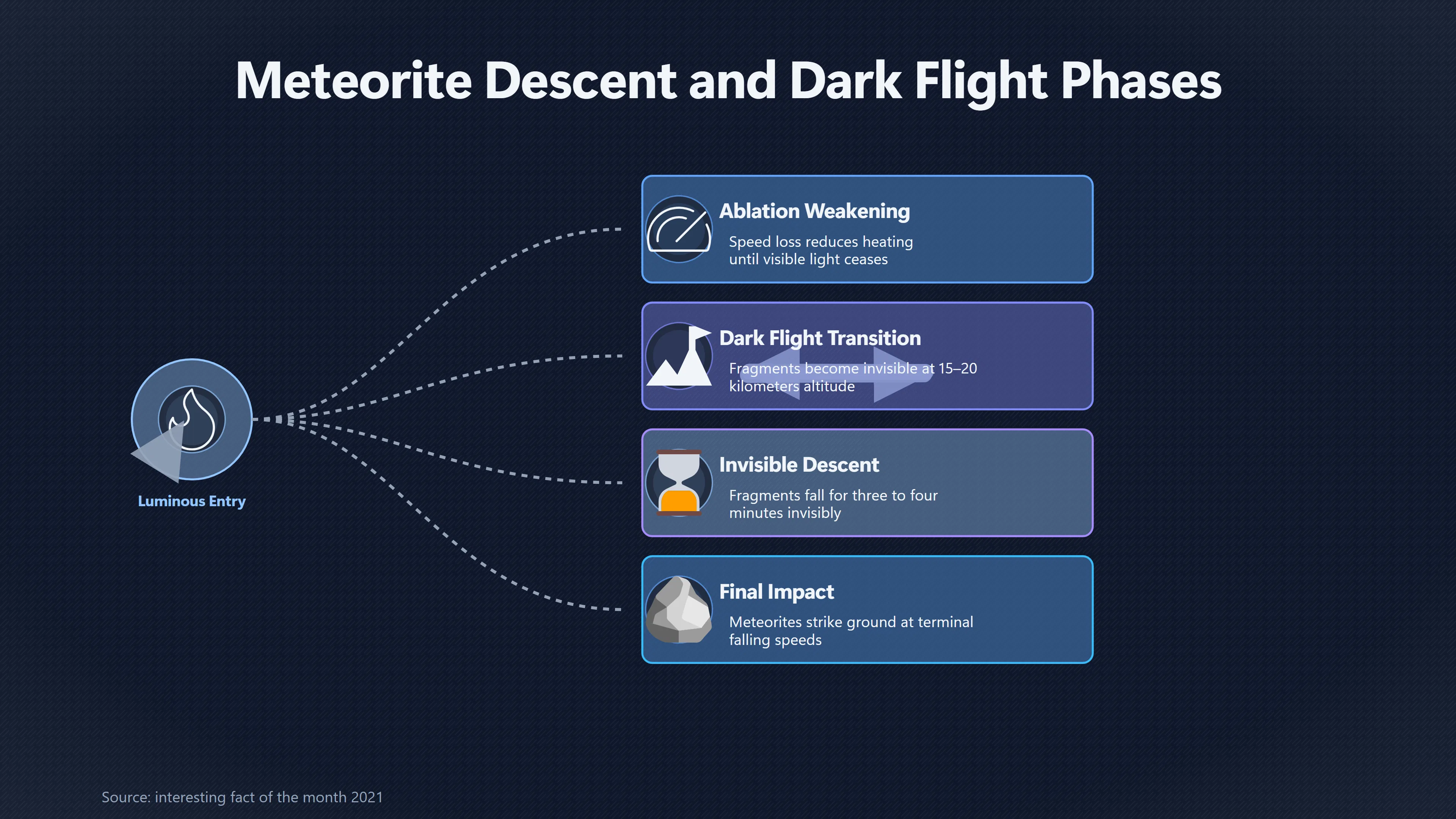
A meteor becomes luminous because the tremendous speed of atmospheric entry compresses and heats the air around it, causing material to vaporise from the object’s surface. As the body loses speed, this ablation process weakens until it can no longer sustain visible light.
For meteorites that survive, the transition usually occurs at altitudes of roughly 15–20 kilometres, although the exact height depends on the object’s size, composition and entry conditions. At this stage the remaining fragments are still travelling at several kilometres per second but rapidly slow to their much lower terminal falling speeds. From then on they are effectively invisible to observers on the ground.[NASA]nasa.govinteresting fact of the month 2021Interesting Fact of the Month 2021 - NASA…
This invisible descent typically lasts around three to four minutes before impact. During that time, witnesses looking towards the point where the fireball disappeared naturally assume they have seen the landing location, even though the surviving fragments are still descending through a large volume of atmosphere.[International Meteor Organization]imo.netInternational Meteor Organization Fireballs and Meteorite Falls | IMOInternational Meteor Organization Fireballs and Meteorite Falls | IMO
How Winds and Drag Move Falling Fragments
Once dark flight begins, the surviving meteorites behave much less like incoming spacecraft and much more like heavy objects falling through moving air.
Instead of following the original high-speed trajectory exactly, each fragment experiences:
- gravitational acceleration towards the ground;
- aerodynamic drag that rapidly reduces its speed to terminal velocity;
- horizontal displacement caused by winds at different altitudes;
- additional variation due to each fragment’s mass, density and shape.
Because upper-level winds often blow in different directions from those near the surface, a meteorite may drift significantly during its final descent. Smaller fragments are especially susceptible because they possess less momentum relative to their surface area and therefore spend longer being pushed sideways by the atmosphere.[NASA Technical Reports Server]ntrs.nasa.govNASA Technical Reports ServerThe Jörmungandr Dark Flight Model for Meteorite and Orbital Debris Recovery - NASA Technical Reports Server…
Modern recovery teams therefore combine observed fireball trajectories with detailed atmospheric wind profiles, frequently obtained from weather balloons or numerical weather models, to estimate where meteorites actually landed. NASA’s Jörmungandr dark-flight model, for example, simulates multiple fragment sizes using measured winds to predict realistic landing zones rather than simply projecting the visible path to the ground.[NASA Technical Reports Server]ntrs.nasa.govNASA Technical Reports ServerThe Jörmungandr Dark Flight Model for Meteorite and Orbital Debris Recovery - NASA Technical Reports Server…
Why Meteorites Form Elongated Strewn Fields
Dark flight also explains why recovered meteorites are usually scattered across an elongated area called a strewn field rather than concentrated at a single impact point.
Fragmentation during the luminous phase produces pieces of different masses before dark flight begins. These fragments then separate further because each responds differently to aerodynamic drag.
In general:
- larger, heavier fragments retain more forward momentum and travel farther before landing;
- smaller fragments slow earlier and may be blown further sideways by the wind;
- multiple breakup events can create several clusters within one overall strewn field.
The result is typically a long, narrow distribution aligned broadly with the direction of travel but modified by prevailing winds. Strong crosswinds can even bend predicted landing zones into curved or “banana-shaped” patterns rather than straight corridors.[NASA Technical Reports Server]ntrs.nasa.govNASA Technical Reports ServerThe Jörmungandr Dark Flight Model for Meteorite and Orbital Debris Recovery - NASA Technical Reports Server…
This characteristic pattern is one of the strongest pieces of evidence that meteorite falls are governed by atmospheric physics rather than by an object crashing intact at the point where witnesses last observed the fireball.

Why the Visible Endpoint Is a Poor Search Target
A common mistake after a spectacular fireball is to organise searches immediately around the place where the light appeared to disappear.
Dark flight makes this unreliable for several reasons:
- the luminous trail usually ends high above the Earth rather than at ground level;
- the fragments continue falling invisibly for minutes afterwards;
- winds alter the eventual landing positions;
- multiple fragments rarely land together.
Consequently, extending an observer’s line of sight to the nearest woodland, lake or hillside almost always identifies the wrong location. Accurate recovery instead requires reconstructing the atmospheric trajectory from multiple camera stations, eyewitness reports, radar or other instrumental observations before modelling the subsequent dark-flight phase.[International Meteor Organization]imo.netInternational Meteor Organization Fireballs and Meteorite Falls | IMOInternational Meteor Organization Fireballs and Meteorite Falls | IMO
Real Recoveries Show the Difference
Instrumentally observed meteorite falls repeatedly demonstrate that successful recoveries depend on modelling dark flight rather than trusting eyewitness impressions alone.
The 2014 Žďár nad Sázavou fall in the Czech Republic illustrates this clearly. Researchers reconstructed the luminous trajectory, modelled fragmentation and dark flight, and predicted where different-sized meteorites should land. The recovered specimens were found very close to the calculated positions, validating the physical models rather than the apparent visual endpoint of the fireball.[arXiv]arxiv.orgThe Žďár nad Sázavou meteorite fall: Fireball trajectory, photometry, dynamics, fragmentation, orbit, and meteorite recoveryDecember…
More recent NASA recovery work likewise uses dark-flight simulations to generate search polygons that account for fragment mass and measured wind conditions. These models routinely predict landing areas displaced from the terminal point of the visible fireball and explain why search teams focus on elongated corridors instead of a single apparent crash site.[NASA Technical Reports Server]ntrs.nasa.govNASA Technical Reports ServerThe Jörmungandr Dark Flight Model for Meteorite and Orbital Debris Recovery - NASA Technical Reports Server…
Why Dark Flight Matters in UFO Crash Claims
Dark flight provides a straightforward physical explanation for many reports that describe a brilliant object apparently plunging into nearby countryside, only for searches to find nothing at the expected location.
The absence of wreckage does not necessarily mean the witnesses imagined the event. Instead, it often reflects a misunderstanding of where the visible phase ended relative to where surviving material eventually landed. When meteorites are recovered after well-documented fireballs, they are typically found only after investigators reconstruct the invisible portion of the descent using atmospheric modelling, not by searching where observers believed the object disappeared.[International Meteor Organization]imo.netInternational Meteor Organization Fireballs and Meteorite Falls | IMOInternational Meteor Organization Fireballs and Meteorite Falls | IMO
Recognising the distinction between the luminous fireball and the subsequent dark-flight phase is therefore one of the most important pieces of evidence separating genuine meteorite falls from the widespread impression that a brilliant object has crashed immediately beyond the horizon.

Amazon book picks
Further Reading
Books and field guides related to Where Meteorites Go After the Light Ends. Use these as the next step if you want deeper reading beyond the article.
Meteorites: The Story of Our Solar System
Meteorite tells the fascinating story of the stones from outer space scattered across our planet. From the impact that finished off the d...
The Cambridge Encyclopedia of Meteorites
Beautifully illustrated with over 140 full colour images, The Cambridge Encyclopedia of Meteorites provides a thorough guide to these fas...
Meteorites: A Journey Through Space and Time
Contains several previously unpublished accounts of meteorite recoveries in Australia and provides deatails on many Australian contributi...
Rocks from Space: Meteorites and Meteorite Hunters
Appendices A-C: Meteorite verification laboratories, Commercial meteorite dealers, Selected list of suspected impact craters worldwide.
eBay marketplace picks
Marketplace Samples
Example marketplace items related to this page. Use the search link to explore similar finds on eBay.
Selected fromUFO decal oneBay.co.uk.

Current eBay listing
Alien UFO Glow In The Dark Sticker (Small) - Peel and Stick!

Endnotes
1.
Source: nasa.gov
Title: interesting fact of the month 2021
Link:https://www.nasa.gov/space-science-and-astrobiology-at-ames/interesting-fact-of-the-month-current/interesting-fact-of-the-month-2021/
Source snippet
Interesting Fact of the Month 2021 - NASA...
2.
Source: ntrs.nasa.gov
Link:https://ntrs.nasa.gov/citations/20230000491
Source snippet
NASA Technical Reports ServerThe Jörmungandr Dark Flight Model for Meteorite and Orbital Debris Recovery - NASA Technical Reports Server...
3.
Source: arxiv.org
Link:https://arxiv.org/abs/1912.11784
Source snippet
The Žďár nad Sázavou meteorite fall: Fireball trajectory, photometry, dynamics, fragmentation, orbit, and meteorite recoveryDecember...
4.
Source: ares.jsc.nasa.gov
Title: ARESARES | Meteorite Falls | Houston, TX
Link:https://ares.jsc.nasa.gov/meteorite-falls/events/houston-tx
Source snippet
Meteorite Falls | Houston, TXMarch 21, 2026 — HOUSTON, TX HOUSTON, TX HOUSTON, TX DATE/TIME 3/21/2026 @ 2140 UTC 3/21/2026 2140 UTC | L...
Published: March 21, 2026
5.
Source: ares.jsc.nasa.gov
Title: meteorite falls
Link:https://ares.jsc.nasa.gov/meteorite-falls/?os=app
Source snippet
Meteorite FallsJune 22, 2026 — METEORITE FALLS MOST RECENT EVENT COCKBURN ISLAND ONTARIO MOST RECENT EVENT COCKBURN ISLAND ONTARIO MOST...
Published: June 22, 2026
6.
Source: nasa.gov
Title: It’s Fireball Season!
Link:https://www.nasa.gov/blogs/watch-the-skies/2026/03/26/its-fireball-season-answering-your-meteor-questions/
Source snippet
Answering Your Meteor Questions - NASAMarch 26, 2026 — WATCH THE SKIES Image Janet Sudnik March 26, 2026 5:18PM CATEGORIES Marshall Space...
Published: March 26, 2026
7.
Source: science.nasa.gov
Title: meteors meteorites
Link:https://science.nasa.gov/solar-system/meteors-meteorites/
8.
Source: science.nasa.gov
Link:https://science.nasa.gov/solar-system/meteors-meteorites/facts/
9.
Source: science.nasa.gov
Link:https://science.nasa.gov/solar-system/meteors-meteorites/exploration/
10.
Source: ares.jsc.nasa.gov
Title: ingalls nc
Link:https://ares.jsc.nasa.gov/meteorite-falls/events/ingalls-nc
11.
Source: exploration.jsc.nasa.gov
Title: meteorites found in natchez ms fall
Link:https://exploration.jsc.nasa.gov/meteorite-falls/updates/meteorites-found-in-natchez-ms-fall
12.
Source: nasa.gov
Title: Tiny Meteors Leave Smoke in the Atmosphere. NASA’s Studying It
Link:https://www.nasa.gov/missions/aim/tiny-meteors-leave-smoke-in-the-atmosphere-nasas-studying-it/
13.
Source: nasa.gov
Title: Why Wasn’t the Russian Meteor Detected Before it Entered the Atmosphere?
Link:https://www.nasa.gov/blogs/watch-the-skies/2013/02/19/why-wasnt-the-russian-meteor-detected-before-it-entered-the-atmosphere/
14.
Source: imo.net
Title: International Meteor Organization Fireballs and Meteorite Falls | IMO
Link:https://www.imo.net/observations/fireballs/meteorites/
15.
Source: imo.net
Title: can a meteorite fall trigger a wildfire
Link:https://www.imo.net/can-a-meteorite-fall-trigger-a-wildfire/
16.
Source: imo.net
Link:https://www.imo.net/observations/fireballs/fireballs/
17.
Source: imo.net
Link:https://www.imo.net/bg/
18.
Source: imo.net
Title: fireball report program
Link:https://www.imo.net/observations/fireballs/fireball-report-program/
19.
Source: imo.net
Link:https://www.imo.net/observations/fireballs/rates/
20.
Source: imo.net
Link:https://www.imo.net/fr/
21.
Source: imo.net
Link:https://www.imo.net/observations/
Additional References
22.
Source: youtube.com
Title: Recovering the Winchcombe meteorite
Link:https://www.youtube.com/watch?v=uKqNptxxHz0
Source snippet
This video on How Weather Radars Track Meteorites explains how radar systems detect falling space rocks during their invisible dark fligh...
23.
Source: youtube.com
Title: On the Trail of Fireballs: Tracking Meteors and Finding Meteorites
Link:https://www.youtube.com/watch?v=iZP69K_a0NI
Source snippet
The Global Meteor Network: A planet-sized scientific instrument...
24.
Source: youtube.com
Title: The Global Meteor Network: A planet-sized scientific instrument
Link:https://www.youtube.com/watch?v=f0LdU1JRpf8
Source snippet
They Built a Network to Catch Meteorites — And Trace Their Origins...
25.
Source: esa.int
Link:https://www.esa.int/Space_Safety/Planetary_Defence/ESA_analysing_fireball_over_Europe_on_8_March_2026?pfrom=mailchimp
Source snippet
ESA analysing fireball over Europe on 8 March 2026March 9, 2026 — ESA ANALYSING FIREBALL OVER EUROPE ON 8 MARCH 2026 09/03/2026 246...
Published: March 9, 2026
26.
Source: doi.org
Link:https://doi.org/10.1093%2Fmnras%2Fstab586
27.
Source: meteoritical.org
Link:https://meteoritical.org/meteorites
28.
Source: nationalgeographic.com
Link:https://www.nationalgeographic.com/science/article/fireball-meteors
29.
Source: youtube.com
Title: How Weather Radars Track Meteorites
Link:https://www.youtube.com/watch?v=EcC6IoqkjDQ
Source snippet
On the Trail of Fireballs: Tracking Meteors and Finding Meteorites...
30.
Source: pnnl.gov
Title: fall recovery and classification park forest meteorite
Link:https://www.pnnl.gov/publications/fall-recovery-and-classification-park-forest-meteorite
31.
Source: youtube.com
Title: They Built a Network to Catch Meteorites — And Trace Their Origins
Link:https://www.youtube.com/watch?v=_hpS1W3CiOs
Source snippet
Recovering the Winchcombe meteorite...