Within Proof Standard
Does the Debris Field Tell One Story?
A genuine crash should leave a physically coherent pattern of wreckage, deformation and ground disturbance that matches its claimed trajectory.
On this page
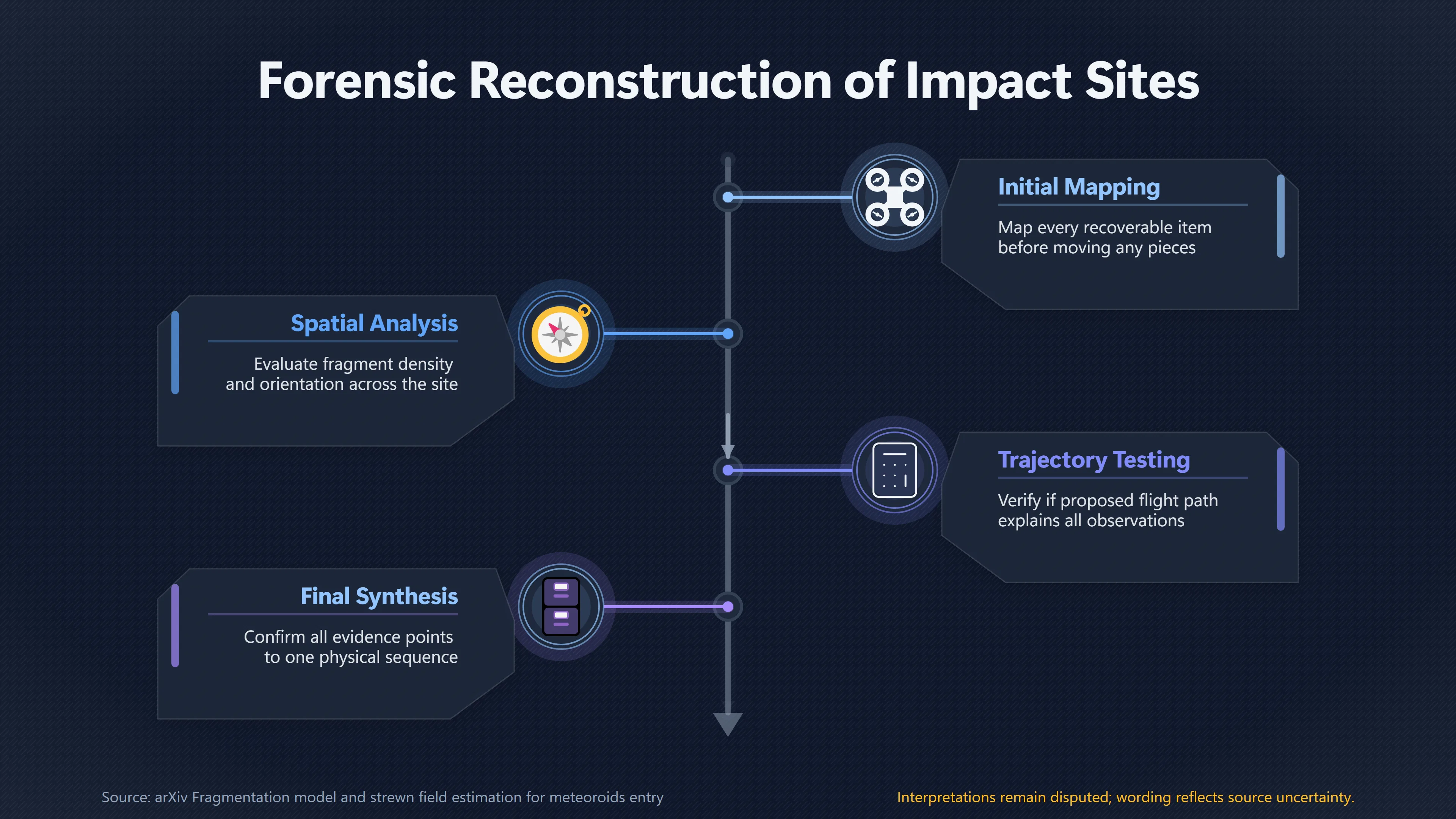
- Mapping wreckage position and orientation
- Reading fractures, deformation and heat damage
- Testing whether the claimed flight path fits the scene
Page outline Jump by section
Introduction
A claimed UFO crash cannot be supported by isolated fragments alone. A genuine high-energy impact should leave a coherent debris field: a pattern of wreckage, ground disturbance and damaged material that can be reconstructed into a single physical sequence. This is the same principle used in aircraft accident investigation, explosive forensics and meteorite recovery. Investigators ask whether the positions, orientations and conditions of recovered objects agree with one another and with the claimed trajectory. If the pieces tell conflicting stories, the crash hypothesis weakens. If they consistently point to one impact direction, one sequence of break-up and one location where energy was transferred into the ground, the physical evidence becomes much more persuasive. Publicly documented UFO crash claims have not yet produced a debris field that has been independently documented and reconstructed to this forensic standard.[USGS]usgs.govMeteoroid mayhem in Ole Virginny: Source of the North American tektite strewn field | U.S. Geological SurveyJanuary 1, 1994…
Does the debris field tell one story?
A real impact is expected to produce an organised distribution rather than a random collection of unusual objects. Investigators begin by mapping every recoverable item before anything is moved. Modern accident reconstruction relies on precise coordinates, photographs, drone surveys and three-dimensional scene mapping so that the relationships between objects remain intact throughout the investigation.
The key question is consistency. Every major piece of evidence should fit the same physical narrative. If one group of fragments indicates travel from north to south while another suggests an unrelated origin, investigators must determine whether there were multiple events, later disturbance or contamination of the scene.
Rather than asking whether a single object looks unusual, investigators ask whether all evidence supports one reconstruction. This shift—from judging individual artefacts to evaluating the complete pattern—is one of the strongest safeguards against false conclusions.
Mapping wreckage position and orientation
The spatial arrangement of debris often reveals how an object failed.
Investigators examine factors such as:
- the overall length and width of the debris field;
- the density of fragments across the site;
- whether heavier objects lie closer to the apparent impact point while lighter material is scattered farther away;
- the orientation of elongated fragments, scrape marks and vegetation damage;
- whether fragments become progressively smaller in the direction of travel.
These observations are interpreted together rather than individually. Wind, water, slopes, rescue activity and human collection can all alter a scene after the event, so investigators distinguish between primary deposition and later movement.
Meteorite recoveries illustrate this principle well. Known meteorite falls often produce “strewn fields” in which atmospheric fragmentation creates a predictable distribution of recovered pieces along the flight path. Recovery teams use observed trajectories, atmospheric models and systematic ground searches because fragment locations are expected to reflect the dynamics of the break-up rather than random chance.[arXiv]arxiv.orgarXiv Fragmentation model and strewn field estimation for meteoroids entryFragmentation model and strewn field estimation for meteoroids entryMay 31, 2021…
What fractures and damage reveal
The condition of debris is as informative as its location. Materials retain evidence of the forces that acted upon them, allowing investigators to distinguish between impact damage, manufacturing defects, weathering and deliberate alteration.
Important observations include:
- Fracture surfaces. Fresh fractures differ from old breaks that have weathered or corroded over time.
- Plastic deformation. Bent metal records the direction and magnitude of forces more reliably than brittle fragments alone.
- Heat effects. Melting, oxidation and thermal gradients can indicate whether heating occurred during atmospheric passage, impact, fire after impact or unrelated industrial processes.
- Embedded material. Soil, rock fragments or vegetation driven into damaged surfaces may demonstrate high-energy contact with the environment.
- Compression patterns. Flattened vegetation, disturbed sediment or displaced rocks should align with the same impact direction inferred from the debris.
No single feature proves extraordinary origin. Heat damage, for example, can result from conventional aircraft fires, industrial equipment or natural wildfires. The significance lies in whether multiple independent indicators converge on one physically plausible sequence.
Does the claimed flight path match the scene?
After mapping debris and examining damage, investigators test whether the proposed trajectory explains everything observed.
This reconstruction asks questions such as:
- Where would the object have first struck the ground?
- Did it fragment before impact or afterwards?
- Does the spacing between fragments match the estimated speed?
- Are ground scars aligned with witness reports and sensor data?
- Could gravity, terrain or prevailing winds account for the final distribution?
The process is iterative. If calculations predict fragments in areas where none are found, investigators reconsider the assumed trajectory, impact angle or even whether the reported event occurred at all.
This approach is widely used outside UFO investigations. Aircraft accident investigators reconstruct break-up sequences from debris distributions, while planetary scientists infer asteroid collisions from the geometry of ejecta and fragment trails. For example, observations of asteroid P/2010 A2 showed an X-shaped debris structure and extended dust trails whose geometry matched expectations from a collision rather than ordinary comet activity. The interpretation rested on the coherence of the entire debris pattern rather than on any single fragment.[NASA Science]science.nasa.govScience Suspected Asteroid Collision Leaves Trailing DebrisNASA ScienceSuspected Asteroid Collision Leaves Trailing Debris - NASA ScienceFebruary 2, 2010…
What weakens a claimed crash site?
Many alleged crash sites fail because the physical scene cannot be reconstructed into one consistent event.
Common weaknesses include:
- objects recovered without documented original locations;
- debris collected years after the reported incident;
- fragments originating from different periods or manufacturers;
- disturbed ground that cannot be distinguished from normal agricultural, construction or natural processes;
- witness accounts that disagree with measurable physical evidence;
- isolated “exotic” materials lacking any demonstrable connection to the surrounding site.
These problems do not necessarily prove a hoax, but they prevent investigators from demonstrating that all recovered material originated from one impact.
Forensic reconstruction depends on relationships between objects. Once those relationships are lost, even sophisticated laboratory analysis cannot reliably recreate the original scene.

Why pattern matters more than unusual materials
Within the broader question of what would constitute convincing evidence of a UFO crash, debris-field reconstruction serves as an independent test of physical reality. An unfamiliar alloy, an unexplained fragment or an eyewitness account may justify further investigation, but none can establish a crash on their own.
A persuasive case would require every major line of evidence to reinforce the same sequence: a documented approach path, a coherent debris distribution, compatible fracture and deformation patterns, consistent ground disturbance and laboratory findings that all point to one event. If these independent observations cannot be reconciled into a single physically consistent reconstruction, the debris does not demonstrate a genuine impact, regardless of how unusual any individual fragment may appear. Current publicly available UFO crash claims have not produced a debris field documented to that standard.
Amazon book picks
Further Reading
Books and field guides related to Does the Debris Field Tell One Story?. Use these as the next step if you want deeper reading beyond the article.
Aircraft Accident Investigation
Beskrivelse af situationer omkring flyvehavarier samt gennemgang af forhold i f.m. undersøgelser og udfærdigelse af rapporter.
Practical Crime Scene Processing and Investigation
All too often, the weakest link in the chain of criminal justice is the crime scene investigation. Improper collection of evidence blocks...
Fractography: Observing, Measuring and Interpreting Fracture...
An advanced 1999 text for those working in materials science and related inter-disciplinary subjects.
eBay marketplace picks
Marketplace Samples
Live-tested eBay searches with available results related to this page.
Selected fromcrash scene model oneBay.co.uk.


Endnotes
1.
Source: usgs.gov
Link:https://www.usgs.gov/publications/meteoroid-mayhem-ole-virginny-source-north-american-tektite-strewn-field-0
Source snippet
Meteoroid mayhem in Ole Virginny: Source of the North American tektite strewn field | U.S. Geological SurveyJanuary 1, 1994...
Published: January 1, 1994
2.
Source: jpl.nasa.gov
Link:https://www.jpl.nasa.gov/news/suspected-asteroid-crash-leaves-odd-debris-trail/
Source snippet
NASA Jet Propulsion Laboratory (JPL)Suspected Asteroid Crash Leaves Odd Debris Trail | NASA Jet Propulsion Laboratory (JPL)...
3.
Source: arxiv.org
Title: arXiv Fragmentation model and strewn field estimation for meteoroids entry
Link:https://arxiv.org/abs/2105.14776
Source snippet
Fragmentation model and strewn field estimation for meteoroids entryMay 31, 2021...
Published: May 31, 2021
4.
Source: arxiv.org
Link:https://arxiv.org/abs/2602.15440
5.
Source: pubs.usgs.gov
Title: Publications Meteoroids and impact craters
Link:https://pubs.usgs.gov/publication/70168934
Source snippet
USGS PublicationsMeteoroids and impact craters...
6.
Source: science.nasa.gov
Title: Science Suspected Asteroid Collision Leaves Trailing Debris
Link:https://science.nasa.gov/missions/hubble/suspected-asteroid-collision-leaves-trailing-debris/
Source snippet
NASA ScienceSuspected Asteroid Collision Leaves Trailing Debris - NASA ScienceFebruary 2, 2010...
Published: February 2, 2010
7.
Source: science.nasa.gov
Title: close up views of nasas dart impact to inform planetary defense
Link:https://science.nasa.gov/missions/close-up-views-of-nasas-dart-impact-to-inform-planetary-defense/
8.
Source: usgs.gov
Link:https://www.usgs.gov/publications/characterizing-meteor-crater-impact-melts-through-geochemistry-and-textural-analysis
9.
Source: science.nasa.gov
Title: hubble captures movie of dart asteroid impact debris
Link:https://science.nasa.gov/missions/hubble/hubble-captures-movie-of-dart-asteroid-impact-debris/
10.
Source: pubs.usgs.gov
Link:https://pubs.usgs.gov/publication/70195110
11.
Source: science.nasa.gov
Title: dissecting the scene of sky crane crash
Link:https://science.nasa.gov/resource/dissecting-the-scene-of-sky-crane-crash/
12.
Source: science.nasa.gov
Title: s hubble captures first images of aftermath of possible asteroid collision
Link:https://science.nasa.gov/missions/hubble/nasas-hubble-captures-first-images-of-aftermath-of-possible-asteroid-collision/
13.
Source: science.nasa.gov
Link:https://science.nasa.gov/?p=25319
14.
Source: nodis3.gsfc.nasa.gov
Title: display All.cfm
Link:https://nodis3.gsfc.nasa.gov/displayAll.cfm?Internal_ID=N_PR_86210001&page_name=ALL
15.
Source: nodis3.gsfc.nasa.gov
Title: display CA.cfm
Link:https://nodis3.gsfc.nasa.gov/displayCA.cfm?Internal_ID=N_PR_86210001&page_name=AppdxB1
16.
Source: usgs.gov
Title: Evidence of the impacting body of the Ries crater
Link:https://www.usgs.gov/publications/evidence-impacting-body-ries-crater-discovery-fe-cr-ni-veinlets-below-crater-bottom
17.
Source: pubs.usgs.gov
Link:https://pubs.usgs.gov/publication/70159492
18.
Source: pubs.usgs.gov
Link:https://pubs.usgs.gov/publication/70017300
19.
Source: pubs.usgs.gov
Link:https://pubs.usgs.gov/publication/70135344
20.
Source: pubs.usgs.gov
Link:https://pubs.usgs.gov/publication/ofr59108
21.
Source: usgs.gov
Title: Impact mechanics at Meteor Crater, Arizona | U.S. Geological Survey
Link:https://www.usgs.gov/publications/impact-mechanics-meteor-crater-arizona
Additional References
22.
Source: aaro.mil
Title: bases its assessment on the object’s strong morphological consistency w
Link:https://www.aaro.mil/Next-AARO-Home-redesign/Next-Parent/Next-AARO-UAP-Imagery-Acc-Table/
Source snippet
Next - AARO UAP Imagery Acc TableMay 8, 2026 — AARO assesses, with high confidence, that the object depicted in the video is almost certa...
Published: May 8, 2026
23.
Source: migflug.com
Title: Structures specialists document every significant piece of wreckag
Link:https://migflug.com/jetflights/what-actually-happens-after-a-mid-air-collision-inside-the-ntsb-investigation/
Source snippet
What Actually Happens After a Mid-Air Collision: Inside the NTSB Investigation | Afterburner - MiGFlug's MagazineMay 25, 2026 — READING T...
Published: May 25, 2026
24.
Source: ecfr.io
Title: 14 CFR 450.121 | Debris analysis
Link:https://ecfr.io/Title-14/Section-450.121
Source snippet
15, 2026 — § 450.121 DEBRIS ANALYSIS. 14 CFR 450.121 Citation 14 CFR 450.121 Corpus Daily eCFR Displayed edition 2026-04-1...
Published: April 15, 2026
25.
Source: defense.gov
Link:https://www.defense.gov/News/News-Stories/Article/Article/3701297/dod-report-discounts-sightings-of-extraterrestrial-technology/
26.
Source: youtube.com
Title: 200 Earth Impact Craters Mapped by Size and Age
Link:https://www.youtube.com/watch?v=iTed69ef1ks
Source snippet
Why Are Most Impact Craters Perfectly Circular? (Rather than Ovals)...
27.
Source: youtube.com
Title: Combine Drone Photos & Laser Scanners for Crash Scenes
Link:https://www.youtube.com/watch?v=m3ckvstBtUo
Source snippet
The Search for a Massive Meteorite Impact With No Crater...
28.
Source: aaro.mil
Link:https://www.aaro.mil/UAP-Cases/Official-UAP-Imagery/4/
29.
Source: trans-safe.org
Link:https://www.trans-safe.org/toolbox/crash-programme-investigation-procedures
30.
Source: amnh.org
Link:https://www.amnh.org/exhibitions/permanent/meteorites/meteorite-impacts/meteor-crater
31.
Source: govinfo.gov
Title: Crash Investigation and Reconstruction Technologies and Best Practices
Link:https://www.govinfo.gov/app/details/GOVPUB-TD2-PURL-gpo143615