Within UFO Crashes
How Media Changed Famous UFO Crash Stories
Books, television and repeated interviews can stabilise dramatic details that were absent from the earliest reports.
On this page
- From local report to national legend
- Repeated interviews and narrative convergence
- Entertainment, memory and public expectation
Page outline Jump by section
Introduction
Media retellings do not merely preserve UFO crash stories; they can reorganise them. A brief local report about scattered debris may, decades later, become a national legend involving an intact craft, alien bodies, military intimidation and secret autopsies. The transformation usually happens through accumulation rather than a single invention: books combine interviews taken years apart, television dramatises uncertain testimony, later witnesses encounter established story elements, and repeated interviews encourage accounts to converge around the version audiences already recognise.
Roswell is the clearest example. Contemporary records from July 1947 describe recovered material resembling a high-altitude balloon and radar reflector, with no documented bodies or intact spacecraft. The familiar alien-crash narrative emerged mainly after the case was revived in the late 1970s, then expanded through books, documentaries, television reconstructions and the widely broadcast “alien autopsy” film.[fbi.gov]vault.fbi.govRoswell UFOOnRoswell UFOOn July 8, 1947, the FBI Dallas Field Office sent a teletype regarding a “flying disc” that resembled a high altitude weath…
This does not prove that every later witness was dishonest. Memory is reconstructive: people recall events using fragments of experience, later information and expectations about what “must” have happened. The central historical question is therefore not simply whether a witness sounded sincere, but when each detail entered the public story, what media the witness had encountered, and whether an earlier independent record supports it.
From local report to national legend
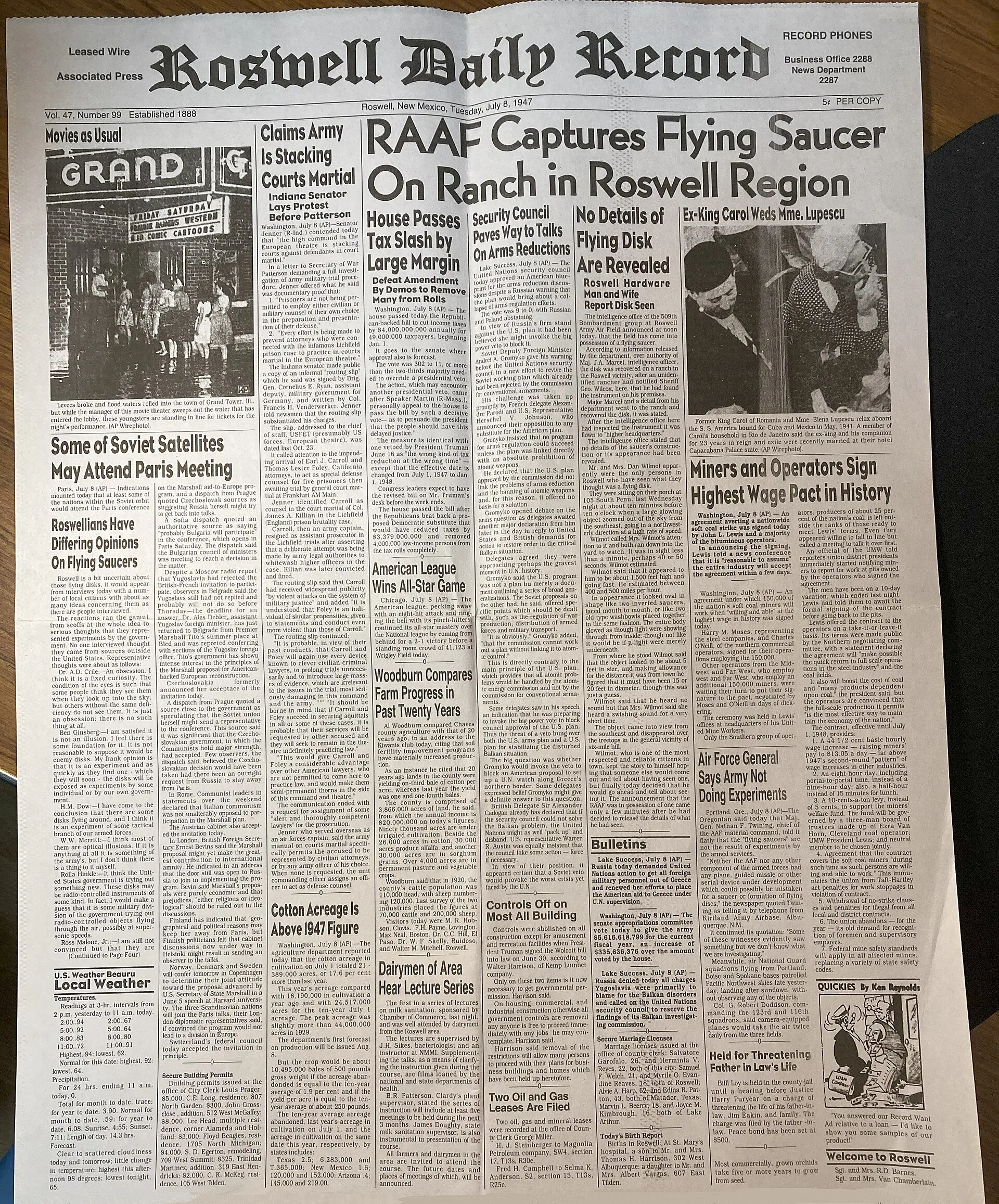
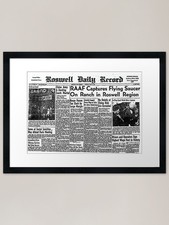
The first Roswell story was dramatic but limited. On 8 July 1947, Roswell Army Air Field announced that it had obtained a “flying disc” from a local ranch. The claim was quickly replaced by a balloon explanation, while an FBI teletype written that day described the recovered object as resembling a high-altitude weather balloon with an attached radar reflector. The surviving contemporary documentary trail does not describe an intact vehicle, an impact crater, alien occupants or an autopsy.[FBI]vault.fbi.govRoswell UFOOnRoswell UFOOn July 8, 1947, the FBI Dallas Field Office sent a teletype regarding a “flying disc” that resembled a high altitude weath…
That distinction matters because the original “flying disc” phrase later functioned as a narrative seed. In 1947, “flying disc” was a new and unstable journalistic label, popularised during a nationwide wave of reports after pilot Kenneth Arnold’s sighting. Arnold had compared the objects’ motion to saucers skipping across water, but press coverage helped turn “saucer” into a description of their shape. Roswell’s press release therefore appeared inside an already developing media vocabulary rather than as a precise technical identification of a recovered spacecraft.[TIME]time.comThis Is Why People Think UFOs Look Like 'Flying SaucersThe fascination grew to include an incident on July 7, when a New Mexico rancher found what was initially thought to be a crashed flying…
After the brief burst of reporting, Roswell attracted little sustained national attention for roughly three decades. The case was revived in 1978 when UFO researcher Stanton Friedman interviewed retired intelligence officer Jesse Marcel, who had helped collect the debris. Marcel’s later belief that the material was unearthly became the foundation for a reconstructed crash narrative, although it was not supported by a comparable contemporary statement from 1947.[TIME]time.comroswell historyBrazel encontró restos extraños en su rancho cerca de Roswell, N.M. Tras contactar al Sheriff George Wilcox, quien a su vez llamó la base…
The decisive media step was the 1980 book The Roswell Incident by Charles Berlitz and William Moore. It turned scattered recollections into a coherent story of extraterrestrial wreckage and government concealment. The book introduced or popularised features that were absent from the earliest records, including extraordinarily strong material, substituted debris, intimidation and reports of small bodies at a second site. Its account did not simply add detail to a stable event; it supplied a framework into which later testimony could be placed.[Wikipedia]WikipediaThe Roswell Incident (1980 bookThe Roswell Incident (1980 book
The book also illustrates how editorial selection shapes a crash case. Its authors said that they had contacted more than 90 witnesses, but only a minority appeared in the published narrative, and still fewer claimed direct contact with the debris. Testimony that supported extraordinary material received prominence, while mundane descriptions were less useful to the central argument. Once published, however, the selected version became easier for subsequent writers, interviewers and witnesses to treat as the underlying event rather than one contested interpretation of it.[Wikipedia]WikipediaThe Roswell Incident (1980 bookThe Roswell Incident (1980 book
Repeated interviews and narrative convergence
A witness interviewed decades after an event is not retrieving an untouched recording. The person may have discussed the incident with relatives, read books, watched documentaries, heard other witnesses and rehearsed the story repeatedly. Memory research calls one relevant process source confusion: a person remembers a detail but misattributes its origin, treating something heard later as something personally seen at the time.[Cambridge Resolve]cambridge.orgResolve Memory source monitoring and eyewitness testimony When called upon to testify, eyewitnesses must distinguish between memories ofResolve Memory source monitoring and eyewitness testimony When called upon to testify, eyewitnesses must distinguish between memories of
The misinformation effect describes the broader finding that misleading post-event information can alter later recall. Experiments have shown that repeated testing does not necessarily protect the original memory; under some conditions, testing before exposure to misinformation can make the later suggestion more influential. This is known as retrieval-enhanced suggestibility.[PsychNet]psychnet.wustl.eduOpen source on wustl.edu.
A related mechanism is memory conformity, in which people’s accounts become more alike after they encounter the statements of other supposed witnesses. Experimental research indicates that repeated misinformation and information presented by multiple sources can increase its persuasive force. Several apparently independent retellings may therefore reinforce one another even when they ultimately trace back to the same book, interviewer or television programme.[PubMed Central (PMC)]pmc.ncbi.nlm.nih.govPub Med Central (PMC)Experimental and meta-analytic evidence that sourcePub Med Central (PMC)Experimental and meta-analytic evidence that source
These findings cannot determine whether a particular Roswell witness remembered accurately. They do show why late testimony must be evaluated differently from a statement recorded before extensive publicity. The longer the delay and the richer the surrounding media environment, the harder it becomes to separate original perception from later interpretation.
Roswell’s later history displays several signs of narrative convergence:
- More elaborate debris: Early descriptions concerned lightweight wreckage. Later accounts increasingly emphasised foil that could not be cut, burned, bent or permanently creased.
- A shift from debris to bodies: The documented 1947 material did not include occupants. Body stories entered the popular narrative through later, often second-hand testimony and became progressively central.
- Multiple crash sites: Competing books placed the supposed craft or bodies at different locations, sometimes abandoning earlier sites when testimony became difficult to reconcile.
- A standard cover-up sequence: Threats, confiscated evidence, substituted wreckage and silenced medical personnel became recurring narrative components, even though the details varied between versions.
The problem was not merely that witnesses disagreed. Disagreement is normal. More revealing was the way published versions reorganised contradictions into successive narratives. One book might promote a particular witness or site; another would discard it and introduce a replacement while preserving the larger conclusion that a spacecraft and bodies had been recovered.[Wikipedia]WikipediaRoswell incidentRoswell incident
Jim Ragsdale’s story, discussed in later Roswell literature, demonstrates the risks of iterative interviewing. Accounts attributed to him changed across interviews, including the position of the alleged crash and increasingly elaborate claims about the craft and objects removed from it. Frank Kaufman became another important media witness, appearing in documentaries and describing radar tracking and a recovery operation, but investigations found conflicts involving his service history, available technology and the geography of the claimed site.[Wikipedia]WikipediaRoswell incidentRoswell incident
Glenn Dennis’s mortuary and alien-autopsy story followed a similar path from interview testimony into books, museums and television. Dennis described calls concerning small coffins and a nurse who had allegedly witnessed alien bodies. Difficulties identifying the nurse, including successive names that could not be verified, weakened the account. Yet the dramatic structure of the story—medical preparations, a distressed nurse and a concealed autopsy—made it especially suitable for television retelling.[Wikipedia]WikipediaRoswell incidentRoswell incident
Television turns uncertainty into scenes
Books can preserve ambiguity in footnotes and qualifications. Television usually needs images, characters and a sequence of events. A tentative second-hand claim may therefore become a fully staged scene: soldiers surround wreckage, witnesses see bodies, a nurse enters an examination room, or an officer issues a threat. Even when labelled a reconstruction, the visual version may become the form viewers remember.
This produces an important evidential reversal. The dramatisation is created from a witness account, but after repeated broadcasts it can appear to validate that account. Later documentaries reuse the imagery, interview participants beside reconstructed crash scenes and present several retellings in quick succession. The audience receives a continuous story even though its components may come from different decades, incompatible locations or witnesses who never met.
Television also rewards narrative completion. A programme about uncertain debris has limited visual possibilities; a programme about an alien recovery can feature crash-site searches, body transport, autopsy rooms and government secrecy. Producers need not deliberately fabricate evidence for this pressure to operate. Choices about pacing, editing and which interview excerpts to retain can make the extraordinary interpretation feel more coherent than the underlying record.
Roswell’s movement into mass television accelerated this process. Programmes such as Unsolved Mysteries exposed large audiences to body-recovery claims, while later books served as the basis for dramatised films. By the mid-1990s, the case was no longer mainly a dispute about debris found on a ranch. Its expected imagery included a wrecked craft, humanoid occupants and medical examination.[Wikipedia]WikipediaRoswell incidentRoswell incident
The alien autopsy becomes remembered evidence
The 1995 “alien autopsy” film shows how entertainment can attach new imagery to an older crash story. British producer Ray Santilli promoted grainy black-and-white footage as film of an extraterrestrial body recovered after Roswell. Fox broadcast Alien Autopsy: Fact or Fiction? in the United States, and the material circulated internationally through television and home video.[Wikipedia]WikipediaAlien Autopsy (1995 filmAlien Autopsy (1995 film
The footage was not supported by a documented chain of custody linking it to 1947. Participants later described how it had been created using a fabricated body and animal material, and Santilli acknowledged that the widely seen film was staged, while continuing to claim that it reconstructed lost original footage. That residual claim allowed the imagery to remain partially insulated from disproof: even if the film was manufactured, believers could argue that it represented something real.[Wikipedia]WikipediaAlien Autopsy (1995 filmAlien Autopsy (1995 film
Its historical importance lies less in whether every viewer believed it than in the visual template it supplied. Before the broadcast, Roswell’s alleged bodies existed mainly through words, drawings and dramatisations. Afterwards, millions had seen apparently archival pictures of a large-headed humanoid on an examination table. The footage made a disputed late addition to the story feel like a recovered visual record.
The programme’s “fact or fiction” format also blurred the difference between testing evidence and staging a debate. Skeptical opinions could be included while the supposed film was replayed at length. Images are often retained more easily than verbal cautions, particularly when the cautions are conditional or appear between repeated viewings of dramatic material. The result can be familiarity without belief: even viewers who reject the footage may later associate the autopsy image with the historical Roswell case.

Entertainment, memory and public expectation
Popular culture does not need to persuade viewers that a specific crash occurred in order to reshape what a UFO crash is expected to contain. Films and television have established a recognisable package: a luminous craft falls in an isolated area; armed personnel seal the site; unusual metal is collected; bodies are moved to a secret base; witnesses are warned; and an official cover story replaces the truth.
Once this narrative grammar becomes familiar, incomplete reports are easier to interpret through it. Military activity near a debris field looks like containment. Missing paperwork looks like deliberate destruction. Inconsistent testimony becomes evidence of intimidation. A lack of photographs suggests confiscation rather than absence. Each gap can be absorbed into a story whose expected features were learned from previous retellings.
This creates a feedback loop between witnesses, researchers and audiences. Interviewers know which details make a crash case significant. Witnesses know which details the public associates with Roswell. Publishers and broadcasters select accounts that can be fitted into an intelligible dramatic sequence. Audiences then use that sequence to judge future incidents. Repetition makes the narrative feel culturally verified even when the underlying claims remain dependent on one another.
The process can also erase distinctions between separate legends. Elements from the discredited Aztec crashed-saucer story—including an intact craft, unusual metals and small humanoid bodies—resembled details that later appeared in Roswell narratives. As stories are retold in anthologies, documentaries and interviews, features can migrate from one case to another while their original source becomes obscure.[Wikipedia]WikipediaThe Roswell Incident (1980 bookThe Roswell Incident (1980 book
Media attention can nevertheless improve scrutiny. Publicity draws researchers to archives, exposes witnesses to cross-examination and encourages official searches for records. The Government Accountability Office’s 1995 review examined reporting requirements and surviving government material connected with Roswell, while the US Air Force produced detailed reports addressing the debris and later body claims. These inquiries were themselves responses to a legend expanded through publishing and broadcasting.[gao.gov]gao.govnsiadNSIAD-95-187 Government Records28 Jul 1995 — July 28, 1995 The. We conducted an extensive search for government records related to the…
The limitation is that corrections rarely reproduce the emotional force of the original story. A report explaining balloon components, test programmes or chronological conflicts competes with decades of vivid images. Once a crash case has acquired memorable scenes, documentary rebuttal may become merely another episode in the narrative—sometimes interpreted as further evidence that authorities are defending a cover-up.
Reading retold crash cases critically
The most useful way to assess a media-shaped UFO crash story is to reconstruct its publication history as carefully as its alleged event history. A dramatic statement made in 1994 should not be silently treated as evidence recorded in 1947. A scene shown in a television film should not be confused with a photograph from the event. Ten witnesses repeating the same detail are not independent corroboration when all encountered the detail through the same researcher or broadcast.
Several questions help separate historical evidence from narrative growth:
- When was the detail first recorded? The earliest dated version should be compared with later versions rather than replaced by them.
- Was the account first-hand? Stories attributed to deceased friends, unnamed nurses or unidentified military personnel are harder to verify.
- What had the witness already seen or read? Exposure to books, conventions, museums and television matters when evaluating late recollections.
- Did interviewers use leading assumptions? Questions that presuppose bodies, threats or exotic materials can narrow the account before it is documented.
- Did the story remain stable? Changes in location, chronology, number of bodies or witness role may reveal adaptation rather than added precision.
- Are sources genuinely independent? Several publications may all derive from one interview, manuscript or investigator.
- What does the earliest physical record show? Contemporary documents, photographs and securely traced material should carry more weight than narrative vividness.
Media retellings are not irrelevant to UFO crash history. They are part of that history. They explain how a modest recovery report can become a durable cultural event, why witnesses separated by decades begin using similar imagery, and why disputed late details can overshadow contemporary records. In famous crash cases, the story’s transmission is therefore not a side issue. It is one of the principal mechanisms that must itself be investigated.
Amazon book picks
Further Reading
Books and field guides related to How Media Changed Famous UFO Crash Stories. Use these as the next step if you want deeper reading beyond the article.
The Roswell Incident
Fully illustrated, "The Roswell Incident" is the definitive book on America's most documented alien encounter. It not only explores every...
Mirage Men: A Journey into Disinformation, Paranoia and UFOs
Seeking the truth about UFOs in America, Mark Pilkington and John Lundberg uncover a 60 year-old story stranger than any conspiracy thril...
Roswell: Inconvenient Facts and the Will to Believe
Voici la solution du plus grand mystère de l'histoire des ovnis : l'affaire de Roswell dans le Nouveau Mexique. Après avoir annoncé à la...
Suspicious Minds: Why We Believe Conspiracy Theories
Suspicious Minds decodes the psychology of why we all believe in conspiracy theories--some of us just hide it better than others.
eBay marketplace picks
Marketplace Samples
Live-tested eBay searches with available results related to this page.
Selected fromRoswell UFO poster oneBay.co.uk.
Endnotes
1.
Source: vault.fbi.gov
Title: Roswell UFOOn
Link:https://vault.fbi.gov/Roswell%20UFO
Source snippet
Roswell UFOOn July 8, 1947, the FBI Dallas Field Office sent a teletype regarding a “flying disc” that resembled a high altitude weath...
Published: July 8, 1947
2.
Source: gao.gov
Title: nsiad 95 187
Link:https://www.gao.gov/assets/nsiad-95-187.pdf
Source snippet
NSIAD-95-187 Government Records28 Jul 1995 — July 28, 1995 The. We conducted an extensive search for government records related to the...
Published: July 28, 1995
3.
Source: time.com
Title: roswell history
Link:https://time.com/3916193/roswell-history/
Source snippet
Brazel encontró restos extraños en su rancho cerca de Roswell, N.M. Tras contactar al Sheriff George Wilcox, quien a su vez llamó la base...
4.
Source: time.com
Title: This Is Why People Think UFOs Look Like ‘Flying Saucers’
Link:https://time.com/3930602/first-reported-ufo/
Source snippet
The fascination grew to include an incident on July 7, when a New Mexico rancher found what was initially thought to be a crashed flying...
5.
Source: Wikipedia
Title: The Roswell Incident (1980 book)
Link:https://en.wikipedia.org/wiki/The_Roswell_Incident_%281980_book%29
6.
Source: Wikipedia
Title: Roswell incident
Link:https://en.wikipedia.org/wiki/Roswell_incident
7.
Source: resolve.cambridge.org
Link:https://resolve.cambridge.org/core/services/aop-cambridge-core/content/view/D91E27C9DBCF5DA8E21FAAC672E3C263/9780511759192c2_p27-55_CBO.pdf/memory-source-monitoring-and-eyewitness-testimony.pdf
8.
Source: Wikipedia
Title: Alien Autopsy (1995 film)
Link:https://en.wikipedia.org/wiki/Alien_Autopsy_%281995_film%29
9.
Source: time.com
Title: alien autopsy hoax history
Link:https://time.com/4376871/alien-autopsy-hoax-history/
10.
Source: gao.gov
Link:https://www.gao.gov/assets/a157449.html
11.
Source: gao.gov
Link:https://www.gao.gov/assets/a301955.html
12.
Source: gao.gov
Title: rced 98 118
Link:https://www.gao.gov/assets/rced-98-118.pdf
13.
Source: gao.gov
Link:https://www.gao.gov/assets/a235613.html
14.
Source: gao.gov
Link:https://www.gao.gov/assets/710/700974.pdf
15.
Source: gao.gov
Link:https://www.gao.gov/assets/nsiad-98-57.pdf
16.
Source: gao.gov
Link:https://www.gao.gov/assets/a248044.html
17.
Source: gao.gov
Link:https://www.gao.gov/assets/gao-10-678.pdf
18.
Source: gao.gov
Link:https://www.gao.gov/assets/680/678340.pdf
19.
Source: vault.fbi.gov
Link:https://vault.fbi.gov/search?SearchableText=Roswell+UFO
20.
Source: vault.fbi.gov
Link:https://vault.fbi.gov/search?SearchableText=ufo
21.
Source: vault.fbi.gov
Link:https://vault.fbi.gov/search?SearchableText=roswell
22.
Source: vault.fbi.gov
Link:https://vault.fbi.gov/search?SearchableText=UFO+Part&%3Bb_start%3Aint=0
23.
Source: vault.fbi.gov
Link:https://vault.fbi.gov/search?SearchableText=[Unexplained
24.
Source: vault.fbi.gov
Link:https://vault.fbi.gov/Roswell%20UFO/Roswell%20UFO%20Part%2001%20%28Final%29/view
25.
Source: vault.fbi.gov
Link:https://vault.fbi.gov/search?Subject%3Alist=Hot+Topics
26.
Source: vault.fbi.gov
Title: alphabetical listing collection
Link:https://vault.fbi.gov/alphabetical-listing-collection?b_start%3Aint=1500
27.
Source: vault.fbi.gov
Link:https://vault.fbi.gov/search?SearchableText=flying+disc&b_start%3Aint=60
28.
Source: Wikipedia
Title: False memory
Link:https://en.wikipedia.org/wiki/False_memory
29.
Source: Wikipedia
Title: Misinformation effect
Link:https://en.wikipedia.org/wiki/Misinformation_effect
30.
Source: Wikipedia
Title: Roswell Daily Record
Link:https://en.wikipedia.org/wiki/Roswell_Daily_Record
31.
Source: time.com
Title: roswell or bust
Link:https://time.com/archive/6598147/roswell-or-bust/
32.
Source: time.com
Title: did aliens really land
Link:https://time.com/archive/6731010/did-aliens-really-land/
33.
Source: psychnet.wustl.edu
Link:https://psychnet.wustl.edu/memory/wp-content/uploads/2018/04/Roediger-et-al-1996_JML.pdf
34.
Source: pmc.ncbi.nlm.nih.gov
Title: Pub Med Central (PMC)Experimental and meta-analytic evidence that source
Link:https://pmc.ncbi.nlm.nih.gov/articles/PMC10492197/
35.
Source: esd.whs.mil
Link:https://www.esd.whs.mil/Portals/54/Documents/FOID/Reading%20Room/UFOsandUAPs/RoswellReportCaseClosed.pdf
36.
Source: pubmed.ncbi.nlm.nih.gov
Link:https://pubmed.ncbi.nlm.nih.gov/22905934/
37.
Source: pmc.ncbi.nlm.nih.gov
Link:https://pmc.ncbi.nlm.nih.gov/articles/PMC12702595/
38.
Source: api.repository.cam.ac.uk
Link:https://api.repository.cam.ac.uk/server/api/core/bitstreams/7e659cb7-0114-4f1f-9d39-845228f9022d/content
39.
Source: frieze.com
Title: roswell incident
Link:https://www.frieze.com/article/roswell-incident
40.
Source: jhmovie.fandom.com
Title: Roswell incident
Link:https://jhmovie.fandom.com/wiki/Roswell_incident
41.
Source: books.google.com
Title: The Roswell Incident
Link:https://books.google.com/books/about/The_Roswell_Incident.html?id=AwPL_isJdjoC
Additional References
42.
Source: wired.com
Title: 0708army announces roswell new mexico ufo sighting
Link:https://www.wired.com/2010/07/0708army-announces-roswell-new-mexico-ufo-sighting
Source snippet
Initially, the military claimed the debris was from a weather balloon, but interest was reignited in the 1980s when new interviews and Ch...
43.
Source: skyatnightmagazine.com
Title: roswell ufo incident
Link:https://www.skyatnightmagazine.com/space-science/roswell-ufo-incident
Source snippet
Sky at Night MagazineRoswell UFO incident facts and history26 Jun 2025 — The story of the Roswell UFO incident was rediscovered in 1978 b...
44.
Source: youtube.com
Link:https://www.youtube.com/watch?v=H4AxRTzASxE
Source snippet
Reel America: "The Roswell Reports" - 1997 U.S. Air Force Film...
45.
Source: media.defense.gov
Title: AFD 101027 030
Link:https://media.defense.gov/2010/Oct/27/2001330219/-1/-1/0/AFD-101027-030.pdf
Source snippet
Department of WarU.S. Air Force: "The Roswell Report: Case Closed"observations of alien bodies associated with the " Roswell Incident...
46.
Source: nature.com
Link:https://www.nature.com/articles/s41598-024-84154-0
47.
Source: youtube.com
Title: Reel America: “The Roswell Reports”
Link:https://www.youtube.com/watch?v=m7rVSri-7es
Source snippet
Area 51, Roswell & the Pentagon Files | Full Documentary...
48.
Source: researchgate.net
Link:https://www.researchgate.net/publication/257464926_Are_Two_Interviews_Better_Than_One_Eyewitness_Memory_across_Repeated_Cognitive_Interviews
49.
Source: psichi.org
Link:https://www.psichi.org/page/214EyeSum17dLoftus
50.
Source: eprints.bournemouth.ac.uk
Link:https://eprints.bournemouth.ac.uk/39507/1/Applied%20Cognitive%20Psychology%20-%202024%20-%20Bird%20-%20The%20efficacy%20of%20the%20Self%25E2%2580%2590Administered%20Interview%20in%20minimising%20the.pdf
51.
Source: spacecentre.co.uk
Link:https://www.spacecentre.co.uk/collections/categories/space-oddities/fake-roswell-alien-head/