Within Emergency Response
When Safety Precautions Look Like UFO Secrecy
Fuel, batteries, pressure vessels, pyrotechnics and other unknown hazards can justify evacuations and specialist handling before debris is identified.
On this page
- Hazards hidden inside aircraft and aerospace debris
- Why responders assume the worst until identification
- How safety measures are retold as concealment
Page outline Jump by section
Introduction
When emergency crews respond to unknown wreckage, their first priority is not identifying what the object is but ensuring that nobody is injured by hazards they cannot yet assess. Fuel, high-energy batteries, pressurised tanks, pyrotechnic devices, toxic materials and, in rare cases, radioactive sources are all recognised risks associated with aircraft, spacecraft and other aerospace equipment. Standard emergency practice therefore assumes the worst until specialists can identify the debris safely.
Within UFO crash narratives, however, these precautionary measures are often reinterpreted as evidence that authorities are concealing an extraordinary discovery. Evacuations, roadblocks, specialist teams and restrictions on photography can appear suspicious when viewed without the underlying safety context. In reality, these actions usually reflect established emergency-management procedures designed to protect responders and the public while preserving evidence for technical investigation.[faa.gov]faa.govFederal Aviation AdministrationMandatory and Voluntary Incident Reporting | Federal Aviation AdministrationApril 12, 2024…
Hazards Hidden Inside Aircraft and Aerospace Debris
Unknown debris may contain dangers that are invisible to bystanders. Responders cannot determine from appearance alone whether apparently harmless fragments are stable or dangerous.
Examples include:
- Residual aviation fuel, hydraulic fluids and oxygen systems that can ignite long after impact.
- Lithium battery packs, increasingly common in modern aircraft, drones and satellites, which can enter thermal runaway, producing intense fires and toxic gases.
- Pressurised vessels, including oxygen bottles, nitrogen systems and accumulators, which may rupture if damaged or heated.
- Pyrotechnic devices, such as aircraft ejection-seat cartridges, emergency parachute deployment systems or spacecraft separation charges, which may remain live after a crash.
- Composite materials, especially carbon-fibre structures, which can produce hazardous airborne fibres when burned or broken.
- Potential radioactive sources, although uncommon in aircraft accidents, are sufficiently hazardous that emergency doctrine requires responders to isolate suspicious objects until experts assess them. Regulatory agencies maintain specific procedures for unidentified radioactive items because accidental exposure has caused serious injuries in past incidents.[faa.gov]faa.govFederal Aviation AdministrationMandatory and Voluntary Incident Reporting | Federal Aviation AdministrationApril 12, 2024…
From the perspective of someone arriving at the scene, none of these hazards is obvious. A quiet field containing scattered metallic debris may nevertheless justify a complete exclusion zone.
Why Responders Assume the Worst Until Identification
Emergency services work from uncertainty rather than confirmation. At the beginning of an incident they often know only that something has fallen from the sky, exploded or burned.
This uncertainty changes operational priorities:
- Rescue must begin before investigators know what crashed.
- Hazardous materials are assumed possible until ruled out.
- Access is restricted to prevent unnecessary exposure.
- Specialists may be summoned before there is evidence that unusual materials are actually present.
This approach follows a precautionary principle common throughout emergency management: the consequences of underestimating a hazard can be catastrophic, while establishing a temporary safety perimeter is comparatively inexpensive and reversible.
For example, hazardous-material reporting requirements in aviation treat battery fires, explosions, chemical releases and suspected radioactive contamination as situations requiring immediate notification and specialist response. Responders therefore have strong institutional incentives to isolate an incident rapidly instead of waiting for complete information.[Federal Aviation Administration]faa.govFederal Aviation AdministrationMandatory and Voluntary Incident Reporting | Federal Aviation AdministrationApril 12, 2024…
Why Safety Measures Are Easily Retold as Concealment
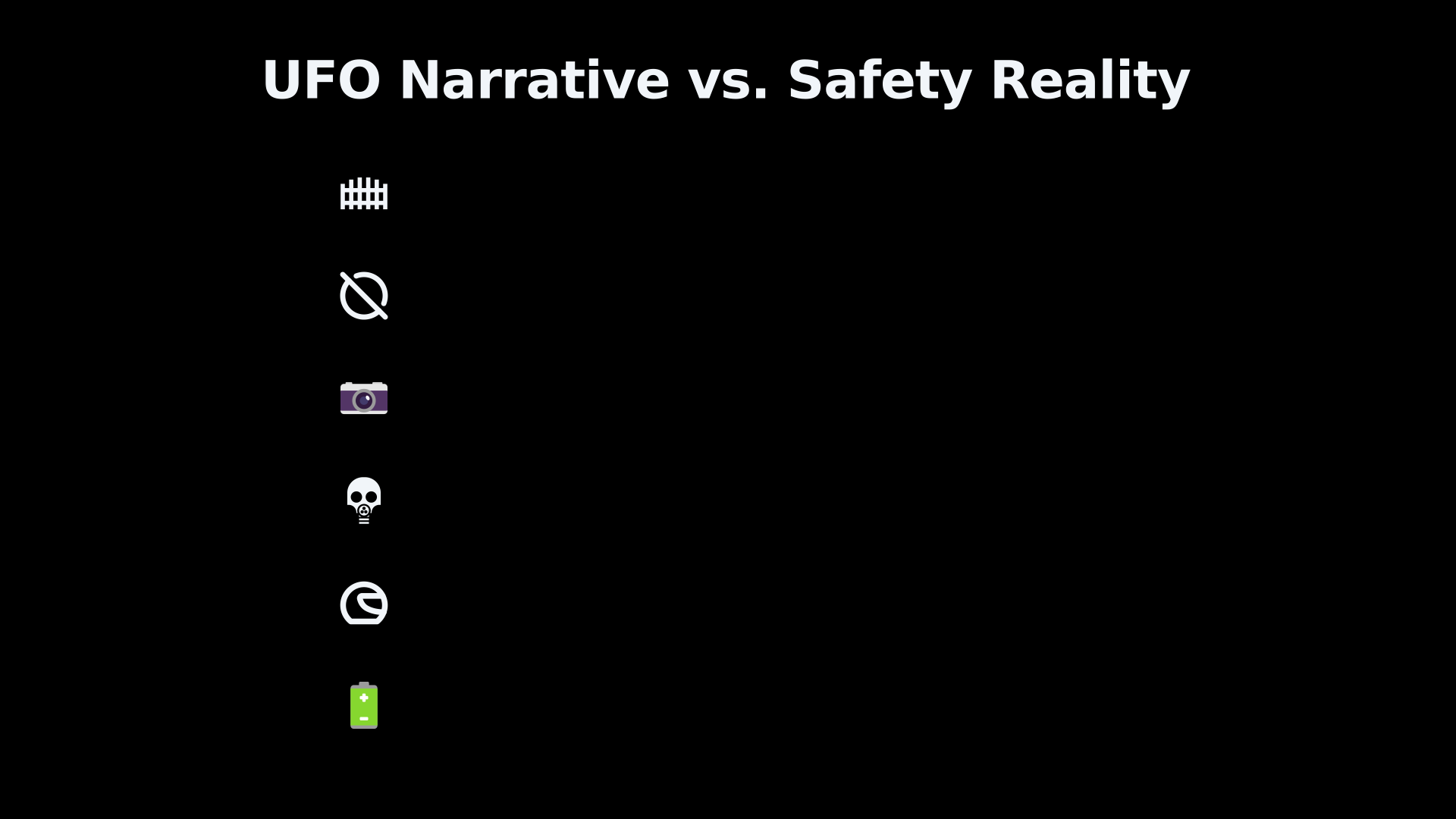
Many actions that look secretive from outside a cordon are, in fact, routine safety procedures.
Emergency precautionLater UFO interpretationPolice establish a perimeterAuthorities are hiding the objectMilitary explosive-ordnance specialists attendThe object contains advanced technologyWitnesses are moved awayOfficials are suppressing testimonyDebris is removed quicklyEvidence is being confiscatedPhotography is restrictedProof is being hiddenInvestigators wear protective equipmentThe wreckage is dangerously exotic
The misunderstanding develops because observers usually see only the visible restrictions, not the risk assessment behind them. Emergency crews rarely explain every operational decision while managing an active incident, allowing speculation to fill the information gap.
The same mechanism appears in many alleged UFO crash stories: the existence of protective measures becomes treated as evidence about the identity of the object rather than evidence that responders considered the object potentially hazardous.
Rare Hazards Make Precaution Reasonable
One reason emergency agencies adopt conservative procedures is that unusual hazards genuinely do exist, even if they are uncommon.
Radioactive “orphan sources” illustrate the principle. These are radioactive devices that have been lost, abandoned or separated from regulatory control. Emergency guidance instructs anyone discovering an unidentified potentially radioactive object not to touch it, to evacuate nearby people, secure the area and summon specialists immediately. These instructions exist because past accidents have shown that brief handling of powerful unshielded sources can produce severe injuries.[iaea.org]gnssn.iaea.orgNucleus Scrap Metal Tool KitNucleusScrap Metal Tool Kit - Prevention and Response…
Although most aircraft wreckage contains no radioactive material, responders cannot immediately exclude specialised equipment, industrial cargo, scientific payloads or military hardware. Consequently, temporary exclusion zones are justified by uncertainty rather than by evidence that radioactive material is actually present.
The same logic applies to explosive devices, toxic propellants and damaged pressure systems. Safety protocols are designed for the possibility of these hazards, not because responders have already confirmed them.

How Information Gaps Feed UFO Narratives
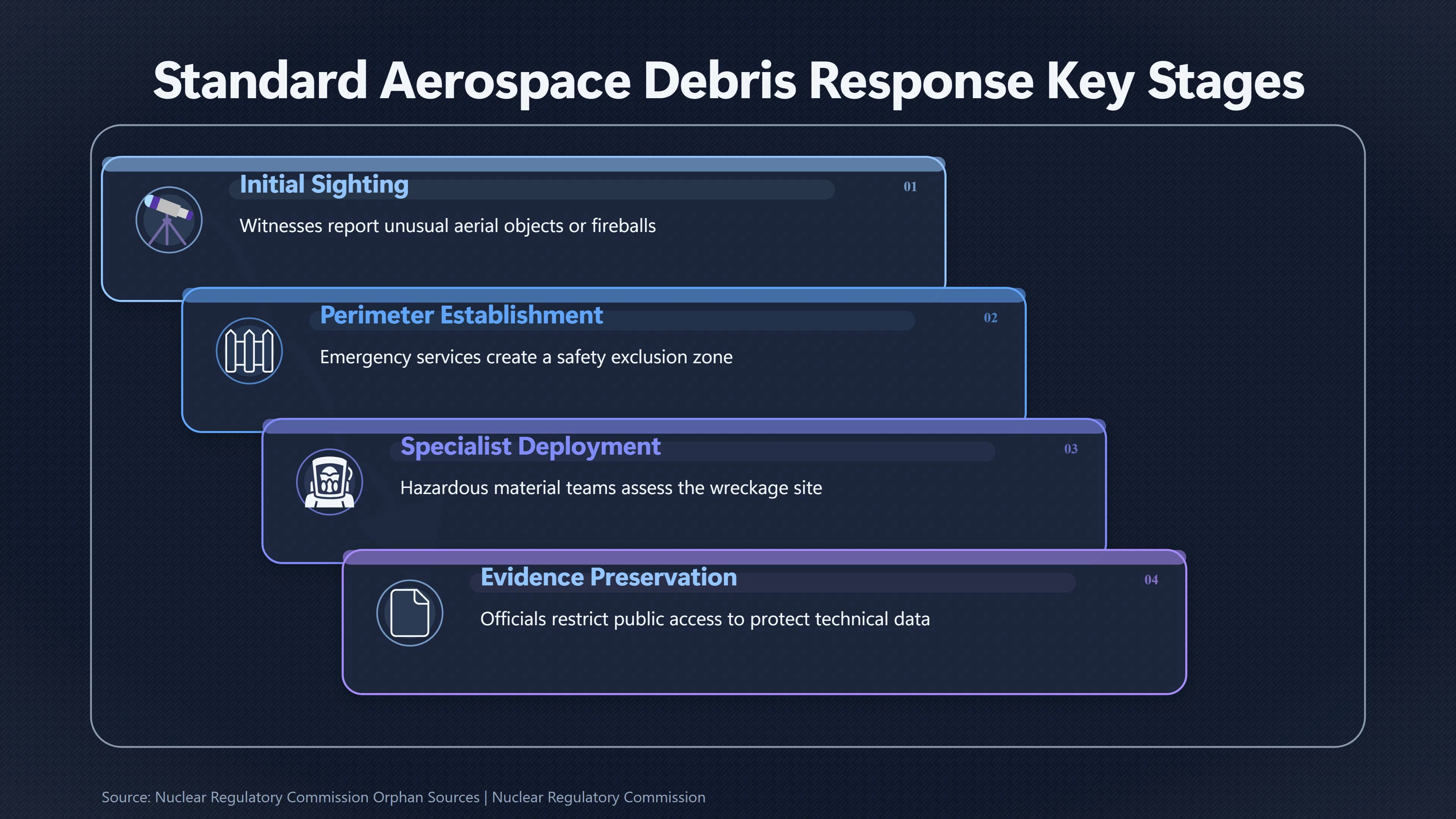
A typical sequence leading from routine safety response to secrecy claims follows a recognisable pattern:
- Witnesses report an unusual aerial object or fireball.
- Emergency services establish a safety perimeter.
- Specialists examine debris before allowing public access.
- Officials release little information until identification is complete.
- Observers interpret the restricted access as evidence that something extraordinary was discovered.
Each step is individually consistent with normal emergency practice. However, when later retellings omit the initial uncertainty and focus only on visible restrictions, the response can appear unusually secretive.
This pattern is reinforced by hindsight. Once a UFO explanation enters the story, ordinary precautions—protective suits, guarded vehicles or controlled removal of debris—are reinterpreted as confirmation rather than as predictable consequences of standard hazard management.
Understanding the Mechanism
The mechanism behind many UFO secrecy claims is therefore straightforward: ordinary emergency precautions become separated from the safety reasoning that produced them. Unknown aerospace debris can contain fire, explosion, chemical, electrical or radiological hazards that are impossible to identify safely from a distance. Emergency responders accordingly establish exclusion zones, limit public access and rely on specialist teams before making any public conclusions.
These actions may look secretive to observers, but they arise from established risk-management practice rather than from evidence that an object is extraterrestrial. The appearance of concealment is often an unintended by-product of cautious emergency response to genuinely uncertain hazards.
Amazon book picks
Further Reading
Books and field guides related to When Safety Precautions Look Like UFO Secrecy. Use these as the next step if you want deeper reading beyond the article.
The UFO Experience: A Scientific Inquiry
Cited by the New York Review of Books as "the best brief for visitation," this classic study presents an analysis of UFO reports and conc...
UFOs: Generals, Pilots, and Government Officials Go on the Re...
NEW YORK TIMES BESTSELLER • Impeccably researched, this riveting journalistic investigation separates fact from fiction, and documents th...
Aircraft Accident Investigation
Beskrivelse af situationer omkring flyvehavarier samt gennemgang af forhold i f.m. undersøgelser og udfærdigelse af rapporter.
Managing the Unexpected
Since the first edition of Managing the Unexpected was published in 2001, the unexpected has become a growing part of our everyday lives....
eBay marketplace picks
Marketplace Samples
Live-tested eBay searches with available results related to this page.
Selected fromalien warning poster oneBay.co.uk.

Endnotes
1.
Source: faa.gov
Link:https://www.faa.gov/hazmat/incident-reporting
Source snippet
Federal Aviation AdministrationMandatory and Voluntary Incident Reporting | Federal Aviation AdministrationApril 12, 2024...
Published: April 12, 2024
2.
Source: nrc.gov
Title: Nuclear Regulatory Commission Orphan Sources | Nuclear Regulatory Commission
Link:https://www.nrc.gov/materials/miau/miau-reg-initiatives/orphan
3.
Source: gnssn.iaea.org
Title: Nucleus Scrap Metal Tool Kit
Link:https://gnssn.iaea.org/CSN/Scrap/SitePages/Prevention%20and%20Response.aspx
Source snippet
NucleusScrap Metal Tool Kit - Prevention and Response...
4.
Source: nucleus-apps.iaea.org
Title: Nucleus Apps IAEA Safety and Security Series
Link:https://nucleus-apps.iaea.org/nss-oui/Content/Index?CollectionId=m_cf69469a-99ce-4443-b225-f8abf10cdff3&type=PublishedCollection
Source snippet
Nucleus AppsIAEA Safety and Security Series - Online Users Interface | Content...
5.
Source: faa.gov
Title: compliance enforcement mishap
Link:https://www.faa.gov/space/compliance_enforcement_mishap
Source snippet
Compliance, Enforcement & Mishap | Federal Aviation AdministrationJune 2, 2026 — We must also ensure that no one is engaged in commercial...
Published: June 2, 2026
6.
Source: content.govdelivery.com
Link:https://content.govdelivery.com/accounts/USAFAA/bulletins/4193e61
Source snippet
Federal Aviation Administration sent this bulletin at 05/29/2026 02:28 PM EDT MAY 2026 “Hazmat Highlights” is the FAA’s Of...
Published: MAY 2026
7.
Source: faa.gov
Title: If so, keep in mind that packing safely s
Link:https://www.faa.gov/blog/clearedfortakeoff/packing-flight-read-fine-print
Source snippet
Before Packing for a Flight, Read the Fine Print | Federal Aviation AdministrationFebruary 19, 2026 — BEFORE PACKING FOR A FLIGHT, READ T...
Published: February 19, 2026
8.
Source: content.govdelivery.com
Link:https://content.govdelivery.com/accounts/USAFAA/bulletins/4067df0
Source snippet
Federal Aviation Administration sent this bulletin at 01/30/2026 10:59 AM EST JANUARY 2026 “Hazmat Highlights” is the...
Published: JANUARY 2026
9.
Source: faa.gov
Title: Resources for Shippers & E-Commerce | Federal Aviation Administration
Link:https://www.faa.gov/hazmat/safecargo/resources
10.
Source: faa.gov
Title: Cargo Safety | Federal Aviation Administration
Link:https://www.faa.gov/hazmat/air_carriers/cargo_safety
11.
Source: faa.gov
Title: Boeing 747-44AF | Federal Aviation Administration
Link:https://www.faa.gov/lessons_learned/transport_airplane/accidents/N571UP
12.
Source: faa.gov
Title: Common Cargo Hazards | Federal Aviation Administration
Link:https://www.faa.gov/aircraft/safety/cargosafety/cargo_hazards
13.
Source: conferences.iaea.org
Link:https://conferences.iaea.org/event/262/contributions/21299/
14.
Source: iaea.org
Link:https://www.iaea.org/node/12190
15.
Source: iaea.org
Title: statement international conference security radioactive sources
Link:https://www.iaea.org/newscenter/statements/statement-international-conference-security-radioactive-sources
16.
Source: iaea.org
Title: disposal options for disused radioactive sources
Link:https://www.iaea.org/publications/7185/disposal-options-for-disused-radioactive-sources
17.
Source: gnssn.iaea.org
Title: Case 7 Detection.aspx
Link:https://gnssn.iaea.org/CSN/Scrap/Case%20Study/Case%207%20-%20Detection.aspx
18.
Source: nucleus.iaea.org
Title: c e6af9985 f923 490c ad94 d4a340a66a2b 8 0
Link:https://nucleus.iaea.org/sites/nss-oui/Published%20Chunks/m_cf69469a-99ce-4443-b225-f8abf10cdff3/c_e6af9985-f923-490c-ad94-d4a340a66a2b__8_0.Html
19.
Source: gnssn.iaea.org
Link:https://gnssn.iaea.org/CSN/Scrap/Publications/Home.aspx
20.
Source: www-pub.iaea.org
Title: qg ind2
Link:https://www-pub.iaea.org/mtcd/publications/pdf/epr-first_res-pda/html/qg-ind2.htm
Additional References
21.
Source: content.govdelivery.com
Title: Lithium battery electronic devices must be in carry-on lugga
Link:https://content.govdelivery.com/accounts/USAFAA/bulletins/41476dc
Source snippet
Office of Hazardous Materials Safety Hazmat Highlights - April 2026April 30, 2026 — TRANSPORT LITHIUM BATTERIES IN CARRY-ON LUGGAGE Trave...
Published: April 30, 2026
22.
Source: youtube.com
Link:https://www.youtube.com/watch?v=H4AxRTzASxE
Source snippet
The Top Secret Project That Spawned the [Roswell]({{ 'roswell/' | relative_url }}) UFO Incident...
23.
Source: youtube.com
Link:https://www.youtube.com/watch?v=qwgYcnatLm0
Source snippet
The Roswell Incident Mystery Finally Solved...
24.
Source: youtube.com
Title: The Roswell Incident Mystery Finally Solved
Link:https://www.youtube.com/watch?v=Pz0vYcc4KiI
Source snippet
UFO Roswell Incident (Full Episode) | Undercover History Updates | National Geographic...
25.
Source: nrc.gov
Title: Orphan sources (unwanted radioactive material) | Nuclear Regulatory Commission
Link:https://www.nrc.gov/reading-rm/basic-ref/glossary/orphan-sources-unwanted-radioactive-material.html
26.
Source: phmsa.dot.gov
Title: advisory guidance transportation batteries and battery powered
Link:https://www.phmsa.dot.gov/regulatory-compliance/phmsa-guidance/advisory-guidance-transportation-batteries-and-battery-powered
27.
Source: ntsb.gov
Title: Lithium-ion Battery Explosion Leads to Fire on Oil Tanker
Link:https://www.ntsb.gov/news/press-releases/Pages/NR20231109.aspx
28.
Source: ntsb.gov
Title: Contact The National Transportation Safety Board
Link:https://www.ntsb.gov/about/Pages/OfficeLocation.aspx
29.
Source: phmsa.dot.gov
Title: aviation recommendations
Link:https://www.phmsa.dot.gov/hazmat/ntsb-safety-recommendations/aviation-recommendations
30.
Source: www-s.ntsb.gov
Title: mwl2017 safety recs.aspx
Link:https://www-s.ntsb.gov/Advocacy/mwl/Pages/mwl2017-safety-recs.aspx