Within Radar Targets
Why Flimsy Reflectors Looked Like Advanced Wreckage
Paper-backed foil and angular frames could make a fragile balloon target seem like unfamiliar manufactured wreckage.
On this page
- The materials hidden inside the shiny surface
- How angular construction changed first impressions
- Why weight and appearance seemed contradictory
Page outline Jump by section
Introduction
One reason the earliest Roswell debris descriptions sounded more like the remains of an unfamiliar machine than an ordinary balloon is that the radar reflectors attached to some balloon trains combined an unusual visual appearance with extremely light construction. When intact, these reflectors presented crisp geometric forms made from reflective laminated surfaces stretched across angular frames. After impact, they collapsed into a confusing mixture of shiny foil-like sheets, stiff paper, adhesive tape and thin wooden members. To someone unfamiliar with specialised radar equipment in 1947, that combination could appear manufactured, purposeful and unlike everyday household materials, even though it was built from inexpensive components. Contemporary technical documentation and later Air Force analysis describe reflector assemblies made from paper-backed metallic laminates, balsa wood, twine and tape, closely matching many of the earliest descriptions of the Roswell debris.[gutenberg.org]gutenberg.orgOpen source on gutenberg.org.

The materials hidden inside the shiny surface
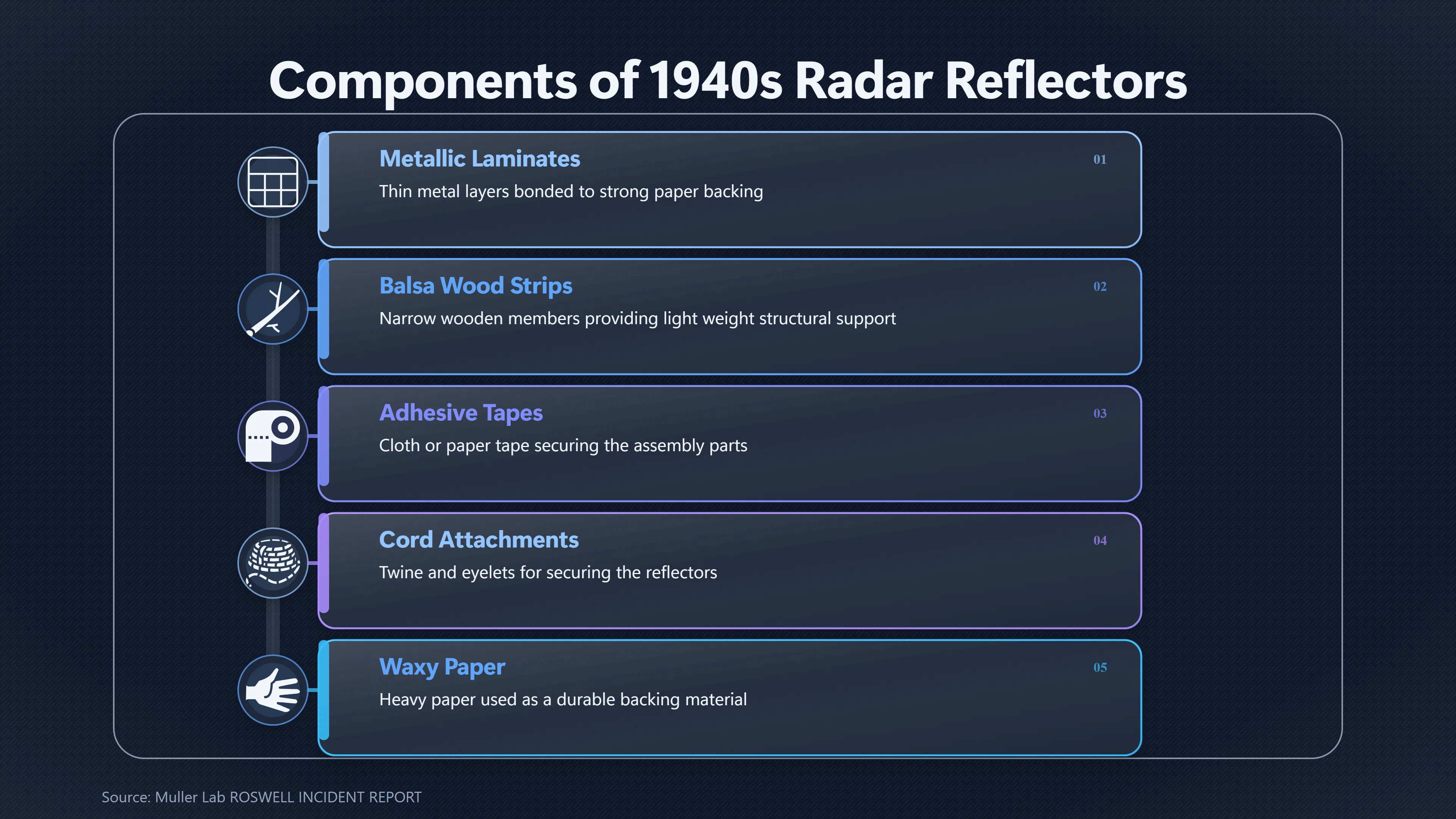
The reflective faces of 1940s radar targets were not simply loose aluminium foil. Most were laminates in which a thin metallic layer was bonded to a stronger paper backing. This gave the panels greater stiffness, allowing them to hold precise angles while remaining exceptionally light. From a distance, the metallic surface suggested solid sheet metal, but close inspection revealed an unusual combination of metallic sheen and paper-like texture that many people would not have encountered before.[Project Gutenberg]gutenberg.orgOpen source on gutenberg.org.
This construction also explains why early witness accounts often described several seemingly contradictory materials together:
- bright metallic fragments;
- heavy or waxy paper;
- thin wooden strips;
- cloth or paper tape;
- eyelets and cord attachment points.
Rather than representing unrelated objects, these were all parts of the same manufactured reflector assembly. Once the laminated panels tore away from their frames, the debris no longer resembled a recognisable device but instead appeared to be fragments from an unknown piece of equipment.[Project Gutenberg]gutenberg.orgOpen source on gutenberg.org.
How angular construction changed first impressions
The machine-like impression came as much from geometry as from materials. Radar reflectors relied on carefully arranged flat panels positioned at right angles to one another to create an effective corner reflector for radar tracking. Unlike a natural object or an ordinary weather balloon, the assembled target displayed repeated straight lines, sharp corners and symmetrical forms.
Even after partial collapse, broken sections retained these geometric features. Witnesses encountering isolated triangular or diamond-shaped fragments could reasonably conclude that they came from a deliberately engineered object rather than from packaging or domestic refuse. The overall appearance resembled part of a lightweight framework rather than the soft, rounded shape most people associated with balloons.[lbl.gov]muller.lbl.govMuller Lab ROSWELL INCIDENT REPORTMuller Lab ROSWELL INCIDENT REPORT
The visual effect was amplified because the reflector’s structural members were extremely thin. Instead of heavy beams, the frame consisted of narrow balsa strips that nevertheless held large reflective surfaces at precise angles. This contrast between delicate supports and rigid-looking geometry made the assembly appear more technically sophisticated than its inexpensive construction suggested.
Why weight and appearance seemed contradictory
Perhaps the most striking feature was the mismatch between appearance and weight. Large reflective panels normally imply substantial metal construction, yet these radar targets weighed only a few pounds. Their radar performance depended on shape rather than mass, so every unnecessary gram was eliminated.
Someone lifting scattered debris therefore encountered an unexpected combination:
- metallic-looking surfaces with almost no weight;
- manufactured geometric shapes that broke into fragile pieces;
- structural components that looked engineered but could be snapped by hand.
This violated everyday expectations. Most manufactured machines of the 1940s were made from steel, aluminium castings or heavy timber. An object that looked mechanically constructed yet weighed almost nothing naturally seemed unfamiliar. That perception helps explain why descriptions often stressed both the debris’s artificial appearance and its surprising lightness without requiring genuinely exotic materials.[gutenberg.org]gutenberg.orgOpen source on gutenberg.org.
Why unfamiliarity mattered in 1947
The appearance of these reflector assemblies has to be understood in historical context. Radar was still relatively new to the public, and specialised balloon-borne tracking targets were not common civilian equipment. Ranchers, local law enforcement officers and even many military personnel would have had little reason to recognise a collapsed radar reflector on sight.
Mac Brazel’s earliest newspaper descriptions referred to foil-like material, paper, sticks and rubber rather than advanced alloys or impossible technology. Those observations align closely with documented reflector construction. Later recollections, recorded decades after the event, often described increasingly unusual material properties, creating an important distinction between contemporaneous accounts and retrospective testimony.[history.com]history.comRoswell - New Mexico, Alien & UFOs | HISTORY…
What this mechanism explains—and what it does not
The “machine-like debris” explanation addresses a specific puzzle: why lightweight balloon equipment could initially be perceived as the remains of an unfamiliar manufactured object.
It helps explain:
- why reflective fragments appeared metallic despite being paper-backed laminates;
- why angular shapes suggested engineered construction;
- why the debris looked more complex than an ordinary weather balloon;
- why observers remarked on the unusual combination of size, lightness and manufactured appearance.
It does not, by itself, resolve the broader Roswell debate. Critics of the Project Mogul explanation argue that some later witness statements describe properties—such as supposedly indestructible or shape-memory materials—that differ substantially from documented radar reflector components. Supporters of the reflector explanation respond that the earliest recorded descriptions correspond much more closely to known balloon and radar-target construction than do recollections recorded decades later. That disagreement concerns the interpretation of witness testimony rather than the physical design of the reflectors themselves.[gutenberg.org]gutenberg.orgOpen source on gutenberg.org.
Amazon book picks
Further Reading
Books and field guides related to Why Flimsy Reflectors Looked Like Advanced Wreckage. Use these as the next step if you want deeper reading beyond the article.
Roswell: Inconvenient Facts and the Will to Believe
For over fifty years an incident near Roswell, New Mexico, has sparked the imaginations of UFO enthusiasts. Did the military recover a cr...
The Roswell Report: Fact versus Fiction in the New Mexico Desert
The Roswell Report: Fact Versus Fiction in the New Mexico Desert is the first of two reports discussing the supposed crash landing of an...
The Invention that Changed the World
The atomic bomb may have ended world War II, but in many ways it was radar that won it. Here is the compelling true story of the colorful...
Introduction to Radar Systems
Since the publication of the second edition of "Introduction to Radar Systems," there has been continual development of new radar capabil...
eBay marketplace picks
Marketplace Samples
Live-tested eBay searches with available results related to this page.
Selected fromUFO collectible oneBay.co.uk.

Endnotes
1.
Source: gutenberg.org
Link:https://gutenberg.org/files/63659/63659-h/63659-h.htm
2.
Source: history.com
Link:https://www.history.com/articles/roswell
Source snippet
Roswell - New Mexico, Alien & UFOs | HISTORY...
3.
Source: newspaceeconomy.ca
Link:https://newspaceeconomy.ca/2026/01/04/challenges-to-the-project-mogul-explanation-for-the-roswell-incident/?amp=1
4.
Source: muller.lbl.gov
Title: Muller Lab ROSWELL INCIDENT REPORT
Link:https://muller.lbl.gov/teaching/physics10/Roswell/RoswellIncident.html
5.
Source: noufors.com
Title: Roswell debris
Link:https://noufors.com/Documents/Books%2C%20Manuals%20and%20Published%20Papers/ROSDEBRI.pdf
Source snippet
Roswell debris...
6.
Source: Wikipedia
Title: Project Mogul
Link:https://en.wikipedia.org/wiki/Project_Mogul
Additional References
7.
Source: hangar1publishing.com
Link:https://hangar1publishing.com/blogs/ufos-uaps-and-aliens/mogul-balloon-explanation-roswell
Source snippet
This is where my training kicks in. When evaluating testimony, the closer to the event, the more weight it carries. Memory changes. Stori...
8.
Source: slashlore.com
Title: Project Mogul: Secret Military Program Behind Roswell
Link:https://www.slashlore.com/project-mogul-roswell-ufo-incident/
Source snippet
July 17, 2025 — PHYSICAL EVIDENCE ANALYSIS AND MATERIAL SCIENCE The physical examination of debris materials recovered from the...
Published: July 17, 2025
9.
Source: apeirron.com
Title: The Roswell Incident — Apeirron
Link:https://www.apeirron.com/node/roswell
Source snippet
The central physical question at Roswell is deceptively simple: what was the material that Mac Brazel found on the Foster Ranch? The answ...
10.
Source: users.globalnet.co.uk
Link:https://www.users.globalnet.co.uk/~hex/ufo/text/pages026-050/page33.html
Source snippet
Air Force Roswell ReportFirst, assistance was requested from various museums and other archives (Atch 28) to obtain information and/or ex...
11.
Source: youtube.com
Link:https://www.youtube.com/watch?v=qwgYcnatLm0
Source snippet
The Roswell Incident Mystery Finally Solved...
12.
Source: thestatefiles.com
Title: The Roswell Tapes
Link:https://thestatefiles.com/the-roswell-tapes/
Source snippet
The State FilesTHE COMPETING EXPLANATIONS The Roswell debate is fundamentally confused because the two sides are arguing about two differ...
13.
Source: altmystery.com
Title: roswell 1947
Link:https://www.altmystery.com/article/roswell-1947/
Source snippet
Its press releases were not casual. The release was telephoned to the Associated Press and the United Press in Albuquerque...
14.
Source: youtube.com
Title: The Roswell Incident Mystery Finally Solved
Link:https://www.youtube.com/watch?v=Pz0vYcc4KiI
Source snippet
Military Weather Surveillance Balloon Roswell UFO Footage...
15.
Source: youtube.com
Title: 9 Facts About the Roswell UFO Incident
Link:https://www.youtube.com/watch?v=yQqP8DmDOKQ
Source snippet
The Roswell Incident as Told by Thomas Snégaroff...
16.
Source: youtube.com
Title: Military Weather Surveillance Balloon Roswell UFO Footage
Link:https://www.youtube.com/watch?v=2U23ylt1sqw
Source snippet
9 Facts About the Roswell UFO Incident...