Within Crash Photos
Can an Authentic Photo Still Have a False Caption?
An old print can be authentic while its later UFO caption is wrong, so the image date, archive history and first identification must be separated.
On this page
- The difference between image age and caption age
- How archive custody can preserve but not validate a claim
- Ways earlier publications can reveal a different event
Page outline Jump by section
Introduction
An authentic historical photograph is not automatically authentic evidence for a UFO crash. The photograph itself may genuinely date from the period claimed, yet the caption linking it to a purported extraterrestrial incident may have been added years or even decades later. For anyone evaluating alleged UFO crash photographs, it is therefore essential to separate three distinct questions: when the image was made, how it reached the present archive, and when the UFO interpretation first appeared. Those timelines often diverge, and confusing them can transform an ordinary historical photograph into an apparently mysterious one.
Within the broader task of assessing photographs that might verify a crash scene, archive captions deserve independent scrutiny. Archives preserve physical objects and digital copies, but they do not necessarily certify every descriptive label that has accompanied an image throughout its history. Establishing provenance—the documented history of an image and its captions—is often more informative than the image itself.[National Archives]archives.govNational Archives Custodial History Note | National ArchivesNational ArchivesCustodial History Note | National ArchivesSeptember 24, 2024…
Can an Authentic Photo Still Have a False Caption?
The answer is yes. Historians distinguish between the authenticity of a photograph as an object and the accuracy of the information attached to it. A print may genuinely have been exposed in the 1940s, stored continuously in an archive and later digitised without alteration, while the caption connecting it to a UFO crash may originate from a book, magazine, television programme or internet post produced many years afterwards.
This distinction matters because photographs rarely carry all of their meaning within the image itself. Without reliable contextual information, a field, damaged aircraft, military recovery team or scattered debris can easily be assigned an entirely different story. Educational guidance from The National Archives demonstrates how identical photographs can suggest completely different historical events depending on the accompanying caption, even though the image itself has not changed.[National Archives]nationalarchives.gov.ukNational Archives How captions change meaningsNational ArchivesHow captions change meanings - The National Archives…
In UFO literature, this mechanism appears repeatedly. Images of conventional aircraft accidents, military exercises, weather-balloon recoveries and archaeological excavations have all circulated online with later captions claiming they depict recovered extraterrestrial craft. The visual evidence has not changed; only its interpretation has.
The Difference Between Image Age and Caption Age
One of the most common errors is assuming that because a photograph is old, every statement attached to it must also be old.
Researchers should instead establish separate timelines:
- Image creation: when the negative, glass plate or print was produced.
- Archive history: when and how the image entered institutional or private collections.
- Caption history: when the specific identification first appeared.
- Claim history: when the image was first linked to a UFO crash.
These dates often differ substantially.
For example, an archive may hold an original print dating from 1947 with only a neutral description such as “military personnel examining debris”. If a UFO-related caption first appears in a 1980s magazine or a twenty-first century website, the UFO identification cannot automatically be projected backwards into the original historical record.
Library of Congress cataloguing guidance also notes that descriptive information accompanying historical images may itself be incomplete or inaccurate, and encourages corrections where better evidence becomes available. This reflects standard archival practice: preservation of an item does not imply that every inherited description is historically correct.[The Library of Congress]loc.govThe Library of Congress Photochrom PrintsThe Library of CongressPhotochrom Prints - Cataloging the Collection - Prints & Photographs Online Catalog (Library of Congress)…
How Archive Custody Can Preserve but Not Validate a Claim
Archives preserve objects, not necessarily the interpretations later attached to them.
A photograph’s custodial history answers questions such as:
- Who originally created it?
- Who owned it over time?
- Was there a documented chain of custody?
- When was it accessioned into an archive?
- Were captions inherited from donors or created later by cataloguers?
The US National Archives explicitly treats custodial history as separate from interpretive description because changes of ownership or breaks in provenance may affect how records should be understood. A well-preserved archival object therefore demonstrates continuity of preservation, not automatic confirmation of later historical claims.[National Archives]archives.govNational Archives Custodial History Note | National ArchivesNational ArchivesCustodial History Note | National ArchivesSeptember 24, 2024…
Similarly, many image collections distinguish between original captions supplied by photographers and titles later devised by archivists to assist retrieval. Where original documentation is absent, cataloguers may create provisional descriptions based on neighbouring material or available evidence, with those decisions remaining open to revision if stronger information emerges.[The Library of Congress]loc.govThe Library of CongressFarm Security Administration/Office of War Information Black-and-White Negatives - Cataloging the Collection - Pri…
For UFO investigations, this means an archive reference should never be presented as proof that an archive endorses an extraterrestrial interpretation unless the archive itself explicitly states that conclusion.

Earlier Publications Often Reveal a Different Event
One of the strongest methods for testing an alleged UFO crash photograph is to identify the earliest publication in which it appeared.
Earlier appearances frequently demonstrate that the image originally illustrated an unrelated event, such as:
- an aircraft accident;
- military salvage operations;
- weather-balloon recoveries;
- wartime wreckage;
- industrial explosions;
- transportation accidents.
Finding an earlier publication does not merely provide another source—it establishes that the image already possessed an identified historical context before acquiring its UFO caption.
Researchers commonly use:
- contemporary newspapers;
- military publications;
- local historical societies;
- government photograph collections;
- archive catalogue records;
- dated books and magazines.
If an image appears in a newspaper decades before its first UFO attribution, the earlier publication usually carries greater evidential weight because it is closer in time to the event depicted and less vulnerable to retrospective reinterpretation.
Recognising Caption Drift
Historical photographs often undergo gradual reinterpretation rather than deliberate falsification.
Typical stages include:
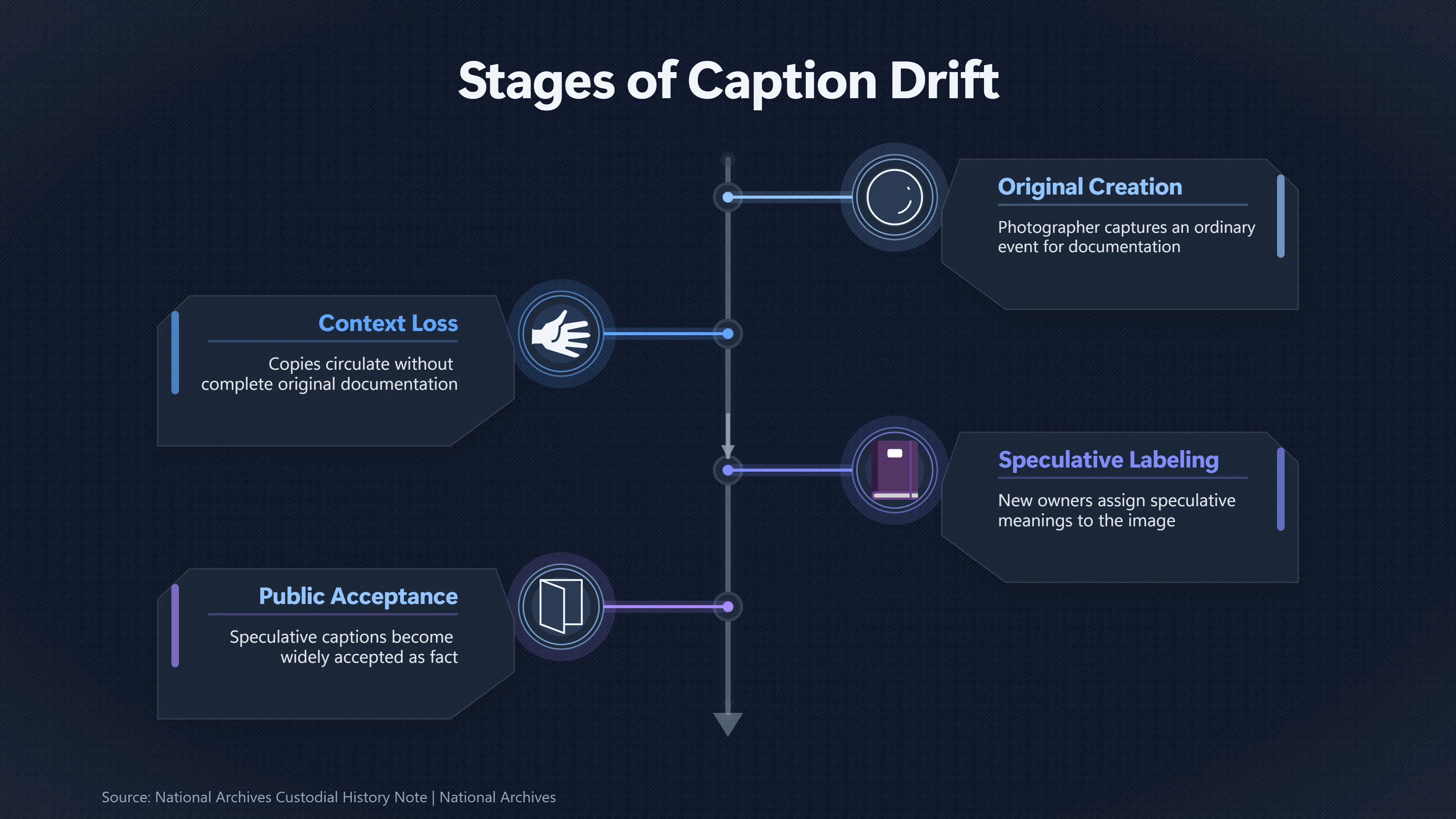
- A photograph is created to document an ordinary event.
- Copies circulate without complete documentation.
- Original captions are shortened or omitted.
- New owners speculate about the subject.
- Later publications repeat the speculation as though established fact.
- Online sharing strips away remaining context.
- The speculative caption becomes widely accepted.
This process, sometimes called “caption drift”, illustrates how misinformation can accumulate even when nobody alters the underlying photograph.
Because digital platforms frequently separate images from their original metadata, later users may encounter only the latest caption rather than the complete publication history.
Practical Tests for Alleged UFO Crash Photographs
When evaluating an archival photograph claimed to show a UFO crash, several questions are especially useful:
- Is the photograph itself dated independently of its caption?
- Does the archive describe the image in the same way as UFO publications?
- What is the earliest known publication?
- Do earlier newspapers identify a different incident?
- Has the caption changed significantly over time?
- Is there documentary evidence connecting the photograph to the alleged crash, or only repeated assertions?
Reverse-image searching, archive catalogue searches and comparisons with contemporaneous newspaper reports frequently resolve these questions more effectively than analysing visual details alone.
The Library of Congress likewise recommends evaluating captions alongside the photographic evidence rather than treating either as independently sufficient proof.[Research Guides]guides.loc.govResearch Guides Photographic EvidenceResearch GuidesPhotographic Evidence - Using Local and Family History Photographs to Tell the Stories of Your Ancestors - Research Guides…
What This Means for UFO Crash Research
Historical photographs remain valuable evidence even when later captions prove inaccurate. A genuine period photograph can document military activity, recovery operations, terrain, vehicles or people present at a particular time and place. What it cannot do is authenticate a later narrative that lacks independent documentary support.
Consequently, the strongest photographic evidence for any alleged UFO crash combines multiple forms of provenance: original negatives or first-generation prints, documented archival custody, contemporaneous captions, identifiable locations and publication histories that consistently describe the same event. Where only the photograph is old but the UFO attribution is demonstrably recent, the image should be treated as evidence of historical photography rather than evidence that the depicted event involved an extraterrestrial craft.
Amazon book picks
Further Reading
Books and field guides related to Can an Authentic Photo Still Have a False Caption?. Use these as the next step if you want deeper reading beyond the article.
Calling Bullshit: The Art of Skepticism in a Data-Driven World
Bullshit isn’t what it used to be. Now, two science professors give us the tools to dismantle misinformation and think clearly in a world...
The Demon-Haunted World: Science as a Candle in the Dark
NEW YORK TIMES BESTSELLER • From the renowned astronomer and author of Cosmos comes a “powerful [and] stirring defense of informed ration...
The Data Journalism Handbook
"A project of the European Journalism Centre and the Open Knowledge Foundation."--T.p. verso.
eBay marketplace picks
Marketplace Samples
Live-tested eBay searches with available results related to this page.
Selected fromUFO memorabilia oneBay.co.uk.

Endnotes
1.
Source: archives.gov
Title: National Archives Custodial History Note | National Archives
Link:https://www.archives.gov/research/catalog/lcdrg/elements/custodial-history-note
Source snippet
National ArchivesCustodial History Note | National ArchivesSeptember 24, 2024...
Published: September 24, 2024
2.
Source: loc.gov
Title: The Library of Congress
Link:https://www.loc.gov/pictures/static/data/fsa/resources/cataloging.html
3.
Source: archives.gov
Title: Digital Photographic Records | National Archives
Link:https://www.archives.gov/records-mgmt/initiatives/digital-photo-records.html
4.
Source: nationalarchives.gov.uk
Title: National Archives How captions change meanings
Link:https://www.nationalarchives.gov.uk/education/students/working-with-photographs/how-captions-change-meanings/
Source snippet
National ArchivesHow captions change meanings - The National Archives...
5.
Source: guides.loc.gov
Title: Research Guides Photographic Evidence
Link:https://guides.loc.gov/local-history-and-family-photos/photographic-evidence
Source snippet
Research GuidesPhotographic Evidence - Using Local and Family History Photographs to Tell the Stories of Your Ancestors - Research Guides...
6.
Source: loc.gov
Title: The Library of Congress Photochrom Prints
Link:https://www.loc.gov/pictures/collection/pgz/cataloging.html
Source snippet
The Library of CongressPhotochrom Prints - Cataloging the Collection - Prints & Photographs Online Catalog (Library of Congress)...
7.
Source: loc.gov
Link:https://www.loc.gov/pictures/collection/fsa/cataloging.html
Source snippet
The Library of CongressFarm Security Administration/Office of War Information Black-and-White Negatives - Cataloging the Collection - Pri...
8.
Source: guides.loc.gov
Title: Research Guides Searching & Viewing
Link:https://guides.loc.gov/cold-war-images/searching-viewing
Source snippet
& Viewing - Cold War: Finding Images in the Prints & Photographs Division - Research Guides at Library of CongressJune 16, 2025 — COLD WA...
Published: June 16, 2025
9.
Source: blogs.loc.gov
Title: beware of photos bearing false captions
Link:https://blogs.loc.gov/picturethis/2011/10/beware-of-photos-bearing-false-captions/
10.
Source: loc.gov
Title: Harris & Ewing Collection
Link:https://loc.gov/pictures/collection/hec/
11.
Source: loc.gov
Link:https://www.loc.gov/static/collections/fsa-owi-black-and-white-negatives/about-this-collection/technical-information.html
12.
Source: wwws.loc.gov
Link:https://wwws.loc.gov/preservation/about/faqs/photographs.html
13.
Source: nationalarchives.gov.uk
Title: Using and interpreting photographic sources
Link:https://www.nationalarchives.gov.uk/education/students/working-with-photographs/using-and-interpreting-photographic-sources/
14.
Source: loc.gov
Link:https://www.loc.gov/pictures/item/2016717823/
Additional References
15.
Source: douglasjohnson.ghost.io
Title: io Crash Story File: The Sources of the Trinity Tale
Link:https://douglasjohnson.ghost.io/crash-story-file-the-sources-of-the-trinity-tale/
Source snippet
Story File: The Sources of the Trinity TaleMay 1, 2023 — Trinity UFO crash, Jacque Vallee, Paola Harris, Reme Baca, Jose Padilla, Ray Sta...
Published: May 1, 2023
16.
Source: theexclusionzone.com
Title: [Roswell]({{ ‘roswell/’ | relative_url }})’s Viral Crater Video: A Forensic Analysis
Link:https://www.theexclusionzone.com/roswell-341-viral-crater-video-forensic-analysis/
Source snippet
July 8, 2026 — 08 Jul 2026 7 min read classic-cases ROSWELL'S VIRAL "CRATER" VIDEO: A FRAME-BY-FRAME FORENSIC ANALYSIS Seventy-nine years...
Published: July 8, 2026
17.
Source: youtube.com
Title: Bizarre Details About Roswell That Still Don’t Make Sense
Link:https://www.youtube.com/watch?v=-HoQFNIwm5c
Source snippet
The Top Secret Project That Spawned the Roswell UFO Incident...
18.
Source: isaackoi.com
Link:https://isaackoi.com/ufog/alien-photos/koi-alien-photo-11/
19.
Source: theguardian.com
Link:https://www.theguardian.com/science/2017/sep/30/alien-photo-roswell-new-mexico-mystery
20.
Source: os-intelligent.com
Link:https://os-intelligent.com/case-studies/verifying-a-viral-image/
21.
Source: youtube.com
Title: 4 Infamous UFO Hoaxes Revealed
Link:https://www.youtube.com/watch?v=RmwukR8_4v8
Source snippet
The Roswell UFO Crash: Uncovering the Truth Behind the Legend...
22.
Source: smithsonianmag.com
Title: in 1947 high altitude balloon crash landed roswell aliens never left 180963917
Link:https://www.smithsonianmag.com/smithsonian-institution/in-1947-high-altitude-balloon-crash-landed-roswell-aliens-never-left-180963917/
23.
Source: curiousarchive.com
Title: The Tombstone Thunderbird Photograph and the Mandela Effect – Curious Archive
Link:https://www.curiousarchive.com/the-tombstone-thunderbird-photograph-and-the-mandela-effect/
24.
Source: thinkaboutitdocs.com
Title: 1947 roswell ufo incident crash and recovery
Link:https://www.thinkaboutitdocs.com/1947-roswell-ufo-incident-crash-and-recovery/