Within Proof Standard
What Would the Ground Remember After a Crash?
Heat, chemicals and damaged vegetation matter only when their location, timing and comparison samples link them securely to the alleged event.
On this page
- Collecting soil, plant and control samples
- Distinguishing impact effects from weather and human activity
- Linking residues to debris and event timing
Page outline Jump by section
Introduction
Soil and vegetation can provide valuable environmental evidence after an alleged UFO crash, but they cannot by themselves confirm that a non-human craft struck the ground. At most, they can help establish whether an unusual physical event occurred at a particular place and time, whether heat, pressure or chemicals altered the environment, and whether those changes match the location of recovered debris. Without secure sampling, comparison with unaffected nearby areas and laboratory analysis that rules out ordinary causes, damaged ground remains suggestive rather than conclusive. This is why environmental traces are treated in forensic science as supporting evidence that must be interpreted alongside physical objects, documented provenance and independent laboratory findings rather than as proof on their own.[James Hutton Institute]hutton.ac.ukJames Hutton Institute Soil ForensicsJames Hutton InstituteSoil Forensics - James Hutton Institute…
What Would the Ground Remember After a Crash?
A genuine high-energy impact can leave measurable changes in soil and plants. The challenge is that fires, lightning, agricultural machinery, chemical spills, military activity, vehicle traffic and natural weathering can produce many of the same effects. Investigators therefore ask not simply whether the ground looks unusual, but whether multiple independent observations point to a single event.
Potential environmental traces include:
- Localised heating that changes soil minerals or organic matter.
- Burnt, scorched or chemically stressed vegetation.
- Unusual distributions of metals or industrial compounds.
- Compacted or displaced soil consistent with a physical impact.
- Changes that diminish with distance from a central point rather than appearing randomly across the landscape.
No single observation is decisive. Instead, investigators look for a coherent pattern that matches the alleged crash location and timing while excluding ordinary explanations.[asteetrace.org]asteetrace.orgAstee Trace American Society of Trace Evidence ExaminersAstee Trace American Society of Trace Evidence Examiners
Collecting Soil, Plant and Control Samples
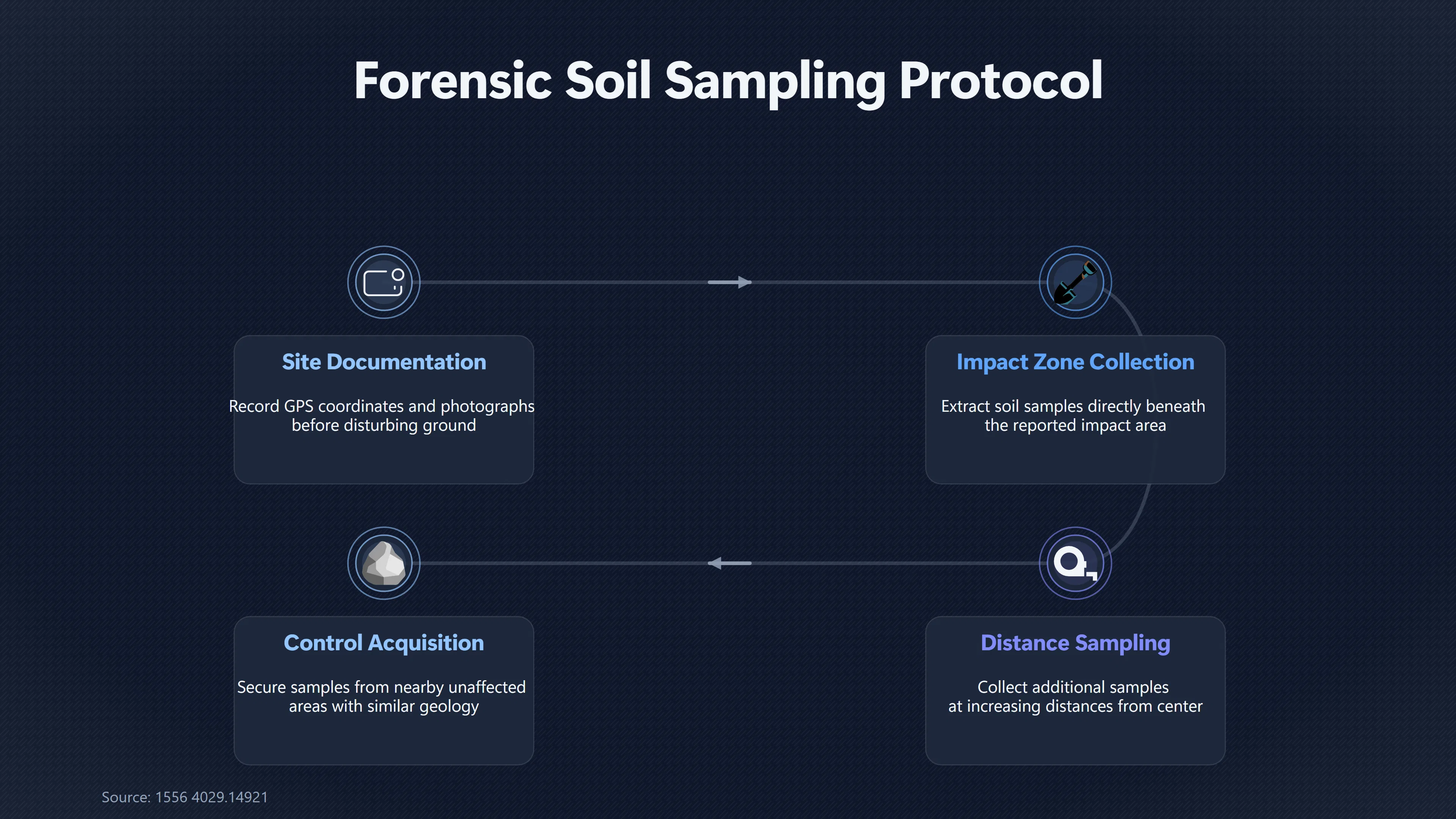
Environmental evidence is only as reliable as the sampling strategy. Modern forensic soil science relies on comparison rather than isolated specimens. A patch of scorched earth has little value if no one knows how it differs from the surrounding landscape.
A scientifically defensible investigation would normally include:
- Soil collected directly beneath the reported impact area.
- Samples taken at increasing distances from the centre.
- Control samples from nearby locations unaffected by the alleged event but sharing similar geology and vegetation.
- Plant material showing visible damage alongside healthy reference plants of the same species.
- Detailed photographs, GPS coordinates and documentation before anything is disturbed.
Control samples are especially important because natural soils can vary dramatically over only a few metres. Without nearby comparisons, investigators cannot determine whether unusual chemistry reflects an extraordinary event or simply normal local variation. This comparative approach is standard practice in forensic geology and soil science because soils naturally differ according to geology, vegetation, land use and weathering history.[hutton.ac.uk]hutton.ac.ukJames Hutton Institute Soil ForensicsJames Hutton InstituteSoil Forensics - James Hutton Institute…
What laboratories actually compare
Rather than looking for one “alien” signature, laboratories compare many characteristics simultaneously, including:
- Mineral composition.
- Grain size and particle structure.
- Elemental chemistry.
- Organic compounds.
- Pollen and spores.
- Microorganisms.
- Plant fragments and root material.
- Isotopic characteristics where appropriate.
The strength comes from agreement across multiple independent measurements rather than any single unusual result. Modern forensic studies have shown that combining mineral, elemental and biological evidence can distinguish closely related soils far more effectively than relying on colour or chemistry alone.[nih.gov]pubmed.ncbi.nlm.nih.govPub Med A case study in forensic soil comparisonA case study in forensic soil comparison - PubMedNovember 27, 2021…
Distinguishing Impact Effects from Weather and Human Activity
Most environmental anomalies reported at alleged UFO crash sites have plausible conventional explanations unless additional evidence narrows the possibilities.
For example, scorched vegetation may result from:
- Grass fires.
- Lightning strikes.
- Controlled burning.
- Vehicle exhaust.
- Electrical faults.
- Agricultural chemicals.
- Drought stress.
Similarly, unusual soil chemistry may reflect:
- Fertilisers.
- Historic industrial activity.
- Mining.
- Road contamination.
- Military exercises.
- Naturally occurring mineral deposits.
Even apparently circular damaged areas can arise from erosion, animal activity, vehicle turning circles or previous construction work. Because of these possibilities, investigators must show that the observed pattern is inconsistent with ordinary environmental processes rather than merely unusual.
Timing also matters. Fresh plant damage, recent heat alteration and rapidly collected samples provide stronger evidence than observations made weeks or months later, when weather, microbial activity and human disturbance may already have altered the site.[nih.gov]pubmed.ncbi.nlm.nih.govPub Med Soil as a tool of revelation in forensic science: a reviewSoil as a tool of revelation in forensic science: a review - PubMed…

Linking Environmental Traces to Debris and Event Timing
Environmental evidence becomes significantly stronger when it supports independently documented physical evidence.
For example, a convincing chain would include:
- A precisely documented impact location.
- Soil changes centred on that location.
- Vegetation damage showing the same spatial pattern.
- Recovered debris embedded within the disturbed ground.
- Chemical residues on both soil and debris that are mutually consistent.
- Witness reports, photographs or sensor data fixing the timing before the site was disturbed.
Without that chain, soil abnormalities remain ambiguous. Conversely, even unusual debris loses evidential value if it cannot be connected to the surrounding environment through documented recovery and matching residues.
Environmental traces therefore function primarily as corroboration rather than independent proof. They strengthen an already well-documented case but rarely establish one by themselves.[James Hutton Institute]hutton.ac.ukJames Hutton Institute Soil ForensicsJames Hutton InstituteSoil Forensics - James Hutton Institute…
Why Vegetation Alone Is an Unreliable Indicator
Reports of flattened circles, dead plants or unusual growth have appeared in many alleged UFO landing and crash claims. Such observations deserve investigation but are difficult to interpret because plants respond to many different stresses.
Growth abnormalities may arise from:
- Heat.
- Water shortages.
- Soil compaction.
- Disease.
- Herbicides.
- Nutrient deficiencies.
- Insect damage.
Even when plants display measurable physiological stress, those measurements rarely identify the cause uniquely. Plant evidence becomes more informative when it aligns with independently measured soil chemistry, documented heat effects and securely recovered physical material from the same location.
Forensic botany therefore emphasises context over appearance. Plant damage is informative because of where it occurs, how sharply it differs from nearby controls and whether it matches other evidence—not because damaged vegetation is inherently unusual.[nih.gov]pubmed.ncbi.nlm.nih.govPub Med Forensic Investigation of Soil and Vegetable MaterialsForensic Investigation of Soil and Vegetable Materials - PubMed…
What Soil and Vegetation Can—and Cannot—Demonstrate
Environmental traces can answer several important questions:
- Did an unusual disturbance occur?
- Was intense heat present?
- Were chemicals deposited?
- Does the affected area form a coherent pattern?
- Can the disturbance be linked to recovered material?
However, they cannot by themselves answer the central question of a UFO crash:
- Whether the source was extraterrestrial or non-human.
- Whether unusual metals originated from an advanced craft.
- Whether an observed disturbance exceeded known natural or human causes.
In forensic investigations, soil and vegetation are powerful contextual evidence because they preserve aspects of an event that manufactured objects alone cannot. Yet their greatest value lies in corroboration. Only when environmental traces, securely documented debris, laboratory analyses and independently verified event timing all point to the same conclusion would the ground provide meaningful support for an extraordinary crash claim.[hutton.ac.uk]hutton.ac.ukJames Hutton Institute Soil ForensicsJames Hutton InstituteSoil Forensics - James Hutton Institute…
Amazon book picks
Further Reading
Books and field guides related to What Would the Ground Remember After a Crash?. Use these as the next step if you want deeper reading beyond the article.
Forensic Botany: A Practical Guide
FORENSIC BOTANY A PRACTICAL GUIDE Forensic Botany: A Practical Guide is an accessible introduction to the way in which botanical evidence...
Practical Crime Scene Processing and Investigation
All too often, the weakest link in the chain of criminal justice is the crime scene investigation. Improper collection of evidence blocks...
Environmental Forensics: Contaminant Specific Guide
Environmental forensics is the application of scientific techniques for the purpose of identifying the source and age of a contaminant. O...
Forensic Geoscience: Principles, Techniques and Applications
Forensic geoscience is an increasingly important sub-discipline within geoscience and forensic science. Although minerals, soils, dusts a...
eBay marketplace picks
Marketplace Samples
Live-tested eBay searches with available results related to this page.
Selected fromalien garden decor oneBay.co.uk.




Endnotes
1.
Source: onlinelibrary.wiley.com
Link:https://onlinelibrary.wiley.com/doi/10.1111/1556-4029.14727
Source snippet
Wiley Online LibraryForensic soil provenancing in an urban/suburban setting: A sequential multivariate approach - Caritat - 2021 - Journa...
2.
Source: onlinelibrary.wiley.com
Link:https://onlinelibrary.wiley.com/doi/abs/10.1111/1556-4029.13313
Source snippet
Wiley Online LibraryForensic Comparison of Soil Samples Using Nondestructive Elemental Analysis - Uitdehaag - 2017 - Journal of Forensic...
3.
Source: onlinelibrary.wiley.com
Title: 1556 4029.14921
Link:https://onlinelibrary.wiley.com/doi/abs/10.1111/1556-4029.14921
4.
Source: hutton.ac.uk
Title: James Hutton Institute Soil Forensics
Link:https://www.hutton.ac.uk/scientific-services/analytical/analytical-services/soil-forensics/
Source snippet
James Hutton InstituteSoil Forensics - James Hutton Institute...
5.
Source: pubmed.ncbi.nlm.nih.gov
Title: Pub Med Soil as a tool of revelation in forensic science: a review
Link:https://pubmed.ncbi.nlm.nih.gov/33135702/
Source snippet
Soil as a tool of revelation in forensic science: a review - PubMed...
6.
Source: asteetrace.org
Title: Astee Trace American Society of Trace Evidence Examiners
Link:https://www.asteetrace.org/soil
7.
Source: ojp.gov
Link:https://www.ojp.gov/library/publications/assessment-added-value-new-quantitative-methodologies-analysis-surface-soils
Source snippet
Office of Justice ProgramsAssessment of the Added Value of New Quantitative Methodologies for the Analysis of Surface Soils in Forensic S...
8.
Source: pubmed.ncbi.nlm.nih.gov
Title: Pub Med A case study in forensic soil comparison
Link:https://pubmed.ncbi.nlm.nih.gov/34837401/
Source snippet
A case study in forensic soil comparison - PubMedNovember 27, 2021...
Published: November 27, 2021
9.
Source: pubmed.ncbi.nlm.nih.gov
Title: Pub Med Forensic Investigation of Soil and Vegetable Materials
Link:https://pubmed.ncbi.nlm.nih.gov/26270478/
Source snippet
Forensic Investigation of Soil and Vegetable Materials - PubMed...
Additional References
10.
Source: pubs.rsc.org
Link:https://pubs.rsc.org/en/content/articlelanding/2020/ay/d0ay01634a
Source snippet
Royal Society of Chemistry PublicationsSoil as a tool of revelation in forensic science: a review - Analytical Methods (RSC Publishing)...
11.
Source: youtube.com
Title: Jacques Vallée – Dimensions: A Casebook of Alien Contact (part two)
Link:https://www.youtube.com/watch?v=e38KNgYZHjs
Source snippet
This list includes relevant videos on physical trace evidence, soil and environmental analysis at reported UFO impact sites (such as Tran...
12.
Source: youtube.com
Title: ANALYSING UFO EXPERIENCERS’ BRAINS & ANOMALOUS MATERIALS
Link:https://www.youtube.com/watch?v=9KORTynxY-g
Source snippet
Jacques Vallée -- Dimensions: A Casebook of Alien Contact (part two)...
13.
Source: youtube.com
Title: Earthbound Evidence: The Most Disturbing UFO Trace Cases
Link:https://www.youtube.com/watch?v=ZY9KX4vxTtU
Source snippet
[Today in History] 8 January 1981 – UFO Sighting in Trans-en-Provence, France...
Published: January 1981
14.
Source: youtube.com
Title: IS THE GOVERNMENT HIDING FOUR ALIEN SPECIES?
Link:https://www.youtube.com/watch?v=0NQ4nmChfOg
Source snippet
ANALYSING UFO EXPERIENCERS' BRAINS & ANOMALOUS MATERIALS - Garry Nolan PHD #62...
15.
Source: research-portal.uu.nl
Title: nl Forensic Comparison of Soil Samples Using Nondestructive Elemental Analysis
Link:https://research-portal.uu.nl/en/publications/forensic-comparison-of-soil-samples-using-nondestructive-elementa/
16.
Source: macaulay.webarchive.hutton.ac.uk
Title: hutton.ac.uk Soil as evidence
Link:https://macaulay.webarchive.hutton.ac.uk/soilfit/soilfit_evidence.html