Within Alien Bodies
Did Television Reshape Gerald Anderson's Roswell Memory?
Gerald Anderson's account appeared after a television reconstruction, raising questions about memory, suggestion and chronology.
On this page
- What Anderson claimed to remember
- The timing of his public account
- How media exposure can influence recall
Page outline Jump by section
Introduction
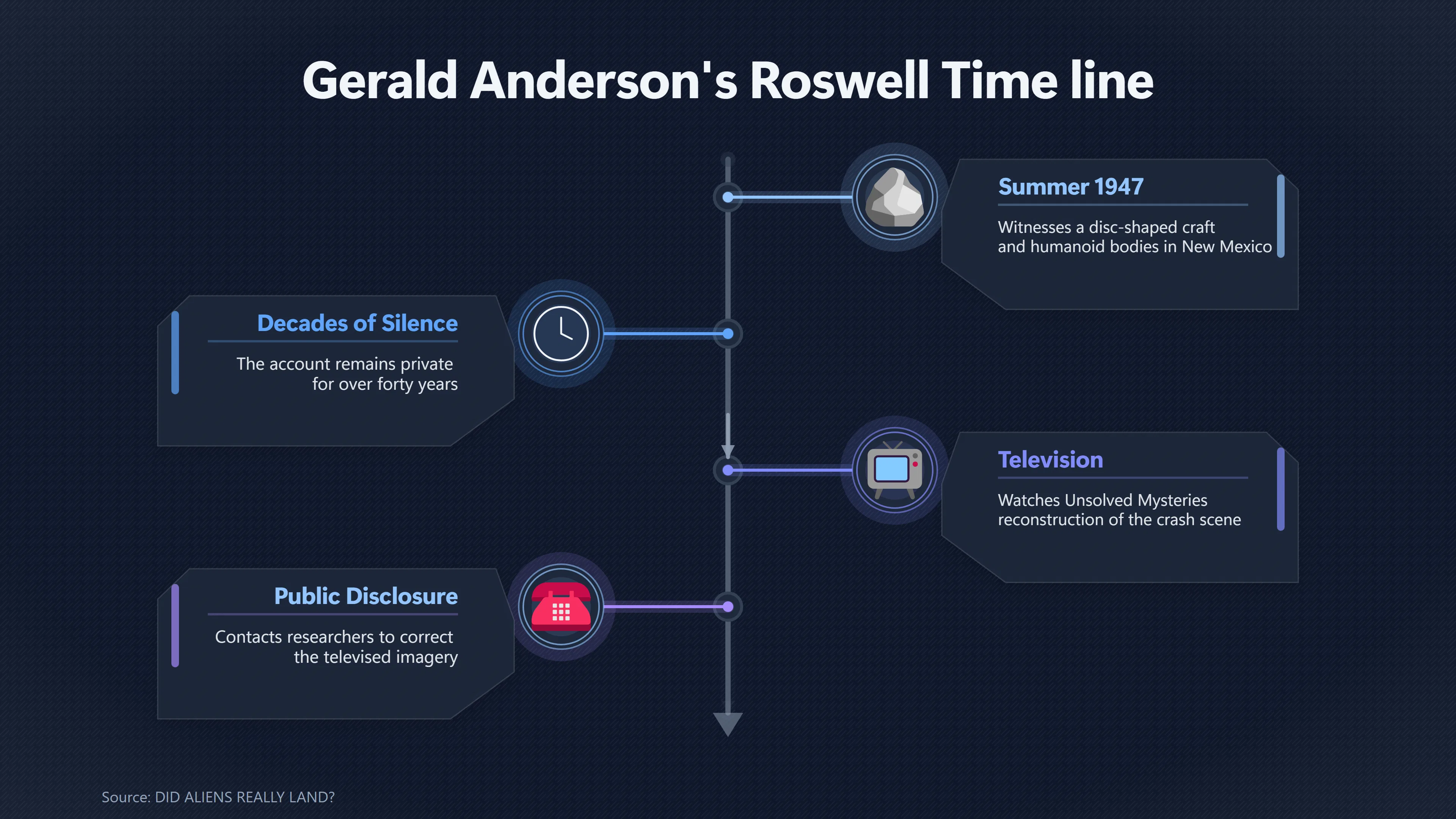
Gerald Anderson’s account occupies a distinctive place in Roswell lore because it combines an alleged childhood memory of a crashed craft and small humanoid bodies with a very late public disclosure. Anderson said he witnessed the scene as a five-year-old during a family rock-hunting trip in New Mexico in 1947. However, he did not enter the public record until after Roswell had become a major cultural phenomenon, and specifically after watching a 1989 television reconstruction of the alleged crash. That sequence has made his testimony an important case study not only in UFO research but also in the psychology of long-delayed memory. The central question is therefore not simply whether Anderson believed his account, but whether decades of media exposure could have reshaped how an early childhood experience was remembered and interpreted.[Time]content.time.comDID ALIENS REALLY LAND?DID ALIENS REALLY LAND? - TIMEJune 23, 1997…
What Anderson claimed to remember
According to Anderson, his family was collecting rocks on the Plains of San Agustin in New Mexico during the summer of 1947 when they encountered a damaged disc-shaped craft. He described seeing several small humanoid beings, some apparently dead and at least one alive. He also claimed that military personnel soon arrived, secured the area and forced civilians away.
His narrative included details that had already become familiar elements of Roswell mythology by the late 1980s:
- A metallic, damaged craft.
- Small non-human bodies.
- One surviving being.
- A rapid military cordon.
- Orders to civilians to leave and remain silent.
These features made Anderson’s account appear to corroborate earlier body-recovery stories circulating within UFO literature. At the same time, critics noted that the same features were already widely available through books, television programmes and magazine articles before Anderson came forward.[Time]content.time.comDID ALIENS REALLY LAND?DID ALIENS REALLY LAND? - TIMEJune 23, 1997…
The timing of his public account
The chronology is one of the most discussed aspects of Anderson’s testimony.
Rather than reporting the story in the decades immediately following 1947, Anderson contacted researchers only after viewing an episode of Unsolved Mysteries in 1989 that reconstructed an alleged Roswell crash. According to contemporary reporting, he called the programme because he believed the reconstruction depicted the spacecraft incorrectly, claiming that he had personally seen the real object as a child.[Time]content.time.comDID ALIENS REALLY LAND?DID ALIENS REALLY LAND? - TIMEJune 23, 1997…
This timing matters because by 1989 Roswell had already been transformed from an obscure 1947 newspaper story into a detailed cultural narrative. Books, documentaries and television programmes had established recurring imagery that included:
- crashed saucers,
- alien bodies,
- military secrecy,
- intimidation of witnesses,
- and government cover-ups.
Consequently, Anderson’s testimony was not recorded in isolation from later cultural influences. It emerged after the framework into which such memories could fit was already familiar to millions of viewers.[Time]content.time.comDID ALIENS REALLY LAND?DID ALIENS REALLY LAND? - TIMEJune 23, 1997…
Why television became part of the credibility debate
The television connection is significant because Anderson himself linked his decision to come forward directly to seeing a televised reconstruction.
Researchers who accept his sincerity have argued that the programme simply prompted him to disclose a memory he had long kept private.
Sceptical investigators draw a different conclusion. They argue that the broadcast may have served not merely as a reminder but also as a source of additional imagery capable of influencing recollection. Rather than retrieving an untouched childhood memory, Anderson may have reconstructed fragments of genuine experience together with details acquired from years of Roswell media coverage.
This distinction reflects a broader question in eyewitness psychology: people often experience reconstructed memories as entirely genuine, even when later information has become incorporated into the original recollection. The subjective certainty of a memory does not necessarily demonstrate that every remembered detail originated in the original event.[sciencedirect.com]sciencedirect.comMisinformation Effects in Recall: Creating False Memories through Repeated Retrieval - ScienceDirect…
How memory research applies to Anderson’s case
Modern cognitive psychology treats memory as reconstructive rather than photographic. Memories are rebuilt each time they are recalled and can absorb information acquired after the original experience.
Research on the “misinformation effect” has repeatedly shown that exposure to later descriptions, questioning or repeated retelling can alter what people sincerely remember. Repeated retrieval may even strengthen inaccurate details until they become experienced as authentic memories.[sciencedirect.com]sciencedirect.comMisinformation Effects in Recall: Creating False Memories through Repeated Retrieval - ScienceDirect…
Several well-established mechanisms are relevant when assessing Anderson’s testimony:
- Source monitoring errors. People may remember a detail accurately but misremember where it came from, confusing direct experience with later reading or television exposure.[PubMed]pubmed.ncbi.nlm.nih.govMemory impairment and source misattribution in postevent misinformation experiments with short retention intervals - PubMed…
- Childhood memory limitations. Anderson claimed to recall events from around age five, an age at which memories are especially vulnerable to later reconstruction and reinterpretation.
- Repeated cultural reinforcement. By the late 1980s, Roswell imagery had become remarkably consistent across books, documentaries and popular culture, providing a ready-made narrative into which uncertain memories could be organised.[Time]content.time.comDID ALIENS REALLY LAND?DID ALIENS REALLY LAND? - TIMEJune 23, 1997…
None of these mechanisms proves Anderson fabricated his story. Instead, they illustrate why delayed eyewitness accounts are generally regarded as weaker evidence than contemporaneous documentation.
Disputes over supporting evidence
The debate surrounding Anderson expanded beyond memory itself because he later produced material intended to support his account, including a diary said to have recorded the events.
Investigators reported forensic testing indicating that ink on key diary entries had not been commercially available until the 1970s, decades after the claimed 1947 observations. Anderson disputed the interpretation, arguing that tested pages were copies rather than the original document, but the alleged originals were not produced for independent examination. This dispute significantly damaged the diary’s evidential value and became one reason several researchers who had initially taken Anderson seriously later questioned his account.[Skeptical Inquirer]skepticalinquirer.orgSkeptical Inquirer Postmortem on 'Alien Autopsy' | Skeptical InquirerSkeptical InquirerPostmortem on 'Alien Autopsy' | Skeptical InquirerJune 1, 2006…
The controversy illustrates an important distinction. Even if a witness appears sincere, supporting physical evidence must withstand independent scrutiny. When corroborating documents become disputed, investigators tend to place greater emphasis on chronology, independent witnesses and contemporary records.
Why Anderson’s case remains important
Gerald Anderson’s story continues to be discussed because it sits at the intersection of two broader issues in Roswell research: delayed witness testimony and the evolution of memory over decades.
Supporters view him as someone whose childhood experience was finally prompted into disclosure by a television programme. Critics argue that the same television exposure demonstrates how a culturally established Roswell narrative could influence recollection long after the original event.
Whatever position one adopts on the underlying UFO claim, Anderson’s case has become one of the clearest examples of why historians, psychologists and investigators distinguish between sincerely remembered experiences and independently verified historical evidence. His testimony illustrates how the timing of a witness’s first public account can be as significant as the content of the memory itself.
Amazon book picks
Further Reading
Books and field guides related to Did Television Reshape Gerald Anderson's Roswell Memory?. Use these as the next step if you want deeper reading beyond the article.
The Memory Illusion: Remembering, Forgetting, and the Science...
THE INTERNATIONAL BESTSELLER 'Truly fascinating.' Steve Wright, BBC Radio 2 - Have you ever forgotten the name of someone you’ve met doze...
The Seven Sins of Memory: How the Mind Forgets and Remembers
Rating: 3.5/5 from 5 Google Books ratings
A New York Times Notable Book: A psychologist's "gripping and thought-provoking" look at how and why our brains sometimes fail us (Steven...
The Seven Sins of Memory
Rating: 3.5/5 from 5 Google Books ratings
A New York Times Notable Book: A psychologist's "gripping and thought-provoking" look at how and why our brains sometimes fail us (Steven...
Eyewitness Testimony
By shedding light on the many factors that can intervene and create inaccurate testimony, Elizabeth Loftus illustrates how memory can be...
eBay marketplace picks
Marketplace Samples
Live-tested eBay searches with available results related to this page.
Selected fromRoswell poster oneBay.co.uk.
Endnotes
1.
Source: content.time.com
Title: DID ALIENS REALLY LAND?
Link:https://content.time.com/time/subscriber/article/0%2C33009%2C986565-3%2C00.html
Source snippet
DID ALIENS REALLY LAND? - TIMEJune 23, 1997...
Published: June 23, 1997
2.
Source: sciencedirect.com
Link:https://www.sciencedirect.com/science/article/pii/S0749596X96900170
Source snippet
Misinformation Effects in Recall: Creating False Memories through Repeated Retrieval - ScienceDirect...
3.
Source: sciencedirect.com
Title: Retrieval-Enhanced Suggestibility: A Retrospective and a New Investigation
Link:https://www.sciencedirect.com/science/article/pii/S2211368117300724
4.
Source: time.com
Title: DI D ALIENS REALLY LAND?
Link:https://time.com/archive/6731010/did-aliens-really-land/
5.
Source: youtube.com
Title: Roswell Incident: Stanton Friedman Interviews
Link:https://www.youtube.com/watch?v=dq_NWlN16WY
Source snippet
Gerald Anderson - Eyewitness to a 2nd Roswell Crash in 1947...
6.
Source: youtube.com
Title: Gerald Anderson
Link:https://www.youtube.com/watch?v=PPeFc770nP4
Source snippet
ROSWELL interview of gerald anderson detailed discription of E.T AND ALIEN CRAFT...
7.
Source: skepticalinquirer.org
Title: Skeptical Inquirer The Roswell Legacy | Skeptical Inquirer
Link:https://skepticalinquirer.org/newsletter/roswell-legacy/
8.
Source: pubmed.ncbi.nlm.nih.gov
Link:https://pubmed.ncbi.nlm.nih.gov/8035684/
Source snippet
Memory impairment and source misattribution in postevent misinformation experiments with short retention intervals - PubMed...
9.
Source: pubmed.ncbi.nlm.nih.gov
Link:https://pubmed.ncbi.nlm.nih.gov/14516215/
Source snippet
Misinformation effects in eyewitness memory: the presence and absence of memory impairment as a function of warning and misinformat...
10.
Source: pubmed.ncbi.nlm.nih.gov
Link:https://pubmed.ncbi.nlm.nih.gov/24000960/
Source snippet
Retrieval enhances eyewitness suggestibility to misinformation in free and cued recall - PubMed...
11.
Source: skepticalinquirer.org
Title: Skeptical Inquirer Postmortem on ‘Alien Autopsy’ | Skeptical Inquirer
Link:https://skepticalinquirer.org/newsletter/postmortem-on-alien-autopsy/
Source snippet
Skeptical InquirerPostmortem on 'Alien Autopsy' | Skeptical InquirerJune 1, 2006...
Published: June 1, 2006
12.
Source: skepticalinquirer.org
Title: Skeptical Inquirer SKEPTICAL
Link:https://skepticalinquirer.org/wp-content/uploads/sites/29/2019/03/Issue-01-13.pdf
Source snippet
INQUIRER Vol. 16, No. 1 FdlM991/$6.25...
13.
Source: pmc.ncbi.nlm.nih.gov
Link:https://pmc.ncbi.nlm.nih.gov/articles/PMC9225701/
14.
Source: pubmed.ncbi.nlm.nih.gov
Link:https://pubmed.ncbi.nlm.nih.gov/2522502/
15.
Source: pubmed.ncbi.nlm.nih.gov
Link:https://pubmed.ncbi.nlm.nih.gov/7931095/
16.
Source: pubmed.ncbi.nlm.nih.gov
Link:https://pubmed.ncbi.nlm.nih.gov/24203660/
Additional References
17.
Source: nature.com
Link:https://www.nature.com/articles/s41598-024-84154-0
Source snippet
Timing of pre-retrieval warnings matters in reducing memory errors in a repeated testing misinformation study | Scientific Reports...
18.
Source: ufouap.com
Title: Then a nuclear physicist found a r
Link:https://www.ufouap.com/articles/roswell-series-30-year-revival/
Source snippet
Roswell, Part 2: The 30-Year Silence and the Explosive Revival That Made Roswell Famous — UFOUAPFebruary 26, 2026 — February 26, 2026 · U...
Published: February 26, 2026
19.
Source: youtube.com
Link:https://www.youtube.com/watch?v=wSacUhdcvNA
Source snippet
Gerald Anderson Roswell UFO crash interview Roswell Incident: Stanton Friedman Interviews - Gerald Anderson 1992 John Staples...
20.
Source: youtube.com
Title: ROSWELL interview of gerald anderson detailed discription of E.T AND ALIEN CRAFT
Link:https://www.youtube.com/watch?v=fl5d3lpgR9Q
Source snippet
Gerald Anderson Eyewitness to a 2nd Roswell Crash in 1947...
21.
Source: ojp.gov
Link:https://ojp.gov/ncjrs/virtual-library/abstracts/reports-suggested-memories-do-people-truly-believe-them-adult
22.
Source: skeptic.org.uk
Link:https://www.skeptic.org.uk/2022/08/75-years-on-the-roswell-mythology-continues-to-captivate-ufologists-and-the-public-alike/
Source snippet
The Skeptic...
23.
Source: youtube.com
Link:https://www.youtube.com/watch?v=ivaWnbKsBkM
Source snippet
Roswell Incident: Stanton Friedman Interviews - Gerald Anderson 1992...
24.
Source: gettyimages.co.uk
Link:https://www.gettyimages.co.uk/detail/video/united-states-interview-with-gerald-anderson-where-he-news-footage/2238573245
25.
Source: roswellfiles.com
Link:https://www.roswellfiles.com/witness.htm
26.
Source: journalofscientificexploration.org
Link:https://journalofscientificexploration.org/index.php/jse/article/view/2635