Within UFO Crashes
What Makes a UFO Crash Photo Credible?
Useful crash photography must preserve scale, location, sequence and original files rather than presenting isolated images without context.
On this page
- Scene coverage, scale and metadata
- Common problems with isolated images
- Preserving originals for independent review
Page outline Jump by section
Introduction
A photograph can help verify an alleged UFO crash only when it documents a scene, not merely a strange-looking object. The strongest photographic record would show where the material lay, how it related to the surrounding terrain, what size it was, whether anything had been moved, and how the image files passed from the camera to investigators. A single dramatic close-up, stripped of its original file and publication history, may be visually intriguing but cannot establish that a crash occurred.
Credible crash photography therefore works as a dataset: wide views establish location, intermediate views connect debris to the wider scene, close-ups preserve detail, and measurements, notes and original files allow independent checking. These standards do not prove that wreckage is extraterrestrial. They do, however, make it possible to test more basic claims: whether the site is genuine, whether the photographs belong together, whether the dimensions are plausible and whether later editing or mislabelling has distorted what was recorded.
Scene coverage, scale and metadata
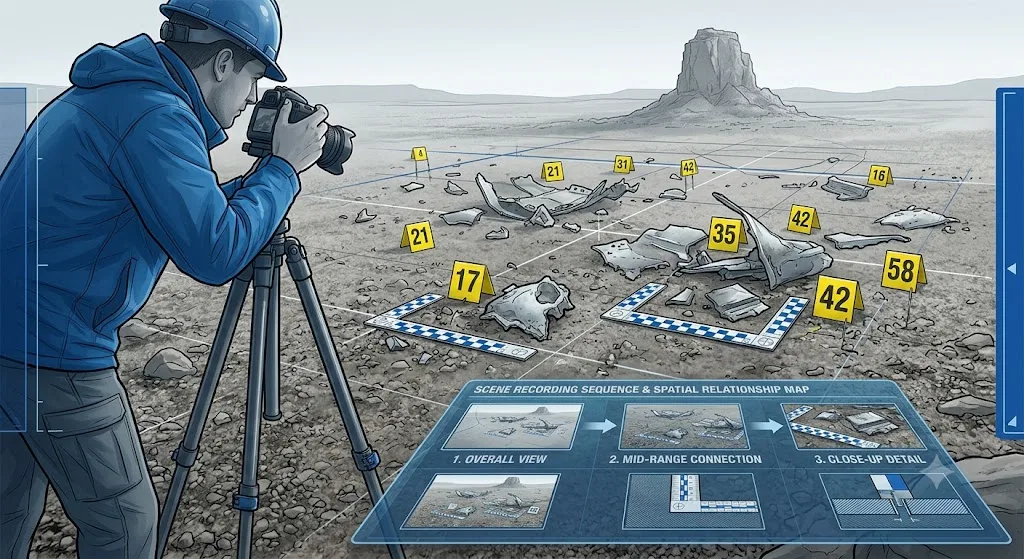
The first requirement is sequence. Investigators should photograph the site before material is collected, rearranged or labelled. Forensic photography guidance recommends beginning with overall views of the scene as first encountered, then moving to mid-range photographs that show the spatial relationship between objects, and finally to close-ups that capture individual details. Overall images should include identifiable surroundings such as roads, structures, signs, landmarks and access routes; mid-range images should connect each item to a fixed feature in the scene.[NIST]nist.govstandard guide crime scene photographystandard guide crime scene photography
For an alleged UFO crash, that sequence should answer several practical questions:
- Where is the supposed impact area in relation to roads, buildings, fences, ridges or watercourses?
- Is there a continuous debris field, a concentrated impact point or merely one isolated object?
- Do broken vegetation, disturbed soil, burn patterns or drag marks form a coherent physical pattern?
- Can the same distinctive landmarks be followed from wide views into closer photographs?
- Was each item photographed in place before anybody touched or repositioned it?
A useful set would include views from several directions rather than one carefully selected angle. It should also record the routes by which people and vehicles entered the area, because tyre tracks and footprints created after discovery can otherwise be mistaken for evidence of impact or recovery activity. Aerial or elevated photographs may help map the overall distribution, but they do not replace ground-level views linking individual objects to exact positions.
Scale must be established twice: contextually and precisely. A person, vehicle or fence post may provide a rough sense of size in a wide image, but close examination requires a recognised measuring scale placed in the same plane as the object. Forensic guidance advises photographing an item before introducing a scale and then, where size matters, taking a second photograph with the scale positioned so that perspective does not distort the comparison. The camera should be as nearly perpendicular to the measured surface as practical.[NIST]nist.govstandard guide crime scene photographystandard guide crime scene photography
This matters because apparent size changes sharply with distance and lens choice. A fragment held near a camera may look much larger than wreckage lying several metres away. Wide-angle lenses can stretch objects near the edge of a frame, while telephoto lenses can compress distance and make separate features appear adjacent. A credible record should therefore preserve focal length, camera position and subject distance where available, and should include overlapping views that allow geometry to be checked.
The photograph log should also identify the photographer, date, time, camera or device, file number, viewpoint and a brief description of what each frame records. The camera clock should be checked at the scene, since inaccurate device time can create false contradictions between photographs, witness accounts and official activity logs. Forensic scene guidance treats the case identifier and location information as part of the photographic record rather than details to be reconstructed later.[NIST]nist.govstandard guide crime scene photographystandard guide crime scene photography
Digital metadata can add useful clues. Exchangeable Image File Format data, commonly called EXIF, may include the capture time, camera model, lens, exposure settings and sometimes GPS coordinates. That information can help determine whether images said to form a sequence were created by the same device within a plausible period. It can also expose obvious anomalies, such as a photograph allegedly taken in 1990 by a camera model introduced much later. Metadata is nevertheless supporting evidence, not proof: it can be altered, removed by messaging platforms or replaced during editing and export.[bellingcat]bellingcat.comMetadata: Meta Useful & Meta CreepyMetadata: MetaUseful & MetaCreepyApril 24, 2015 — 24 Apr 2015 — Metadata is data that is often included with an image, such as…
Location should therefore be verified independently from visible features. Roads, mountain profiles, utility poles, vegetation, drainage channels, building layouts and shadows can be compared with maps, satellite imagery and photographs made at other times. Reverse-image searching can reveal that an alleged crash photograph appeared online years earlier under a different description. Shadow direction and length may help test the claimed time and broad location, although terrain, camera angle and uncertain object height make shadow analysis a corroborative method rather than a decisive one.[bellingcat]bellingcat.comGeolocate Images with Bellingcat's Shadow Finder ToolGeolocate Images with Bellingcat's Shadow Finder ToolAugust 22, 2024 — 22 Aug 2024 — Bellingcat's new Shadow Finder Tool, devel…
Why isolated images fail
The principal weakness of most alleged UFO crash photographs is not low resolution. It is the absence of a demonstrable link between the depicted object and the claimed event. A close-up of twisted metal may genuinely show twisted metal, yet reveal nothing about where it was found, when it was photographed or whether it ever lay at the supposed crash site.
Several recurring problems sharply reduce evidential value.
No transition from landscape to object. The image shows debris but not the terrain around it. Without overlapping wide and intermediate views, an examiner cannot establish that the close-up belongs to the named location.
No before-and-after sequence. Material may already have been lifted, cleaned, grouped or transported. Once rearranged, the original distribution—and therefore much of the evidence about impact direction, fragmentation and deposition—is lost.
No reliable scale. Hands, shoes and vehicles are poor measuring tools unless their dimensions and distance from the object are known. A ruler photographed at an angle can also mislead.
No original file. A screenshot, social-media download or photograph of a print may have lost metadata, resolution, colour information and evidence of previous processing. Compression artefacts can then be mistaken for structural details or traces of manipulation.
No photographer or custody history. Anonymous provenance leaves unanswered whether the image came from a witness, a journalist, an investigator, a film production or a later reconstruction.
No corroborating record. A photograph gains weight when its position agrees with field notes, maps, measurements, witness accounts and images from other cameras. It weakens when it exists alone.
The well-known Roswell photographs illustrate the distinction between photographs of alleged recovered debris and photographs of a crash scene. The surviving press images show officers posing with material at Fort Worth Army Air Field on 8 July 1947, after the debris had been collected and transported. They are historically important because they document what was presented to journalists, but they do not show the New Mexico recovery location, the original distribution of material or an impact feature. They therefore cannot, by themselves, verify the claimed crash site.[uta.edu]sites.libraries.uta.eduMajor Jesse A. Marcel (looking right) of Houma, LA holding foil debris from Roswell, New Mexico UFO crash site, July 1947.Read more…
This limitation is independent of the continuing dispute about whether the displayed material was identical to everything collected. Even a perfectly authenticated Fort Worth photograph would establish only that particular material was photographed in that room at that time. It would not prove where the material originated or whether a different object struck the ground. Photographs must be assessed according to what they directly record, not the larger story attached to them.
The same caution applies to later “rediscovered” photographs. Archival custody can establish that a print or negative existed by a certain date, but an archive’s possession of an item does not automatically validate its caption. Investigators must distinguish the date of the physical photograph, the date it entered an archive and the date someone first labelled it as a UFO crash scene. A crater, burned patch or debris-strewn hollow may have many ordinary origins unless its location and event history are independently established.
Visual strangeness is also a weak test. Unfamiliar alloys, insulation, radar reflectors, weather equipment, aircraft composites and industrial wreckage can look extraordinary when photographed without context. Conversely, genuinely important evidence may appear mundane. The appropriate question is not “Does this look alien?” but “Can this photograph be tied to a specific place, time, object and documented sequence?”
Testing whether a photo set belongs together
A credible crash-scene dataset should be internally consistent. Independent reviewers should be able to place the photographs in an approximate order and reconstruct the photographer’s movement around the site.
The following checks are especially useful:
- Landmark continuity: the same rock outcrop, tree, fence line or structure should recur from wide to close views at geometrically plausible angles.
- Lighting continuity: shadows, cloud cover and illumination should not change in ways inconsistent with the claimed timeframe.
- Debris continuity: distinctive fragments should remain in stable positions until movement is documented.
- Track continuity: footprints, tyre marks and equipment should appear only after the people or vehicles responsible entered the scene.
- File continuity: filenames, sequence numbers and capture times should form a coherent series, allowing for documented clock errors or multiple cameras.
- Measurement continuity: distances recorded in photographs should agree with diagrams, survey data and the stated dimensions of the debris field.
- Source continuity: each copy should be traceable back to a known camera, memory card, negative, film roll or institutional archive.
Missing frames do not automatically prove deception. A camera may fail, photographs may be withheld for legitimate reasons, and analogue film may be incomplete. But gaps should be identified rather than filled with assumption. A sequence that jumps directly from a distant landscape to a studio-like close-up warrants more caution than a continuous survey.
Multiple independent cameras would substantially strengthen the record. Two photographers positioned differently can confirm that objects occupied the same places at the same time. Drone imagery, survey measurements, satellite data, emergency-service body cameras and nearby security footage can provide additional spatial or temporal anchors. NASA and official UAP investigators have repeatedly emphasised that isolated imagery is often insufficient for firm conclusions; useful assessment depends on contextual data, calibrated sensors and corroboration.[AARO]aaro.milOpen source on aaro.mil.
Preserving originals for independent review
The evidential master should be the file as first recorded by the camera or received from the witness, preserved without resizing, filtering, annotation or conversion. UK digital-imaging guidance defines a master copy as the definitive, documented version stored so that it cannot be altered or accidentally erased. Working copies may then be created for enhancement, publication and analysis, with significant changes recorded in an audit trail.[GOV.UK]GOV.UKDigital Imaging and Multimedia Procedure v3.0Digital Imaging and Multimedia Procedure v3.0
For a claimed UFO crash, preservation should begin as soon as the files are acquired:
- Copy the complete contents of the memory card or device where legally and practically possible.
- Record who supplied the files, how they were transferred and whether any platform had already processed them.
- Preserve native formats, including RAW files where available, alongside camera-produced JPEGs.
- Calculate a cryptographic hash for each master file.
- Store the hashes separately and securely.
- Keep at least one verified backup.
- Conduct analysis on working copies rather than the master.
- Record every crop, enhancement, colour adjustment, annotation and export.
A cryptographic hash functions as a highly sensitive digital checksum. If even one bit changes, the resulting hash normally changes. NIST guidance recommends hashing digital images as close to collection as possible, documenting their original source and maintaining secure copies so that later reviewers can test whether the files remain identical to those first preserved.[NIST Publications]nvlpubs.nist.govPublications Digital Evidence Preservation: Considerations for Evidence HandlersPublications Digital Evidence Preservation: Considerations for Evidence Handlers
Hashing does not establish that the camera photographed a real crash. It establishes that a particular file has not changed since the hash was calculated. That distinction is crucial. A staged photograph can be perfectly preserved, while a truthful photograph can be badly handled. File integrity and scene authenticity are separate questions, and both must be answered.
Enhancement should likewise be transparent. Adjusting brightness or contrast may reveal detail, but sharpening, denoising and AI-assisted enlargement can create edges and textures not present in the source. Every published enhancement should be linked to the untouched master, with the process reproducible. Forensic image-management standards emphasise transparency, integrity, security and availability so that conclusions can be checked rather than accepted on trust.[NIST]nist.govosac 2024 n 0011 standard guide forensic digital image management version 10osac 2024 n 0011 standard guide forensic digital image management version 10
Modern provenance systems such as Content Credentials can record a signed history of capture and editing. They may help show that a file came from a supported device and that its declared processing history has not been tampered with. However, the C2PA standard itself warns that valid credentials do not determine whether the depicted event is true; they verify the integrity of provenance assertions, not the reality or interpretation of the scene.[C2PA]c2pa.orgOpen source on c2pa.org.
Absence of signed credentials should not condemn an image, particularly one made before such systems existed. Nor should a valid credential end the inquiry. The decisive assessment still combines file provenance with geography, chronology, physical measurements, other records and access to the underlying scene or material.
What a genuinely strong crash-photo record would contain
The most persuasive photographic evidence of a UFO crash would not be one spectacular frame. It would be a coherent package created before the site was disturbed and open to qualified independent examination.
At minimum, that package would contain:
- original wide views identifying the location and approaches;
- overlapping mid-range views connecting every major item to fixed landmarks;
- close-ups both without and with correctly placed scales;
- photographs of ground disturbance, vegetation damage, heat effects and fragment distribution;
- a scene map tied to measured positions;
- an unbroken image log and custody record;
- native files, metadata and cryptographic hashes;
- documented working copies and enhancements;
- corroboration from independent cameras, witnesses or sensors;
- continued access to physical debris whose photographed positions and labels can be matched to the scene record.
Such photographs could establish that an unusual physical event occurred and that specific material came from a particular site. Further laboratory work would still be required to identify the object and exclude terrestrial explanations. Photography can preserve a crash scene and make extraordinary claims testable; it cannot, on appearance alone, convert unidentified wreckage into evidence of an extraterrestrial craft.
Amazon book picks
Further Reading
Books and field guides related to What Makes a UFO Crash Photo Credible?. Use these as the next step if you want deeper reading beyond the article.
UFOs: Generals, Pilots, and Government Officials Go on the Re...
NEW YORK TIMES BESTSELLER • Impeccably researched, this riveting journalistic investigation separates fact from fiction, and documents th...
Forensic Photography: A Practitioner's Guide
Forensic photography plays a vitally important part in the investigation of crime and the subsequent administration of justice. Written b...
Crime Scene Photography
Crime Scene Photography is a book wrought from years of experience, with material carefully selected for ease of use and effectiveness in...
The Demon-Haunted World: Science as a Candle in the Dark
NEW YORK TIMES BESTSELLER • From the renowned astronomer and author of Cosmos comes a “powerful [and] stirring defense of informed ration...
eBay marketplace picks
Marketplace Samples
Live-tested eBay searches with available results related to this page.
Selected fromUFO poster oneBay.co.uk.

Current eBay listing
VINTAGE UFO FLYING SAUCERS COMIC ADVERTISING A2 POSTER PRINT
Current eBay listing
I Want To Believe UFO Poster Giclée Fine Art Heavyweight Print

Endnotes
1.
Source: nist.gov
Title: standard guide crime scene photography
Link:https://www.nist.gov/document/standard-guide-crime-scene-photography
2.
Source: bellingcat.com
Title: Metadata: Meta Useful & Meta Creepy
Link:https://www.bellingcat.com/resources/how-tos/2015/04/24/metadata-metauseful-metacreepy/
Source snippet
Metadata: MetaUseful & MetaCreepyApril 24, 2015 — 24 Apr 2015 — Metadata is data that is often included with an image, such as...
Published: April 24, 2015
3.
Source: bellingcat.com
Title: Geolocate Images with Bellingcat’s Shadow Finder Tool
Link:https://www.bellingcat.com/resources/2024/08/22/shadow-geolocate-geolocation-locate-image-tool-open-source-bellingcat-measure/
Source snippet
Geolocate Images with Bellingcat's Shadow Finder ToolAugust 22, 2024 — 22 Aug 2024 — Bellingcat's new Shadow Finder Tool, devel...
Published: August 22, 2024
4.
Source: bellingcat.com
Title: a beginners guide to social media verification
Link:https://www.bellingcat.com/resources/2021/11/01/a-beginners-guide-to-social-media-verification/
Source snippet
A Beginner's Guide to Social Media Verification1 Nov 2021 — The following guide seeks to explain how we can be vigilant about t...
5.
Source: sites.libraries.uta.edu
Link:https://sites.libraries.uta.edu/roswell/images
Source snippet
Major Jesse A. Marcel (looking right) of Houma, LA holding foil debris from Roswell, New Mexico UFO crash site, July 1947.Read more...
Published: July 1947
6.
Source: commons.wikimedia.org
Link:https://commons.wikimedia.org/wiki/File%3AMarcel-roswell-debris_0.jpg
Source snippet
Wikimedia CommonsFile:Marcel-roswell-debris 0.jpgAt Fort Worth Army Air Field, Major Jesse A. Marcel (looking left) of Houma, LA - holdin...
7.
Source: aaro.mil
Link:https://www.aaro.mil/UAP-Cases/Official-UAP-Imagery/4/
8.
Source: aaro.mil
Link:https://www.aaro.mil/Next-AARO-Home-redesign/Next-Parent/Next-AARO-UAP-Imagery-Acc-Table/
9.
Source: GOV.UK
Title: Digital Imaging and Multimedia Procedure v3.0
Link:https://www.gov.uk/government/publications/digital-investigations-digital-imaging-and-multimedia-procedure/digital-imaging-and-multimedia-procedure-v30
10.
Source: nvlpubs.nist.gov
Title: Publications Digital Evidence Preservation: Considerations for Evidence Handlers
Link:https://nvlpubs.nist.gov/nistpubs/ir/2022/NIST.IR.8387.pdf
11.
Source: nist.gov
Title: osac 2024 n 0011 standard guide forensic digital image management version 10
Link:https://www.nist.gov/document/osac-2024-n-0011-standard-guide-forensic-digital-image-management-version-10
12.
Source: c2pa.org
Link:https://c2pa.org/specifications/specifications/2.2/explainer/Explainer.html
13.
Source: spec.c2pa.org
Link:https://spec.c2pa.org/about/charter/
14.
Source: GOV.UK
Title: www.gov.uk Forensic science activities: statutory code of practice
Link:https://www.gov.uk/government/publications/forensic-science-activities-statutory-code-of-practice-version-2/forensic-science-activities-statutory-code-of-practice-version-2-accessible
15.
Source: GOV.UK
Title: incident scene examination fsr gui 0006
Link:https://www.gov.uk/government/publications/incident-scene-examination-fsr-gui-0006
16.
Source: GOV.UK
Title: www.gov.uk Digital investigations: Digital imaging and multimedia procedure
Link:https://www.gov.uk/government/publications/digital-investigations-digital-imaging-and-multimedia-procedure
17.
Source: GOV.UK
Title: www.gov.uk How we use drones at air accident sites
Link:https://www.gov.uk/government/publications/how-we-use-drones-at-air-accident-sites/how-we-use-drones-at-air-accident-sites
18.
Source: spec.c2pa.org
Link:https://spec.c2pa.org/specifications/
19.
Source: spec.c2pa.org
Link:https://spec.c2pa.org/about/resources/
20.
Source: spec.c2pa.org
Link:https://spec.c2pa.org/specifications/specifications/2.1/index.html
21.
Source: spec.c2pa.org
Link:https://spec.c2pa.org/specifications/specifications/2.2/index.html
22.
Source: spec.c2pa.org
Title: release 1 pr
Link:https://spec.c2pa.org/post/release_1_pr/
23.
Source: nist.gov
Link:https://www.nist.gov/digital-evidence
24.
Source: nist.gov
Link:https://www.nist.gov/itl/csd/secure-systems-and-applications/computer-forensics-tool-testing-program-cftt/digital
25.
Source: nist.gov
Link:https://www.nist.gov/standard/3351
26.
Source: nist.gov
Link:https://www.nist.gov/standard/2536
27.
Source: nvlpubs.nist.gov
Link:https://nvlpubs.nist.gov/nistpubs/Legacy/IR/nistir7490.pdf
28.
Source: bellingcat.com
Title: advanced guide verifying video content
Link:https://www.bellingcat.com/resources/how-tos/2017/06/30/advanced-guide-verifying-video-content/
29.
Source: aaro.mil
Link:https://www.aaro.mil/Next-AARO-Home-redesign/Inactive-Parent/Next-UAP-Imagery-dup/
30.
Source: aaro.mil
Link:https://www.aaro.mil/
31.
Source: aaro.mil
Link:https://www.aaro.mil/FAQ/
32.
Source: ia601607.us.archive.org
Title: DTIC ADA326148
Link:https://ia601607.us.archive.org/20/items/DTIC_ADA326148/DTIC_ADA326148.pdf
33.
Source: assets.publishing.service.gov.uk
Title: ediscovery digital forensic investigations 3214
Link:https://assets.publishing.service.gov.uk/media/5a7e427ded915d74e33f1185/ediscovery-digital-forensic-investigations-3214.pdf
34.
Source: bellingcat.gitbook.io
Title: io Guides & Handbooks
Link:https://bellingcat.gitbook.io/toolkit/resources/guides-and-handbooks
35.
Source: ejournal.seaninstitute.or.id
Link:https://ejournal.seaninstitute.or.id/index.php/esaprom/article/download/8056/6127/22627
36.
Source: cbsnews.com
Link:https://www.cbsnews.com/pictures/roswell-66-years-of-alien-lore/
Additional References
37.
Source: firstdraftnews.org
Link:https://firstdraftnews.org/wp-content/uploads/2017/03/FDN_verificationguide_photos.pdf
Source snippet
First DraftVISUAL VERIFICATION GUIDE PHOTOS | First Draft NewsA reverse image search returns identical photos indexed online before the e...
38.
Source: youtube.com
Title: The story of the Calvine UFO photograph | In Case You Missed It
Link:https://www.youtube.com/watch?v=0mQ1kGk2A88
Source snippet
This video explains how forensic photogrammetry and spatial documentation techniques capture crash scene layouts to verify physical evidence...
39.
Source: youtube.com
Link:https://www.youtube.com/watch?v=HX_RrO7ZQaU
Source snippet
The story of the Calvine UFO photograph | In Case You Missed It...
40.
Source: youtube.com
Title: Dot3D Scanning for Crime/Crash Scene Mapping: Updates from an Expert Panel
Link:https://www.youtube.com/watch?v=Us06sWsWM0k
Source snippet
5 Common Mistakes when Photographing for Photogrammetry | CLICK 3D EP 1...
41.
Source: ojp.gov
Link:https://ojp.gov/library/publications/accuracy-suas-photogrammetry-use-accident-scene-diagramming
43.
Source: ojp.gov
Link:https://ojp.gov/ncjrs/virtual-library/abstracts/admissibility-digital-photographs-criminal-cases
44.
Source: maine.gov
Link:https://www.maine.gov/dps/msp/sites/maine.gov.dps.msp/files/inline-files/Crime%20Scene%20Photography.pdf
45.
Source: defense.gov
Link:https://www.defense.gov/News/News-Stories/Article/Article/3965403/dod-examining-unidentified-anomalous-phenomena/
46.
Source: defense.gov
Link:https://www.defense.gov/News/News-Stories/Article/article/3368109/dod-working-to-better-understand-resolve-anomalous-phenomena/