Within UFO Crashes
Why Balloon Wreckage Can Look Otherworldly
Balloons, radar reflectors and instrument packages can leave unfamiliar debris that appears more exotic than its real purpose.
On this page
- Materials used in high altitude balloon systems
- How debris changes after weathering and impact
- Historic cases shaped by secret balloon flights
Page outline Jump by section
Introduction
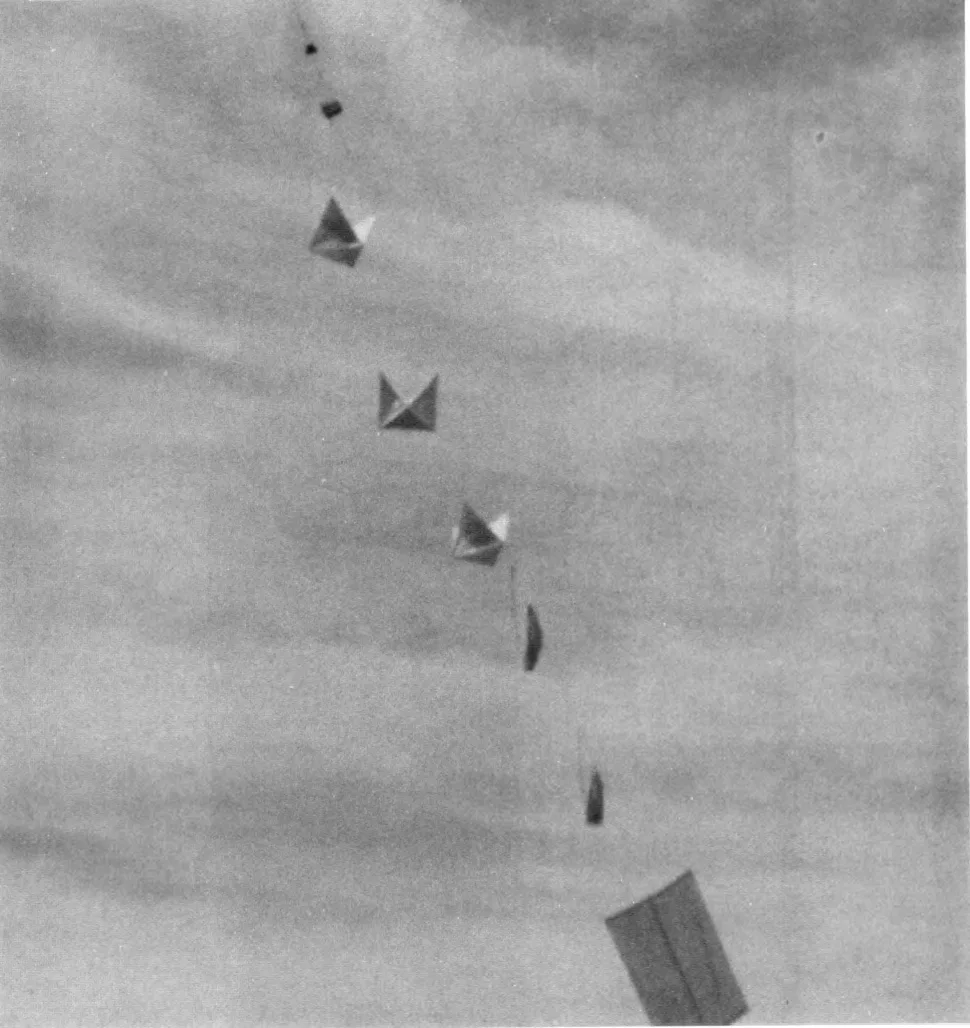
Balloon wreckage can look remarkably unlike a balloon. Once a high-altitude system has burst, descended and been dragged across rough ground, the recognisable envelope may be reduced to dark rubber shreds while its less familiar parts—metallic foil, angular radar reflectors, wooden struts, cords, parachutes and instrument boxes—are scattered over a wide area. To someone who did not see the equipment before launch, the result can resemble fragments of a lightweight manufactured craft rather than an atmospheric experiment.
The most consequential example is the debris recovered near Roswell, New Mexico, in 1947. Contemporary descriptions emphasised rubber, foil-like material, paper, tape and sticks. Later investigation connected that combination to Project Mogul, a classified programme that flew long trains of balloons, radar targets and acoustic equipment. The case shows how ordinary materials, assembled for an unusual and secret purpose, can create highly convincing “UFO wreckage” without containing anything beyond terrestrial technology.[fbi.gov]vault.fbi.govRoswell UFOOnRoswell UFOOn July 8, 1947, the FBI Dallas Field Office sent a teletype regarding a “flying disc” that resembled a high altitude weath…
What actually falls from a balloon system?
A weather or research balloon is not merely an inflated envelope. Even a routine modern sounding consists of a suspended “train”: balloon, cord, parachute and an instrument package called a radiosonde. More specialised flights may add batteries, radio transmitters, antennas, ballast, tracking equipment, cameras, sensors or larger scientific payloads. When the envelope reaches its expansion limit, it bursts or is deliberately separated, leaving the remaining equipment to descend.[National Weather Service]weather.govNational Weather Service What Goes Into the Weather Balloon Launches?Attached to the balloon is the "train", which consists of a parachutNational Weather ServiceWhat Goes Into the Weather Balloon Launches?Attached to the balloon is the "train", which consists of a parachute…
That distinction matters at a debris site. The balloon itself may be the least conspicuous component by the time it is found. Latex or neoprene can collapse into smoky-grey sheets and strips, while structural and electronic parts retain shapes suggestive of deliberate engineering.
Several materials are particularly liable to be misread:
- Metallised foil or foil-backed paper can look like an unfamiliar skin or heat shield. Its low weight may seem surprising to anyone expecting ordinary aircraft wreckage.
- Radar reflectors use flat reflective surfaces arranged at angles so that radio waves are returned towards a radar set. Collapsed reflectors can produce triangular, hexagonal or box-kite-like fragments rather than anything recognisably meteorological.[Overlook Horizon]overlookhorizon.comradar reflectorsOverlook HorizonWeather Balloon Radar Reflectors10 Jun 2018 — Your flight should contain an onboard radar reflector for air traffic safet…
- Thin wooden or cardboard members provide stiffness without adding much mass. Broken into short lengths, they may be interpreted as structural spars from a craft.
- Tape, eyelets and cord reveal that separate pieces were joined, but not necessarily what the complete object looked like. Decorative markings on manufactured tape can appear mysterious when detached from their commercial origin.
- Instrument packages may contain radio components, batteries, pressure sensors and wiring. Unmarked or classified equipment is especially likely to invite speculation.
Modern radiosondes are often plainly labelled as harmless weather instruments, partly because they routinely return to the ground. That reassurance was not always present on experimental military equipment, and identifying labels may be torn away, bleached or buried.[National Weather Service]weather.govRadiosondes are attached to cotton twine which may also be attached to an orange parachute and/or shredded balloon…
Why impact makes the parts look more exotic
Balloon debris is transformed in stages rather than in a single aircraft-like crash. At high altitude, the envelope expands enormously before bursting. The remaining train then descends, sometimes under a parachute and sometimes less gently if the recovery system tangles or fails. NASA records include payloads landing under fouled parachutes and, in one case, separating from the parachute and free-falling into a remote area.[NASA]nasa.govUpdate on BETTII Mission Flight Termination, RecoveryUpdate on BETTII Mission Flight Termination, Recovery
After touchdown, wind can continue the destruction. A partly inflated balloon or an open parachute acts like a sail, pulling lightweight equipment across soil, scrub and rocks. Reflector panels tear along seams; struts snap; foil crumples; cords separate; and components are distributed along the direction of travel. The resulting field can therefore be much larger than the compact bundle eventually collected from it.
Weathering then alters both appearance and memory:
Rubber darkens and fragments. Sunlight, temperature changes and oxidation can turn a pale flexible envelope into brittle grey or brown material that no longer resembles a balloon.
Foil alternates between bright and dull surfaces. Creases catch light differently, producing flashes or unusually dark patches. Layered paper-and-foil material can peel apart, making a simple laminate look complex.
Adhesives fail before the underlying panels. Tape may remain attached to isolated edges while other joins disappear. The surviving pattern can suggest a more elaborate construction than the original mass-produced reflector.
Lightweight material spreads disproportionately far. A few kilograms of debris can cover a broad area because flat sheets and balloon remnants are readily moved by wind. The size of the field is therefore a poor guide to the mass or sophistication of the original apparatus.
This is one reason descriptions such as “metallic”, “thin”, “unusually light” and “scattered over a large area” are not by themselves diagnostic of spacecraft wreckage. Those characteristics are exactly what balloon engineers seek when every gram carried to altitude matters.
Roswell’s unfamiliar mixture of foil, rubber and sticks
The Roswell recovery remains the clearest case of balloon hardware becoming persuasive UFO debris. Rancher William “Mac” Brazel found material on the Foster ranch north-west of Roswell and reported it to local authorities. Personnel from Roswell Army Air Field collected the wreckage. The base then issued its famous 8 July 1947 announcement that it had recovered a “flying disc”, before senior officers presented the material as balloon equipment.[FBI]vault.fbi.govRoswell UFOOnRoswell UFOOn July 8, 1947, the FBI Dallas Field Office sent a teletype regarding a “flying disc” that resembled a high altitude weath…
The earliest descriptions are notably mundane in substance, even if the assembly was unfamiliar. Brazel’s account, as reported at the time, referred to rubber strips, foil-like material, tough paper, sticks and tape. He reported no engine, propeller or substantial metal machinery. An authenticated FBI teletype sent on 8 July described a hexagonal object suspended by cable from a large balloon and said it resembled a high-altitude weather balloon fitted with a radar reflector.[skepticalinquirer.org]skepticalinquirer.orgSkeptical Inquirer Roswell UFO 'Strange Metal' MysterySkeptical Inquirer Roswell UFO 'Strange Metal' Mystery
Those details fit a reflector far better than a powered vehicle. A radar target must offer reflective faces from several directions, so its geometry can resemble a faceted disc or collapsed kite. Its foil surfaces require a light supporting framework, explaining the combination of metallic-looking sheets and slender sticks. Cords, eyelets and tape account for the many fastening pieces without requiring an aerodynamic hull.
The surprise came from scale and configuration. Project Mogul was not an ordinary single-balloon weather sounding. It was an experimental attempt to detect distant nuclear tests by carrying acoustic sensors into a high-altitude sound channel. Early flights used clusters of meteorological balloons linked into long trains and carried equipment including radar targets, a sonobuoy or related acoustic package, parachutes and ballast-control components. The classified purpose was concealed behind an unclassified atmospheric research programme.[nsa.gov]nsa.govOpen source on nsa.gov.
The Air Force’s later reconstruction concluded that the recovered material was consistent with such a device and most likely came from a Mogul balloon train lost in June 1947. That is stronger than saying merely that “a weather balloon” fell, because it explains why the debris was more extensive and peculiar than Brazel expected. It also explains why military personnel could publicly use a simple meteorological cover while withholding the actual mission.[af.mil]dafhistory.af.milDAF HistoryThe Roswell ReportProject MOGUL, the top-priority classified project of balloon-borne experiments, which provides the explanat…
The patterned tape was terrestrial, not hieroglyphic
One of the most memorable later Roswell claims concerned small coloured or symbol-like markings on structural pieces. In extraterrestrial retellings, these became writing or “hieroglyphics”. The balloon explanation offers a much less dramatic but unusually specific match.
The radar reflectors used in Mogul-related work were lightweight commercial targets assembled from foil-covered panels and slender supports. Accounts from project personnel and subsequent investigation linked the coloured markings to decorative adhesive tape used by a toy manufacturer involved in producing reflector targets. Once the reflector was broken apart, a repeated floral or geometric print on narrow tape could easily look like an intentional code, especially when recalled decades later without the complete object for comparison.[Science Friday]sciencefriday.comthe real roswell cover up spying on airthe real roswell cover up spying on air
This illustrates a recurrent identification problem: a fragment is interpreted according to its appearance after destruction, not according to its original function. Decorative stock tape is unremarkable in a workshop. Attached to a splinter of balsa amid metallic wreckage from a secret military recovery, it acquires an entirely different meaning.
The claim should nevertheless be framed carefully. No surviving Roswell fragment with an independently documented chain of custody has been publicly tested and traced to a particular reflector batch. The match rests on the consistency between contemporary debris descriptions, known target construction and testimony about the materials used. It is a strong contextual explanation, not a laboratory identification of a preserved specimen.
Secrecy made a balloon explanation seem less credible
The Roswell story endured partly because the first official explanation was incomplete. Calling the debris a conventional weather balloon did not disclose the long experimental train or its intelligence purpose. When Project Mogul became public decades later, the admission that the original account had concealed something was readily interpreted as confirmation that every later allegation might also be true.
In reality, secrecy can produce suspicion without producing extraterrestrial technology. Project Mogul’s objective—detecting Soviet atomic activity—was sensitive in the early Cold War. Officials had a genuine reason not to describe its microphones, flight arrangements or strategic purpose. The cover explanation therefore contained a material truth, because the system used meteorological balloons and familiar reflector technology, while omitting the reason those components had been assembled.[nsa.gov]nsa.govOpen source on nsa.gov.
The later documentary picture is imperfect. The Government Accountability Office found that some Roswell Army Air Field administrative records and outgoing messages from the relevant period had been destroyed without a properly recorded disposal authority. That absence is often treated as evidence of a special purge, but the GAO also noted that many Air Force organisational records from the period had been destroyed under similarly poor record-control practices. Its search did recover the contemporary FBI teletype identifying a balloon and radar reflector.[GAO]gao.govnsiadnsiad
There is also a narrower historical dispute over whether the debris can be assigned with certainty to the flight commonly designated Mogul Flight 4. The Air Force reconstruction relied on project diaries, launch configurations, trajectories and the absence of a recorded recovery, rather than a serial-numbered component preserved from the ranch. The defensible conclusion is therefore that a Mogul-type balloon train provides the best-supported identification, while the exact flight attribution remains reconstructive rather than physically proven.
Secret balloon programmes created a wider UFO problem
Roswell was not the only point at which balloons and UFO reports intersected. In the late 1940s and 1950s, the United States developed high-altitude balloons for cosmic-ray research, meteorology, photographic reconnaissance and intelligence collection. Programmes descended from or related to this work included Skyhook scientific balloons and later reconnaissance efforts such as Moby Dick and Genetrix. Their great altitude, slow apparent motion and reflective surfaces made them difficult for observers to judge accurately; their classified status prevented straightforward public identification.[Wikipedia]WikipediaProject MogulProject Mogul
Most of those incidents concerned objects seen in the sky rather than recovered wreckage, but the underlying mechanism was the same. A technically ordinary platform became anomalous because observers lacked three pieces of information: its true size, its altitude and its purpose. Once it landed, the problem changed from optical ambiguity to material ambiguity. The observer encountered real manufactured debris but lacked the intact shape needed to recognise it.
AARO’s historical review concluded that classified national-security programmes, including high-altitude balloon activity, contributed to portions of the historical UFO record. This does not mean that every unidentified wreckage report was caused by a balloon. It means that balloons form a documented case family with a clear mechanism: unfamiliar geometry, minimal-weight construction, fragmented recovery and official secrecy working together.[AARO]aaro.milAARO Historical Record Report VolAARO Historical Record Report Vol
How to recognise balloon wreckage in a crash claim
No single feature proves that debris came from a balloon. The identification becomes persuasive when several features form a coherent system:
- Large quantities of lightweight material but no engine, fuel system, cockpit, heavy frame or propulsion hardware.
- Torn latex, neoprene or plastic membrane mixed with cords and parachute material.
- Foil-faced panels supported by wood, cardboard or very light tubing.
- Repeating angular sections consistent with a corner radar reflector.
- A small radio or sensor box suspended separately from the main debris.
- A long or irregular debris trail indicating dragging after touchdown.
- Contemporary records of balloon launches, tracking loss or recovery activity in the relevant region.
- Materials that match equipment from the correct period, rather than technology introduced much later.
The strongest analysis reconstructs the complete flight train from the fragments. Foil alone is ambiguous; foil, balsa struts, eyelets, cord, rubber and an instrument package together describe a recognisable balloon system. Conversely, an alleged fragment that appears years later without documented recovery history cannot establish either a balloon or an extraterrestrial origin.
The practical lesson of the Roswell debris
Balloon wreckage can be convincing because it is simultaneously ordinary and strange. Each ingredient may be commonplace, yet the assembled apparatus is rarely seen by the public. After impact, the assembly is destroyed, the familiar balloon shape disappears and the remaining fragments preserve only hints of function. Add a classified mission, a military collection team and an ill-judged “flying disc” announcement, and an identification problem can harden into a crash legend.
Roswell’s early evidence is most naturally explained by this mechanism. Its rubber, foil-like sheets, paper, sticks, tape and hexagonal reflector description correspond to the construction of a lightweight balloon train far better than to a powered spacecraft. The secrecy surrounding Project Mogul explains why the first official account was evasive; it does not supply evidence of alien wreckage.[defense.gov]media.defense.govU.S. Department of WarU.S. Department of War
The broader lesson for UFO crash investigations is not simply that balloons exist. It is that debris should be interpreted as parts of a system, with attention to weight, fastening methods, recovery conditions and historical flight activity. When that reconstruction is performed, material that initially appears otherworldly can become a highly specific record of twentieth-century balloon engineering.
Amazon book picks
Further Reading
Books and field guides related to Why Balloon Wreckage Can Look Otherworldly. Use these as the next step if you want deeper reading beyond the article.
The Roswell Incident
Fully illustrated, "The Roswell Incident" is the definitive book on America's most documented alien encounter. It not only explores every...

Roswell: Inconvenient Facts and the Will to Believe
Voici la solution du plus grand mystère de l'histoire des ovnis : l'affaire de Roswell dans le Nouveau Mexique. Après avoir annoncé à la...
Roswell: The Ultimate Cold Case
"[The authors] have, like each whistleblower before them, paid a price for their . . . amplification of the truth. . . . The most profoun...
Scientific Ballooning: Technology and Applications of Explora...
This introduction to scientific ballooning thoroughly covers large stratospheric balloons, planetary balloons, and rubber balloons used f...
eBay marketplace picks
Marketplace Samples
Live-tested eBay searches with available results related to this page.
Selected fromUFO poster oneBay.co.uk.


Current eBay listing
VINTAGE UFO FLYING SAUCERS COMIC ADVERTISING A2 POSTER PRINT

Current eBay listing
I Want To Believe UFO Poster Giclée Fine Art Heavyweight Print
Endnotes
1.
Source: vault.fbi.gov
Title: Roswell UFOOn
Link:https://vault.fbi.gov/Roswell%20UFO
Source snippet
Roswell UFOOn July 8, 1947, the FBI Dallas Field Office sent a teletype regarding a “flying disc” that resembled a high altitude weath...
Published: July 8, 1947
2.
Source: media.defense.gov
Title: U.S. Department of War
Link:https://media.defense.gov/2021/Jul/13/2002761373/-1/-1/0/GENERAL_ACCOUNTING_OFFICE_S_SCHIFF.PDF
3.
Source: weather.gov
Link:https://www.weather.gov/ilx/ua-tour
Source snippet
National Weather ServiceWhat Goes Into the Weather Balloon Launches?Attached to the balloon is the "train", which consists of a parachute...
4.
Source: weather.gov
Link:https://www.weather.gov/upperair/radiosonde
Source snippet
Radiosondes are attached to cotton twine which may also be attached to an orange parachute and/or shredded balloon...
5.
Source: weather.gov
Link:https://www.weather.gov/upperair/factsheet
Source snippet
These sensors are linked to a battery powered, 300 milliwatt or less radio transmitter that sends the sensor measurements to a sensitive...
6.
Source: nasa.gov
Title: Update on BETTII Mission Flight Termination, Recovery
Link:https://www.nasa.gov/centers-and-facilities/wallops/update-on-bettii-mission-flight-termination-recovery/
7.
Source: nasa.gov
Title: to Fly Six Scientific Balloons From New Mexico
Link:https://www.nasa.gov/centers-and-facilities/wallops/nasa-to-fly-six-scientific-balloons-from-new-mexico/
8.
Source: gao.gov
Title: nsiad 95 187
Link:https://www.gao.gov/products/nsiad
9.
Source: nsa.gov
Link:https://www.nsa.gov/portals/75/documents/news-features/declassified-documents/ufo/report_af_roswell.pdf
10.
Source: aaro.mil
Title: AARO Historical Record Report Vol 1 2024
Link:https://www.aaro.mil/Portals/136/PDFs/AARO_Historical_Record_Report_Vol_1_2024.pdf
11.
Source: Wikipedia
Title: Project Mogul
Link:https://en.wikipedia.org/wiki/Project_Mogul
12.
Source: csbf.nasa.gov
Title: balloons txt
Link:https://www.csbf.nasa.gov/balloons-txt.html
13.
Source: nasa.gov
Title: Scientific Balloon FAQs
Link:https://www.nasa.gov/scientificballoons/faqs/
14.
Source: nasa.gov
Title: NAS A Safely Ends Second Super Pressure Balloon Test Flight
Link:https://www.nasa.gov/blogs/wallops/2025/05/13/nasa-safely-ends-second-super-pressure-balloon-test-flight/
15.
Source: nasa.gov
Title: Scientific Balloons Glossary
Link:https://www.nasa.gov/scientificballoons/balloons-glossary/
16.
Source: svs.gsfc.nasa.gov
Link:https://svs.gsfc.nasa.gov/31302/
18.
Source: science.nasa.gov
Title: payload recovery key capability for nasa balloons
Link:https://science.nasa.gov/blogs/super-pressure-balloon/2016/03/21/payload-recovery-key-capability-for-nasa-balloons/
19.
Source: nasa.gov
Title: NAS A Details Super Pressure Balloon Recovery Plans in the Australian Outback
Link:https://www.nasa.gov/news-release/nasa-details-super-pressure-balloon-recovery-plans-in-the-australian-outback/
20.
Source: nasa.gov
Title: Great Moments in GRIStory
Link:https://www.nasa.gov/missions/scientific-balloons/great-moments-in-gristory/
21.
Source: ntrs.nasa.gov
Link:https://ntrs.nasa.gov/citations/19930027386
22.
Source: Wikipedia
Title: Roswell incident
Link:https://en.wikipedia.org/wiki/Roswell_incident
23.
Source: Wikipedia
Title: Roswell (TV series)
Link:https://en.wikipedia.org/wiki/Roswell_%28TV_series%29
24.
Source: Wikipedia
Title: Roswell, New Mexico
Link:https://en.wikipedia.org/wiki/Roswell%2C_New_Mexico
25.
Source: Wikipedia
Title: Roswell, New Mexico (TV series)
Link:https://en.wikipedia.org/wiki/Roswell%2C_New_Mexico_%28TV_series%29
26.
Source: Wikipedia
Title: List of Roswell episodes
Link:https://en.wikipedia.org/wiki/List_of_Roswell_episodes
27.
Source: aaro.mil
Link:https://www.aaro.mil/
28.
Source: weather.gov
Link:https://www.weather.gov/rev/upperair
29.
Source: weather.gov
Link:https://www.weather.gov/okx/Tour_Weather_Balloon
30.
Source: weather.gov
Link:https://www.weather.gov/okx/upperair
31.
Source: weather.gov
Title: NW S Sterling, VA
Link:https://www.weather.gov/lwx/onlinetour_uprair1
32.
Source: weather.gov
Link:https://www.weather.gov/lch/uahome
33.
Source: weather.gov
Link:https://www.weather.gov/tbw/tampabayofficetourupperair
34.
Source: preview.weather.gov
Link:https://preview.weather.gov/okx/upperair
35.
Source: weather.gov
Link:https://www.weather.gov/gjt/education_corner_balloon
36.
Source: weather.gov
Link:https://www.weather.gov/chs/upperair
37.
Source: dafhistory.af.mil
Link:https://www.dafhistory.af.mil/Portals/16/documents/AFD-101201-038.pdf
Source snippet
DAF HistoryThe Roswell ReportProject MOGUL, the top-priority classified project of balloon-borne experiments, which provides the explanat...
38.
Source: overlookhorizon.com
Title: radar reflectors
Link:https://overlookhorizon.com/how-to-launch-weather-balloons/radar-reflectors/
Source snippet
Overlook HorizonWeather Balloon Radar Reflectors10 Jun 2018 — Your flight should contain an onboard radar reflector for air traffic safet...
39.
Source: prod-01-alb-www-noaa.woc.noaa.gov
Title: Radiosondes | National Oceanic and Atmospheric Administration * Severe Weather
Link:https://prod-01-alb-www-noaa.woc.noaa.gov/jetstream/upperair/radiosondes
Source snippet
These sensors are linked to a battery-powered radio transmitter that sends the information to a ground receiver.... When the balloon has...
40.
Source: skepticalinquirer.org
Title: Skeptical Inquirer Roswell UFO ‘Strange Metal’ Mystery
Link:https://skepticalinquirer.org/newsletter/roswell-ufo-strange-metal-mystery/
41.
Source: muller.lbl.gov
Link:https://muller.lbl.gov/teaching/physics10/Roswell/USMogulReport.html
42.
Source: sciencefriday.com
Title: the real [roswell cover]({{ ‘roswell-cover/’ | relative_url }}) up spying on air
Link:https://www.sciencefriday.com/articles/the-real-roswell-cover-up-spying-on-air/
43.
Source: media.defense.gov
Link:https://media.defense.gov/2010/Oct/27/2001330219/-1/-1/0/AFD-101027-030.pdf
44.
Source: dafhistory.af.mil
Link:https://www.dafhistory.af.mil/The-DAF-Legacy-Vault/DAF-History-Publications/igphoto/2003789023/
45.
Source: sgp.fas.org
Link:https://sgp.fas.org/othergov/roswell.html
46.
Source: hackaday.io
Link:https://hackaday.io/project/12759-high-altitude-weather-balloon/log/42807-radar-mk1-balloon
47.
Source: ncei.noaa.gov
Title: weather balloon
Link:https://www.ncei.noaa.gov/products/weather-balloon
48.
Source: gml.noaa.gov
Link:https://gml.noaa.gov/ozwv/wvap/instrument.html
49.
Source: csl.noaa.gov
Link:https://www.csl.noaa.gov/projects/b2sap/instruments.html
Additional References
50.
Source: youtube.com
Link:https://www.youtube.com/watch?v=qwgYcnatLm0
Source snippet
The Roswell Incident Mystery Finally Solved...
51.
Source: roswell-nm.gov
Link:https://www.roswell-nm.gov/
52.
Source: stratoflights.com
Link:https://www.stratoflights.com/high-altitude-balloons-for-filmmaking-marketing-capturing-near-space-visuals/
53.
Source: uni-giessen.de
Link:https://www.uni-giessen.de/de/fbz/fb07/fachgebiete/physik/institute/iipi/arbeitsgruppen/ag-lange/copy_of_strato/william/%40%40download/file/PROJEKTARBEIT_WILLIAM_ROSTER.FINAL.pdf
54.
Source: rottentomatoes.com
Link:https://www.rottentomatoes.com/tv/roswell
55.
Source: facebook.com
Link:https://www.facebook.com/groups/spacehipsters/posts/8096320837079395/
56.
Source: seeroswell.com
Link:https://seeroswell.com/
57.
Source: facebook.com
Link:https://www.facebook.com/CombatCatalog/posts/the-roswell-ufo-crash-was-a-classified-balloon-program-designed-to-spy-on-soviet/122230753928307620/
58.
Source: gocivilairpatrol.com
Link:https://www.gocivilairpatrol.com/media/cms/Near_Space_Balloon__Pamphlet_Nov_20_B1893DF34F513.pdf
59.
Source: reddit.com
Link:https://www.reddit.com/r/UFOs/comments/1tajeuo/the_first_description_telephoned_to_the_fbi_on/